
There was a time when the symbol of a heart meant something —
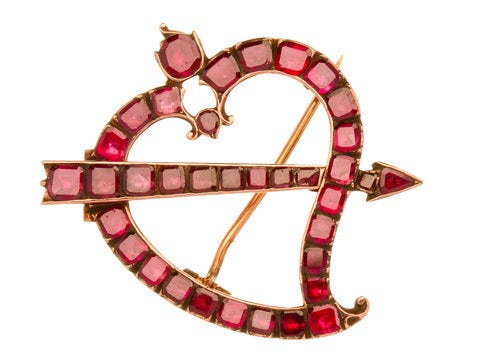
In religious iconography, the Sacred Heart has been associated with devotions to Jesus and the Blessed Mother. Medieval hearts would appear in jewellery, often inscribed with short love poems. On playing cards, the heart suit has been cited to represent a figure pure in nature. The witch’s heart, wherein the tail of the heart twists, was a favoured Georgian symbol in rings and brooches. Initially seen as a sign of protection, tiny metal witch’s hearts would be pinned to baby’s blankets to ward off evil spirits, and later recognised as a token of the receivers bewitching love. In traditional Irish jewellery, two hands hold a heart in the Claddagh Ring, given as an emblem of love, loyalty, and friendship. And the Victorian’s used hearts in jewellery as a sign of romantic love, which has come to be the overarching commercialised symbol of love today. Commercialisation of the love heart has forgotten all of its value when it comes to digital space. Deteriorating as a romantic symbol to instead denote a ‘like’, and perhaps, in fact, even worse – merely as an acknowledgement that someone has seen the image or video you’ve posted on the internet.
Being seen on the internet, and receiving a ❤️ via an on screen interface through the tap of the watcher’s finger, has made us aware of exactly whose attention we currently hold in the laziest of fashions. We’re all familiar with noticing whether our current crush liked our latest post, questioning the nuance of their tap, deciphering if they are still interested or simply wanted our attention. Flirting has gone from receiving a poetically inscribed ring declaring their yearning, to an intangible heart icon sent and received in under a second. The prospect of romance through the red love heart has degraded itself, moving away from declaration and into dopamine. It is within this lack that we begin to analyse exactly what each digital love heart means, for when we do not receive a clear and fulfilling sign of romantic interest, we are left to make up the rest in our heads – or, in our hearts.
Creators online are dissecting this, and I’m watching them. My fellow meme-sharing-detective-girlfriend recently sent me a reel by @rowilson speaking to the camera about a phenomenon she’s coined as ‘digital voyeurism’. In the reel, she discusses how men (plural) are “way more obsessed with Instagram” than the girls who chronically post are, because they use the app as a “reality television of our lives … they sit and watch and watch and watch without taking any IRL action” (@rowilson, 2026).
Through my own experience, this concept absolutely resonates. My current lust interest is often the first to watch my stories and like my posts. Sometimes they’ll disappear in conjunction with a non-committal soft launch post of their new girl, only to return through a tap when the new girl is no more. I can honestly, at the risk of sounding compulsively vigilant and just as voyeuristic (I am), track exactly who is actively flirting with me based on how frequently they send me their digital hearts.
@rowilson further explains that these men are more concerned with our ‘social resume’ than getting to know us as the humans that we are. As if watching and monitoring our online behaviours has become a methodical process of elimination to find their idealised archetype of a girlfriend. Acknowledging that men looking at women in an objectified manner isn’t anything new, she adds that it is the ‘access’ these men have to our daily lives via our social media that allows them to remove themselves from human contact and thus, the accountability that comes with building any new relationship.
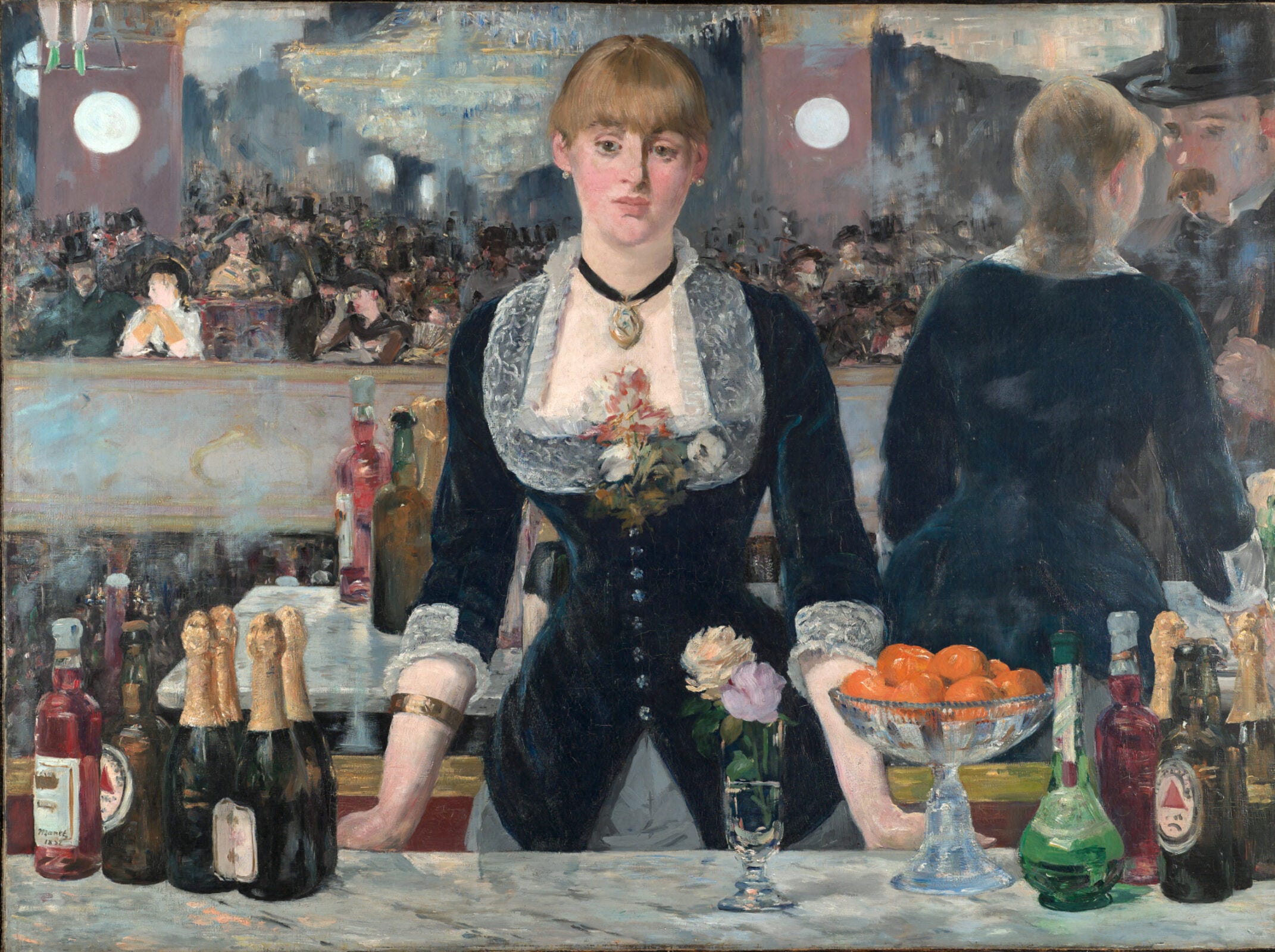
In the history of visual culture, looking at women is a heavily depicted trope in art and cinema. Éduoard Manet often painted female subjects whose bodily positions seemingly invite viewership in their openness. In his painting A Bar at the Folies-Bergère (1882), a clothed woman stands behind a bar, her bosom directly facing outward as she stares vacantly back at the viewer. Behind her is a mirror, reflecting a room full of people facing in her direction specifically pointing to the act of looking. Her expression exhibits the kind of nonchalance that a woman used to being looked at displays. The bar frames her whilst giving an element of distance, as if behind a shop window, she becomes an unreachable spectacle to both us and the people in the room.
Wim Wenders’ film Paris, Texas (1984) depicts a similar gaze in one of the most recognised Peep Show scenes in cinema. The shot shows mused character Jane Anderson, played by Nastassja Kinski, as she sits directly to face us in her domestically decorated booth, wearing the brightest pink of jumpers with lipstick to match. As she talks to her visitor Travis Henderson, played by Harry Dean Stanton, the viewer is situated in such a way that we could be him. Placed behind a one-sided mirror, she looks at herself whilst he looks at her. In the dialogue of this scene, she tells him (us) that she cannot see him, only he can see her, establishing the one-sided gaze intrinsic to the Peep Show and to cinema.
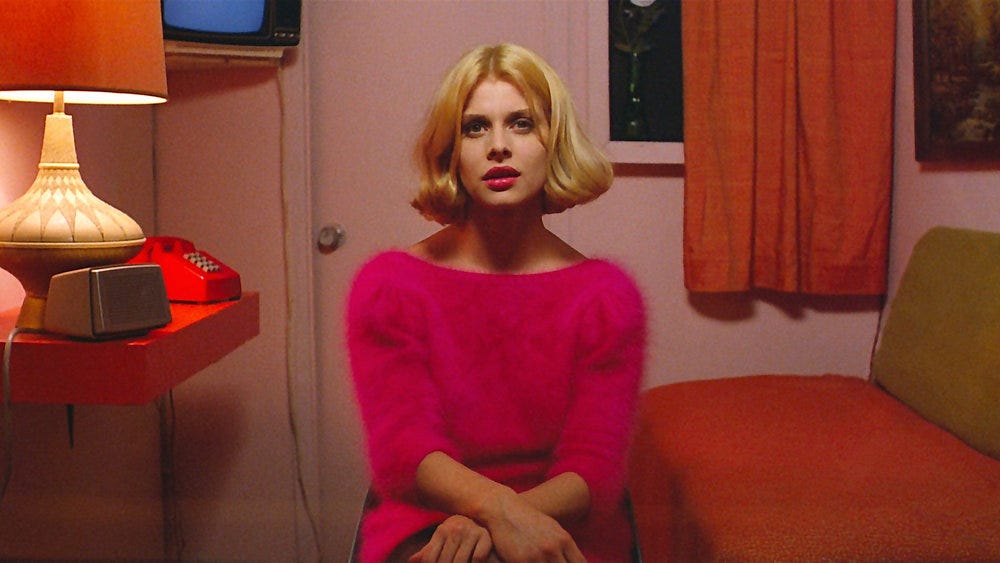
The women in Manet’s painting and Wenders’ film are not wholly objectified – clothed with a present posture in the public space of a bar, or actively moving with vocal agency in the private space of a Peep Show. But their positions behind a screen of sorts assert the sense that they are unattainable. They are depicted in such a way that makes the spectator – the Bar goers in hats, Travis Henderson and us – feel drawn in, as if you were standing right there with them yet unable to touch them and in fact, not seen by them at all.
In a reel that my algorithm so helpfully fed me, the creator @sofia_lily_fernandez comments on this dynamic in the context of social media. Speaking directly to the camera, she says “a lot of men these days have parasocial relationships with [women] online … the amount of men who’ve matched with me on Hinge once, or they asked me out but they never followed through, or we did date and nothing ever happened [and now] they just stalk [me] online”. She explains further that once a woman gives her social media to a man it’s over, as in her experience the need to meet up disappears because watching you from afar gives these men the illusion of access. The reel concludes by her telling us that “from here on out, I’m not giving my socials to men” (@sofia_lily_fernandez, 2026).
Facing outwardly and looking directly at the viewer, @rowilson and @sofia_lily_fernandez adopt the same position that the women of Manet and Wenders’ art do. It is as if, within their critical social media posts about the way men consume their digital image, they replicate the male gazed vision. And this is likely because that vision is, as stated, deeply ingrained into visual culture. The difference between them and the painted woman or the character of Jane Anderson, is that due to social media’s interface in which our viewers can directly contact us, we are seemingly ‘attainable’. And this apparently creates the complex concept of ‘access’.
This idea of ‘giving access’ as a woman is one I loathe, and yet cannot deny as a catalyst to enabling bad behaviour from men who like to toy. I too, like @sofia_lily_fernandez, have made a rule to ask exes or the men that’ve done me wrong to unfollow me, because I find being observed by a man unable to hold my value in real life unsettling. Some would consider this extreme. I consider it self respect. Paintings and films are observed with intrigue and respect, so why is this not extended to our most popular contemporary medium of online space? Is it because the subjects in these art forms cannot see their audience? Does the one-sided gaze allow the power of being a desired entity to remain intact? — and thus, left alone?
It is a privilege to consume my digital self – the one I have so thoughtfully curated – and whilst I have no intention of making my profile private, passively watching me from the comfort of your home if you have hurt me IRL is in bad taste. It reinforces that you (the watcher) want to objectify me, not know me. That I was desired and pursued based on image, or my social resume, not for being alive. For the men that have had and lost my actual in person attention (not something I give freely), seeing their silly little man face on my list of viewers is an unwelcome reminder — they want something from me without giving anything back. This, naturally, gets tiresome.
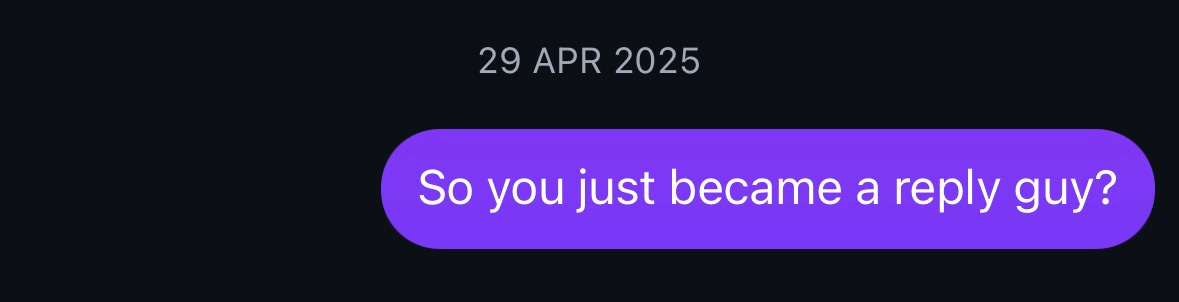
There have been other men who I haven’t met in person, those of whom my girlfriends and I define as ‘reply guys’. These are the men that consistently reply to stories yet never make it out of the screen. Sometimes, if they reply with words that capture my attention (imagine) as opposed to just a like or *eye roll* flame emoji, I will entertain them. We may discuss meeting – I am a single woman on the internet after all – but more often than not, these men fail to meet my expectations of said proposed date, affirming their more comfortable position behind the screen. If (most likely when) they revert to becoming a reply guy, I am inclined to call them out. Embarrassed that yes, they couldn’t graduate to wining and dining me IRL, they revert further back into the online shadows as mere watchers of my online antics. As @rowilson suggested, it is these kinds of men that seem to actively make my online expressions a reality TV show of their own. It’s as if all they ever wanted was to watch me, as to personify me from outside of the screen would ruin their joy.
Thanks for reading Ozziline Mercedes 666! This post is public so feel free to share it.
Men watching women is culture, in many ways, so to interrogate why these men watch us this way would be a waste of words. I, too, love to watch women — and men. Yet why they actively pursue us through a cycle of interact - retract - interact - retract - interact - retract is, quite honestly, a mystifying annoyance to me. Sending a heart through the screen seems like a forget me not message, an assertion that despite their lack of follow up they are still crushing, that you are still on their mind. But when a fully formed message becomes a conversation becomes a date proposal becomes silence, it’s hard not to want to shake them and scream WAKE THE FUCK UP through the screen. Surely if the woman you’ve so patiently chased – even if in the most passive of ways – agrees to go on a date with you, then you would do the most to make that date happen? Perhaps if we were instead a painting, or behind the screen of a Peep Show in a movie, the desire would never fade? Instead, the ability to interact with us creates an unclear sense of who is watching and who is being watched – watching them watch us feeds some kind of performance with a seemingly never-ending finale.
On performance, I return to the reality TV show theory that got this piece going. Social media, I suppose, mimics the interactive nature that reality TV introduced. Big Brother was the first of its kind in the history of viewership participation, giving the audience an ability to vote on who remained in the Big Brother House. Many television programmes have followed this model, including my current reality TV obsession: Love Island. Like Big Brother, the contestants on Love Island are not publicly known figures before entering the show, giving them a personable and perceptively attainable quality much like social media does. They are everyday people that you could, in theory, meet on a night out (if new money bars in Kent is your thing).
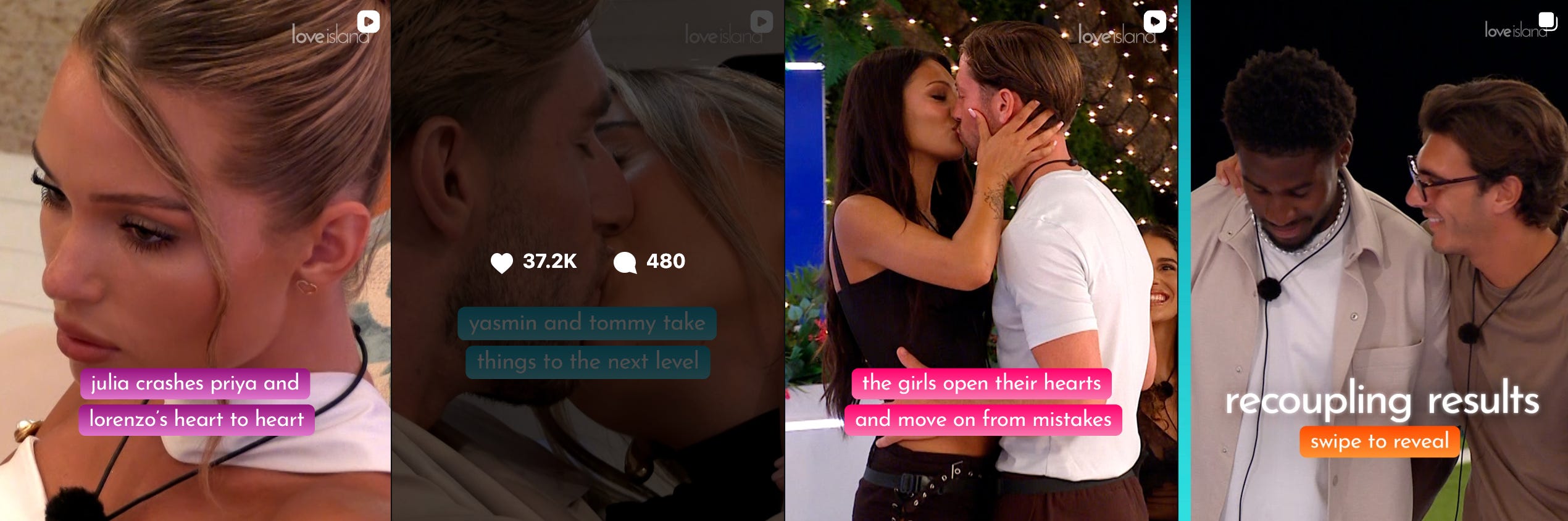
As a show that’s grown in parallel to social media’s development as an everyday tool, we watch the contestants actively create content in between their main focus of finding love: walking around with phones in hand, taking selfies by the fire pit or mirror pics in the dressing room. Simultaneously, the official Love Island Instagram page posts snippets of the show in the form of reels, and photos taken by the islanders during their stay. This adds an extra element of audience participation, a kind of Love Island panopticon in which we can watch the show, vote for our [least] favourite couples, and send digital red love hearts to @loveisland all at the same time. And the best part, the whole show is a gamified framework to finding L❤️VE.
I don’t know many, if any, straight men that watch reality TV, at least not as religiously as my girlfriends do, or without being forced by their girlfriend (in which case I hope even more so that they’re not the ones watching and liking my posts). But as a medium, it is highly addictive, amazing and thrilling, which is why its become the most watched form of television. Watching people do their lives in the kind of performative manner that surveillance culture has produced grips us in all the primitive, psychoanalytically curious places that just make us want more and more and more.
So, for straight men (that particular kind of straight man) perhaps we (chronically online baddies) have in fact become their reality TV show? So, does that mean they view us as their entertainment? Are we internet jesters that they also kind of want to fuck, but aren’t quite sure enough if they do, because whats it like to fuck a 2D internet woman? When they like our posts and reply with emojis that we may or may not respond to, is this their equivalent of voting for their favourite Love Islander?
Entering a reality TV show is with consent. Being watched for entertainment is something contestants of these shows – shows which historically can have savage mental health implications – are paid for. And whilst public scrutiny affects their realities, they are playing the game with each other, not with us, the viewers. Whilst I choose to post myself publicly on the internet (let me not pretend my exhibitionism is coerced), I have not consented to becoming an interactive entertainment show for confused men to play with.
When likes and story replies progress into verbal flirtations, or talking in a way that suggests they wish to be more than a mere spectator, it’s as if we become a fictitious character within a fictional game of their making. The gamification of romance is widely discussed at the moment, primarily in dating apps. Endless scrolling and images of different faces make it difficult to humanise the people behind the screen, but the dating app interface removes the imbalance of watcher vs. watched that social media platforms enable, as both parties are vulnerable.
Gamified interfaces are designed to hold our attention. And so I wonder, does the lazy digital love heart allow men to keep our attention, even if they have no pure intention? Perhaps they only wanted us for their daily dopamine hit? And that, like any idolised star, the concept of meeting us boosts their ego yet is absolutely forbidden, for one should never really meet their idols.
You might ask – what do I, as an online sex symbol (so I’ve been told), expect? For nobody to look at me? For no man to follow his lust with the tap of his finger? No. Obviously I make things on the internet to be watched. But I post online for work and play — my own play, nobody else’s. My background is in photography, I am a voyeur, I am interested in the concept of looking, all my work is about looking.
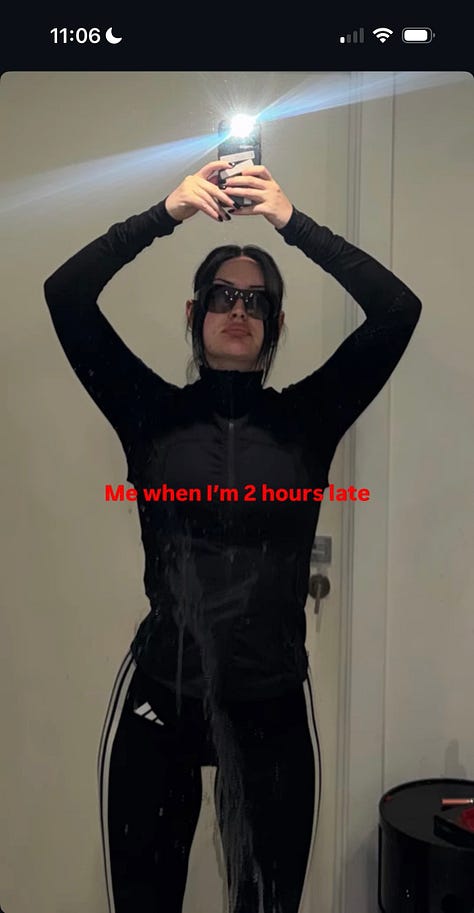
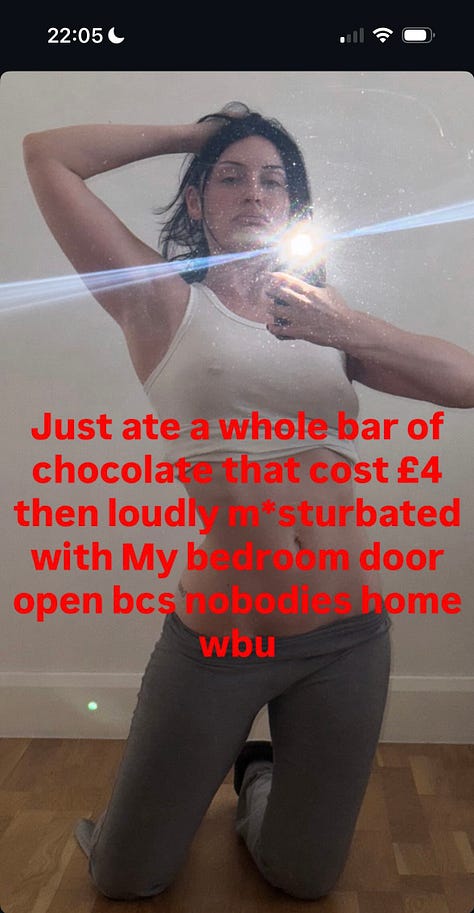
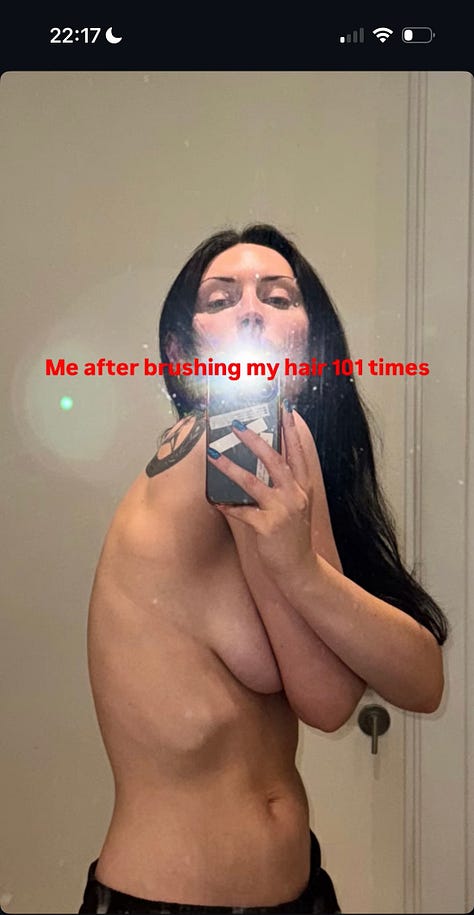
What I post of myself on the internet is not representative of my whole self. To those who do not understand the nuance of my posting, or who do not themselves participate in being an online persona, or have read the personal exposés I publish, or have seen the photos of my arse I post, it might be surprising to learn that I actually share very little of myself on the internet. What you see is a curated internet-based-performance not to be mistaken with the person behind the screen. I invite lookers through this performance, but when the person looking breaks the fourth wall through their interaction, they must consider what’s to follow.
At this point in our digital history, it is time that the men who watch us interrogate their viewership. Fluxing between absence and presence as a little face in my inbox weakens the possibility of true connection. And if the intent was never human connection, then respectfully, leave the woman (the women) alone.
I will never equate a heart on my screen to romance. Nor do I desire to be a reality TV star, or to become the fictitious game character that my male lookers might project onto me. The question of consent and ownership is ongoing in the digital realm. And truly, I have surrendered to the ways in which I am received by the person watching me, because one must. But what I will not surrender to is the devaluation of the love heart. So, if I stop being chronically online, it might just be because the right suitor has come galloping through the streets of London holding the poetically-transcribed-metal-witch’s-heart that my human self wants to wear offline.

No posts
Comments
Nothing yet. Say the first thing.
Sign in to join the conversation.