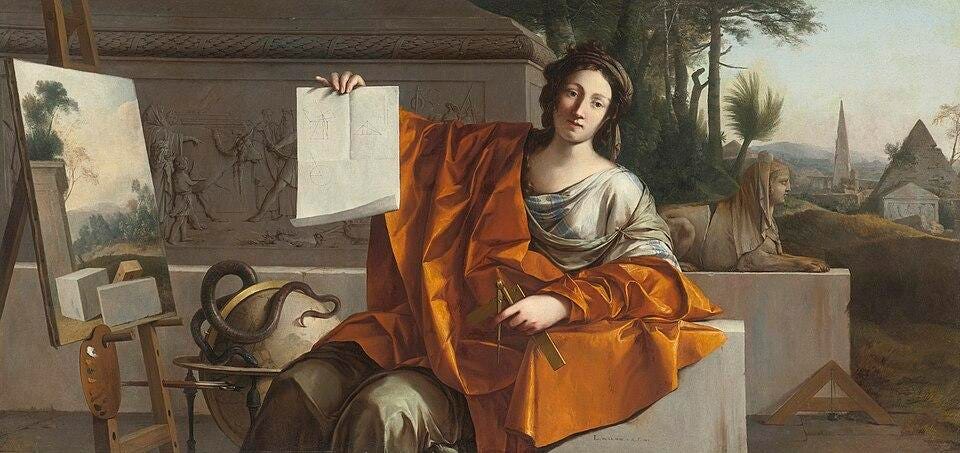
The Forgotten Chapter of Why Johnny Can’t Add
Morris Kline’s book, Why Johnny Can’t Add, is an incisive critique of the pedagogy of the New Math movement.

The Memoria College online courses offer a broad yet meaningful encounter with the Great Books.
Live Last read · last published · next check
Morris Kline’s book, Why Johnny Can’t Add, is an incisive critique of the pedagogy of the New Math movement.
The Renaissance polymath Heinrich Cornelius Agrippa defined occult qualities as those whose “causes lie hid, and man’s intellect cannot in any way reach and find them out.”1 Though his Three Books of Occult Philosophy or Magic was condemned by Catholic and Protestant authorities, it remained influential in esoteric circles.
Meditations on technology while playing Italian.
The term “intellect” is often associated with a narrow sector of human life: the academic.
Lost in the dark forest of his life, standing at the threshold of his cosmos-spanning journey through Hell, Purgatory, and the Paradiso, Dante finds beside him his guide: Virgil.
In Knowledge Worthily Received, we considered the paradox that Socrates considered himself “barren of wisdom”—yet was able to help bring forth knowledge in his students.
by Astrid Donovan
In the Theaetetus, Socrates describes himself as a midwife of the mind:
The mathematician Israel Gelfand once said: “The most important thing a student can get from the study of mathematics is the attainment of a higher intellectual level.”1 We might twist this slightly to say that “the most important thing a human being can get from the study of mathematics is an understanding of oneself as developing intellectually”.
Every year, when I teach Plato’s Republic, something subtle happens to the students.