
This is an essay on the appeal of Heated Rivalry to female audiences, or more specifically, the appeal of male-on-male erotica in the context of competition and high-pressure environments. I'll discuss Challengers, Heated Rivalry, and Red, White & Royal Blue with no major spoilers. This was heavily informed by Lucy Neville's book Girls Who Like Boys Who Like Boys.
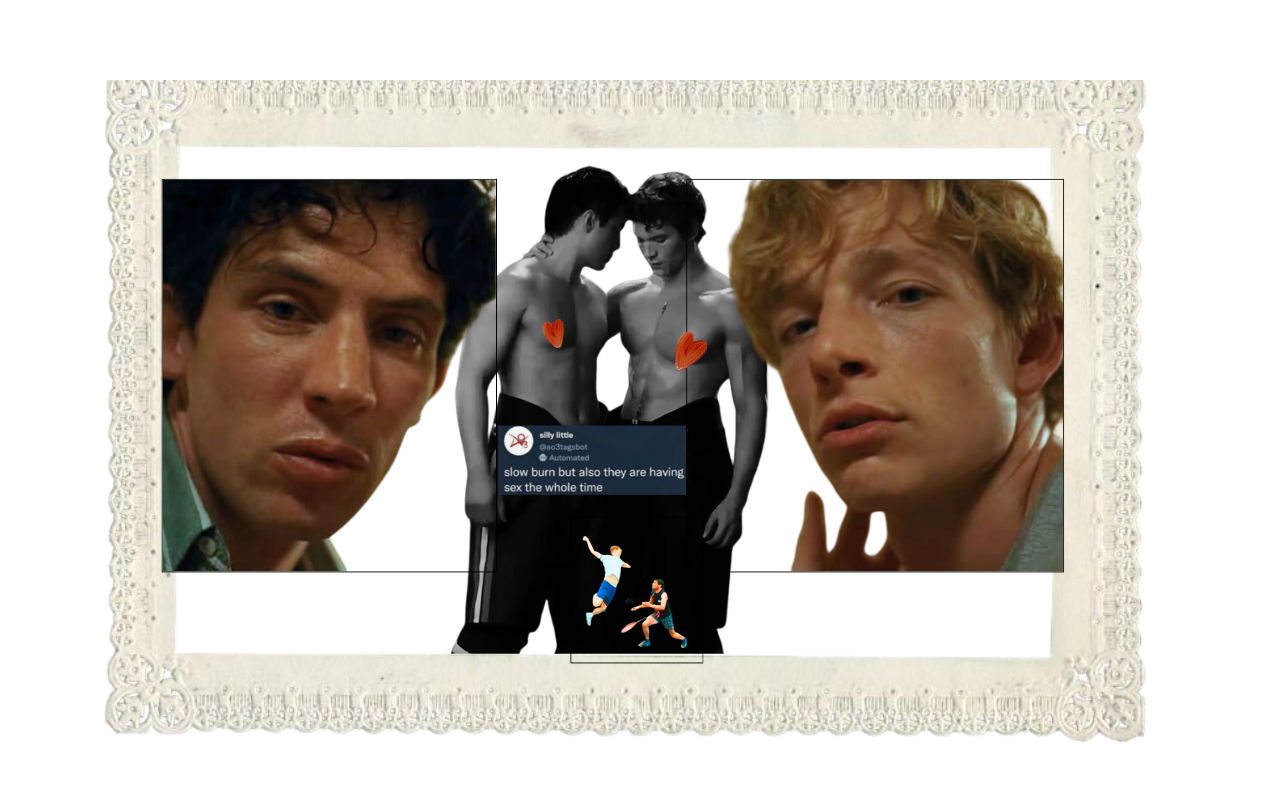
It’s no secret: women love to watch men getting it on.
The stats are in. Over a third of gay male porn viewers are women1, male-on-male romance and erotica has an estimated over eighty percent female reader base2, and slash fanfic of male protagonists from Star Trek to Sherlock is mostly authored by women.
Why are women, especially straight women, such a huge audience for a genre that seems tailored for gay men? Most research conducted on the subject approached it “by theorising rather than by asking readers for their reasons,” notes Lucy Neville in her book Girls Who Like Boys Who Like Boys3, rendering most of the research on the subject one-dimensional and based on popular assumptions.4
But female desire, just like women’s penchant for male-on-male erotica, is both complex and simple. Complex, because women are not a monolith. Each one has a different reason for why this type of media appeals to her.5
Simple, because as much as I love overthinking things and telling you why, for a lot of women, male-on-male erotica is a fantasy of surrendered power, broken hierarchies, and unscripted desire... at the end of the day, women just want to see pretty boys fuck!
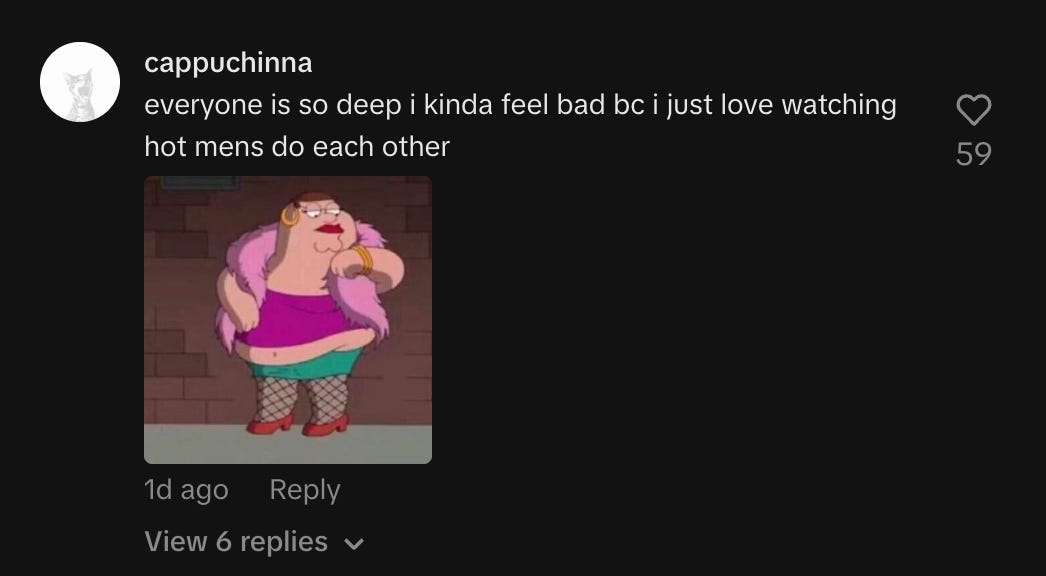
But overcomplicating things is fun. So when I binged Heated Rivalry – a very spicy gay romance show about two opposing hockey players who get into a decade-long situationship – I did so with a notebook in hand, a pen and a dream.
What caught my attention was the show’s similarities with another homoerotic piece of media: Challengers, Luca Guadagnino’s movie that follows a love triangle through the world of tennis competition. Stylistically, the show borrows some of its features. Notably, the very upbeat soundtrack during competition between the two protagonists, which enhances the eroticism of the scene, as the music seems to signal that something is about to happen..and it has nothing to do with hockey or tennis.
But overall, it’s the high-stakes world of competition. A very masculine and serious context, that both pieces use as a stage for rivalry and eroticism between two men.
In an interview with GQ, Justin Kuritzkes, screenwriter of Challengers, said:
“I remember growing up, me and all my straight guy friends would watch WWE. And you’re watching guys in underwear who are jacked up and have oiled themselves up so their muscles are glistening, they’re wrestling each other. And the stadium is full of men—I’m sure most of them identify as straight—who are cheering them on. And so, you’d have to really try not to see the homoeroticism of sports.”
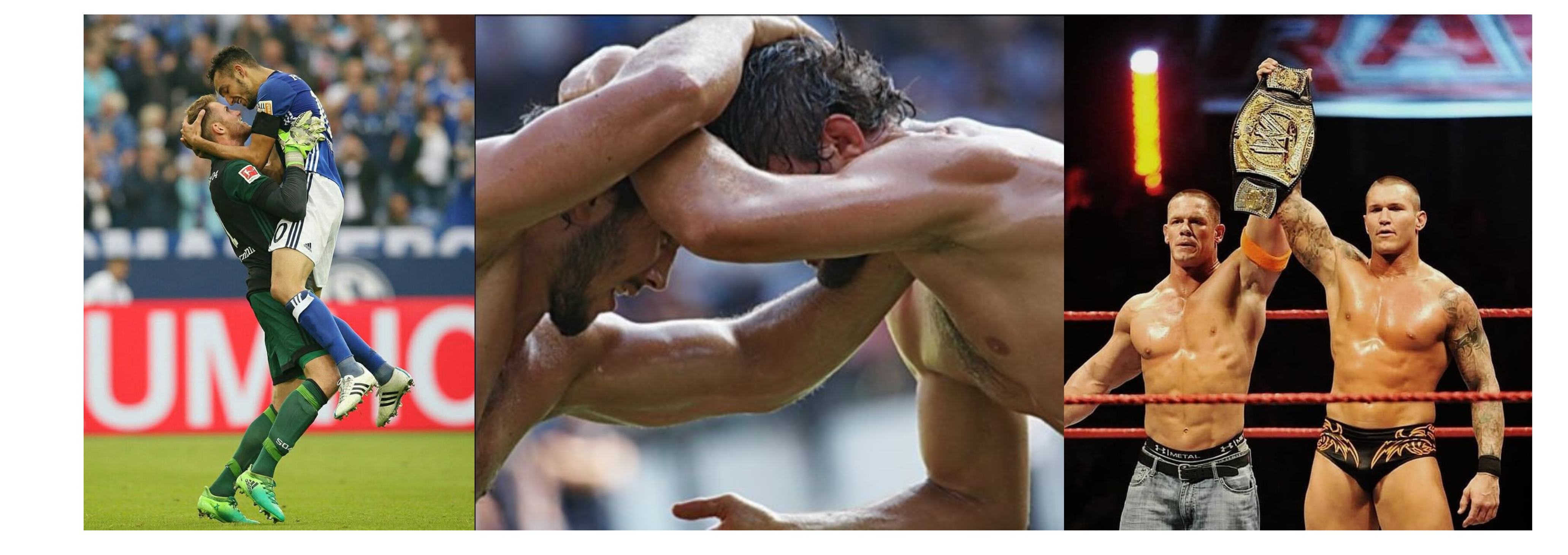
And I agree. It’s hard to ignore the homoeroticism of same-sex competition.
Lucy Neville’s book Girls Who Like Boys Who Like Boys answers the question “why do women love male-on-male erotica?” with care and precision. But watching Heated Rivalry left me with even more questions:
What is it about male-on-male erotica in the context of male competition that is so enticing for female audiences? Why does it have us panting in front of our screens?
And ultimately, why is it so cathartic?
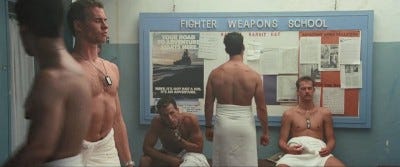
The war movie, the Western, the action movie are all genres that pay tribute to male virility. Men can be seen in full effort and at various stages of undress. They’re sweating, grunting, sometimes even touching each other, but always for a higher purpose; whether it is war or a fight scene. But the focus on proximity between male bodies inadvertently conveys a different idea for those with the eyes to see: the American film is packed with undeniably homoerotic visuals.
And yet, when men get naked near each other on screen, they always have a good reason for it, “reminding viewers they remain in control, still agents of movement.” We rarely get to see “a soft, disarmed male body.”6
Challengers and Heated Rivalry subvert this expectation by offering a bridge between the action-packed homoerotic genre and explicitly erotic media. They use sports competition, one of the most intense displays of emotions between men, as a catalyst for erotic tension. As Justin Kuritzkes says in that GQ interview, “there’s a lot of repression in the world in general, and especially sports,” because “sports competitively are usually played by people of the same gender, they’re homoerotic. And it’s sort of there, pretty nakedly on display whenever you watch sports.”
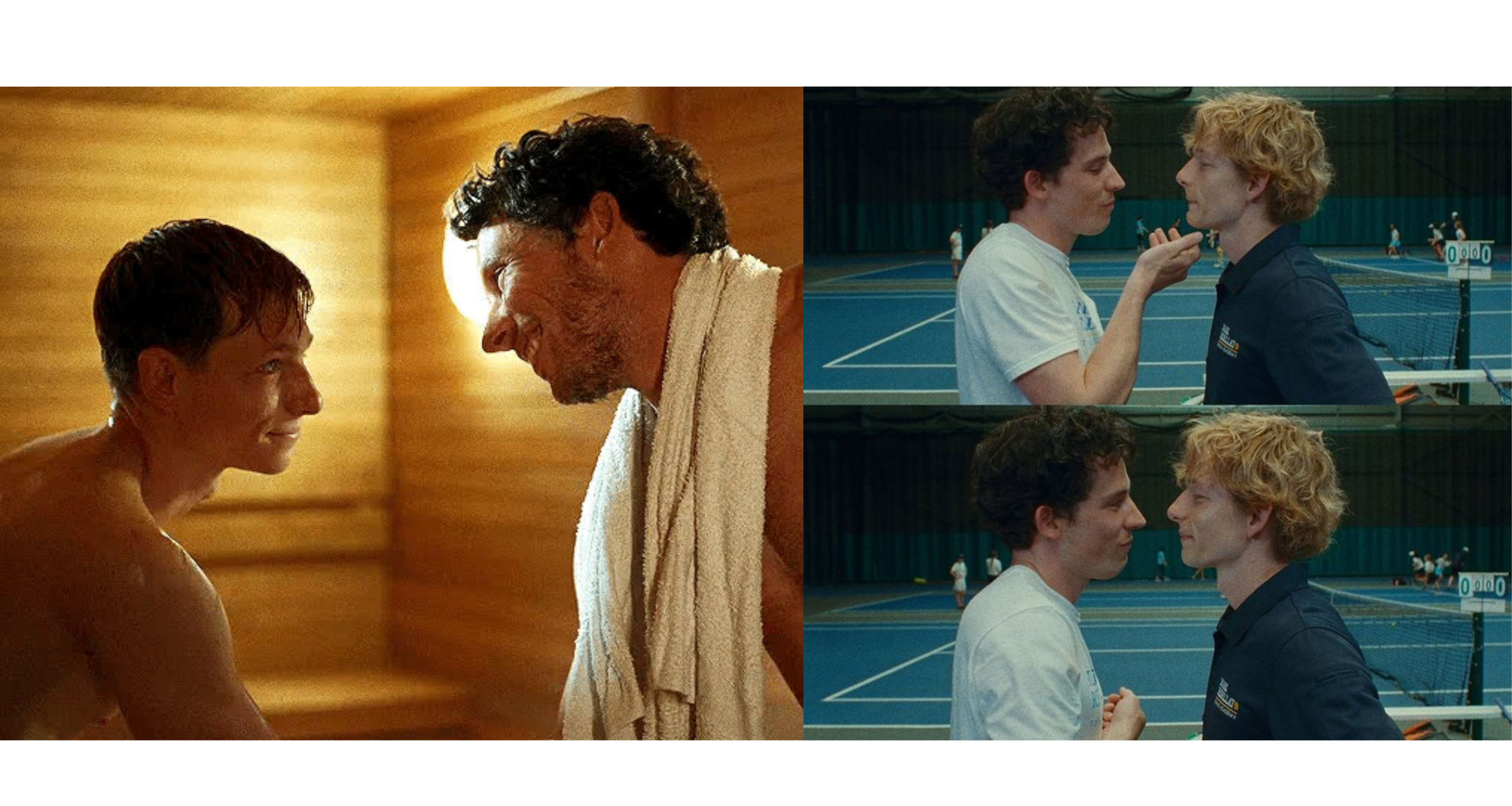
The difference is that Challengers uses tennis as a display for the erotic, whereas Heated Rivalry uses hockey as a bridge to the actual consummation of the erotic act.
In a scene at the beginning of the show, the two protagonists get on bikes at the gym, next to each other, without a word said between them. They start cycling as fast as they can, glancing at each other to see where the other one is at. They’re sweating, grunting. The homoeroticism of the scene is undeniable: sweat and anger, which are the signifiers of competition, here carry undeniable erotic charge.
If this was a regular sports movie, we’d only get that scene! But instead, this tense competition leads to the characters actually having sex afterwards.
Sweat is profuse. But it doesn’t just appear on our male protagonists’ foreheads during their intense sports effort; it is also present when they touch each other. In other words, nothing is “repressed” about Heated Rivalry. The homoeroticism transcends the subtext because the protagonists actually fuck. The desires of the audience are granted, satisfied.
We get to see the completion of the subtext we always read in intense competition between men. We see them transition from a state of “control,” usually granted to them in competition and other action-packed genres, to “softness.”
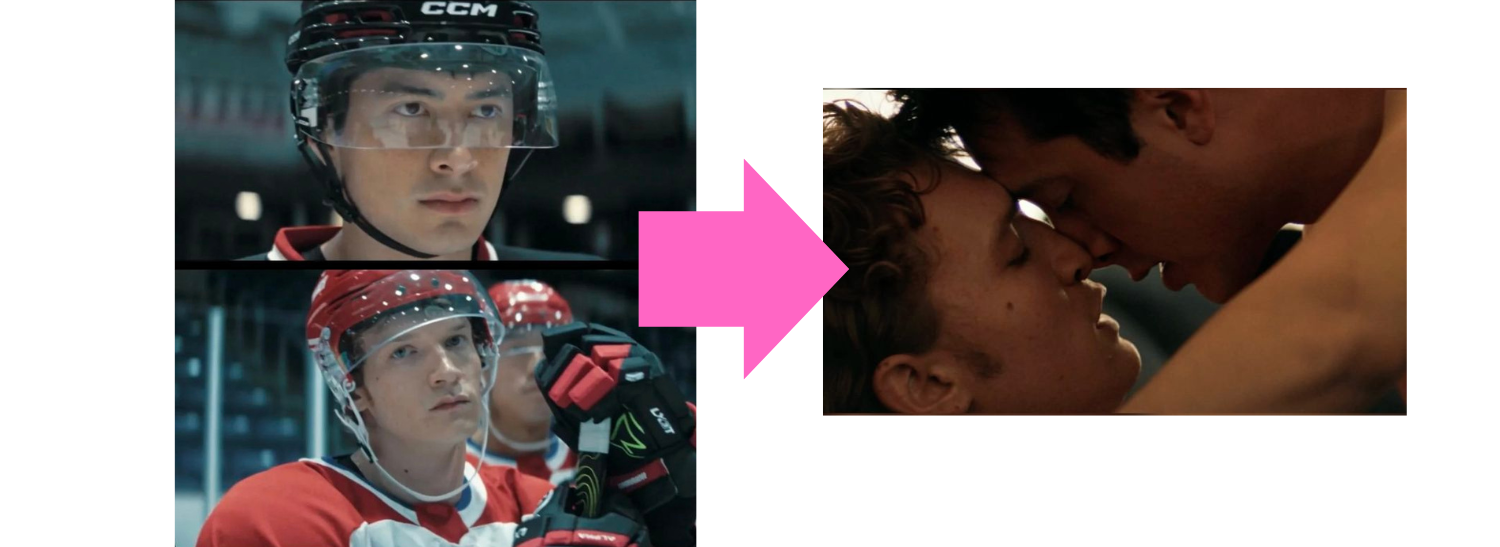
In both their personal lives, the two characters of Heated Rivalry are under a lot of pressure. Ilya has to deal with a brother who is constantly asking for money, a dad with dementia, and the pressure of keeping his sexual identity secret because of the lack of tolerance in his home country. While Shane... well, Shane is mostly fine in comparison, but his management team (mom and dad) is greedy, and he’s also a high-profile closeted gay man.
It’s a similar pattern to another gay romance, Red White & Royal Blue, where the two protagonists live a very high-pressure public life (one is from the royal family and the other is the US President’s son; it doesn’t get more high-stakes than that!), which forces them to constantly prove their worth and put their family’s interests first.
Both pieces of media depict the protagonists in a high-profile, high-pressure position—echoing how many men wish they were perceived (important, level-headed), a fantasy media often indulges. Except that both pieces of media also stage the vulnerability of the two male protagonists in a way that feels gratifying. We see these men in positions of power cracking under pressure and finding solace within each other.
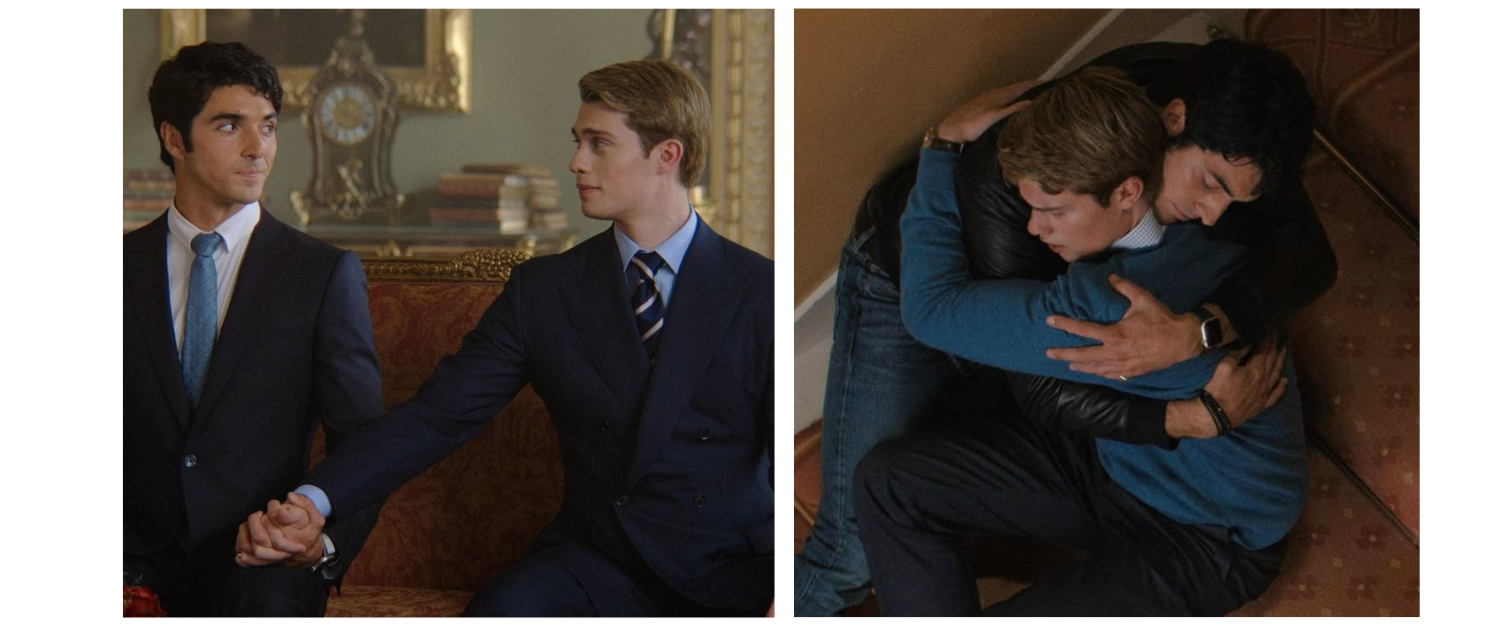
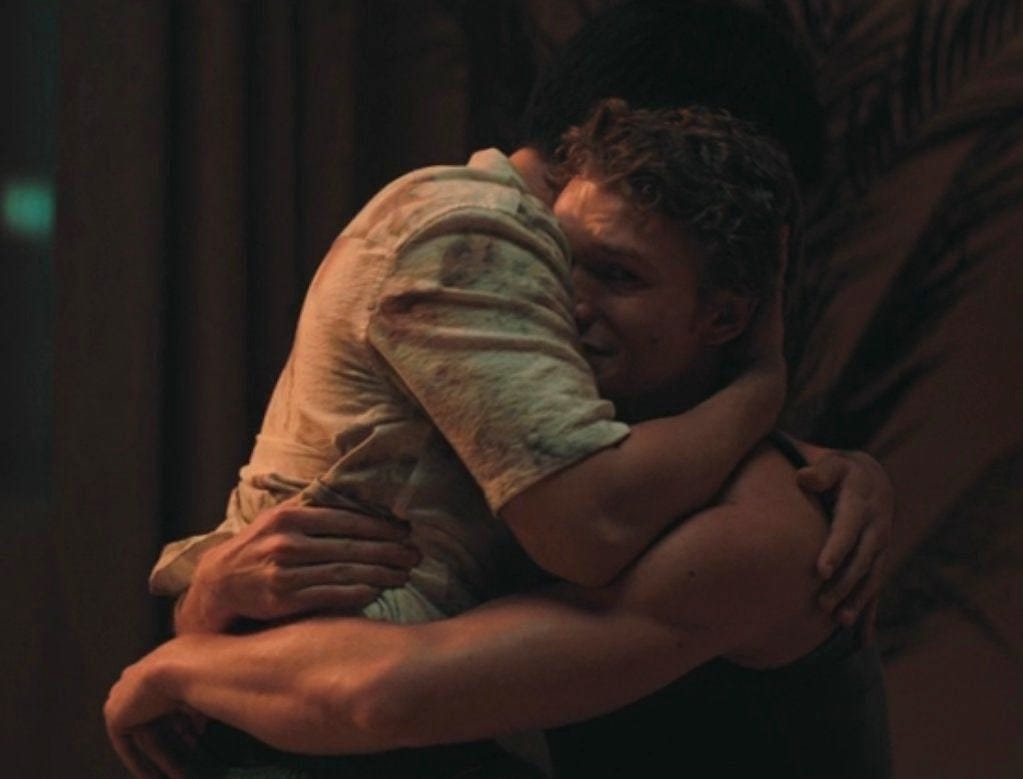
When they’re together, they don’t need to be manly and strong; they can just be soft and disarmed. In Heated Rivalry, after seeing Ilya in alternating states of being mean and cocky to his opponents or yelling at his brother on the phone, we finally see him melt in the arms of his lover, crying as he recounts to him everything he’s had to go through in the last few years.
It’s a vulnerable display of emotion. And for a lot of women it’s satisfying to see men on screen capable of being soft and vulnerable. For the female viewer, it gives her an in: a way to project herself onto the screen, to break through their usual tough performance. To borrow Suzanne Moore’s term, it “dephallicises”7 men, presenting them not “as all-powerful.”8
All in all, it could be that the success of the show can be attributed to the word of the year: yearning.
In an interview for Them, the actor who plays Ilya uses a term I absolutely love to describe what might entice straight women to watch Heated Rivalry: “prolonged foreplay.”
I couldn’t agree more. I think the way the story is built, with both an “enemies to lovers” and an “opposite sides/Romeo and Juliet” structure, gives room for a long, never-ending yearning between the two characters. Or as they say to each other every time they finish having sex after a tournament, not sure when they’ll be in the same city at the same time: “see you next season.”
Two men on opposite teams is the perfect site for a slow erotic burn. When Ilya and Shane start seeing each other, it is in the secrecy reserved for queer people trying to protect their identity. Their late-night meetings in hotel rooms, furtive exchanges of their room numbers, all echo a very familiar depiction of queer relationships as “secret,” but also help build up the slow development of their relationship over time.
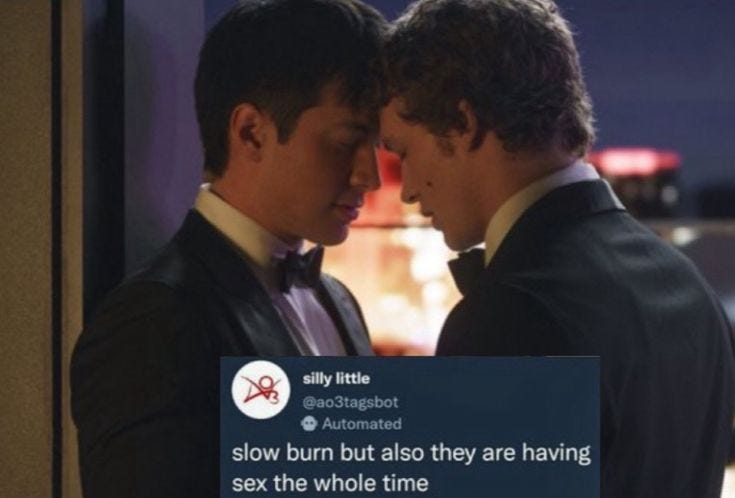
Heated Rivalry, while having some of the most explicit sex scenes I’ve seen in a decade, relies on subtlety as a narrative device. What the characters increasingly feel for each other is not spelled out; it can only be caught in the in-betweens. I think it’s an approach to romance that female audiences are particularly attuned to. Gestures that mean everything, contained in brief fleeting moments that one has to catch in order to feel the heat.
For example, one of the most romantic scenes ever has to be “the hand flex” scene in Pride and Prejudice. A scene that is the epitome of passion and subtle desire: Darcy helps Elizabeth get in her carriage; for a brief moment, their hands touch; in the next scene, Darcy is seen flexing his hand, a simple gesture meant to capture Darcy’s growing affection for Elizabeth.9
It is very short; blink and you’ll miss it. But its power is discussed to this day.

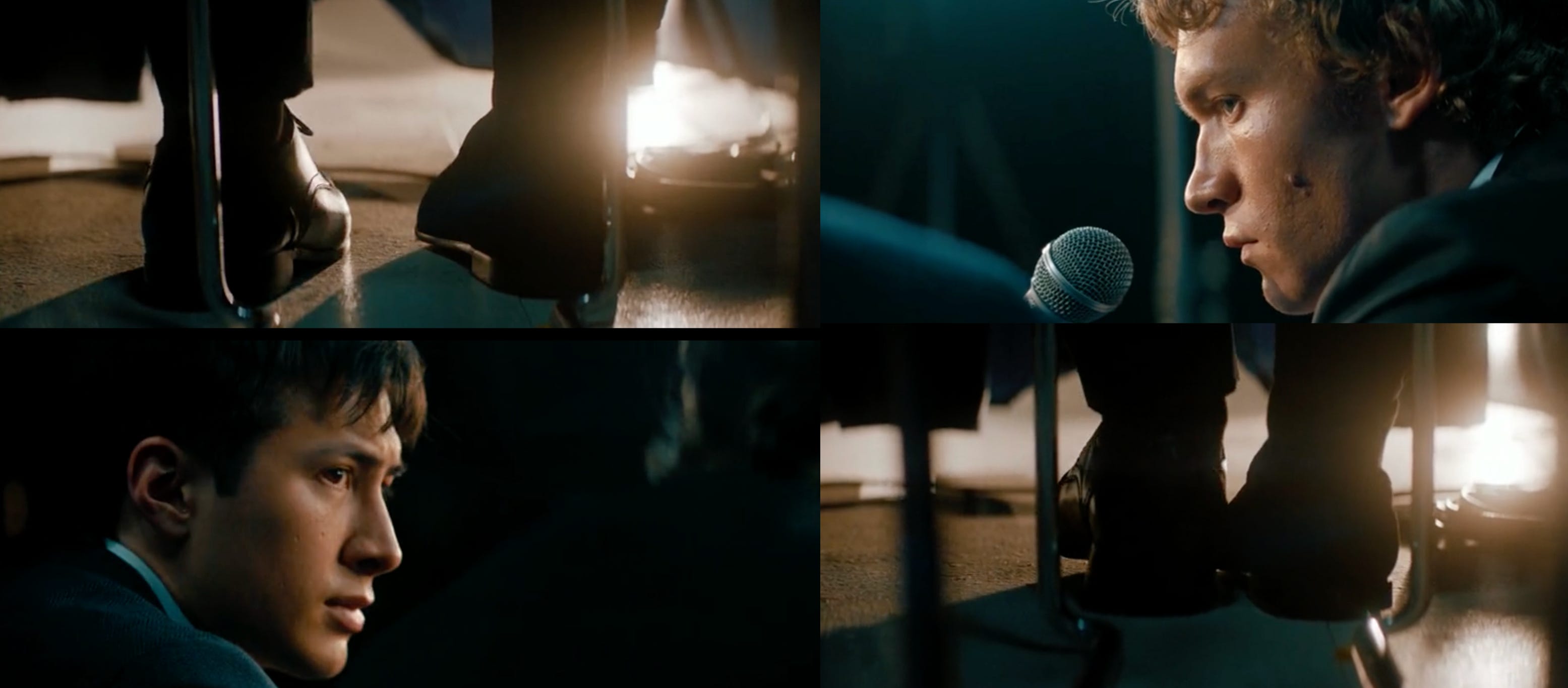
In Heated Rivalry, when the characters have their first erotic encounter, it all starts with a bottle of water. Exchanging it back and forth while maintaining eye contact, Shane and Ilya make a point of making sure their hands graze the other’s every time they pass it. Later on, during a press conference, while they are being questioned by journalists, their feet under the table slowly get closer, until they finally touch.
This is not a feature exclusive to male-on-male erotica, but one that is common to any erotica authored by a woman, or at least tailored to a female audience. The enemy/arch-nemesis dynamic only adds to the “prolonged foreplay.” These two men cannot be with each other for reasons beyond their control. Yet, reason goes out the window in the presence of each other.
And maybe this sums up the power of a romance like Heated Rivalry. Men on film seem to insist they get depicted as gods, as people whose reason transcends their humanity, and whose vulnerability is not made for display. Yet, male-on-male erotica insists that men can yearn, be unable to resist each other, surrender to passion, get sick with love.
So maybe male-on-male erotica is a sort of great gender equalizer for human passions…
…Or, maybe.. women just love to see men fuck each other.

Pornhub Insights. “Pornhub’s 2015 Year in Review.” Pornhub, 2015.
Girls Who Like Boys Who Like Boys: Women and Gay Male Pornography and Erotica by Lucy Neville is an amazingly researched book on the subject of women who consume and create male erotica, AND is based on real conversations with them (contrary to most of the research in that field that is based on theory)
When I say “assumptions”, I mean the tendency to pathologize female desire and paint it as deviant, or, as one of the participants from Girls Who Like Boys Who Like Boys perfectly said “the evolutionary psychological perspective has tended to view women’s production of m/m erotic material as ‘some kind of fetish’ carried out by ‘gay groupies’ ”
As Lucy Neville says in Girls Who Like Boys Who Like Boys: there isn’t one unequivocal reason women enjoy m/m content. Which is why her book takes a contextualist approach acknowledging “different realities—different ways of seeing and being—for different women.”
Neale, Steve. "Masculinity as Spectacle." Screen, vol. 24, no. 6, 1983, pp. 127-128. Quoted in Lucy Neville, Girls Who Like Boys Who Like Boys, Springer International, 2018.
"Dephallicise" means to remove or diminish phallic associations, symbolism, or power from something. Basically, to strip away the masculine/phallic authority or dominance.
Moore, Suzanne. “Here’s Looking at You, Kid!” The Female Gaze: Women as Viewers of Popular Culture
“MacFadyen’s hand flex is the physical manifestation of the moment when his transformation, his unlocking, by Lizzie begins. It’s a phenomenal emotional beat because we see that for all his broodiness, Darcy is affected by Lizzie.” - Hannah Kerns for Elite Daily
No posts
Comments
Nothing yet. Say the first thing.
Sign in to join the conversation.