
So you made a comic. Maybe it’s your first, or maybe it’s your 20th; either way, all the art is done, it’s been lettered, and your comic is ready for print or digital distribution.
Now you need to market it, and a big chunk of comic book marketing includes getting as many eyes as possible on your art through comic and entertainment news websites and podcasts.
To me, it’s the hardest part of the entire process. And it oftentimes is the chunk of creation that takes the most work, with the least reward. But given some recent questions I’ve been asked, I wanted to write a little guide to hopefully help make it a little bit easier.
I’ve been on both sides of the equation. In the closing months of 2024, I wrapped up an eight-year career writing about comics, film, and television at ComicBook.com full-time. After that, I spent another year or so at CBR as an editor overseeing comic news and reviews.
I’ve fielded coverage pitches from publishers and creators of every level, and as a result, I feel I have a good barometer on what editors are looking for.
First and foremost, let’s talk about the landscape as a whole. Entertainment news websites are hurting. Big time. With Google’s continued investment in AI, it’s an entirely new environment for news site to navigate—and it’s one anyone has yet to really figure out.
With site’s not getting the typical ad revenue (clicks) from their typical, virtually every one of the sites in the industry have had to undergo pretty sizable layoffs. When I left ComicBook, I had 30 or so coworkers that worked on the site full-time. Judging by the current masthead on the site, just 10 of those remain at the site a year and some change later.
At the same time, comics coverage doesn’t pay the bills. It rarely did when the times were good, even less now that the times are tough. That’s not a death sentence for coverage, it just means you need to navigate the situation at hand and understand it’s an uphill battle for indie and small press creators to get any sort of coverage.
Given the above scenario, you need to understand “blind” headlines aren’t going away. Blind headlines are what we called those that forced readers to click into an article to see the news. After all, if the news was revealed in the headline—why click in to read the article and display the ads, generating the revenue for the website in question?
I should note I’m not arguing right or wrong in this post. I’m just saying that’s how it is—and how it will be, probably for the remainder of our lives. If you feel like that’s sacrificing and impeding on your artistic integrity, then absolutely ignore this part of the post.
Some recent examples of these blind headlines include Another Major DC Villain Reportedly Returning in The Batman 2 and Alan Ritchson’s War Machine Sets Release Date. Neither headline is necessarily sensationalistic, but it gives you a taste of the information. Some may call it clickbait, even though I still reserve that for the more traditionally sensational fare like “Cameras Caught John Doe in a Situation You Wouldn’t Believe!” But that’s a story for a different time.
Thinking of a blind headline is where you should start your press pitch. Pretend you’re one of the writers writing these articles, or one of the editors approving the pitches. How would you cover the idea you’re trying to pitch?
Let’s look at my initial press pitch for our Summit Comics reveal release. The Marvel Cinematic Universe is the biggest franchise to ever hit Hollywood, the DC Universe is a hit with its earliest releases, and the Ultimate and Absolute Universes are dominating press headlines.
So I went for the angle of a shared universe, because that’s what Summit is. Even though the company has nearly two dozen owners, each story being told is set in the same world with the same continuity.
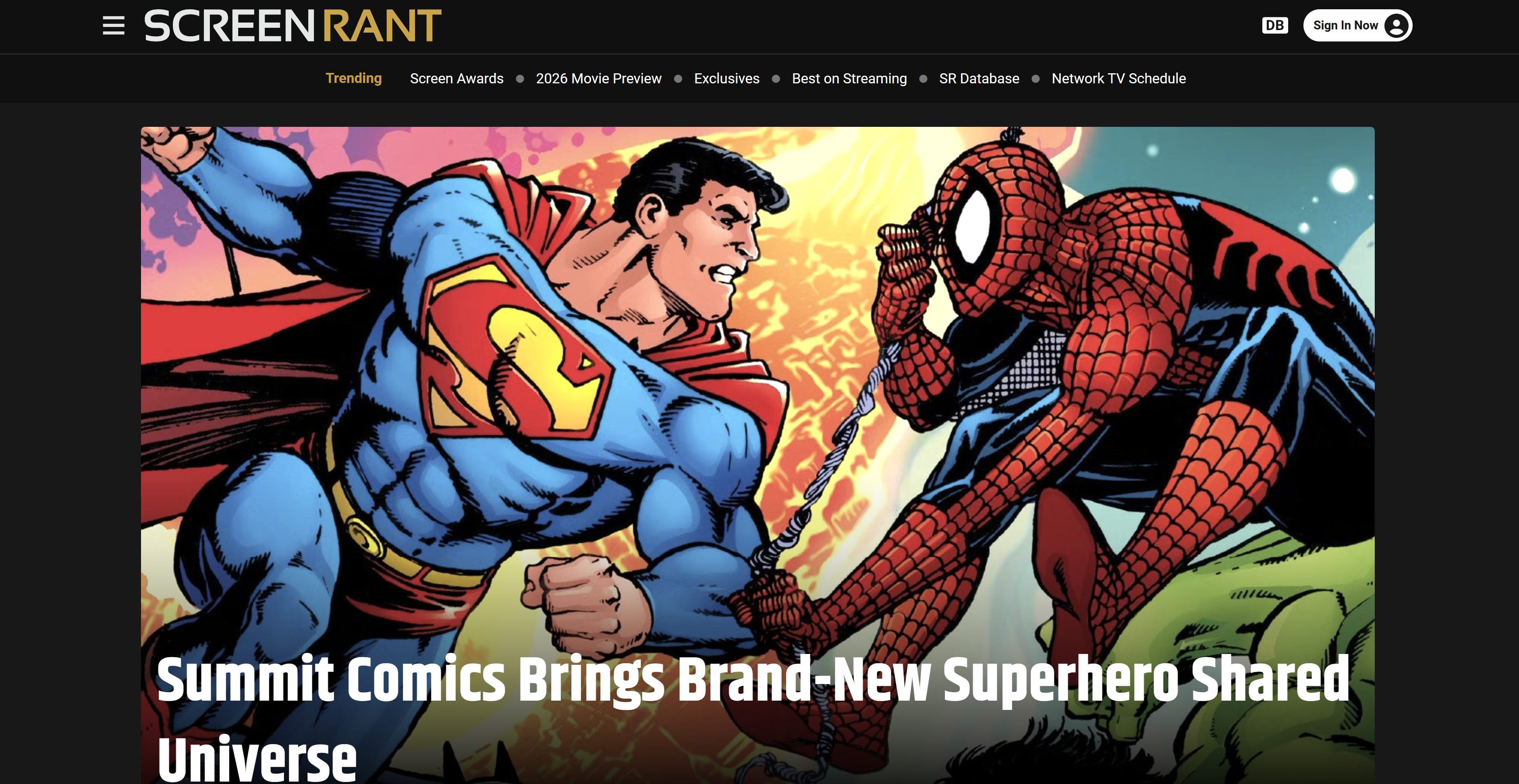
Suffice it to say, sites bit on the pitch. We landed an exclusive with CBR, arguably the biggest comics website on the internet, and had coverage on ScreenRant (probably the biggest overall entertainment site), TripWire, and other comics-focused websites like Graphic Policy and First Comics News.
Although we at Summit now have one published comic and another one on the way, at the time we were just some guys with an idea. And we decided to start a comics company instead of a burger joint that played The Lumineers and Mumford & Sons from open to close.
Once you have a good way to angle your pitch, you need of things you can do to sweeten the pot, or opportunity for the outlet(s) in question.
This bullet point is super easy to do if you’ve never talked about your project in a public manner. You could offer an outlet an exclusive opportunity to announce the series, and give them a window (at least an hour or two minimum) to have the news on their site before you send it out to other outlets.
If you have talked about the series in a public manner, you’ll just need to get creative. Do you have a cover that’s never been shared? Do you have plot points or characters you haven’t talked about? What about interior artwork that hasn’t seen the light of day?
Whatever exclusive material you can offer an outlet, the better your chances get at landing coverage.
Ultimately—and unfortunately for some—networking is a key part of the process. It might be the most important part. As with anything else in life, it’s largely who you know and not what you know that will get you what you want.
Again, that’s just the cold, hard truth. You can be the best comic writer in the world, but if you’re not rubbing elbows with other creators or editors, or refuse to have a social media presence, it’s going to be hard…likely impossible…for someone to discover your work.
The same works for comics press. Support comics press. Read the articles of sites like The Beat, Graphic Policy, First Comic News, and more. Follow those sites and writers on social media, and share their stories. Start dialogue with them on those same platforms—not about your projects, but about what the conversation is.
Shit, corporations like Valnet (owner of ScreenRant, CBR, many others) and Static Media (/Film and others) are always on the lookout for freelance news and features writers. Apply for one of those gigs.
Or volunteer to write in an unpaid role for one of the smaller comics-first websites. That option may be the best for immediate connection, in fact.
You don’t want to seem desperate, nor do you want to make it all about you because that’s not how any of this works. Press coverage is a two-way street, or a little acorn that you need to water and nurture until it becomes a big, strong oak tree.
This is something that takes time. Weeks, months. Hell, maybe years even. But it’s something that absolutely needs to be done, sooner rather than later.
There’s probably more nuance and details that can help pad your pitch to press outlets, but the three bullet points listed above will give you a great start with reaching out to outlets.
In fact, if enough of you are interested, I may even make a little series on this where we can get into action items such as putting together press kits, media training, and the like.
Comments
Nothing yet. Say the first thing.
Sign in to join the conversation.