
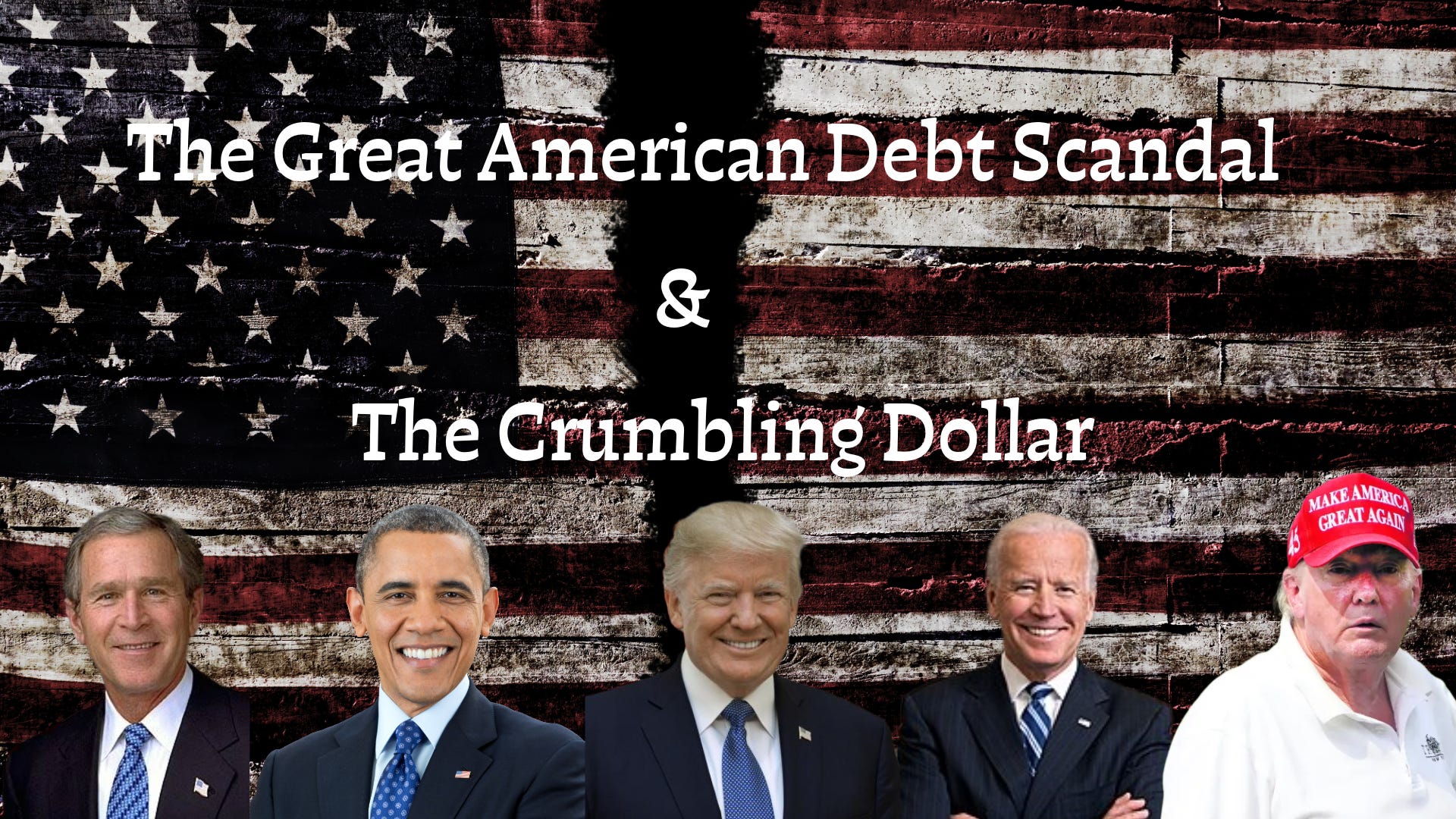
One of the advantages of hitting your 40s is that you can remember back through different generations of political controversies. Anyone who remembers the farce and fraud of the Obama years will recall the endless histrionics from the Republican Party and endless sell outs by the Democrats who over the much fabled “debt ceiling”. Earlier still is the propaganda from the 1990s about how government borrowing was an evil which needed to clamped down upon. In the fullness of time all of these arguments from the bourgeoisie and their tame politicians turn to ashes. The borrowing of the US government continually exploded over the last three decades whilst the fevered rhetoric about the evils of debt remained.
So it is no surprise really that last week, the United States national debt crossed $40 trillion — months ahead of forecasters’ expectations, and just five months after it passed $39 trillion. The immediate accelerant tells you everything about the class character of the moment: the Supreme Court struck down the Trump tariff regime, forcing the Treasury to refund over $100 billion in import duties — money that now has to be borrowed, on top of a deficit already running above $2 trillion a year.1
The number is growing by roughly $1 trillion every five months, as it has since 2020. It has doubled since 2017. It amounts to around 123% of GDP. And it now costs the US state roughly a trillion dollars a year in interest — more than it spends on its own military machine.
The business press reports all this with a furrowed brow and calls it “unsustainable.” It is worth being more precise about what is actually happening: the American state is being converted, before our eyes, into a tribute mechanism for finance capital — and its own creditors are becoming the arbiters of imperial policy. None of this would have surprised Marx, Engels or Lenin. They described the machinery while it was still being built.
“The credo of capital”
Marx treated the national debt not as an aberration but as one of the founding institutions of capitalism itself. In the chapter of Capital on the genesis of the industrial capitalist, he wrote:
“National debts, i.e., the alienation of the state — whether despotic, constitutional or republican — marked with its stamp the capitalistic era. The only part of the so-called national wealth that actually enters into the collective possessions of modern peoples is their national debt… Public credit becomes the credo of capital. And with the rise of national debt-making, want of faith in the national debt takes the place of the blasphemy against the Holy Ghost, which may not be forgiven.”
Note the mechanism he isolates — it reads like a description of the modern Treasury market:
“The public debt becomes one of the most powerful levers of primitive accumulation. As with the stroke of an enchanter’s wand, it endows barren money with the power of breeding and thus turns it into capital, without the necessity of its exposing itself to the troubles and risks inseparable from its employment in industry or even in usury. The state creditors actually give nothing away, for the sum lent is transformed into public bonds, easily negotiable, which go on functioning in their hands just as so much hard cash would.”7
The state creditor “gives nothing away”: he hands over cash and receives back a liquid, tradable asset that pays him interest forever, funded by taxation of the working population. And who pays? Marx was blunt: the fiscal system built around the debt “contains within itself the germ of automatic progression. Over taxation is not an incident, but rather a principle.”7
How the ledger reached forty trillion
In the year 2000 the gross federal debt stood at $5.7 trillion. The government was running a surplus, and official projections discussed paying the debt off entirely within a decade.3 A quarter-century of ruling-class policy produced the present number:
Tax cuts for capital: seven rounds since 2001 — Bush’s, the 2017 Tax Cuts and Jobs Act, and the recent One Big Beautiful Bill Act — stripped out roughly $8.7 trillion in revenue, about 30% of the total increase in debt.3
Imperial war and corporate welfare: the wars on Afghanistan and Iraq and associated spending added around $7.6 trillion.3
Socialising the crises of capital: the 2008 bailouts and the COVID interventions added $6.8 trillion — the state’s balance sheet deployed without limit to rescue the system, while the bill was left to accumulate.3
Compounding interest: the residue that is now becoming the main story.
The asymmetry is the point. Revenue was cut at the top of society; the costs of empire and of capital’s own crises were socialised. The $40 trillion is not a bookkeeping accident. It is the ledger of a ruling class that refuses to pay for its own system — and of a state that, as Engels put it, “no matter what its form, is essentially a capitalist machine — the state of the capitalists, the ideal personification of the total national capital.”
The trillion-dollar tribute
Here is where the quantitative becomes qualitative. Net interest cost the US government $970 billion in fiscal year 2025 — 3.2% of GDP, a post-war record share — and is crossing $1 trillion in FY2026, making it the second-largest line in the entire federal budget after Social Security. The Congressional Budget Office projects it will reach $2.1 trillion a year by 2036 — some $16.2 trillion over the decade.5 9 Interest already exceeds the defence budget; it already exceeds Medicaid; it already consumes the entire corporate income tax.6
This is a direct transfer of surplus value, extracted through taxation, to the owners of financial capital — the banks, funds, insurers, foreign central banks and wealthy households who hold the roughly $32 trillion of publicly held debt. Marx, anatomising interest-bearing capital in Volume III of Capital, caught the essence of a state (and a class) living this way:
“In its capacity of interest-bearing capital, capital claims the ownership of all wealth which can ever be produced, and everything it has received so far is but an instalment for its all-engrossing appetite. By its innate laws, all surplus-labour which the human race can ever perform belongs to it. Moloch.”
He also left us a delicious historical footnote. The eighteenth-century British state rationalised its debt through the Rev. Dr. Price’s fantasy of compound interest — a sinking fund that would magically spiral into infinity. Marx’s comment: “What a pretty theoretical introduction to the national debt of England!” — and he summarised Pitt’s fiscal method as “an infinity of loans — loans to pay loans.”14 The US Treasury in 2026, borrowing over $2 trillion a year in new money while rolling over trillions more of maturing paper, is Price’s system with the mask off. In 2025 alone it ran more than 400 auctions and sold roughly $29.7 trillion in marketable securities — most of it simply refinancing the old debt at new, higher rates. The average interest rate carried by the debt has more than doubled since the cheap-money era, as pandemic-era paper matures and reprices.
The bond market as the commanding heights of state power
This is the vulnerability, and it deserves to be stated in class terms. The US state’s solvency is not tested annually at budget time; it is tested every week, at auction. When the market’s appetite wavers, the consequences are immediate: in March 2026, consecutive Treasury auctions went so badly that primary dealers — the banks contractually obliged to absorb what genuine buyers refuse — had to take up double their normal share, at yield concessions (“tails”) across the curve. The 10-year yield has climbed to around 4.7% and the 30-year above 5.2% despite Federal Reserve rate cuts — the market, not the central bank, now sets the state’s marginal borrowing cost.
Meanwhile the foreign bid — the foundation of the “exorbitant privilege” — is quietly withdrawing. Foreigners hold about $9.3 trillion of Treasuries, roughly 30% of the publicly held stock, but the composition is shifting: Japan, the largest holder, is selling to defend the yen, and China’s holdings have fallen to their lowest level since 2008. The weaponisation of the dollar — the freezing of Russian and Iranian reserves — taught every central bank on earth that Treasury holdings are safe assets only for as long as Washington approves of your foreign policy. Reserve diversification is now rational self-defence.
Marx described exactly this power relation in 1850, dissecting the July Monarchy — a regime in which, he wrote, the ruling finance aristocracy
“had a direct interest in the indebtedness of the state. The state deficit was really the main object of its speculation and the chief source of its enrichment. At the end of each year a new deficit. After the lapse of four or five years a new loan. And every new loan offered new opportunities to the finance aristocracy for defrauding the state, which was kept artificially on the verge of bankruptcy — it had to negotiate with the bankers under the most unfavorable conditions.”
The July Monarchy, he concluded, “was nothing other than a joint stock company for the exploitation of France’s national wealth.”22 And he distilled the whole relationship into one sentence that could serve as the epigraph for the present era: “Public credit rests on confidence that the state will allow itself to be exploited by the wolves of finance.”22 Every Treasury auction is a test of that confidence. Every failed auction is the wolves baring their teeth.
Engels, for his part, identified the mechanism of rule in a democratic republic: wealth “exercises its power indirectly, but all the more surely” — through the corruption of officials and through the “alliance of the government and the Stock Exchange.” The revolving door between the Treasury, the Fed, and Wall Street; the primary-dealer system; the institutional veto the bond market holds over any policy that might displease it — this is that alliance, perfected. It disciplines every government regardless of party. No programme that frightens the long bond survives contact with the auction calendar.
The usurer state in decline
Lenin gave this formation its name. Writing in 1916, at the height of the last great wave of financialisation, he observed:
“Imperialism is an immense accumulation of money capital in a few countries… Hence the extraordinary growth of a class, or rather, of a stratum of rentiers, i.e., people who live by ‘clipping coupons,’ who take no part in any enterprise whatever, whose profession is idleness… The rentier state is a state of parasitic, decaying capitalism.”
The United States was once the world’s greatest creditor — the power whose navy, in the words Lenin quotes from Schulze-Gaevernitz, “plays the part of bailiff in case of necessity” for the creditor nations.24 Today it is history’s greatest debtor, and the tribute flow runs increasingly outward: hundreds of billions a year in interest to foreign holders, and over a trillion in total to the coupon-clippers at home and abroad.
There is a deeper historical rhyme here, and Marx himself sketched it. Tracing how the “villainies of the Venetian thieving system” became a secret source of Dutch wealth, and Dutch lending in turn built up England, he added: “The same thing is going on today between England and the United States.”7 Giovanni Arrighi built his account of hegemonic cycles in The Long Twentieth Century (Verso, 1994) on exactly this pattern: in the autumn of every systemic cycle of accumulation — Genoese, Dutch, British — the declining hegemon turns from production to finance, its state becomes a debtor to the moneyed interests its own power nurtured, and the system’s centre of accumulation migrates eastward. The US state paying a trillion-dollar annual tribute to bondholders while its auctions falter, its allies are strong-armed into holding its paper, and its chief systemic rival pares back its Treasury holdings to 2008 levels — this is Arrighi’s “signal crisis” rendered as a Treasury yield curve.
And the constraint binds the war machine too. An imperial state that must refinance trillions of dollars of marketable debt every year, at prices set by a market that includes its rivals’ central banks, has its room for manoeuvre set in New York and Tokyo as much as in Washington. When the Cato Institute — no hotbed of Marxism — warns that America’s defence cannot depend on the assumption that investors will always finance unlimited deficits at favourable rates, the ruling class is admitting the contradiction out loud.12 An empire that must watch the term premium while it plans its wars will increasingly subcontract them — hence the desperate push to remilitarise Germany and Japan.
Some Conclusions
The $40 trillion milestone is not a story about fiscal imprudence. It is a story about what kind of state the United States has become: a machine for transferring value from labour to capital, now so thoroughly financialised that its own creditors hold a standing veto over its policies, and so indebted that the interest alone outruns the largest war budget in human history. Marx’s “modern bankocracy,” Lenin’s “state of usurers” — the categories are no longer polemical. They are the second-largest line item in the federal budget, growing faster than any other.
The entire political “debate” in US bourgeois politics over debt thus stands revealed as a total utter farce. The reality is that when faced with dangers to profits or threats to the whole system, brought about by that systems parasitism, there is no limit to the amount of debt that the US ruling class is prepared to generate. They hold much of it themselves and so the process of bailing out themselves can then be turned into securing and endless tribute from the state that bailed them out in the first place. It is a brutal expression of the class war on the American worker and the utter parasitism and decay of US capitalism.
The wolves of finance demand their tribute. The question — for the working class that pays it — is how long the tribute will be paid, and what it will take for the working class to refuse to pay it.
Figures verified against US Treasury, CBO, Federal Reserve and TIC data as reported to 21 August 2026.
[1] NPR. https://www.npr.org/2026/08/19/nx-s1-5937552/the-u-s-debt-tops-a-record-shattering-40-trillion-yes-with-a-t
[2] The Washington Post. https://www.washingtonpost.com/business/2026/08/18/us-debt-set-hit-40-trillion-months-earlier-than-expected/
[3] Peter G. Peterson Foundation. https://www.pgpf.org/article/4-ways-the-united-states-got-to-40-trillion-in-national-debt/
[4] USAFacts. https://usafacts.org/answers/how-much-debt-does-the-us-have/country/united-states/
[5] Committee for a Responsible Federal Budget. https://www.crfb.org/blogs/net-interest-costs-will-double-again-over-next-decade
[6] Committee for a Responsible Federal Budget. https://www.crfb.org/blogs/interest-costs-just-surpassed-defense-and-medicare
[7] Marxists Internet Archive. https://www.marxists.org/archive/marx/works/1867-c1/ch31.htm
[8] Marxists Internet Archive. https://www.marxists.org/archive/marx/works/1880/soc-utop/ch03.htm
[9] Committee for a Responsible Federal Budget. https://www.crfb.org/papers/cbos-february-2026-budget-and-economic-outlook
[10] Committee for a Responsible Federal Budget. https://www.crfb.org/blogs/interest-debt-grow-past-1-trillion-next-year
[11] House Budget Committee. https://budget.house.gov/press-release/interest-costs-surpass-national-defense-and-medicare-spending
[12] Cato InstituteCato Institute. https://www.cato.org/commentary/americas-debt-national-security-risk
[13] treasury.gov. https://ticdata.treasury.gov/resource-center/data-chart-center/tic/Documents/slt_table5.html
[14] Marxists Internet Archive. https://www.marxists.org/archive/marx/works/1894-c3/ch24.htm
[15] Charles Schwab. https://www.schwab.com/learn/story/how-do-treasury-auctions-work
[16] The American Action Forum. https://www.americanactionforum.org/insight/sizing-up-interest-payments-on-the-national-debt/
[17] Committee for a Responsible Federal Budget. https://www.crfb.org/blogs/weak-auctions-underscore-risks-our-growing-debt-burden
[18] Committee for a Responsible Federal Budget. https://www.crfb.org/blogs/10-year-treasury-yield-eclipsed-46
[19] TRADING ECONOMICS. https://tradingeconomics.com/united-states/government-bond-yield
[20] Seoul Economic Daily. https://en.sedaily.com/international/2026/08/18/foreign-holdings-of-us-treasuries-fall-as-japan-china-cut
[21] FirstpostFirstpost. https://www.firstpost.com/business/japan-china-uk-cut-us-treasury-holdings-whats-driving-the-global-shift-14038995.html
[22] Marxists Internet Archive. https://www.marxists.org/archive/marx/works/1850/class-struggles-france/ch01.htm
[23] Marxists Internet Archive. https://www.marxists.org/archive/lenin/works/1917/staterev/ch01.htm
[24] Marxists Internet Archive. https://www.marxists.org/archive/lenin/works/1916/imp-hsc/ch08.htm
No posts
Comments
Nothing yet. Say the first thing.
Sign in to join the conversation.