
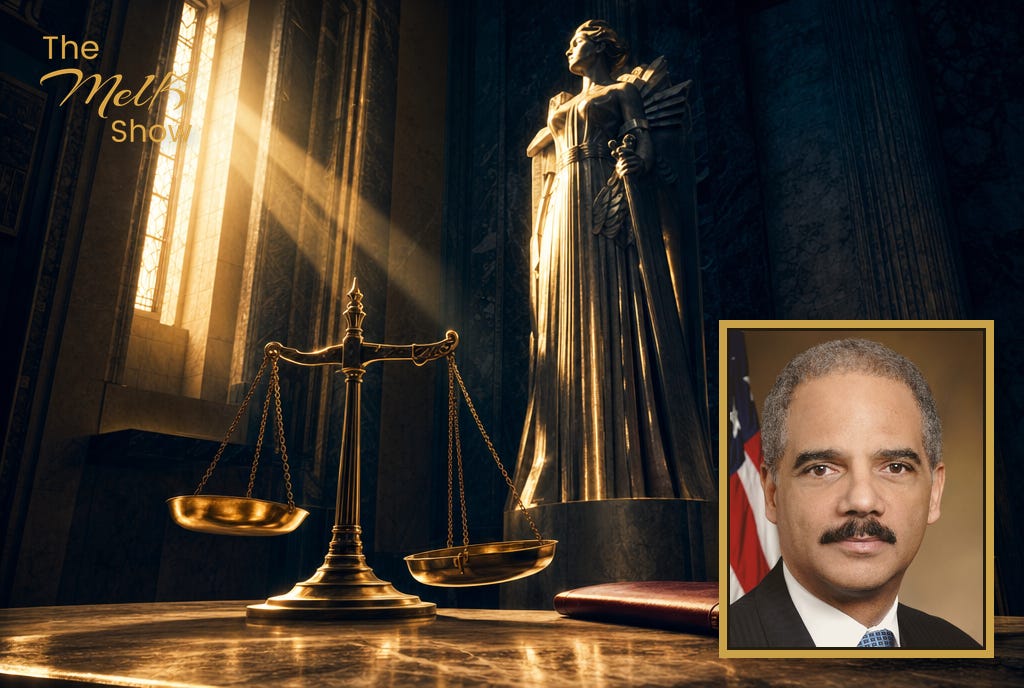
I. THE GREAT HALL
February 18, 2009. Less than a month after Barack Obama took the oath of office, his Attorney General walked into the Great Hall of the Department of Justice, stood beneath the aluminum statue called the Spirit of Justice, and told the country what kind of nation he believed it had always been.
Eric Holder said the United States had never honestly confronted race. He said the country remained, in his words, voluntarily socially segregated. Then he said the sentence that ran in the papers for a week. In things racial, Holder told the room, Americans are “essentially a nation of cowards.”
The controversy was immediate. The significance was not.
Most Americans remember the phrase. Few remember the room. The room is the argument, because the building Holder stood in is not what most citizens think it is.
The Department of Justice is imagined as a law-enforcement agency. It is something more consequential than that. Congress writes the law. The courts read it. The Department of Justice decides how much of the law will ever touch the ground. Between the statute and the citizen stands an institution that chooses which cases to file, which theories to advance, which precedents to attack, which states to investigate, and increasingly, how discrimination itself will be defined. The discretion is the power. The man who holds it decides, in practice, what equal protection means in fifty states.
Inside that institution sits a smaller and more powerful one. The Civil Rights Division. The American people have never heard the names of its section chiefs. They cannot recite its leadership. They do not read its annual reports. Yet the Division sets the federal posture on voting, elections, redistricting, school discipline, housing, employment, policing, disability, and the practical meaning of equal protection in every state of the Union. Whoever holds the Division holds the pen that defines discrimination itself.
Eric Holder understood this from the first month. In June 2009, before the Washington Lawyers’ Committee for Civil Rights and Urban Affairs, he called the Division the Department’s crown jewel. He used the phrase again and again across his tenure. At the time the line drew little notice. Looking backward, it was among the most important sentences he spoke, because what followed was not a change in leadership. It was a change in orientation. A different understanding of discrimination. A different understanding of equal protection. A different understanding of civil rights themselves.
The evidence did not arrive all at once. It surfaced in pieces. A voting case narrowed in Philadelphia. A voter-identification fight in Texas. A series of speeches about race. The appointment of one man to run the crown jewel. A Department increasingly concerned with disparate impact, structural barriers, and unequal outcomes. Read one at a time, each could be explained away. Read together, they form a pattern. And the dispute that pattern ignited was never simply about Eric Holder.
It was about the meaning of justice.
The question was never whether civil rights would be enforced. It was how justice would be measured: by equal treatment under the law, or by equal outcomes in society. Holder chose. The country never agreed.
II. HE SAID IT HIMSELF
Begin the investigation where Holder ended the argument. In his own words. This is the method I rely on throughout this piece, and it’s the only method that survives a hostile reading. Let the architecture indict itself through the words of the people who built it.
August 4, 2014. The Hill published an interview Holder gave to Juan Williams, a Fox News analyst, after a speech in Philadelphia to the nation’s criminal defense lawyers. Williams put to him the label his critics had spent five years throwing. Holder did not deflect it. He took it up and wore it. “If you want to call me an activist attorney general,” he said, “I will proudly accept that label.” An attorney general who is not an activist, he added, is not doing the job, and the role exists to change things and bring the country closer to the ideals of its founding documents. Asked about critics who charged him with running an activist civil rights division under an activist chief, Holder said he agreed “1000 percent” and was proud of it.
He was not accused of a worldview. He volunteered one.
In the same interview he named the principle he had set himself against. He said he was “bothered by” Chief Justice John Roberts’ famous formula, that the way to stop discrimination on the basis of race is to stop discriminating on the basis of race. There are still racial issues the society is working through, Holder said, and the lack of desire to confront them undermines the nation’s ability to make progress. Roberts measures justice by the rule, treat every citizen the same. Holder measures it by the result. That is not a quarrel about tactics; it is a quarrel about what the word means, and a free people cannot share a Republic while disagreeing about it.
The worldview was not a secret he kept; it was a creed he preached. The only remaining question, once a man tells you what he believes, is what he does with the instrument when you hand it to him.
III. THE CROWN JEWEL
To understand what Holder built, follow the man he chose to build it.
October 6, 2009. Holder welcomed Thomas E. Perez as Assistant Attorney General for Civil Rights and said that restoring the Division ranked among his highest priorities. Perez was not new to the building. He had served in the Division from 1988 to 1999, rising from the Criminal Section to Deputy Assistant Attorney General. The man Holder named to run the crown jewel knew exactly where its levers were.
The appointment told observers what the speeches had only suggested. Holder did not treat the Civil Rights Division as one office among many. He treated it as the instrument through which a stated worldview would become enforcement. Personnel was the policy. Whoever ran the Division would decide which theories the United States advanced in court, which cases it filed, which it declined, and which precedents it chose to fight.
The Division’s own records describe the period in the language of revival. Its accomplishments report covering 2009 to 2012 recorded that Holder repeatedly called it the crown jewel and presented the years after 2009 as a reinvigoration of enforcement. A later retrospective covering 2009 to 2017 catalogued work across policing, voting, criminal justice, disability, language access, and the rights of LGBT Americans and people living in poverty. The Division called it a return to form.
Whether that revival amounted to restoration or to redirection is the question the documents alone cannot settle, and I won’t pretend they settle it. The honest answer requires comparing what the Division did before 2009 with what it did after, section by section and case by case. That comparison is the spine of any fair verdict, and it is the work that separates a pattern from an accusation. What is not in dispute is the priority. Of every office in the Department, this is the one Holder named as the jewel, and the one he handed to a man who knew its machinery cold.
IV. THE REVOLT INSIDE THE BUILDING
The first sustained challenge to Holder’s Division came from inside it.
In the spring of 2009, the Department narrowed a civil voting-rights case it had already brought against members of the New Black Panther Party over conduct outside a Philadelphia polling place on Election Day 2008. The decision reached the United States Commission on Civil Rights, a federal body created to examine exactly this kind of question.
Two former Voting Section attorneys carried the charge. Christopher Coates had led the Voting Section. J. Christian Adams had served under him and would lay out the case at book length in Injustice, published in 2011. In testimony recorded in the Commission’s interim report of November 23, 2010, Coates said the Division harbored a hostile atmosphere toward race-neutral enforcement of the Voting Rights Act. In the Commission’s summary of December 3, 2010, both men testified that the reversal reflected a culture inside the Division that did not believe voting law should be enforced the same way for every citizen, regardless of race.
Holder felt the charge personally, and he said so. On March 1, 2011, before a House subcommittee, Representative John Culberson read a former Democratic official’s statement calling the Philadelphia incident the most serious voter intimidation he had seen. Holder bristled. To compare that incident to the Jim Crow-era struggle, he said, did a disservice to those who had risked everything “for my people.” The phrase drew fire. Read fairly, it was identification with the Black Americans who fought and died for the vote, including his own wife’s sister, a civil-rights figure. It was not animus toward anyone. But it told the country which history sat closest to the Attorney General’s heart.
The record requires the other side, and I keep it in on purpose. The Department rejected the attorneys’ characterization, maintaining the case was resolved on the legal merits and shaped by career officials rather than political appointees. An internal Department review concluded the handling did not amount to improper political interference, while documenting deep disagreement among the lawyers involved. And the dispute did not split cleanly along partisan lines. Abigail Thernstrom, the Commission’s vice chair and a longtime conservative critic of race-conscious policy, publicly doubted the episode carried the weight her fellow critics assigned it.
So the Commission record does not prove that Holder politicized the Voting Section. It proves something narrower and still consequential. By 2010, career attorneys and former supervisors were willing to testify under oath that the Division had grown hostile to the principle that the law should protect every voter the same way. That testimony entered the public record. It has never been fully resolved. And it framed every voting fight that followed.
Comments
Nothing yet. Say the first thing.
Sign in to join the conversation.