
Have you noticed that everyone is talking about trust right now?
Scroll LinkedIn for two minutes and count. AI is reshaping the workforce, and trust is the answer. Layoffs are shaking engagement, and trust is the answer. Mismanagement, burnout, return-to-office battles: trust, trust, trust.
I don’t think these voices are wrong. I think they’re incomplete. Because I keep waiting for the second half of the sentence, the part that tells a leader what to actually do, and it never comes.
So let me ask you the question that has been on my mind:
Think of the leader you trusted most in your career. Not admired. Trusted. What did they actually do?
Hold that person in your mind for a second, because I’d bet money on something: you’re not picturing their values statement. You’re picturing moments. The time they told you the truth when it was awkward. The time they took the blame that was theirs. The time they stayed calm when everything was on fire, or asked for your view and actually changed their mind.
That instinct you just had is what the research says too. Mary Crossan who has spent over a decade studying leader character with her colleagues at Ivey, argues that trust isn’t something you build directly at all. Trust is an outcome. It shows up
Here’s the definition of trust I find most useful, from Mayer and colleagues’ classic work: trust is the willingness to be vulnerable to another person, based on the expectation that they’ll act well toward you even when you can’t monitor them.
Read that again, because it’s doing a lot of quiet work. Trust means being willing to be vulnerable.
Now connect it to what I’ve been studying: belonging. In the inclusion research, belonging means feeling valued as a full member of the group while still being able to be your actual self. Shore and colleagues call these two needs belongingness and uniqueness, and you need both met at once to experience inclusion.
Maybe you see where I’m going here… You cannot feel you belong somewhere you cannot be vulnerable. Bringing your real self to work, the accented, still-learning, awkward, they/them, first-generation, whole self, is an act of vulnerability. Which means every deposit into trust is also a deposit into belonging. And every withdrawal, every spun message, every dodged accountability moment, quietly tells people to armour up.
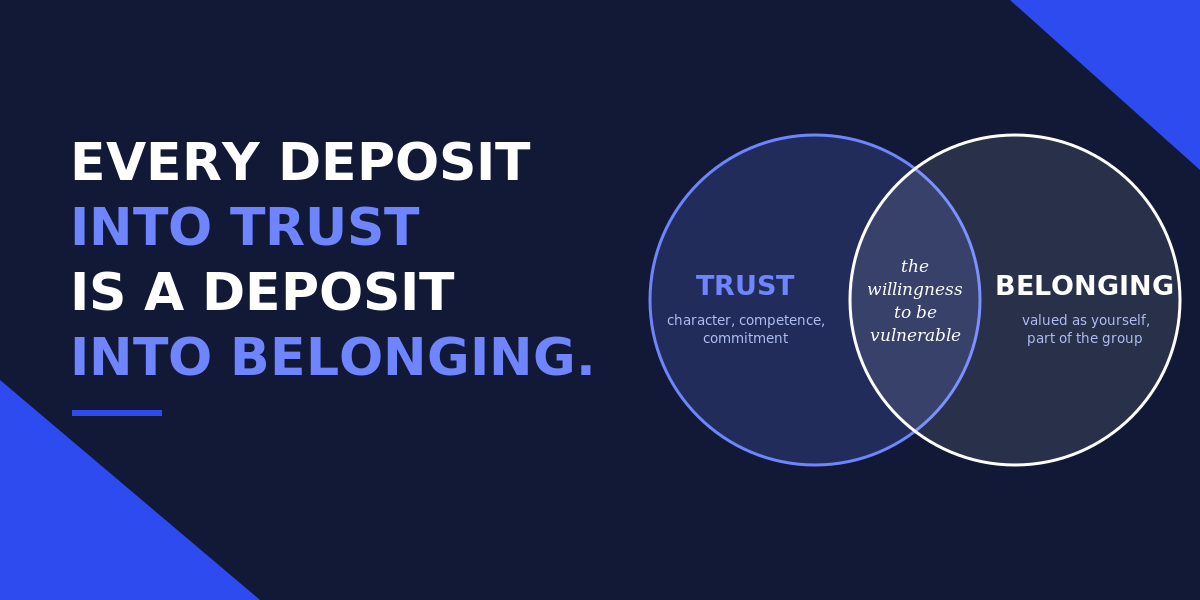
This is why I get restless when trust is discussed as an abstract virtue. For the people I study, first-level leaders, trust and belonging are built or broken in the same ordinary moments, by the same observable behaviours. And in most organizations, nobody has ever taught those leaders what the behaviours are.
Over the next few posts I want to get concrete: what the trusted leader in your head actually did, why kind leaders still lose trust, who taught any of us to lead, and whether you really can have too much integrity (the research answer might surprise you).
But first, I want to hear from you. Tell me in the comments about the leader you trusted most: what is ONE specific thing they did? I’ll gather the answers and map them against the character research in the next post. Your sharing moment might be someone else’s how-to, let’s dig in together.
If you’re new here, welcome. I’m Melissa (they/them), an executive operator, and doctoral student studying how first-level leaders create belonging at work. Subscribe and you’ll get the whole series and more from my DBA and leadership journey.
Melissa
Enjoying my content?
If you’d like to support my research and work in Inclusive Leadership Development, consider buying me a coffee! Your one-time contribution helps me continue sharing insights and creating impactful content.
☕️Thank you for your support!☕️
Sources: Crossan (2025), What Leaders Need to Know About the Trust Equation, Forbes; Crossan et al. (2017), Journal of Management Studies; Mayer, Davis and Schoorman (1995), Academy of Management Review; Shore et al. (2011), Journal of Management.
No posts
Comments
Nothing yet. Say the first thing.
Sign in to join the conversation.