
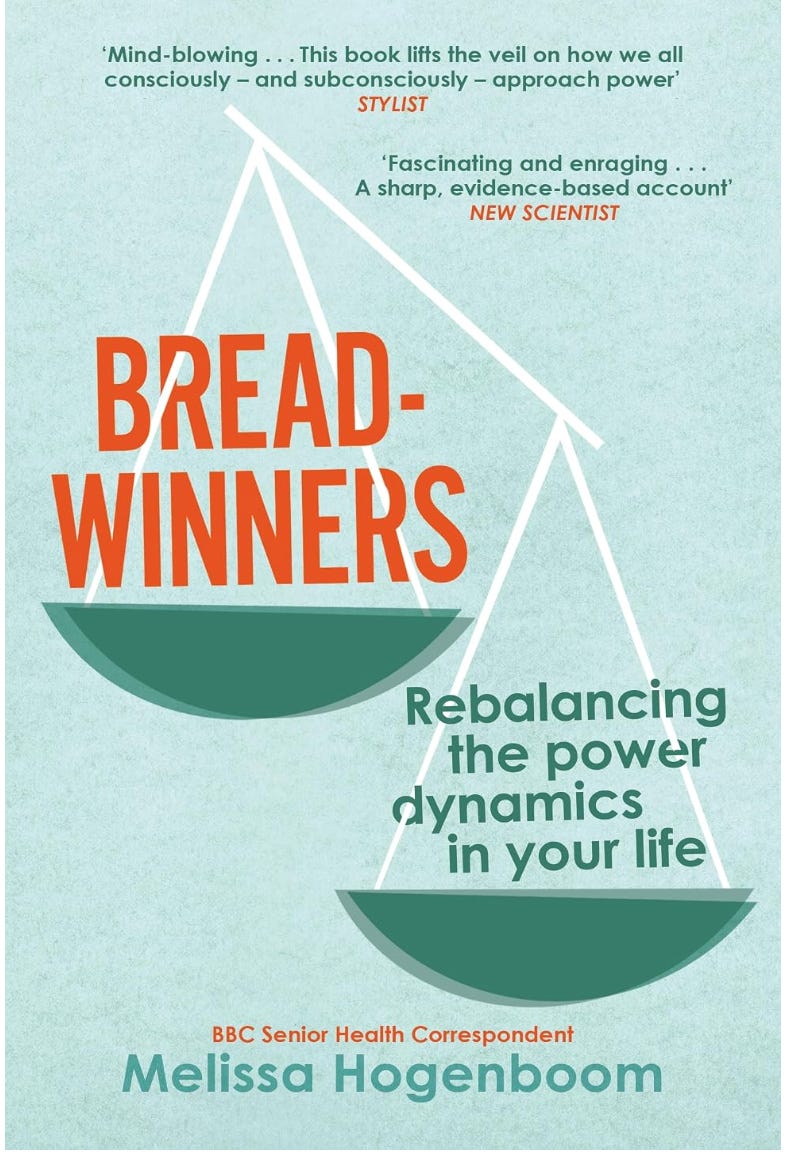
The paperback of my book Breadwinners, is out this week - check out the beautiful new cover below - it’s a perfect and compact holiday read!
Now onto this week’s newsletter.
The more I’ve reported about inequality in relationships, the more interested I’ve become in the contradiction that when we grow up, we demand fairness as children. Our parents often tell growing minds that everyone is equal and politicians and philosophers do the same.
But as many of us can no doubt relate to, early on children have to learn the lesson that life really isn’t fair. I remember telling my then five-year-old that no, she couldn’t have a tablet just because one of her friends did, and that yes, some children have more toys than others (I stand by the decision to keep my house as clutter-free as physically possible in the constant desire to foster better imaginative play, and yes it’s a battle!).
And yet, despite these constant reminders, children still seek equality in daily life. Siblings will share sweets, friends will offer (or trade) snacks and as I witnessed this week, understand that their friend will be jealous if they are allowed an ice cream but others aren’t. My two will compare a glass of milk to check it’s fair!
Parents cave in too - one of the major reasons parents give their children a mobile phone early is due to peer pressure from others, peer pressure that children then come home upset about!
This sense of fairness stays with us though but we grow up into a society where due to the alarming inequality around us, we learn to accept that “life isn’t fair” - which is an important reason why inequality at home feels so uncomfortable. We expect it to some extent but it doesn’t make it okay that one person in a couple does the majority of the visible and invisible labour (I have spoken to so many couples about this that I am extremely unsurprised at why divorce rates are so high…)
I digress, but I wanted to understand how exactly a sense of fairness develops in children, so reported on it this week for the lovely team at Bold, an excerpt is below.
—
Almost any group of children at snack time is attuned to what everyone else has, wanting to make it as fair as possible. My children regularly compare their pieces of cake or glasses of milk, and lament when they aren’t given exactly the same.
As children compare themselves with others on a daily basis, learning how to react appropriately to inequity is an important skill for them to master – and it is learnt from an early age.
How and why children develop a sense of fairness is what Katherine McAuliffe, a developmental psychologist at Boston College, has spent her career asking. She says a sense of fairness helps children understand the moral and social rules that are part of many human interactions.
To understand how this develops, McAuliffe and colleagues devised an experiment called the Inequity Game. In the game, one child gets four sweets and another gets one. The child with one can pull a green lever, meaning they both keep their sweets, or a red lever, so that all the sweets tip into a bowl and neither get any.
Many children as young as four would rather forgo their sweet than see another child have more. Children learn early to reject an unfair deal, even when it comes at a personal cost.
In this early stage of developing a sense of fairness, McAuliffe explains, children protect their own self-interests. This is called ‘disadvantageous inequity aversion’, the objection to getting less than others.
As children get older, they begin to consider what others get too, and can look beyond their own interests. In another version of the Inequity Game, the child with more sweets makes the decisions. From around the age of eight, children make sure everyone has an equal amount even if it means throwing some of their own away. I saw this ‘advantageous inequity aversion’ when my own children counted their Halloween bounty and realised one had more – they were happy to discard sweets to ensure they each had the exact same amount.
This sense of fairness is closely tied to a child’s theory of mind, which is their knowledge that the mental states of others may differ from their own. Children who were better at taking another person’s perspective were more likely to act on this more costly form of fairness. In other words, the more your child can imagine how it feels to have only one sweet, the more likely they are to give theirs away if they have more.
You might also like:
No posts
Comments
Nothing yet. Say the first thing.
Sign in to join the conversation.