
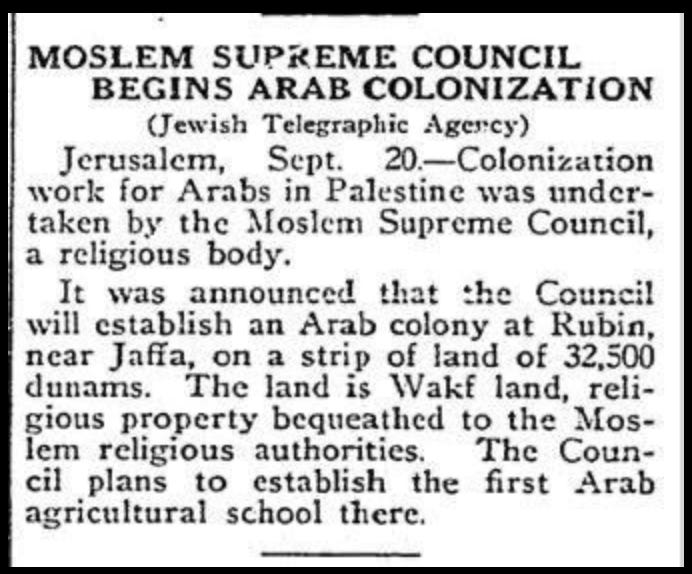
This article started with a Facebook post from Uri Kurlianchik. It’s the image you see above…a 1926 newspaper clipping under the headline “Moslem Supreme Council Begins Arab Colonization.” Of course, I had to find the original and see what else was behind it. I wanted to know what this “Arab colony” was, who was building it and what became of it. Turns out, that little clipping was only the beginning.
On September 21, 1926, the Jewish Telegraphic Agency published the short article under the following headline (Also seen in the main image)
I’m on a mission as a history activist to document Jewish history before it’s rewritten, distorted, or erased. Every paid subscription helps fund the research behind these essays and enables me to continue this work full-time. For $75 a year (just 21¢ a day), you’re doing more than supporting a writer. You’re helping preserve the Jewish story.
“Colonization work for Arabs in Palestine was undertaken by the Moslem Supreme Council,” it reported. The council planned to establish an “Arab colony at Rubin, near Jaffa,” on 32,500 dunams of waqf land (property held in an Islamic religious trust), about 8,000 acres, or 12.5 square miles. It also planned what JTA described as the first Arab agricultural school in Palestine.
The article is only a few sentences long, but its language opens a much larger window into the way Palestine was discussed a century ago. An Arab Muslim institution could undertake “colonization work” in Palestine and establish an “Arab colony” there without the newspaper treating either phrase as an accusation that Arabs were foreigners occupying someone else’s homeland.
That becomes important when the same language appears in Zionist documents. Today, an old Jewish organization with colonization in its name or a Zionist leader discussing agricultural colonization is regularly presented as evidence that Zionists considered themselves foreign colonial invaders. The argument depends heavily on the word itself: they called it colonization; therefore, they…the Zionists, admitted Zionism was colonialism.
The documents surrounding Rubin show why that argument falls apart.
The Supreme Muslim Council held enormous influence in Mandatory Palestine. The British administration established it in 1921 and placed Muslim waqf property and major parts of Sharia administration under its authority. Haj Amin al-Husseini, the Mufti of Jerusalem, became its president in 1922.
The council controlled substantial property and revenue. It maintained mosques and religious institutions, operated schools and an orphanage, funded scholarships, constructed buildings and expanded waqf holdings. British reporting during the Mandate credited it with building 224 shops and houses, repairing 300 waqf buildings, planting approximately 40,000 trees and purchasing about 25,000 additional dunams of land, around 6,180 acres.
Agricultural development was part of that work, and Rubin was a major project.
Rubin, also called Nebi Rubin, lay south of Jaffa on the coastal plain around a Muslim shrine and a large tract of waqf property. The 32,500 dunams reported by JTA closely matches archival research, which places the Nebi Rubin waqf at nearly 33,000 dunams or 8,150 acres.
The council developed the property through wells, water pools, mechanical pumps, eucalyptus planting, and drainage work. This was a substantial agricultural development covering miles of land.
Four years after the 1926 article appeared, the British government documented the project.
Sir John Hope Simpson traveled to Palestine in 1930 to investigate immigration, land settlement and agricultural development for the British government. His report discusses Nebi Rubin directly.
The Supreme Muslim Council was draining the area and preparing land for irrigation. About 5,000 dunams (1,235 acres) were considered suitable for irrigation. An engineer connected with the Rockefeller Foundation had reportedly prepared the drainage and irrigation plan. The developed land would provide agricultural holdings for Arab tenants of the waqf.
The 1926 announcement and the 1930 British report tell the same continuing story. The Supreme Muslim Council announced a large Arab agricultural settlement project at Rubin, and several years later British investigators found the council carrying out drainage and irrigation work there.
Reporting had called the project Arab colonization.
The terminology makes sense when other documents from the period are read alongside the Rubin article.
Colonization had a much broader everyday meaning. It was used for organized settlement, agricultural development, and the creation of communities on developed land. Jewish organizations used it freely because the word itself didn’t automatically imply imperial conquest.
A 1926 Zionist memorandum to the League of Nations listed “Agricultural colonization” among the major areas of Jewish development in Palestine. The memorandum also reported that land made available for Jewish colonization during 1925 had been acquired through purchase on the open market.
Jewish organizations had colonization associations, colonization departments, colonization budgets and agricultural colonies. Those names are frequently cited today as evidence that Zionism was understood by its participants as a foreign colonial enterprise.
Then the Arab documents enter the picture.
Contemporary reporting discussed Arab colonization. The Supreme Muslim Council established an Arab colony. By 1930, there was even discussion of creating an “Arab colonization bank” that would provide agricultural credit to Arabs.
The same vocabulary could describe both Jewish and Arab projects because it carried a broader meaning. That changes how those old Zionist documents have to be read.
Rubin wasn’t the only example.
On July 11, 1929, JTA reported that Arab organizations were increasing efforts to acquire land as Jewish purchases grew. Citing the Arabic newspaper Filastin, it reported that villagers at Taibe had sold 4,000 dunams (about 990 acres) to the Supreme Muslim Council as part of an effort to prevent the property from passing into Jewish hands.
The same article included another report that is even harder to reconcile with today’s use of the word colony. According to an Arab newspaper in Haifa, Arab immigrants living in the United States were planning to establish an Arab colony in Palestine. They reportedly intended to acquire approximately 5,000 dunams (1,235 acres) for the project.
These were Arabs living abroad who planned to buy land in Palestine and establish what contemporary reporting called an Arab colony. Their residence in America didn’t make colony a declaration that they had no connection to Palestine. Their purchase of land didn’t transform the word into proof of imperial conquest. The terminology described the proposed settlement.
That same historical reading has to apply when Jews appear in the sentence.
The Taibe purchase also adds something important to the history of land ownership during the Mandate. Arab institutions weren’t passive participants in a land market controlled entirely by Zionist organizations. The Supreme Muslim Council was buying property too.
According to the contemporary report citing Filastin, the council acquired 990 acres at Taibe as part of a campaign to prevent the property from being sold to Jews. British authorities later reported that the council had purchased approximately 25,000 dunams (more than 6,000 acres) for waqf holdings.
Land was already part of the national struggle. Jewish institutions bought property for Jewish agricultural communities and development. Arab institutions acquired property, expanded waqf holdings and worked to keep land in Arab hands. Both communities understood that ownership and settlement would help determine the future of Palestine.
The competition became increasingly bitter, but the surviving documents show a history far more complicated than the version usually compressed into a few political labels.
Old Zionist documents are regularly mined for three words: colonization, colony, and settler. Once one appears, its current political meaning gets carried backward a hundred years. A Jewish agricultural colony becomes proof of foreign conquest. A Jewish colonization organization becomes proof that Zionists understood themselves as agents of an empire. A settler becomes someone whose presence on the land was inherently foreign.
Rubin gives us a way to test that method.
In 1926, the Supreme Muslim Council undertook “colonization work for Arabs in Palestine.” It planned an “Arab colony.” In 1929, Arab immigrants living in America reportedly planned another “Arab colony” in Palestine.
Applying today’s meaning mechanically would turn all of those people into Arab colonial settlers. Nobody seriously reads the documents that way because the conclusion makes no sense. The same method fails when applied to Jewish sources.
Jews didn’t become foreigners to Judea because an English-language Zionist organization used a word that commonly described agricultural settlement. Jewish historical connection to the land dates back thousands of years before the terminology of nineteenth-century colonization societies was coined. Jewish communities remained in the land through centuries of conquest, expulsion, migration and foreign rule, while Jewish communities elsewhere continued to orient religious life, memory and identity toward Jerusalem and the Land of Israel.
A vocabulary word used in 1926 can’t erase thousands of years of Jewish history.
The same problem appears with settler.
British officials routinely used settlement language while discussing Arab agricultural development. Hope Simpson wrote about settling Arab families, moving cultivators onto developed land and calculating how many families could be supported on available acreage. Those Arabs were settlers because they were being settled on land. The word described what was happening.
Today, settler attached to a Jew frequently carries an entire political conclusion before the history is even discussed. Yet when old British documents describe Arabs being settled on agricultural holdings, everyone understands that the word needs historical context.
The document hasn’t changed. The way it is being read has.
The old land reports reveal a Palestine far more complicated than the static picture often presented today.
Jewish organizations purchased land. Arab landowners sold it. Some Arab tenants were displaced following sales. Jewish agricultural development created employment for Arabs. Arab institutions bought property themselves. The Supreme Muslim Council expanded waqf holdings. Arab organizations worked to prevent land from passing into Jewish hands. British officials proposed moving Arab cultivators onto newly developed agricultural property.
People moved within Palestine. Jews immigrated. Arabs immigrated. People emigrated. Villages expanded. New communities were established. Agricultural land was developed. Swamps were drained. Water systems were built. Land changed hands through purchases, inheritance, religious trusts, and government action. Jews and Arabs were increasingly building institutions around competing national movements.
The documents from that period reflect the world they were describing. Reading them through vocabulary that developed generations later changes their meaning.
On September 21, 1926, someone could open a newspaper and read:
“Moslem Supreme Council Begins Arab Colonization.”
The article could report “colonization work for Arabs in Palestine” and the creation of an “Arab colony at Rubin.” Nobody needed an explanation for how Arabs could colonize land while also having deep roots in the region. Nobody concluded that the word colony had erased Arab history.
The word didn’t carry that accusation.
A century later, colonization has become one of the most powerful words in the political vocabulary surrounding Israel. Understanding its earlier meaning becomes especially important when century-old Zionist documents are quoted as though their authors were speaking our language instead of theirs.
Rubin gives us the comparison sitting right there in the archive.
If “Arab colonization” didn’t prove that Arabs were foreign to Palestine in 1926, the appearance of colonization in a Jewish document cannot prove that Jews were foreign either.
The same historical standard has to apply to both.
I’m on a mission as a history activist to document Jewish history before it’s rewritten, distorted, or erased. Every paid subscription helps fund the research behind these essays and enables me to continue this work full-time. For $75 a year (just 21¢ a day), you’re doing more than supporting a writer. You’re helping preserve the Jewish story.
Sources:
https://www.jta.org/archive/moslem-supreme-council-begins-arab-colonization
https://www.jta.org/archive/land-question-agitates-arabs-colonization-plans-under-way
https://www.un.org/unispal/document/auto-insert-194707/
https://www.un.org/unispal/document/auto-insert-208860/
https://www.jta.org/archive/49000000-invested-by-jews-in-palestine-in-last-eight-years-zionist-executive-states-in-memorandum
https://makale.isam.org.tr/server/api/core/bitstreams/ffcef136-6c0c-4499-a361-614c8e80d16c/content
No posts
Comments
Nothing yet. Say the first thing.
Sign in to join the conversation.