
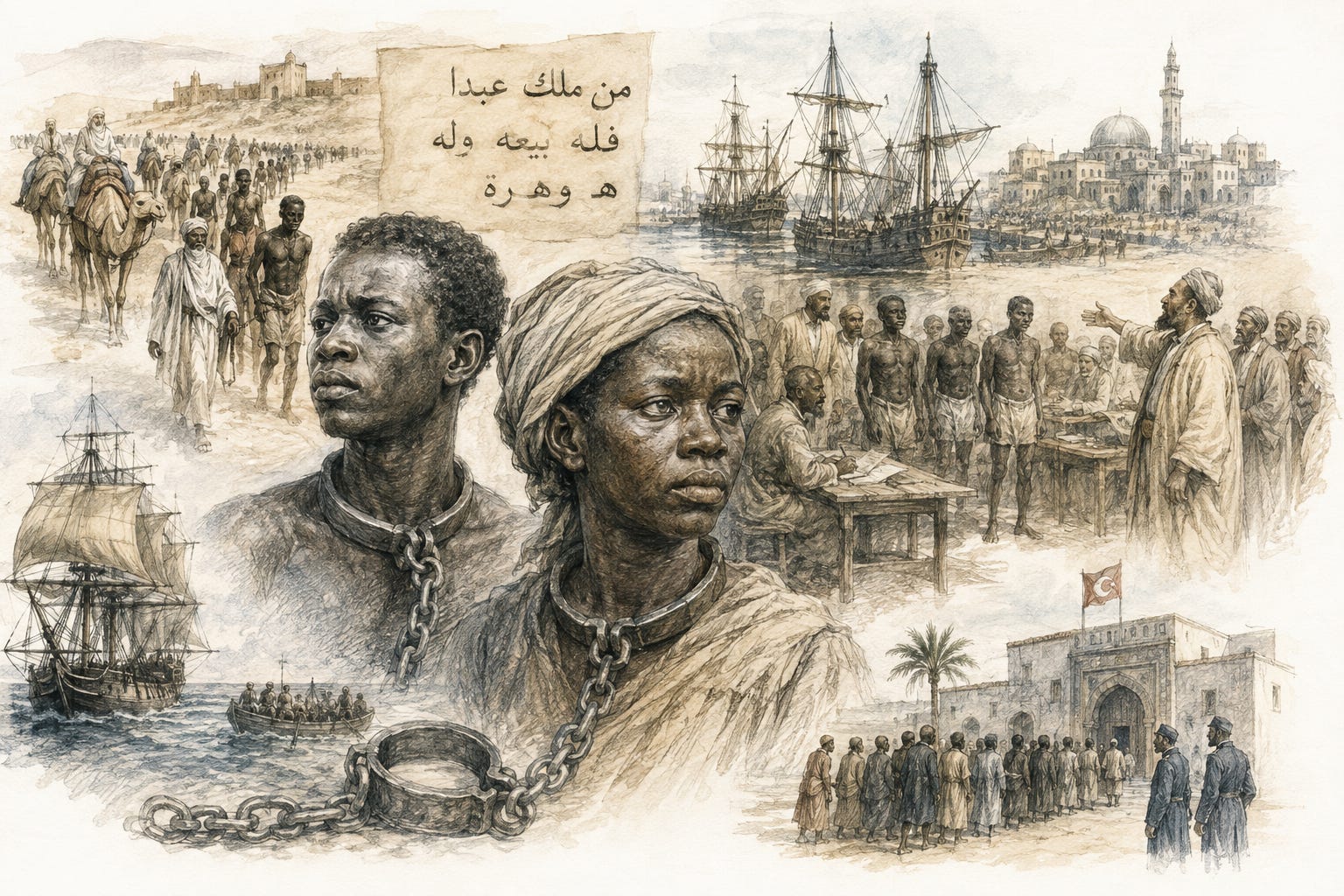
For more than a thousand years, human beings were bought, sold and transported through slave networks stretching across the Sahara, North Africa, the Mediterranean, the Red Sea, the Middle East and the Indian Ocean. Millions of Africans were carried north and east. Europeans were captured from ships and coastal towns and sold in North African markets. Women and girls were sold as concubines. African boys were castrated and sold as eunuchs. Jewish communities maintained funds to ransom Jews taken captive. Centuries later, Americans were enslaved in Algiers, and the young United States eventually went to war against the Barbary States.
I’m on a mission as a history activist to document Jewish history before it’s rewritten, distorted, or erased. Every paid subscription helps fund the research behind these essays and enables me to continue this work full-time. For $75 a year (just 21¢ a day), you’re doing more than supporting a writer. You’re helping preserve the Jewish story. (For the rest of this week, my annual subscription is on sale for only $65!)
This history didn’t disappear in the nineteenth century. Saudi Arabia abolished slavery in 1962. Mauritania waited until 1981 and didn’t criminalize it until 2007. ISIS openly revived the enslavement and sale of Yazidi women and girls in 2014. In February 2026, United Nations investigators were still documenting slavery and forced labor involving migrants in Libya.
Millions of Africans entered slave systems across North Africa and the Middle East over centuries, but those regions did not develop African-descended populations on the scale seen in Brazil, the Caribbean or the United States. Several forces contributed to that difference. Enslaved African boys and men were castrated and sold as eunuchs, eliminating their ability to have children. Mortality was high, family formation among enslaved men was limited, and descendants of enslaved women and free Muslim fathers entered the free population. Genetic evidence still carries the imprint. African maternal ancestry appears in Arab populations at substantially higher rates than recent African paternal ancestry, reflecting a slave system in which African women had descendants while many enslaved African men did not.
Then there is the claim that Jews dominated the Atlantic slave trade. It continues to circulate despite census data, shipping records, slave registers, tax records and commercial records showing otherwise. In the American South in 1830, only 23 of approximately 59,000 slaveholders who owned 20 or more enslaved people were Jewish. Among approximately 11,000 who owned 50 or more, only four were Jewish. France’s 1685 Code Noir, the law regulating slavery in its Caribbean colonies, began by ordering Jews expelled from those colonies.
Jews lived inside slaveholding societies, and some owned and traded enslaved people. That participation needs no erasing. It needs proportion. The larger history includes the trans-Saharan, Red Sea, Indian Ocean, Barbary and Ottoman slave systems that operated across more than a millennium.
That story begins long before the Atlantic slave trade and reaches disturbingly close to the present.
There wasn’t one “Arab slave trade.” There were overlapping slave systems operating across an enormous geographic area for centuries. Arab traders and Arab states played major roles, particularly in the trans-Saharan, Red Sea and East African trades. Berbers, Ottoman Turks, Persians, Africans, Europeans and others participated at different times and places.
The enslaved came from an equally large geographic area. Black Africans were transported out of East, Central, West and Northeast Africa. Europeans were captured around the Mediterranean and Atlantic coasts. Slavs and other Eastern Europeans entered slave markets. Circassians and Georgians moved through Caucasus and Black Sea routes. Women and girls were sold into domestic service and concubinage. Men became laborers, servants, soldiers and eunuchs.
Slavery existed in Arabia, Africa, Europe and the Mediterranean before Islam. After the seventh century, Islamic law continued to recognize slavery as a legal institution and developed rules governing enslavement, ownership, manumission, concubinage and the status of enslaved people. Free Muslims generally could not legally be enslaved, making captives brought into Muslim territories an important source of slaves.
Enslaved Africans crossed the Sahara into North Africa and Egypt. Others moved through Sudan and the Nile Valley. Captives traveled toward Red Sea ports and Arabia. East Africans were transported through Indian Ocean networks connecting the African coast with Arabia, the Persian Gulf, India and destinations farther east. Crimean and Black Sea networks supplied captives to the Ottoman world, while Mediterranean corsairs captured Europeans and carried them into North African slave markets.
The Atlantic slave trade left an enormous commercial archive. Ships produced manifests. Ports kept customs records. Merchants maintained ledgers. Insurers created policies. Plantation owners kept accounts. SlaveVoyages has reconstructed tens of thousands of voyages and estimates that more than 12 million captive Africans were embarked aboard Atlantic slave ships.
The trans-Saharan, Red Sea and Indian Ocean systems stretched across a much longer period and frequently moved people through inland routes where equivalent documentation never existed. Captives who died crossing the Sahara never appeared on a ship manifest. Transactions conducted in inland markets centuries ago could disappear without leaving a surviving ledger.
Studies of the Red Sea trade estimate close to 2.5 million enslaved Africans between roughly 800 and 1900. Historian Richard Allen estimates that 2.9 to 3.65 million people from eastern and southern Africa, Madagascar and the Horn were transported toward Arabia, the Persian Gulf, South Asia and Southeast Asia between approximately 800 and 1900. Estimates of trans-Saharan trafficking also run into the millions.
Those numbers overlap and cannot simply be added together. They document an enormous forced movement of human beings through North Africa, the Middle East and the Indian Ocean across more than a millennium.
My original article described the Atlantic trade as the shortest and smallest of three major slave systems. The “smallest” part was wrong. The Atlantic trade moved more than 12 million captive Africans in a much more concentrated period and left far better records. The eastern and trans-Saharan systems operated for much longer across numerous routes.
Between 869 and 883, southern Iraq was consumed by a fourteen-year revolt known as the Zanj Rebellion. Many of the rebels were East African laborers working in brutal conditions around Basra, including agricultural reclamation and the clearing of salt-damaged land.
The revolt grew into a sustained military challenge to Abbasid rule. Rebel forces defeated government armies, captured territory and established their own center of power. The rebellion lasted roughly fourteen years before Abbasid forces finally crushed it in 883.
Medieval writers reported enormous death tolls that cannot be independently verified. The size and duration of the rebellion are well established, and archaeology has added physical evidence. A 2025 study published in Antiquity examined the agricultural landscape of southern Iraq and its relationship to the labor system associated with the Zanj period.
Large populations of enslaved African laborers were living and working deep inside the Abbasid world more than 1,100 years ago.
Comments
Nothing yet. Say the first thing.
Sign in to join the conversation.