
Luck is not something you find; it’s something you tune into and create.
This isn’t the ominous omen of whispered warnings but an invitation—an open gateway for your mind to become a magnet for micro-miracles.
Imagine stepping into a dew-glazed forest at dawn: every droplet catches the light, each shimmer hinting at hidden treasures. In exactly the same way, your brain harbors a silent scout—the Reticular Activating System (RAS)—always filtering the world for what you seek.
Today, as the calendar reads Friday the 13th, let that inner scout unfurl its banner: you’re on a quest to notice fortune in motion.
On this day, when an estimated 17–21 million Americans avoid ordinary routines out of superstition, you’ll lean in rather than shrink back. https://en.wikipedia.org/wiki/Friday_the_13th?
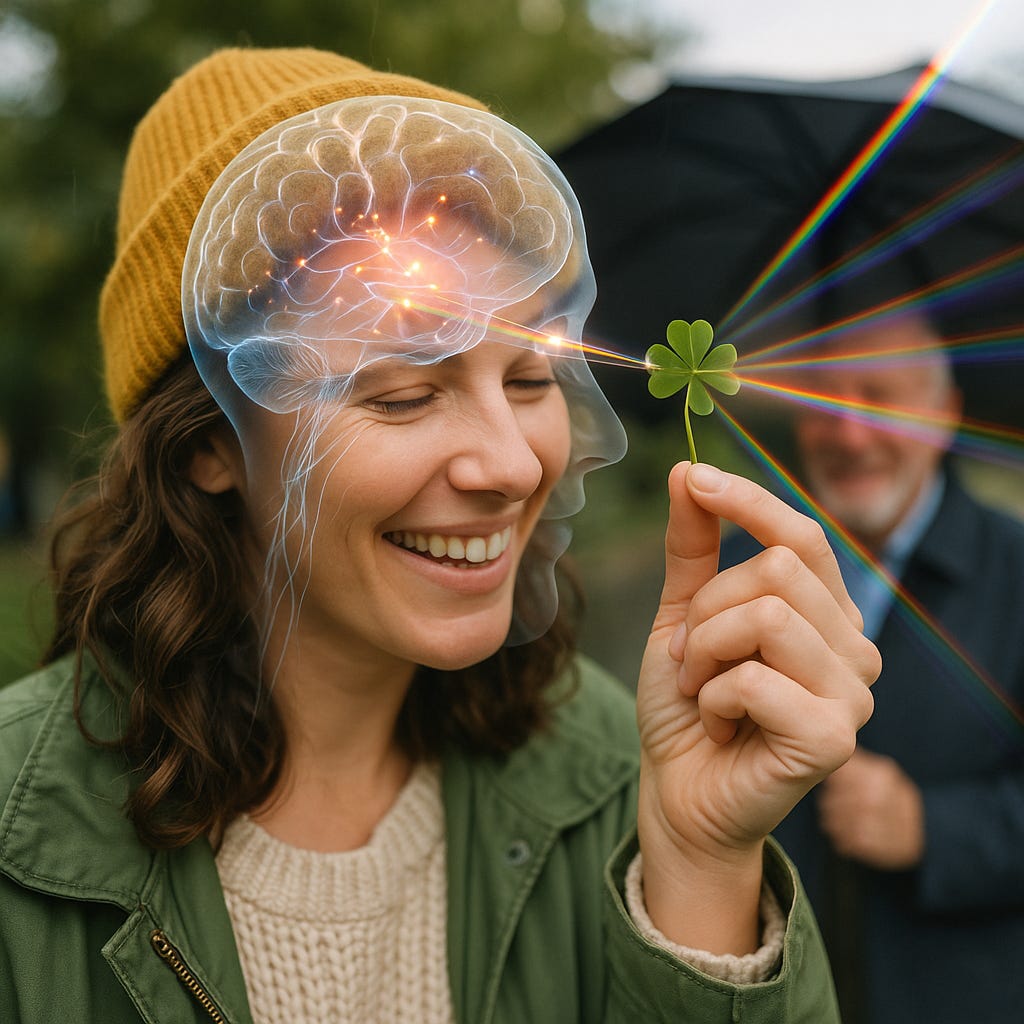
You’ll watch shadows dance under ladders not as bad luck but as secret pathways leading you to unexpected boons. You’ll feel the thrill of possibility pulse in your chest, priming every sense for the smallest serendipities—a perfect parking spot, a chance remark from a stranger, the glint of four leaves when you least expect it.
By awakening the part of your brain that notices luck, you transform Friday the 13th from a talisman of fear into a beacon of adventure. And so, our journey begins…
Psychologist Richard Wiseman’s landmark research shows that “lucky” people aren’t guided by supernatural forces but by measurable habits. An overview of his decade-long study reveals four core principles:
Create and notice chance opportunities
Listen to your intuition
Expect good fortune
Turn bad luck into good
“Lucky people generate their own good fortune via four basic principles. They are skilled at creating and noticing chance opportunities, making lucky decisions by listening to their intuition, creating self-fulfilling prophecies via positive expectations, and adopting a resilient attitude that transforms bad luck into good.” https://en.wikipedia.org/wiki/Luck
By adopting these habits, you effectively prime your mind to both spot and act on fortuitous events.
I once identified as “luck-ambivalent”—a skeptic of mantras and charms. But on my 13th birthday, which fell on a Friday the 13th, my parents and I chose to lean into superstition. We invited 13 friends, walked under a ladder, and hunted for 13 hidden treasures around the house. That celebration became one of my fondest memories—and it quietly shifted my outlook from passive ambivalence to an active “we can make our own luck” mindset.
Last night, I tested this mindset at a pop-up night market in San Francisco’s crisp air. I spotted the announcement by chance, parked steps from the entrance, and followed the scent of street food to live music and colorful stalls. I paused to pet a joyful dog, struck up impromptu conversations with vendors and strangers, and sipped rose-flavored chai that smelled like perfume in the night air. Each of these moments felt serendipitous—tiny victories that collectively made the evening glow with possibility.

Two core processes shape what your mind notices:
The Reticular Activating System sits at the top of your brainstem, acting as a “gatekeeper” that filters the flood of sensory data into what your conscious mind receives. “The R.A.S. is the gatekeeper, filtering the unnecessary from the important. It decides what we should give our attention to” - Charles Leon https://www.charlesleon.uk/blog/how-to-get-what-you-want-your-reticular-activation-system1012021?
By tuning your RAS toward luck—willing yourself to notice opportunity—you literally see more of it.
Rather than passively recording reality, your brain continuously generates and updates internal models of the world—then tests incoming sensory data against these expectations. According to predictive coding theory, “the brain is constantly generating and updating a ‘mental model’ of the environment... such a model is used to predict input signals from the senses that are then compared with the actual input signals” en.wikipedia.org
If you expect luck, even ambiguous sights—like scattered leaves—can be reinterpreted as meaningful signs.
Together, these systems form your personal “luck lens”: the RAS selects for possible fortunate events, and predictive coding helps you interpret them in ways that reinforce your belief in good fortune.
As Barbara Blatchley reminds us in What Are the Chances?,
To harness that advantage, try these daily practices:
Scan for Opportunities. Consciously look for small advantages—an open parking spot, a smile from a stranger, a timely email.
Act on Intuition. When a hunch nudges you, trust it—even modest leaps of faith can open doors.
Reframe Setbacks. Treat obstacles as redirections. Often, what feels like bad luck is simply the prelude to something better.
By coaching your attention—and trusting your brain’s built-in filters—you transform randomness into opportunity. So on this Friday the 13th, step into your quest: tune your mind, awaken your “luck lens,” and discover how fortune really favors the observant.
Feeling Lucky?
Maybe that’s you… because, you were already lucky… 😉
No posts
Comments
Nothing yet. Say the first thing.
Sign in to join the conversation.