
Happy August, everyone! I can’t believe summer is almost over. Where did it go?! I say that every year, but I swear summers go by faster and faster.
This week, I have a very cool podcast to offer you. I was lucky enough to join three amazing parenting experts for a special parenting-related episode for Psychologists Off the Clock, a podcast I love about the science and practice of living well.
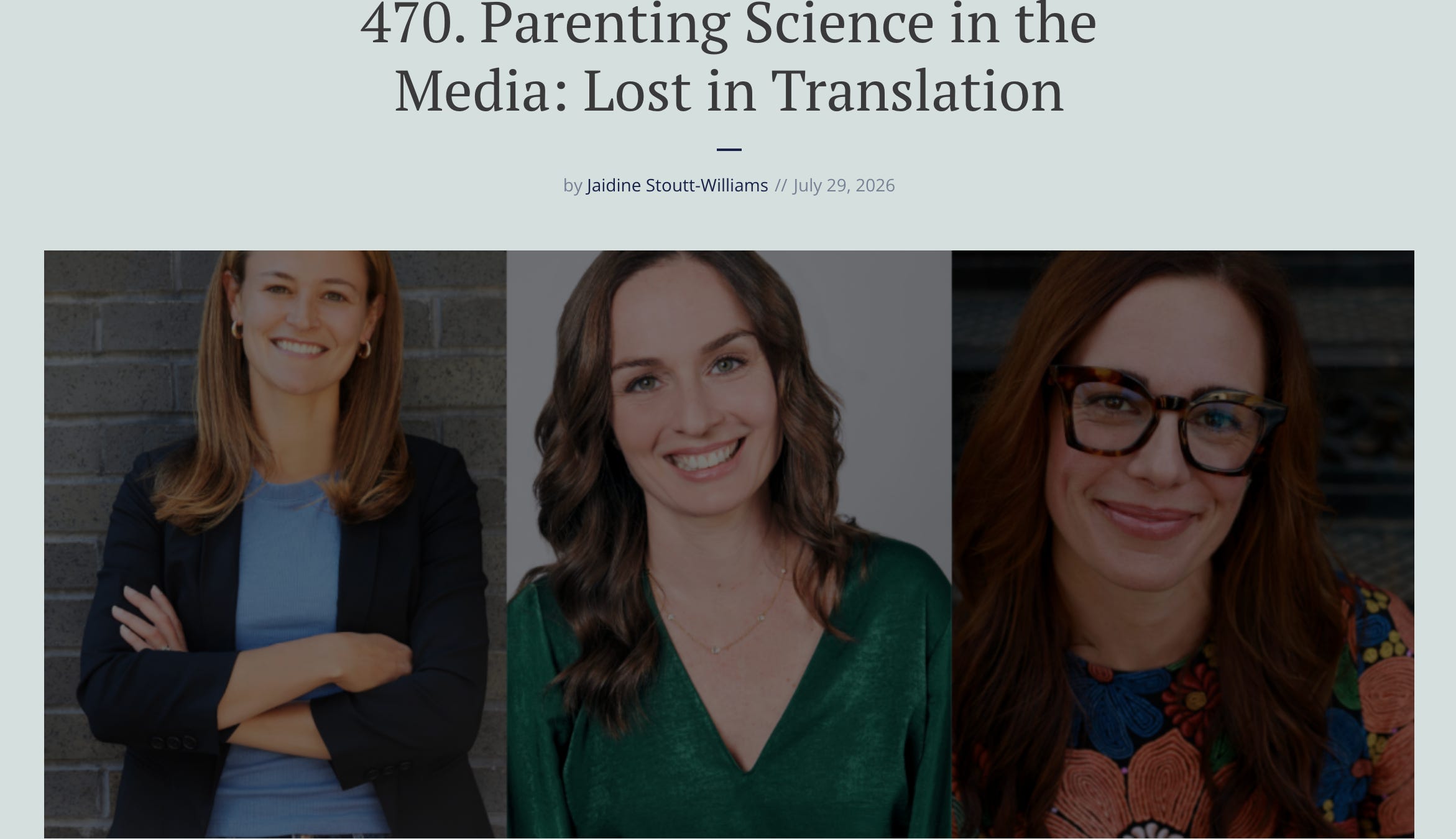
The experts who joined me were clinical psychologist and parenting expert Emily Edlynn (who writes the Substack Parent Smarter, Not Harder), psychologist and adolescent technology guru Jacqueline Nesi, PhD (who writes Techno Sapiens), and clinical psychologist and digital technology / mental health expert Tracy Clark-Flory (who writes The Future of Sanity). They are brilliant and amazing and I was so honored to be part of the conversation.
In the podcast, we talked about how parents can spot trustworthy parenting guidance amid all the online noise. We also talked about the strengths and limitations of parenting research (both historically and today). For instance, we discussed why it’s so frustrating that dads haven’t participated more in parenting research (both because they haven’t always been invited, and because when they are invited, they often don’t sign up). As a result of this imbalance, we may mistake findings about mothers for findings about all parents. We cannot tell whether the identity of the parent matters or whether the parenting behavior is all that matters. The lack of information about dads’ influence also means that when parents are blamed for their kids’ actions our outcomes, it’s typically moms who receive all the blame.
Another thing I highlighted in the podcast was an easy-to-spot red flag parents can use when assessing the quality of parenting advice. This is something I also discussed a few months ago in my Q&A with writer Elizabeth Weingarten. In a nutshell, questionable parenting advice is typically framed as one-size-fits-all — if you’re not getting the results you want, it’s because you’re doing it wrong. Parenting advice you can trust, on the other hand, is framed as contextual — it may not work for everyone, and if you aren’t getting the results you want, it’s probably not because you’re doing anything wrong. It may simply be that the advice isn’t a good fit for your child or family.
Different cultures have different parenting norms too, and research suggests that parenting practices that are constructive in one cultural context may not have the same effects in another. That’s in part because kids may interpret and respond to parenting practices differently depending on the norms that surround them.
We talked about many other things in the podcast, too, including:
How parenting advice moved past simple “good vs. bad” rules to consider how things like culture, environment, and everyday context shape what works
Biases in parenting science and the importance of leaning into “goodness of fit” to figure out what actually works for a specific kid
How nuanced, multimethod science often gets distorted by media algorithms and fear-based messaging—and how to spot misleading science headlines
How kids are actively using AI, why vulnerable or unfulfilled kids are most at risk of becoming overly dependent on it, and how parents can guide their children through open communication rather than strict bans
Positive trends in youth resilience and self-control, how shifts in modern parenting may be helping to drive these improvements, and why adults in every generation fall victim to the cognitive bias that “kids these days” are doomed
If you’d appreciate a reassuring, reality-based sanity check on modern parenting advice, please check out this podcast.
Comments
Nothing yet. Say the first thing.
Sign in to join the conversation.