
Uglystocks’ investing seeks to purchase roadkills trading at multi-year lows, selling below net asset intrinsic value within the Ben Graham/Schloss/ Templeton framework. I have lost all faith in the current price economy trust-value discovery process. Most financial assets trade at an extreme premium to their net fair returns due to artificial liquidity sustaining the market. Quantitative accounting metrics are unreliable and untrustworthy due to the preeminence of cheap debt financing and short-term incentive mechanisms. I believe buying 1/3 rotten-tomatoes gives me a better picture of the asset’s true worth because “ugly” asset prices are better aligned with reality. I want to deal with real “facts,” and ugly companies tend to better reflect their underlying economics unlike artificially stimulated high-techs and popular theme-driven oversubscribed securities.
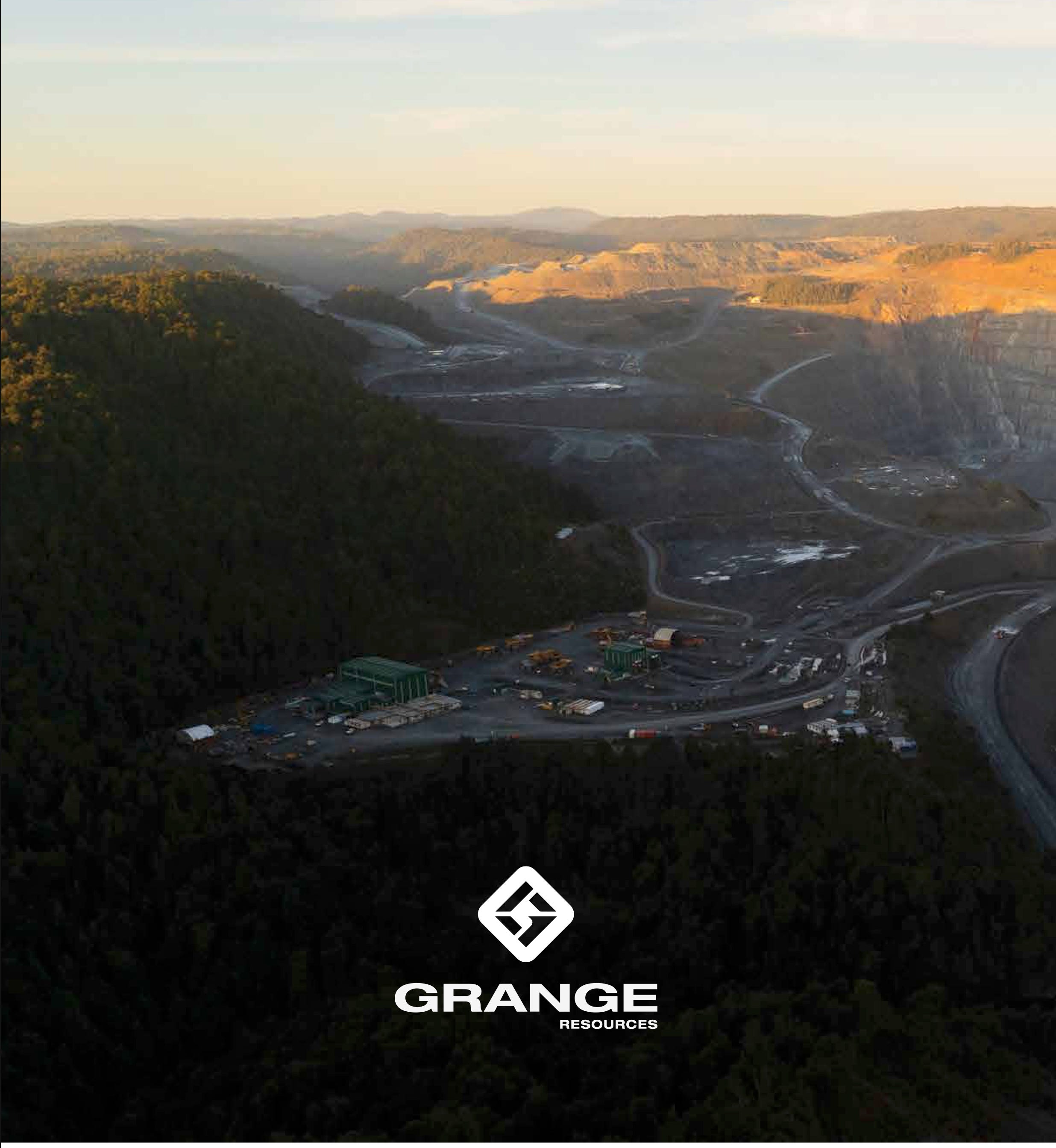
Grange Resources Limited (ASX: GRR) is Australia’s oldest continuous magnetite iron ore producer, operating the Savage River integrated mine and pellet plant in Tasmania for over 55 years. At a price of A$0.16 per share, the company trades at a deep discount to its net-tangible asset value of A$0.93 per share. Its balance sheet is loaded with A$284 million in cash and liquid investments against a market capitalization of only A$185–231 million. The implied deeply negative enterprise value of approximately A$95 million looks interesting.
The market is essentially paying you to own the underlying operating business, the Port Latta pellet plant, the world-class Southdown Magnetite Project optionality, and the rights to over 1.2 billion tonnes of mineral resources.
Yet the discount exists for reasons. Iron ore pellet prices have fallen sharply from their post-COVID peaks. The company has deferred its flagship North Pit Underground (NPUG) project multiple times. Dividend payments have been eliminated. Profit after tax declined 61% in FY2024 and a further 48% in H1 2025. The controlling Chinese shareholders (Jiugang Group) add governance opacity. This report tries to deconstruct the ugly side and extract the beautiful opportunity underneath the company’s trashy appearance.
Grange’s magnetite pellets occupy a distinct and strategically valuable niche. Magnetite is a naturally occurring mineral commonly refined into an iron ore concentrate and used for steel production. Iron ore makes up about five per cent of the Earth’s crust and most commonly occurs in the form of haematite or magnetite. Most of the magnetite mined is usually used to produce concentrate for pellet feed or pellets which are used to make steel. Magnetite concentrate has internal thermal energy, meaning less energy is required to convert the magnetite into haematite pellets. This results in lower carbon dioxide emissions. The blast furnace chemically reduces iron oxide into liquid iron called ‘hot metal’. The iron ore and reducing agents (coke, coal and limestone) are combined. Pre-heated air is injected at the bottom of the combination for up to eight hours. The final product is a liquid which is drained and eventually refined to produce steel. Mining magnetite ore is capital-intensive and requires significant downstream processing infrastructure, including a beneficiation plant, a pellet plant, and port facilities. Magnetite products command a value premium over hematite ore products such as fines and lump. This premium is derived from two sources, namely additional iron content and a quality premium. As magnetite concentrate is a refined product, it usually has a higher iron content and lower impurity levels. This can have beneficial effects and environmental outcomes for the steelmaker.
Grange Resources looks terrible on the surface (depleting pits, project risk, cyclical commodity, small/illiquid/foreign-controlled, volatile earnings). That ugliness drives the extreme discount to net cash and book value.
The most significant and immediate risk facing Grange Resources is the cyclical nature of iron ore and pellet pricing. The company’s entire revenue stream derives from selling iron ore pellets and concentrates into Asian steel markets, primarily China. The benchmark 65% Fe iron ore fines price declined approximately 21% from US$146/t in late 2023 to US$115/t by December 2024. Pellet premiums have compressed as Chinese steel demand faces structural headwinds from the country’s property sector downturn.
The Savage River magnetite mine in Tasmania (its core asset) has open-pit reserves depleting, particularly at North Pit. The company is transitioning to underground mining through the North Pit Underground (NPUG) project, a complex, capital-intensive block-cave/sub-level-cave development. This was paused/delayed earlier due to softer iron ore price forecasts; it is now advancing with due diligence and funding work in 2025–2026, with development targeted to ramp up in +2026.
Grange Resources is effectively controlled by Shagang Group or Shasteel, a large Chinese state-owned steel enterprise. While the company is listed on the ASX and subject to Australian corporate law and ASIC oversight, the concentration of ownership by a SOE introduces governance considerations that value investors must price:
Shagang International (Australia) Pty Ltd (26%) and Jiangsu Shagang Group (21.5%) are major shareholders. This brings long-term offtake contracts, Letters of Credit for credit risk mitigation, and historical strategic support. But it creates perception risks for many investors: governance concerns (past shareholder complaints about influence), potential conflicts, or geopolitical overhang in Australia-China relations. It can feel like “a Chinese steel mill subsidiary” rather than a pure independent ASX play.
Also, while the company remains debt-free and operationally stable, its backward-looking financial metrics show severe deceleration.
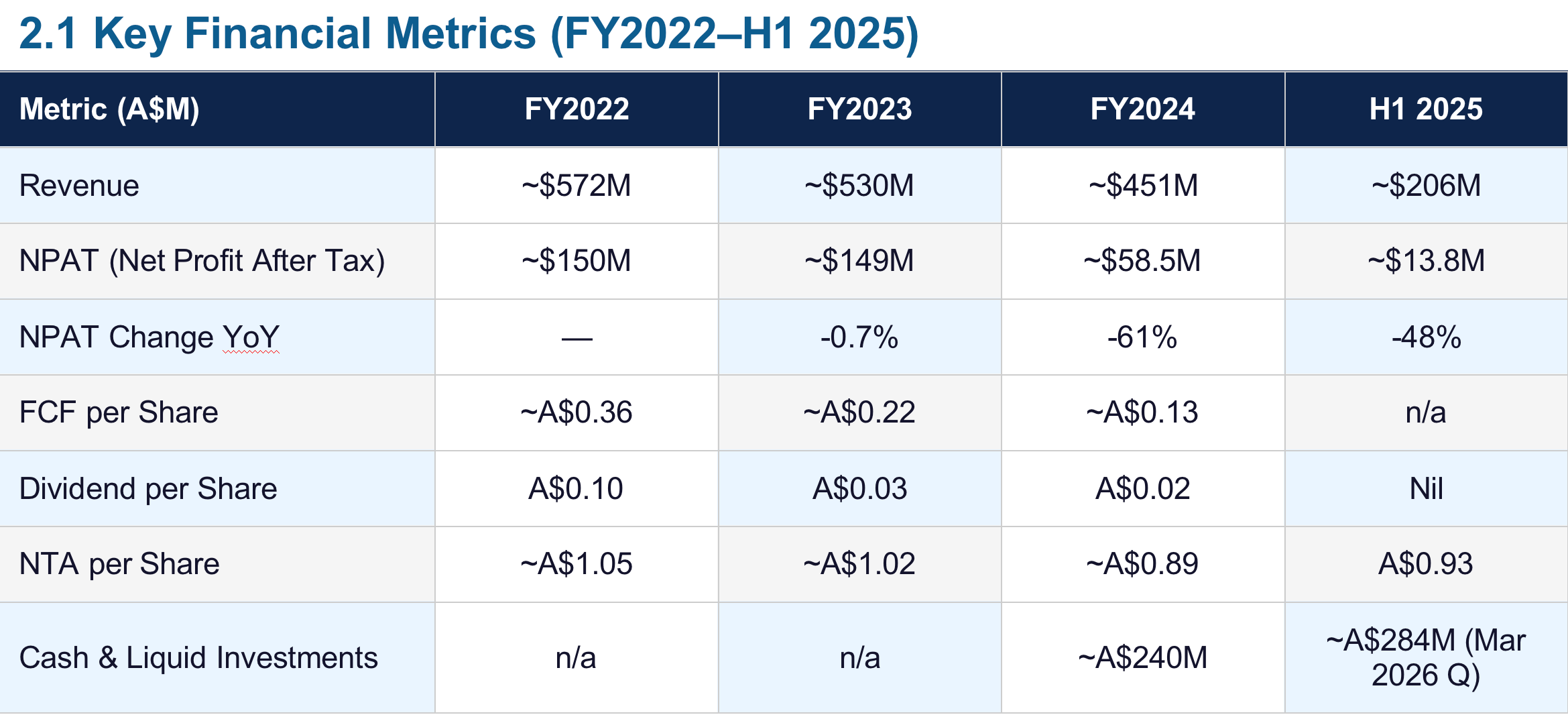
Revenues and Profits have collapsed dramatically over 5 years
Between FY2022 and FY2024, revenue collapsed from A$572M to A$451M, and net profit after tax fell from A$150M to A$58.5M. Operating leverage is substantial: a US$10/t change in realized price for ~2.5 Mt of annual pellet production translates into an A$35–40M EBITDA impact. The FY25 full-year results, released in February 2026, confirmed that revenue fell 8% to A$477.9 million and net profit after tax declined 21% to A$46.6 million, with no final dividend declared – a decision that disappointed income-focused investors who had previously enjoyed average annual yields of approximately 11% over five years. The earnings pressure stems from iron ore prices, which have been under sustained pressure rather than any fundamental operational failure.
At current price levels (US$126/t realized as of Q1 2026), margins remain acceptable but thin, and any further deterioration would rapidly erode the profitability that underpins the balance sheet accumulation story.
The dividend trajectory tells a stark story of deteriorating free cash flow and management caution. GRR paid A$0.10 per share in FY2022 — implying a yield of 5–6% at prevailing prices. By FY2024, this had fallen to A$0.02, and Q1 2025 saw no interim dividend. While the balance sheet remains robust (A$284M in cash), the decision not to return capital to minority shareholders as cash accumulates on the balance sheet is a point of tension. The cash is nominally owned by shareholders, but its deployment is at management’s and the board’s discretion, and the board is majority-influenced by Jiugang.
Finally, Grange frequently highlights its Southdown Magnetite Project in Western Australia as a world-class optionality asset, boasting a massive resource capable of producing 5 million tonnes per annum (mtpa) of premium direct-reduction grade concentrate over a 28-year mine life. However, looking at the Feasibility Study reveals why the market values this asset at near-zero:
The capital expenditure required to build Southdown has risen to A$2.34 billion due to inflation and the scale of the infrastructure. Grange cannot advance this project alone. It has explicitly stated that Southdown is dormant until it finds a strategic equity partner willing to bankroll construction. Until a partner signs on the dotted line, Southdown remains an expensive piece of paper rather than a cash-generating asset.
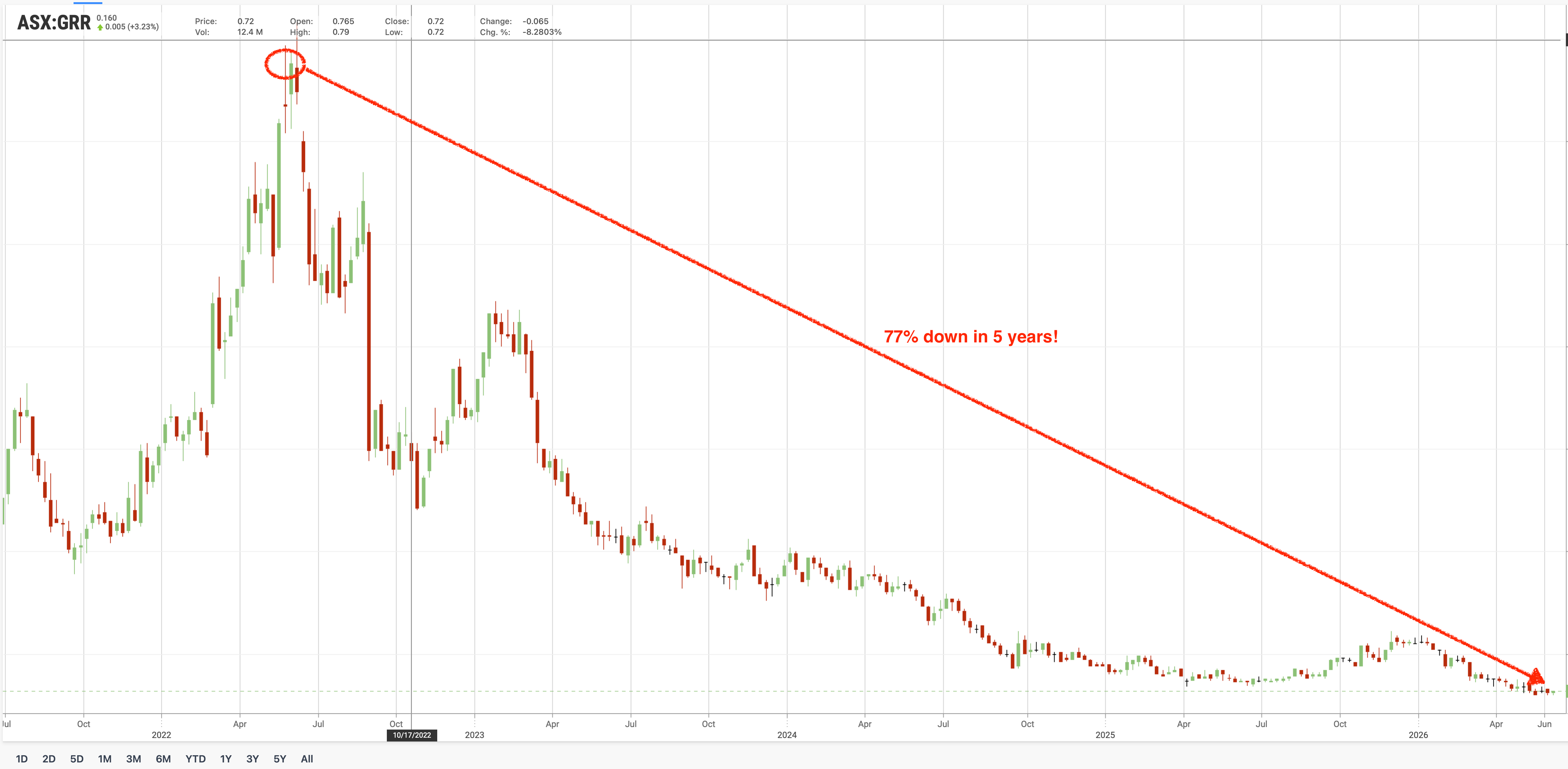
In all, a combination of a maturing open-pit operation, uncertainty around a high-stakes underground transition, cyclical small iron ore, a tiny, illiquid, neglected small-cap, and Chinese majority ownership might explain the stock's underperformance and investors' skepticism. The equity has effectively crashed to its 5-year lows, with further uncertainty tied to the slowdown in steel demand and macroeconomic deceleration that could push iron ore below $100.
With a market cap hovering between A$185 million and A$275 million cash in hand, and a rock-bottom P/E ratio of under 4x, the market is pricing Grange as if it is headed straight into a wall. However, a deep-value, contrarian thesis reveals several massive structural mispricings.
Grange does not mine standard 62% Fe iron ore fines (the stuff that heavyweights like BHP and Rio Tinto dump onto the market, which is highly sensitive to the cooling Chinese property sector). Instead, it produces premium 65%+ Fe magnetite pellets.
Even in a softer global iron ore environment, Grange achieved a stable average realized product price of US$ 126.29/t (A$182.61/t) for the March 2026 quarter. This reflects a major, structural premium (18%) over the standard 65% Fe benchmark.
The global steel industry is under intense pressure to decarbonize. Blast furnaces require significantly less energy and emit far less carbon dioxide when using high-grade pellets than when using low-grade fines. As steelmakers transition to Electric Arc Furnaces (EAF) and Direct Reduced Iron (DRI) technologies, the structural premium for Grange’s specific product is poised to widen, decoupled from standard iron ore price slumps.
With a market cap of A$185M at A$0.16 per share, and A$275M in cash and liquid investments (with nearly zero debt), the enterprise value is negative A$90M. You’re essentially getting the entire operating business (Savage River mine, Port Latta pellet plant, premium product capability, Southdown resources, inventory, etc.) for free or at a discount to cash. This provides a rock-solid floor: limited downside in a worst-case scenario (e.g., prolonged weak iron ore prices or transition hiccups), as the cash hoard funds operations, potential dividends/buybacks, or self-funded optimizations. This is an interesting “ugly statistical asymmetry” where time decay works in your favor through cash preservation and potential distributions.
The market crushed the stock because of the looming A$890 million capex required to transition the Savage River mine underground. While retail investors fled, management has been systematically de-risking the project behind the scenes:
In the Q1 2026 update, Grange confirmed that independent technical and legal due diligence reviews for the North Pit Underground (NPUG) project financing are fully complete.
The company is currently progressing with lender engagement to secure project debt. More importantly, they are seeking a project completion guarantee from their majority shareholder, Shagang Group (China’s largest private steelmaker). If Shagang steps up to guarantee the completion, the existential funding risk evaporates, exposing the market’s “value trap” narrative as overly pessimistic.
The Southdown project near Albany, Western Australia, contains 1.2 billion tonnes of mineral resources and 412 million tonnes of ore reserves — a world-scale deposit by any measure. In isolation, this represents one of the largest undeveloped high-grade magnetite projects globally. The pre-feasibility study indicated an initial production capacity of 5 million tonnes per annum of premium magnetite concentrate — double Savage River’s current output. Grange recently reacquired its partner’s stake, now holding 100% ownership.
The development capex is substantial (multiple billions of dollars) and well beyond Grange’s current independent financial capacity. However, a strategic partnership, sale, or joint venture with a major steel producer seeking long-term supply security could unlock enormous value. At normalized magnetite concentrate valuations of US$8–15/t NPV per tonne of annual capacity, a 5Mt/year operation represents US$40–75M of annual EBITDA potential — implying a project NPV (appropriately risk-adjusted) that could dwarf Grange’s entire current market capitalization.
At A$0.16 per share, the market ascribes zero value to Southdown. A deep value investor would view this as a free embedded option on a world-scale asset.
The Ben Graham/Walter Schloss perspectives are my valuation anchors. Sir John Templeton has inspired me to look globally for potential bargains and contrarian value brand equity. The current untrustworthiness in economic calculation has led me to focus on the core assets’ net worth before any other financial metrics. I am interested in sound, healthy, low-debt stocks.
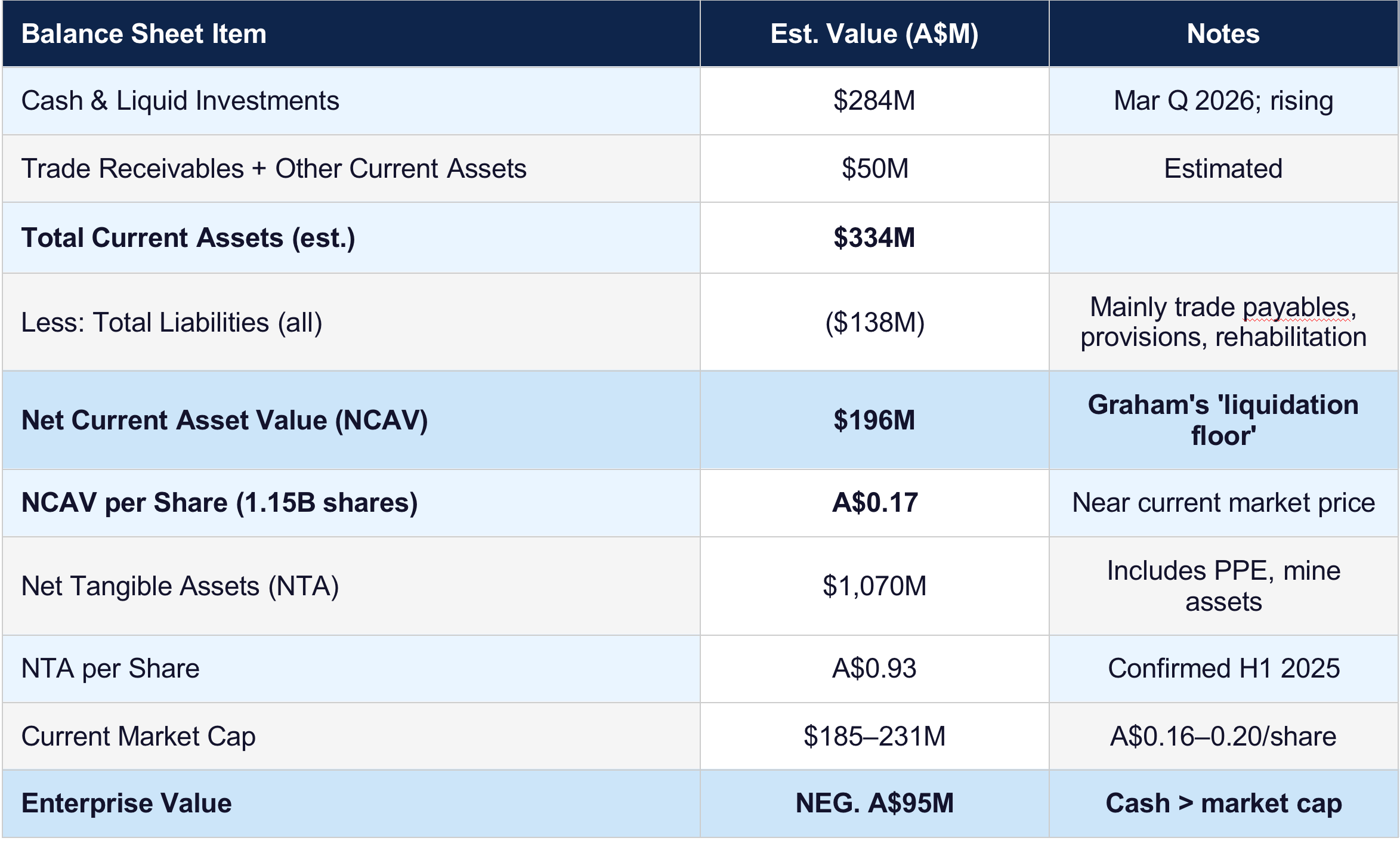
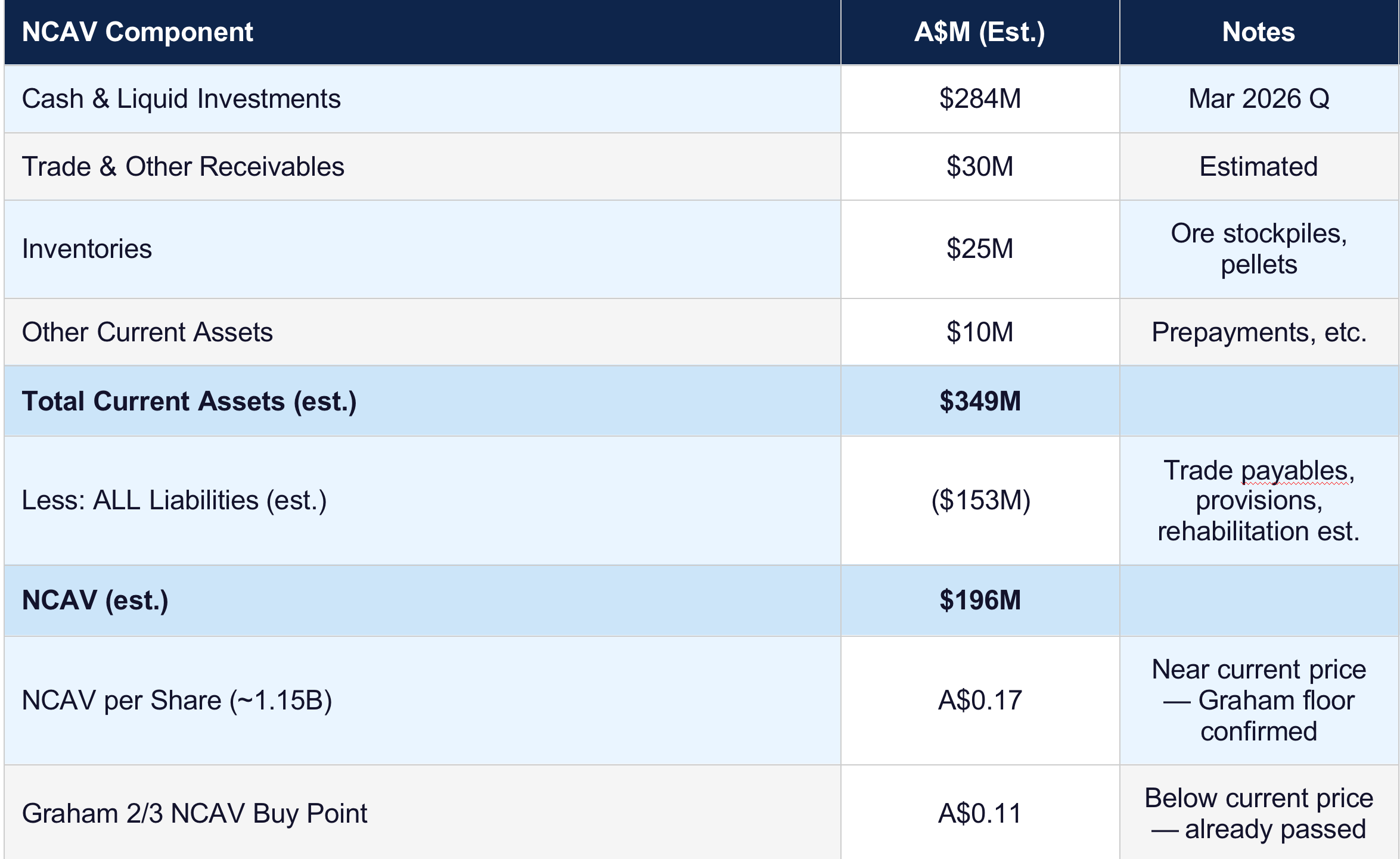
My analytical starting point is the balance sheet. As of March 2026, Grange holds A$284 million in cash and liquid investments. With a market capitalization of approximately A$185, the company’s enterprise value is a deeply negative figure of approximately negative A$95 million. This means an investor buying GRR at current prices is receiving.
A$1.54 of cash per A$1.00 of market value paid (based on A$185M cap, A$284M cash.)
The full operating business (Savage River / Port Latta) effectively for free.
100% of the Southdown Magnetite Project (1.2Bt resource, 412Mt reserves) for free.
The NPUG underground optionality for free.
Graham’s description of the net-net investor’s advantage was simple: you are buying a dollar for fifty cents. In Grange’s case, the arithmetic is arguably more compelling — you are buying a dollar of cash for roughly 65 cents, plus a free operating business producing A$400M+ of annual revenue.
GRR currently trades near or at its NCAV — an extremely rare occurrence for a company with positive earnings. The NCAV analysis establishes a hard downside floor at ~A$0.11–0.17 (2/3 NCAV to full NCAV), implying extremely limited downside from current levels in a Graham framework. The company would need to actively destroy its cash balance through value-destructive capex or losses to breach this floor — which, given its current operational profitability and rising cash balance, appears unlikely.
Walter Schloss, who ran a concentrated net-net value portfolio at the Graham-Newman fund and later independently for 45 years, famously focused on price-to-book value (P/B) as his primary entry criterion. He sought stocks trading at meaningful discounts to book, typically below 0.5x.
GRR’s current price-to-NTA ratio is approximately 0.18–0.22x. This is extraordinary even by Schloss’s demanding standards. The NTA of A$0.93 per share includes tangible mining assets — mine infrastructure, the pipeline, the Port Latta pellet plant, and port facilities — that have genuine replacement value.
GRR’s NTA is A$0.93/share (confirmed H1 2025). A 50% discount to NTA — Schloss’s minimum comfort level for deep value — implies A$0.465. A 60% discount (approximately 0.18–0.22x NTA) is what the market offers. Historically, mining companies with operating businesses trade at 0.5–1.2x NTA through the cycle. Mean reversion to even 0.5x NTA yields A$0.465, while normalization to 0.7x NTA implies A$0.651.
Target implied by P/NTA reversion: A$0.37–0.65 depending on multiple applied.
Even applying a severe 50% haircut to the carrying value of all non-cash tangible assets (to account for distressed sale or cyclical impairment), the resulting adjusted NTA would still be materially above the current share price. The margin of safety, even after stress testing, is substantial.
Even when applying other valuation methodologies (Sum of the Parts, Earnings Power Value, Discounted Cash Flow, Technical analysis), the company remains at a significant discount to fair value, with a relatively safe margin of safety protecting against downside uncertainty. I tend to be particularly interested in companies trading at 10-year lows, and $ GRR's 2/3 NACV is A$0.11, which aligns with 2015’s entry price.
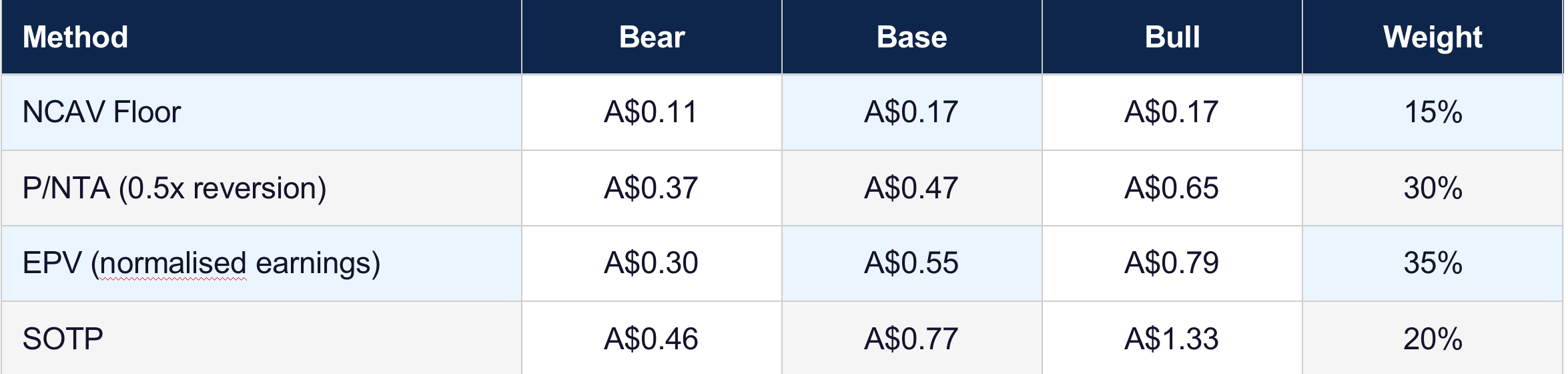
Applying a conservative 25–30% governance/liquidity/single-asset discount to the base composite of A$0.52 yields a published price target of A$0.38. This represents approximately 90–138% upside from the prevailing price of A$0.16 and remains well below the reported NTA of A$0.93.
The market is valuing Grange Resources as if it were on the brink of bankruptcy. That isn’t true. The company has operated for nearly 60 years. In fact, it is a highly profitable, debt-free operation with a mountain of cash that exceeds its market capitalization. If Grange secures institutional debt funding for the underground transition over the coming quarters—backed by its Chinese parent—the capital wall overhang disappears. Once the capital expenditure uncertainties pass, the business will be positioned to resume its historic role as a massive cash generator and dividend machine. A value investor with a 3-5 year time horizon, willing to accept the genuine risks of Chinese governance, commodity cyclicality, and single-asset concentration, is being offered an extreme margin of safety that compensates for these risks.
This report is for informational purposes only and does not constitute financial advice. The author may hold positions in the securities discussed. Past performance is no guarantee of future results. Equity research involves the risk of total capital loss.
MELIFINANCE NEWSLETTER is a reader-supported publication. To receive new posts and support my work, consider becoming a free or paid subscriber.
Comments
Nothing yet. Say the first thing.
Sign in to join the conversation.