
I’m interested in “uglystocks” for a simple reason: I’ve lost faith in the current pricing system. I believe its discovery function has been compromised, making it extremely challenging to perform reliable economic calculations and value projections.
I believe buying undervalued stock issues, Ben Graham Net-nets, Walter Schloss cheap TBV, and contrarian international /oversold stocks (selling at their 5- to 10-year lows) is an intriguing proposition because these assets have already shed their “inflationary” excesses, making them leaner, healthier investments with potential for a turnaround. More importantly, the wider investment public and the US centric pros are rarely privy to such opportunities.
“ At the end of the day, the history of Business is ultimately the History of Men.”
Wendy’s is at the center of a huge meme-driven “ stonk” euphoria. The stock is currently trading upward to +40% above its recent lows with the expectation of a continuous rally in the next few weeks.
The famed fast-food company has struggled in recent years due to a multitude of negative factors that a simple observer like me cannot begin to list. Let’s just say the laundry list is more than exhaustive.
Watch video below for a full rise and fall history.
The bottom line is simple: many people are nostalgic for the old-fashioned Dave Thomas’ motto of “ never cutting corners,“ a distinctive call that set Wendy's apart from its competitors for its sit-down diner feel and homey interior, creating a "premium" fast-food identity.
Customers believe the company has lost its unique touch and has become a mere profit-extraction tool for corporate raiders and financiers.
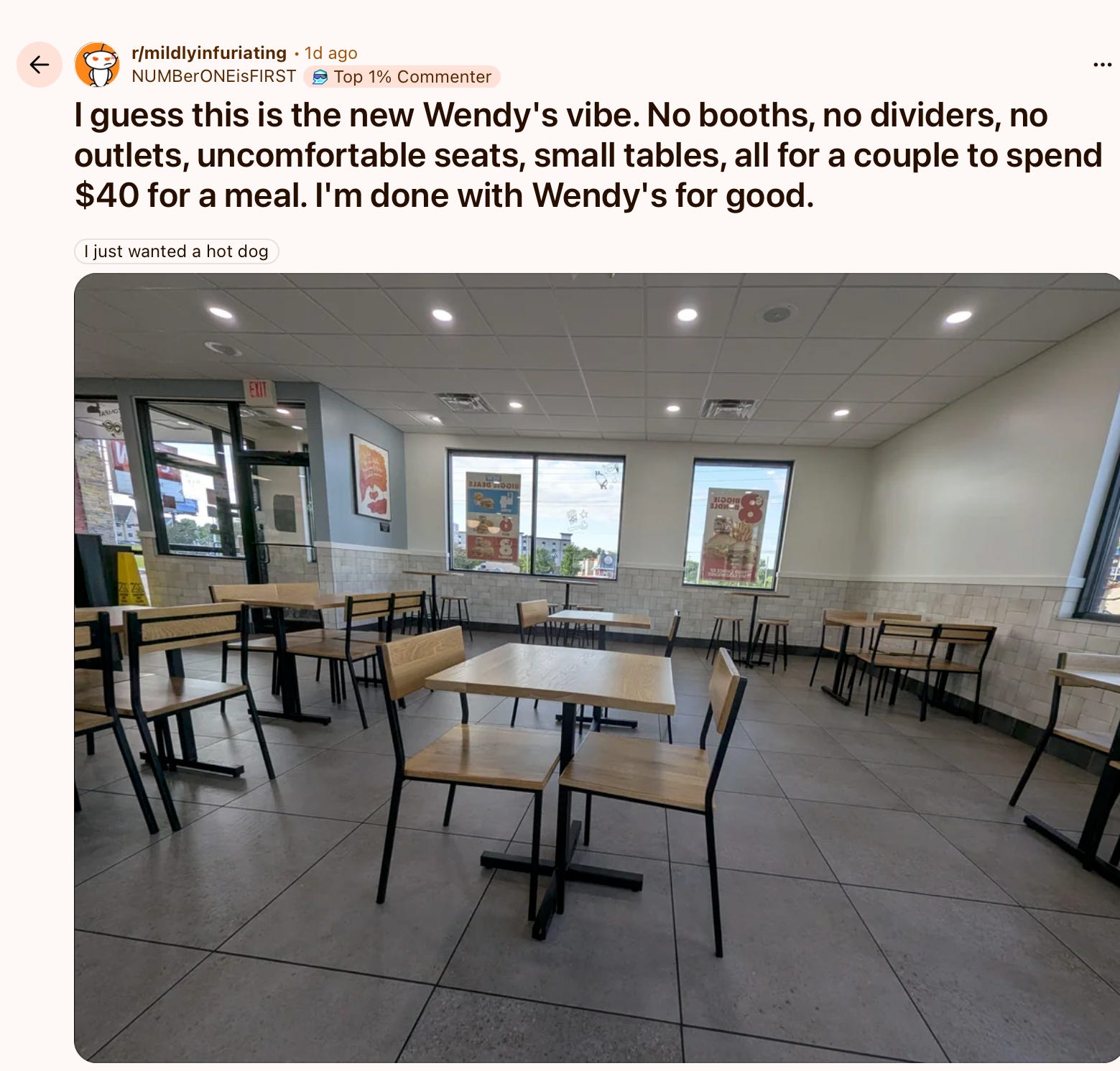
Someone commented that Wendy’s looked like a prison visitor's parlor.
The stock recently touched its 5-year low, an attractive marker for an “uglystocks” hunter like me. The share count has decreased by 6% y/y, with a P/E of 9.42 and a P/S of 0.64. Wendy’s pays a generous dividend yield, averaging 7% on an absolute basis, with a 72% payout ratio.
WEN 0.00%↑ is statistically cheap enough to warrant consideration by bottom-barrel stocks pickers. If anything, the recent “Apes” driven euphoria is evidence of the power of “brand equity,” a major asset class often ignored by LLM-generated valuation models.
Wendy’s is nearly 60 years old and has been a staple of the US fast-casual food industry. Millions of Americans have worked, eaten, and hung out there. The company is an important part of American restaurant identity and of its folksy culture.
The company has also expanded globally and enjoys a respectable reputation, with 7,000 restaurants in more than 30 countries and US territories.
Wendy’s still enjoys a considerable goodwill that cannot be easily wiped out.
With an EV/EBITDA of 15.5, a fat dividend yield, and close to 18.6% FCF Yield, WEN 0.00%↑ is not a complete clunker despite its $4B debt load.
Many “Wall Street” analysts are deriding the “WallStreetBets” stonk-bros as a bunch of financially illiterates betting on a dead carcass. They ignore that the securities market does not reward “formal expertise” or generated financial modeling.
Instead, the market is a dynamic and complex ecosystem driven by real-world action and entrepreneurial decisions.
Investing is more art than science, and the right touch and the right personality at the helm of a company can be the engine that sparks a turnaround.
The human factor cannot be easily translated into a balance sheet or in a discounted cash flow, but that factor is probably the most important gauge of value.
Wendy’s is still a respectable business, a struggling one maybe, but a valuable and profitable enterprise worthy of a fair appraisal.
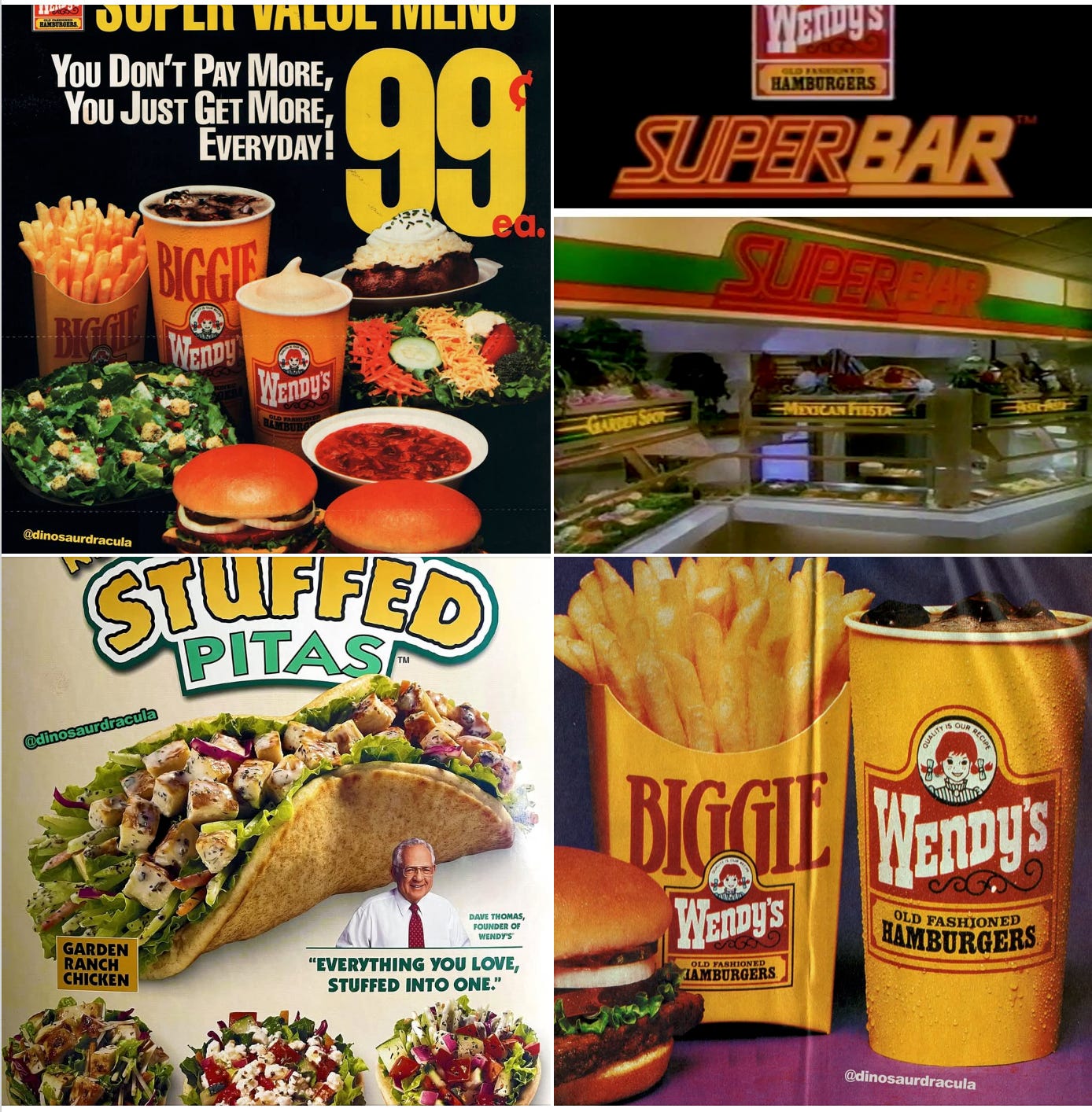
Nostalgia 101: “We really had it all and we threw it away.”
Beyond social media-driven speculative craze and the unending back-and-forth-ism between the pros and the cons camps lies an important factor that could systematically re-rate the company’s value: leadership.
The story of Wendy’s is the story of its leaders, or to be more precise, its founder: Dave Thomas.
Since his passing, the company has lost its unique cache and personality. Its near-term and long-term future will thus hinge on finding the right personality and character fit to reconnect the restaurant with its customers in the age of AI.
Wendy’s brought Bob Wright back to lead its turnaround project after going through 3 CEOs changes in less than 3 years.
I believe the market ( the Apes and analysts ) is neglecting this important game-changing development.
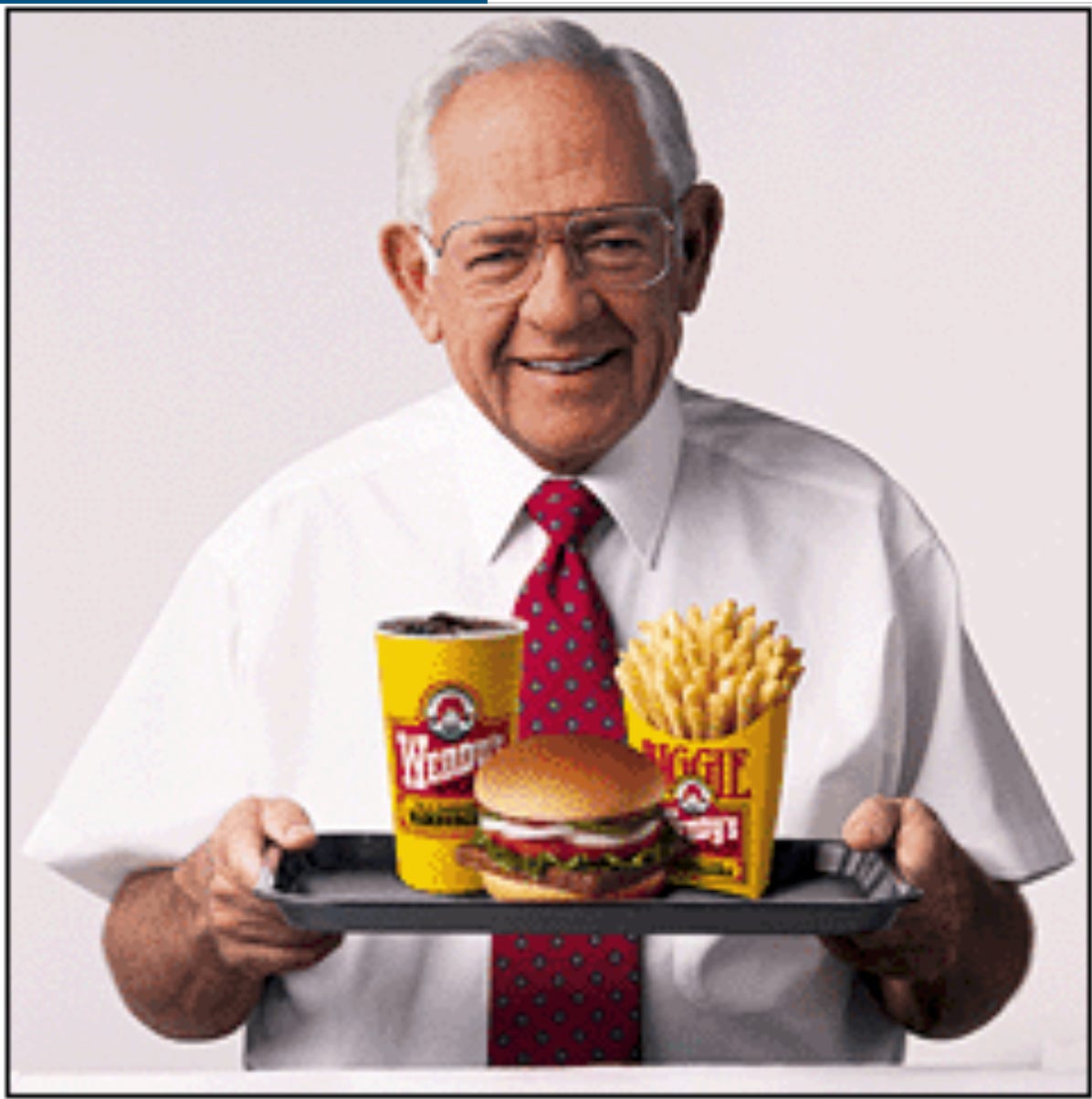
Many customers believe that Wendy’s died the day Dave Thomas was buried in 2002. And rightfully so! Dave Thomas was more than a founder; he was literally and figuratively the company’s patriarch.
An orphan and high school dropout, he built the chain from a single Columbus, Ohio, location in 1969 into a global powerhouse by emphasizing simple, folksy values and qualities, fresh beef, premium service, and its unique differentiated square burgers.
His personal story of overcoming abandonment infused the brand with genuine warmth, customer focus, and hands-on excellence.
“The passing of Dave Thomas also marked the loss of its Iconic Spokesman and Human Face.”
Dave appeared in over 800 TV commercials between 1989-2002, making him one of the most recognized founders in US history. A survey showed that nearly 90% of Americans knew who he was.
His simple, trustworthy, grandfatherly persona differentiated Wendy’s from its competitors (McDonald's, Burger King), setting the company apart in a crowded, low-barrier-to-entry quick-service restaurant business.
After his death, the company struggled to maintain an identity long defined by a single persona. To many, Wendy’s lost its authentic voice, moral compass, and public persona that made it feel like a family operation rather than just another corporate chain.
This remains a foundational part of its ongoing turnaround struggles.
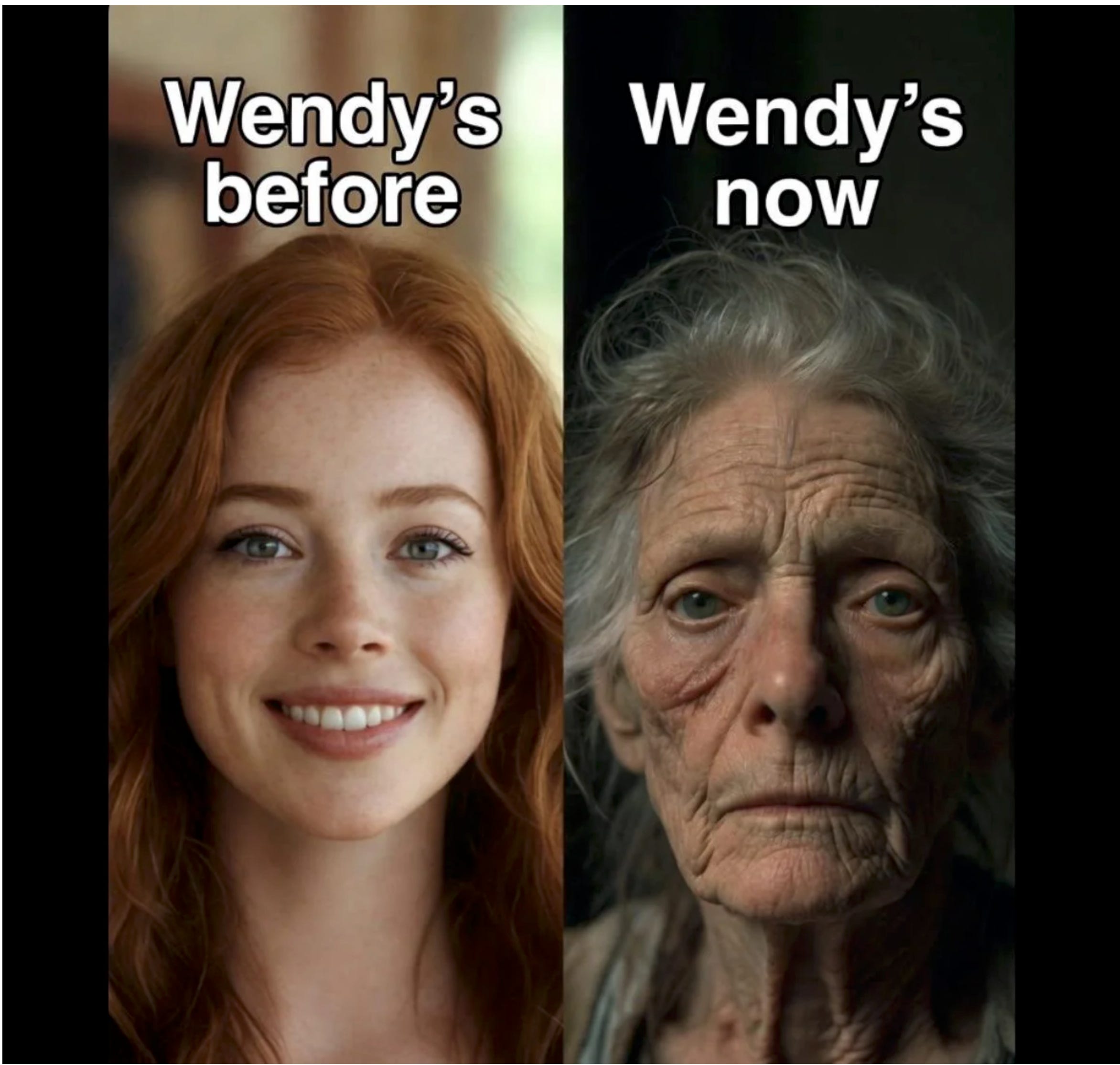
Wendy’s in the days of Dave. Wendy’s after Dave.
Nostalgics may be yearning for the glorious days of Dave Thomas; meanwhile, skeptics are rightfully exposing the company’s records:
300 planned restaurant closures, 5 consecutive quarters of same-store sales declines, and an 11.3% sales drop in a single quarter. A vulture investor and the largest shareholders circling around to take the company private at a lower price than in previous attempts.
It is difficult to rationalize the business performance and reputation and agree with Reddit’s WallStreetBets exuberance.
On the other hand, Wendy’s is still a major operator vowing to expand its footprints across the world. The company is actively executing a massive international expansion, targeting 2,000 global locations by 2028.
So while the closure of restaurants in the US makes the headlines, Wendy’s is betting on the world for its growth.
Its shareholders’ expectations are high, and only a well-seasoned captain can rightfully steer Wendy’s ship in the right direction.
I believe Robert “Bob” Wright is the right leader to mitigate Wendy’s decline and the most apt to steer it back its planned turnaround strategy.
Wright is a career restaurant industry executive with deep familiarity with Wendy's and a proven track record in both fast-casual and quick-service restaurant turnarounds. He enjoys challenges and is willing to embrace the job and leave a mark. By bringing Bob Wright back, Wendy’s is betting on:
A turnaround proof of concept with documented results.
Bob's most recent stint was at Potbelly, a chain that was hemorrhaging through eleven consecutive quarters of same-store sales declines before he arrived. Wright delivered a 39% increase in average unit volumes, 42% system-wide sales growth, a thriving digital platform built from scratch, and ultimately a $566 million exit to RaceTrac. He fixed the unit economics and let the outcome speak to the delight of shareholders.
WEN 0.00%↑ challenges are urgent and require immediate attention. Robert Wright's success in turning around Potbelly during the height of the COVID pandemic is noteworthy for shareholders. He orchestrated a comprehensive, post-pandemic operational turnaround, expanded the brand footprint, and built one of the industry’s fastest-growing digital ordering platforms. His tenure at Potbelly has set him up as a capable shareholders friendly executive. He will be expected to replicate his post-COVID success at Wendy’s, a company he knows from top to bottom.
Franchisee credibility trust.
Bob Wright spent years as Wendy's COO. But his stint with the company goes back to 1998, when he was a franchise area director responsible for all aspects of franchise relations with over 90 franchises restaurants and 12 Wendy’s Franchisees in the West Virginia, Kentucky, and Ohio markets.
The franchise community already knows him well. In a system that is almost entirely franchised, you cannot execute a turnaround without operators’ buy-in. Most external CEO hires spend eighteen months earning that trust. Wright walks in with it on day one. Decades of Wendy’s field-to-corporate office experience give him instant credibility. Franchisee economics and system health are make-or-break for Wendy’s predominantly franchised model.
Wendy’s appears to be betting that Wright’s combination of operational expertise, prior company familiarity, and franchise credibility can help stabilize execution while positioning the company for more sustainable growth.
genuine digital upside lever.
A primary driver of Potbelly's turnaround under Wright was a swift, aggressive pivot to digital ordering infrastructure. With Wendy's currently navigating an industry-wide shift toward mobile apps, drive-thru automation, and loyalty reward ecosystem capture, Bob Wright’s technical implementation history at Potbelly serves as a direct blueprint. Wendy's mobile and loyalty infrastructure remains a fraction of what McDonald's and even Burger King have captured. Margin improvement from digital order mix is a real, near-term driver that the market is not pricing in.
Wright’s hands-on success in building a high-performing digital/loyalty engine at Potbelly is one of his strongest credentials for Wendy’s. It provides a repeatable framework to close the gap with McDonald’s/BK, capture more high-margin digital mix, and drive the operational excellence pillar of Project Fresh. If he replicates even a portion of Potbelly’s digital momentum, especially accelerating loyalty growth and owned-channel shift while scaling FreshAi, it could be a material near-term catalyst for traffic, AUV, margins, and franchisee economics.
A kitchen floor up executive.
Bob Wright began his career at age 19 in the food industry, delivering pizza, and his leadership style is therefore grounded in operational reality rather than corporate gamesmanship. He is reputed to be empathetic and people-centric.
He frequently credits his early days as a pizza delivery driver for giving him a genuine appreciation for the daily hustle of restaurant staff. He is equally disciplined and process-oriented. And more importantly, Wright intentionally fights against the pitfalls of large corporate structures which he describes as getting “big and fat and slow.”
Bob Wright’s leadership philosophy is deeply rooted in blue-collar operational grit, frontline empathy, and a deliberate resistance to bureaucratic bloat, traits forged from humble beginnings that make him a culturally resonant choice for Wendy’s “Dave’s Place” heritage and Project Fresh turnaround.
Bob Wright is the right fit to revamp WEN -11.72% and salvage one of America’s most recognizable fast-casual restaurants.
His selection aligns with the company’s founder ethos of simplicity, customer focus, quality, affordability, and premium service. More importantly, Bob Wright was brought back to re-engineer his successful turnaround of Potbelly at Wendy’s.
His career trajectory, including multiple leadership roles at Wendy’s and stints at Charleys Philly Steaks, Checkers, Domino’s, and Potbelly, shows a consistent focus on executional excellence.
At Potbelly, he completely rebuilt the management team and the organization to deliver industry-leading results.
He delivered approximately 785% total shareholder returns over 5 years, resulting in the company’s sale for $17.12 per share. He grew market capitalization from $50M to $566M in that same 5-year period.
He would be joined in his effort to revitalize the company by Steve Cirulis, Potbelly’s CFO, with whom he successfully steered the company out of near bankruptcy.
Bob Wright is a winner, but more importantly, a decent human principled floor general. And that’s exactly what Wendy needs.
The WallStreetBets’ “Operation Save Wendy’s” is not a silly speculative call by a bunch of ignoramus degenerates. It is a fair and just assessment of a mismanaged American fast-food institution.
Wendy’s still holds significant goodwill among its customers and stakeholders, which warrants patience as the company tries to turn around.
The “Apes” might be driven by short-term stock-squeeze tactics, but in the long run and with the right leadership, Wendy’s can return to a respectable standing in its industry.
As an “uglystocks” investor, I sail only with a ship captain I trust and forget the rest. Bob Wright's reputation is stellar, and he comes across as a decent bloke. That’s all I need to know.
Struggling companies cannot be systematically ascertained through quantitative financial metrics alone. Businesses are not “spreadsheets” but the byproducts of human action and vision.
In that regard, the “Apes” are far smarter than professional analysts at gauging Wendy’s value. In fact, Wendy’s was built in the image of its founder, and its success or failure hinges on the management's ability to maintain Dave Thomas’s vision and ethos, something that has been neglected by the rating agencies.
I believe the market has not yet fully grasped the unique skillset Bob Wright brings to the table; once his plans are in place and his operational discipline and organizational skills are put to work, the current share price will be seen as an absolute bargain.
Meanwhile, I expect a lot of near-term volatility and I have appraised the risks of a market crash caused by general market uncertainty and macroeconomic dynamics. This is a high-risk, high-reward turnaround opportunity that can take up to 2 years to work out.
Things might get worse before they get better.
Extreme patience is warranted.
( Not Investment advice. I write for entertainment and for intellectual stimulation only. Always contact a professional investment advisor before trading a stock. )
Comments
Nothing yet. Say the first thing.
Sign in to join the conversation.