
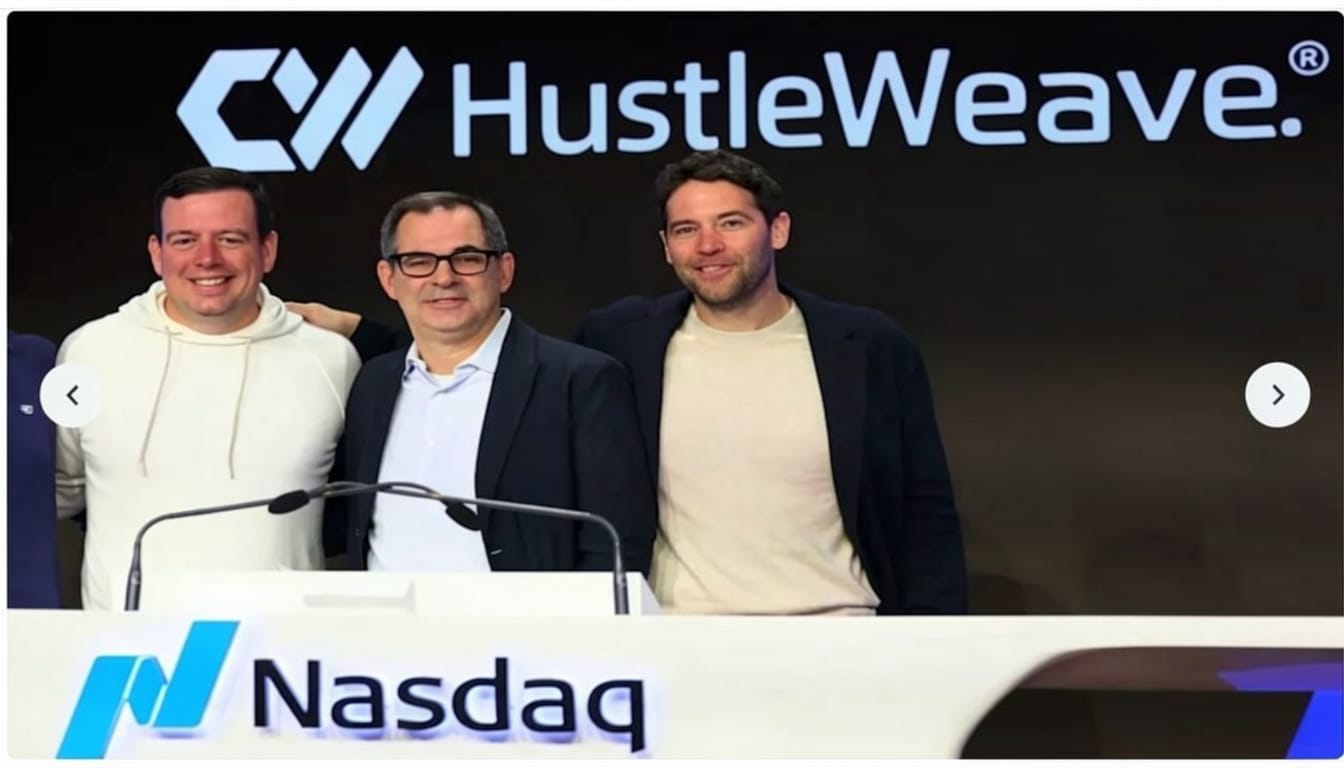
“The three stocks sellers”
A distinctive yet often overlooked aspect of the dominant Financial Regime is the emergence of an elite class known as Fiat Oligarchs—individuals and organizations whose wealth and power mainly stem from issuing, accumulating, and selling Fiat Financial products and securities.
Because monetary policy incentivizes credit flow into speculative and structurally unviable ventures where profitability is secondary to orchestrating public share offerings, the industry of “ Get Rich or IPO trying” has exploded to unheard-of heights in recent years.
What has emerged is not a functioning capitalism rooted in productive value creation, but rather its corruption into excessive financial engineering.
As credit-capital has artificially sustained the financial economy, securities holders’ wealth has increased faster than the net returns of their underlying businesses whilst consumers and real producers have been left to bear the burden of higher prices.
This “Fiat” Financial system has thus morphed into a mechanism for wealth transfer, in which securities issuers dump their overvalued, often fraudulent, and zombified stock issues onto the public exit-liquidity market.
Rather than fulfilling its stated mission of democratizing the ownership of industries across all segments of society, the financial market has been essentially bastardized into a welfarist and parasitic means of wealth extraction for a tiny class of securities undertakers.
The story of CoreWeave is intimately tied to two failed companies that preceded it: Hudson Ridge Asset Management LLC and Atlantic Crypto. Without beating around the bush, a clear question must be asked: Will CoreWeave be any different?
From January 2013 to January 2018, Michael Intrator served as co-founder and CEO of Hudson Ridge Asset Management, LLC, a fundamental, systematic natural gas hedge fund.
Natural gas trading is notoriously volatile, and Hudson Ridge attempted to algorithmically and systematically trade natural gas futures. Unfortunately, the company became a casualty of the post-2015 energy market oversupply of NG. The prolonged shale boom suppressed volatility, compressing trading margins. The cost of capital and data infrastructure began to outpace returns, forcing Intrator to quietly shut down the operations.
In September 2017, as Hudson Bridge was reeling from the effects of the long NGs bull market, Intrator teamed up with fellow energy traders Brian Venturo and Brannin McBee to chase after a new kind of digital volatility: Ethereum mining. They founded Atlantic Crypto Corp.
The trio bought thousands of Graphics cards ( Mostly Nvidia GPUs), built custom rigs and leased warehouses with cheap power access. At its peak, Atlantic Crypto was one of the largest private GPU inventories in the USA.
The 2018 cryptocurrency crash obliterated Ethereum's price, driving mining profitability to near zero. Compounding this, the Ethereum network was openly preparing to transition from GPU-heavy proof of work to proof of stake, which would render GPU mining completely obsolete.
The company rebranded as CoreWeave in 2019 and pivoted its hardware stack toward GPU rendering for visual effects studios, then toward AI compute when ChatGPT's 2022 launch triggered a global GPU shortage that hyperscalers couldn't meet fast enough.
The company went public on March 28, 2025, at a price of $40 per share (raising $1.5 billion, scaled back from the initial target of $40 billion) and listing under the ticker CRWV. The stock later surged (peaking near $119 in mid-2026) before settling around $95–96 as of late June 2026, implying a market capitalization of roughly $50+ billion.
“ The three founders instantly became Billionaires.”
CoreWeave’s execs have seemingly gone from nearly burning down a Manhattan office building while plugging Nvidia GPUs to mine Ethereum, to the status of Billionaires without ever earning a profit in their operating business!
How was that possible?
Short seller Kerrisdale Capital (September 2025) has characterized CoreWeave as a “debt-fueled GPU rental business with no moat,” arguing it is undifferentiated, financially engineered rather than innovative, and that lenders capture front-loaded returns while equity is left with residual claims on rapidly obsolescing hardware.
Famed investor Jim Chanos has called the company a risky leasing and finance company rather than a technology business. He views Coreweave (and similar “neoclouds”) as middlemen that buy chips from Nvidia and rent them out to hyperscalers. He therefore argues that premium valuation multiples should not apply to a company that does not build AI models.
The stock dropped 11% on July 1st after Meta announced plans to establish a cloud infrastructure division to sell surplus AI computing power.
The market declined amid concerns that a large hyperscaler such as Meta might soon rival independent “neocloud” providers. This vulnerability aligns with Kerrisdale Capital's calls and Jim Chanos’ criticisms of the company as a debt-funded GPU real estate operation lacking a competitive moat.
The continuous insider share exit pressure is beginning to make sense.
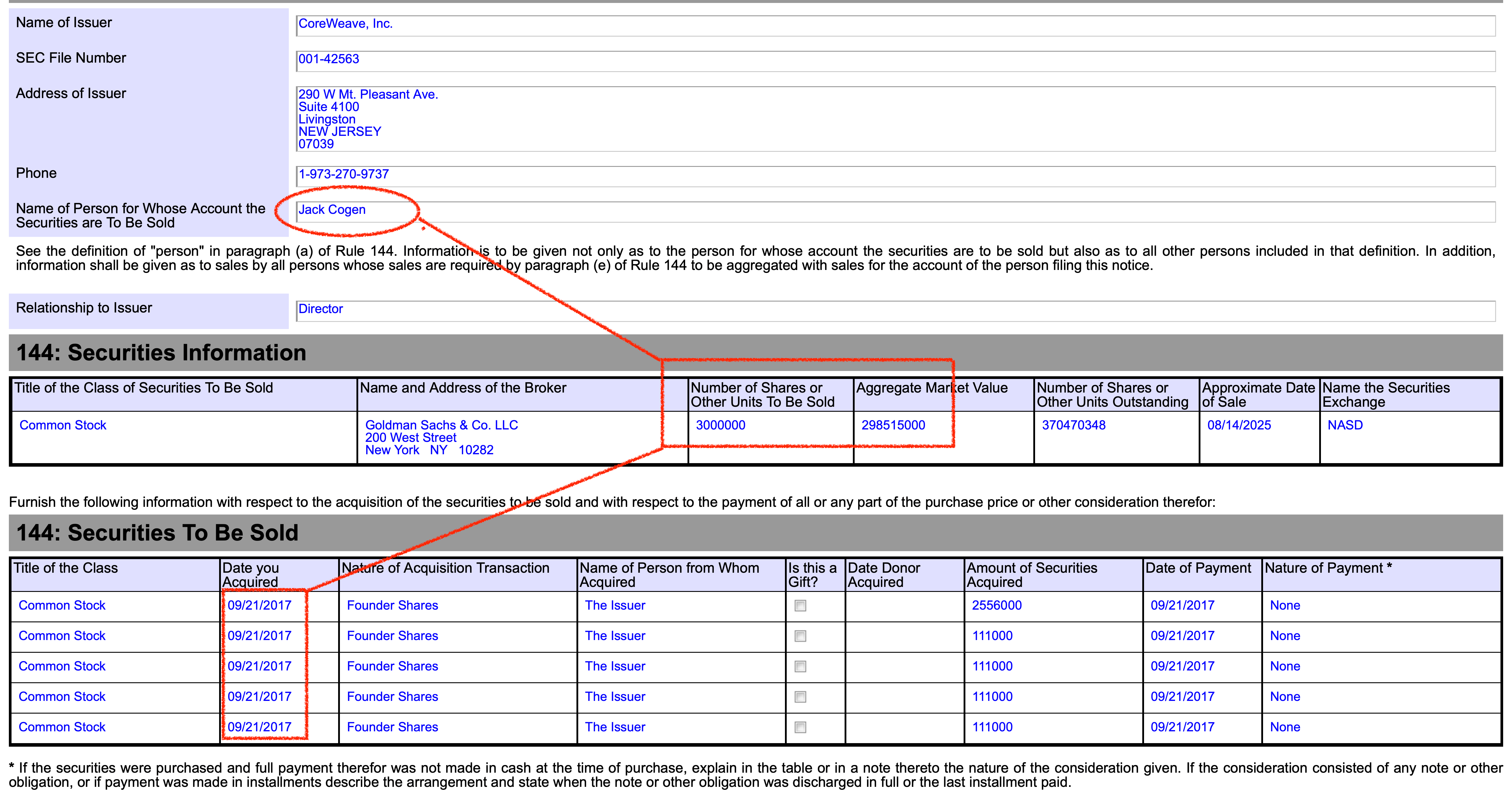
Pre-IPO cash-out: All three founders pocketed over $150 million apiece by cashing out shares ahead of the IPO. Collectively, the founders and early investor Jack Cogen sold $660 million of CoreWeave stock before the March 2025 IPO, and another $640 million since.
The company’s execs have sold over $2.3 billion of stock since the IPO lockup expired in August 2025. Its institutional backers, such as Magnetar Financial, have sold over $5.5 billion in stock, cutting its stake in half.
1-Micheal Intrator: The founder.
Is the CEO and co-founder of CoreWeave ( CRWV 0.00%↑ ) and its most recognizable public figure. He embodies the company’s multiple pivots from its origin as an Ethereum miner into today’s AI hyperscaler infrastructure.
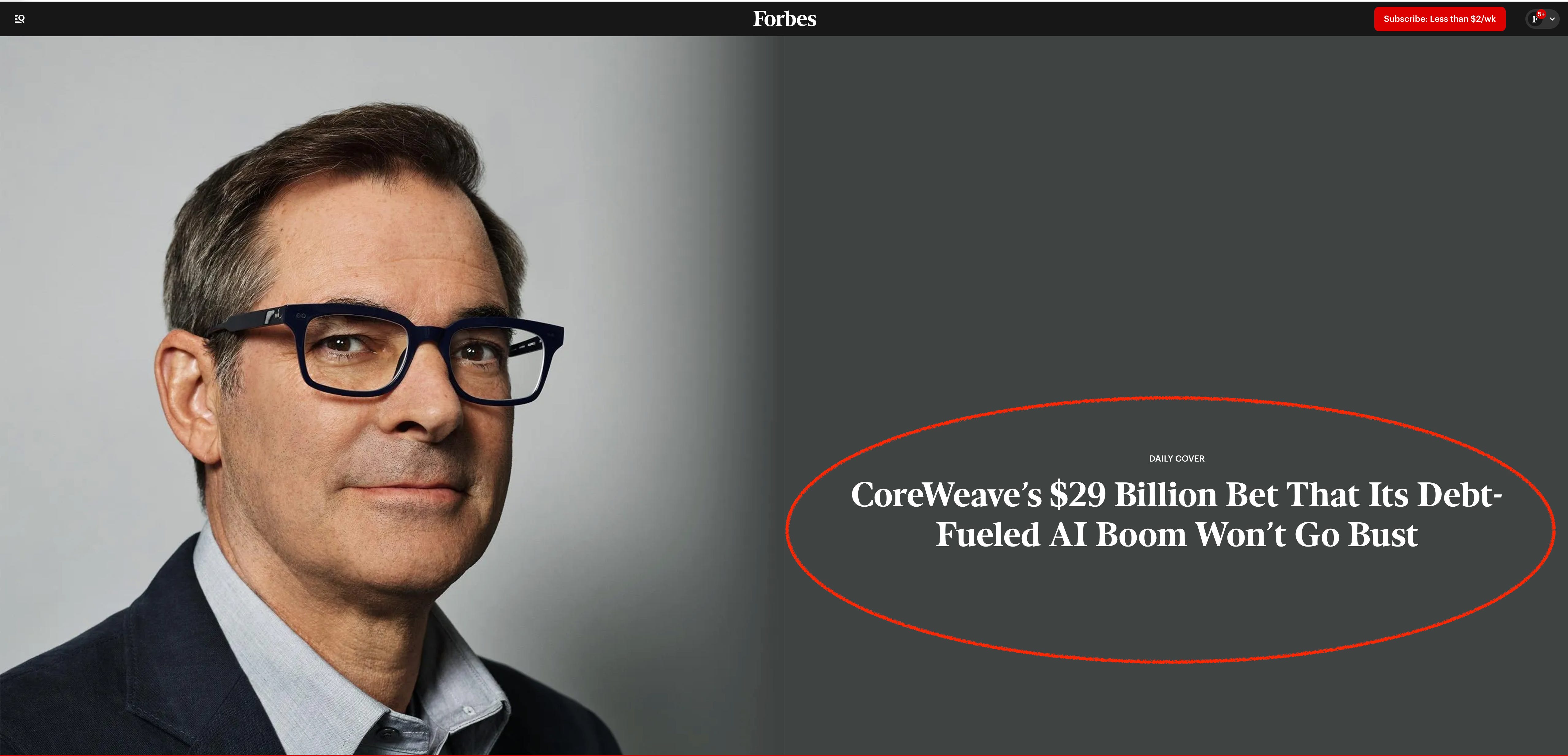
Michael Intrator has an estimated personal fortune of $6.7 billion, according to the latest figures tracked by Forbes. This represents an adjustment from mid-2025, when a rapid post-IPO stock surge briefly drove his net worth to an estimated $10 billion. Still, the scale and the speed of the wealth acquisition are staggering. In less than a decade, Michael Intrator went from a failed Natural Gas trader to a Billionaire in the novel AI Real Estate business.
Some would see through his journey a story of resilience and opportunity taken; others will judge him as an opportunistic theme rider waving through an artificial narrative built on easy-credit access for the AI/adjacent industry.
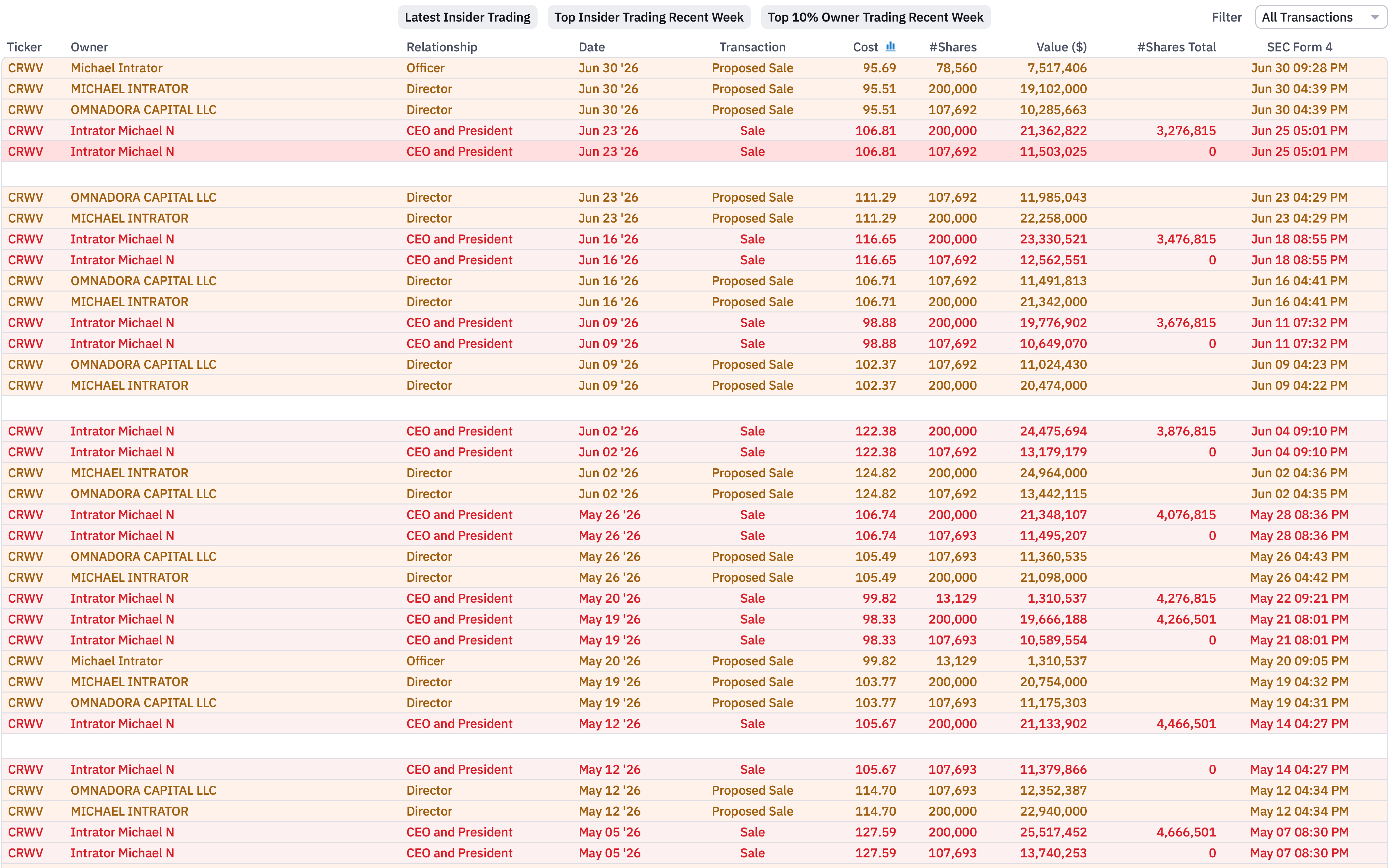
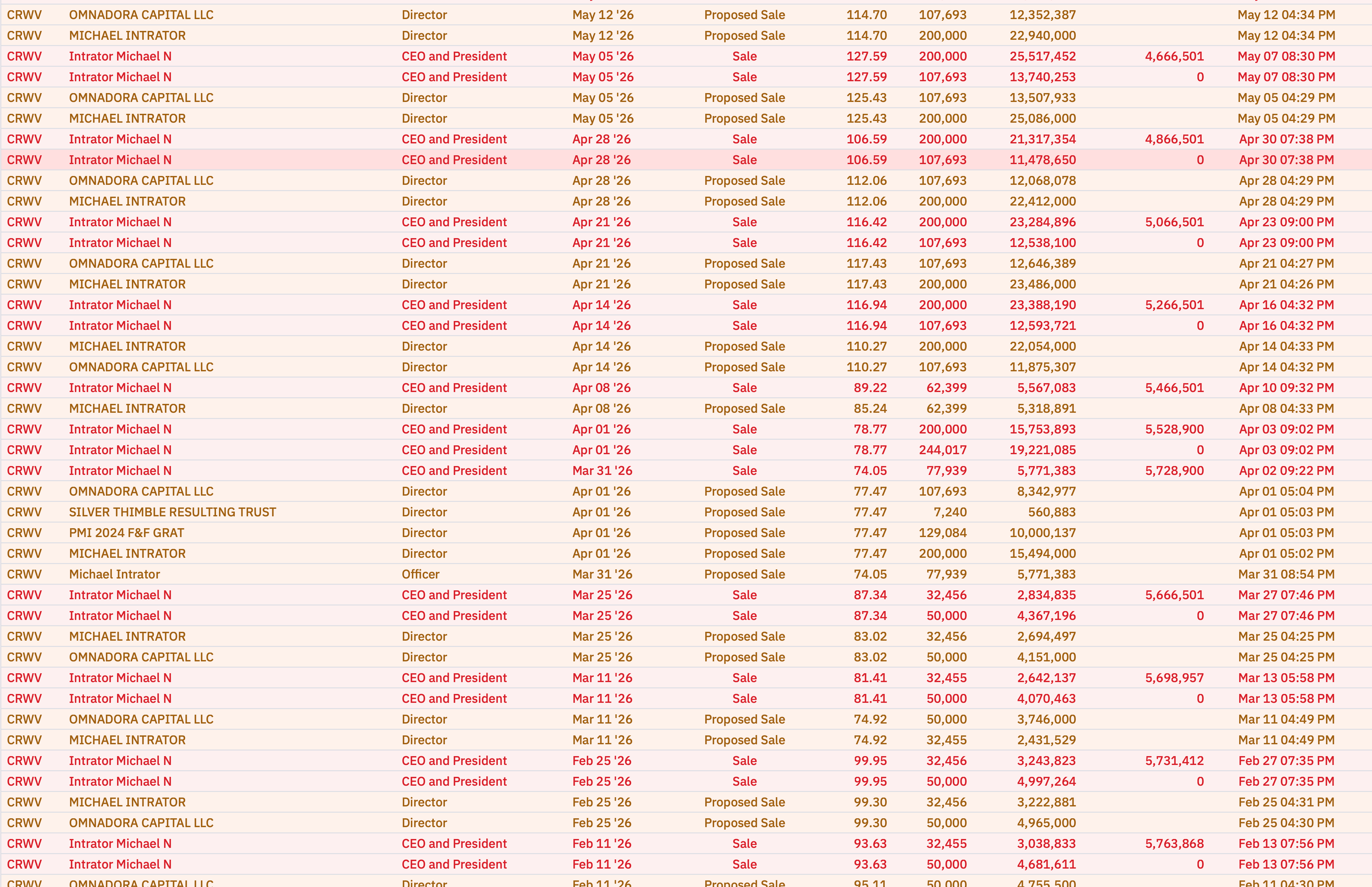
Nevertheless, Michael Intrator appears to be the most gun-shy stock-selling insider among his co-founders.
Estimated total sales post lock-up are valued at around $600M with the bulk of his fortune still tied to his holding of nearly 10.4% of the company’s shares outstanding.
2-Brian Venturo
Chief Strategy Officer, co-founder. Got his start at Intrator's hedge fund after cold-calling Intrator every morning at 6 a.m. for five months until Intrator finally answered. Forbes estimates his ownership at roughly 6% of the company.
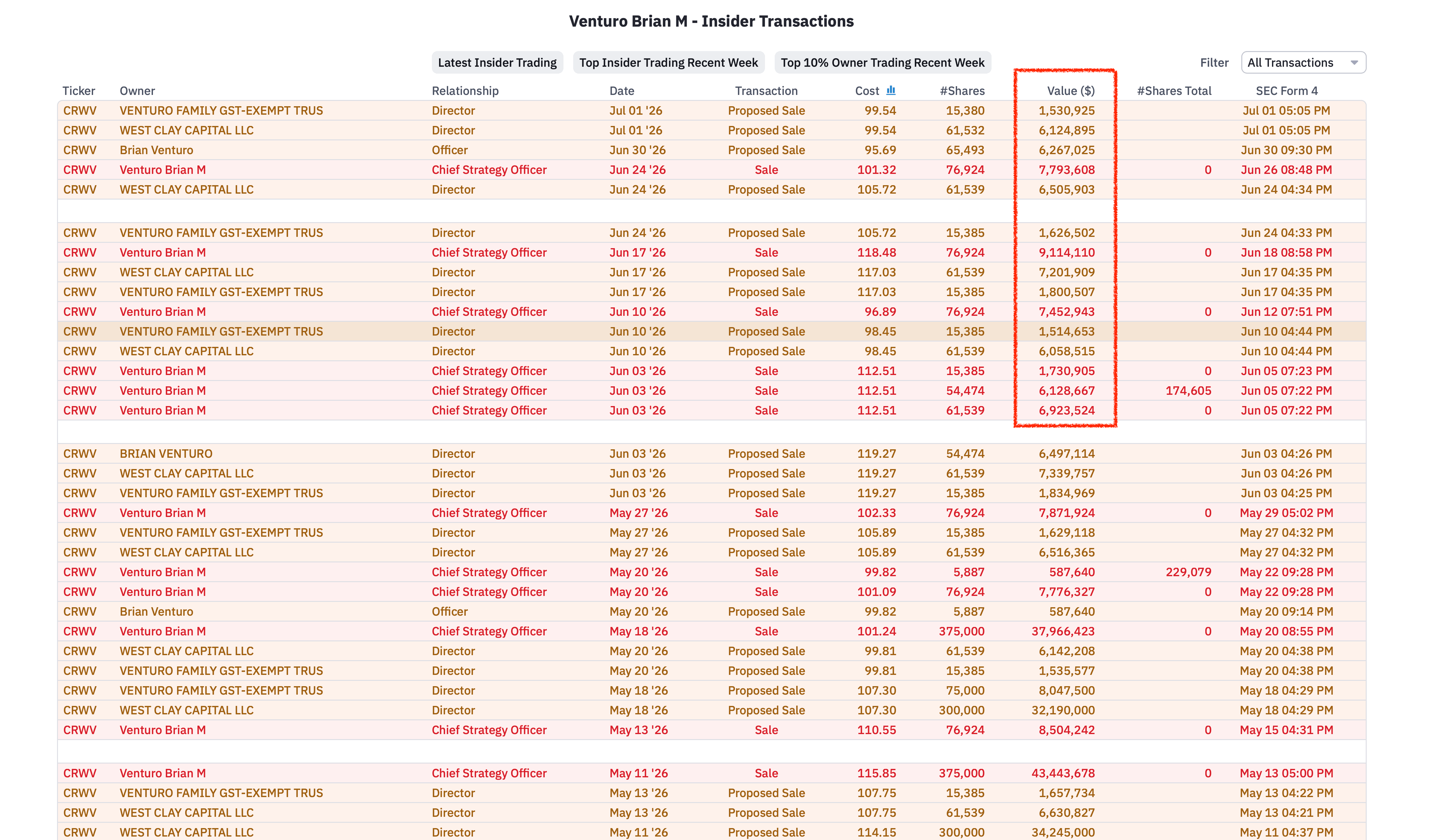
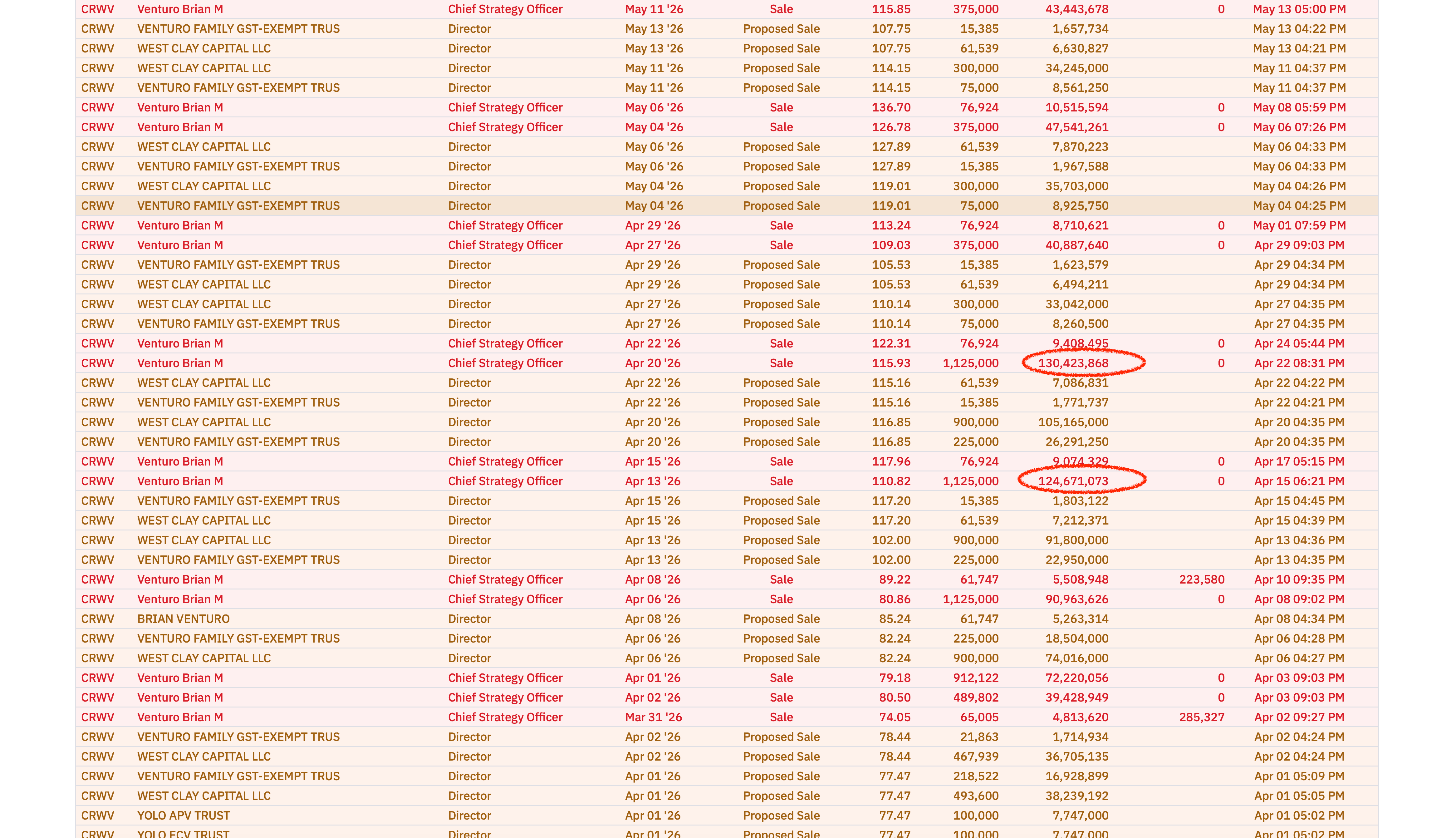
Per Forbes' September 2025 report, he is listed with a net worth of roughly $1.4 billion. He has cashed out an estimated $1.3 billion by selling about 13.5 million shares since the company's public debut. Brian Venturo has filed a total of 467 insider trades since 2021. His most recent trade was a sale of 15,380 shares made on July 1st, 2026.
3-Brannin McBee
Chief Development Officer, co-founder. Brannin McBee is one of our co-founders and has served as our Chief Development Officer since March 2024. He has an estimated net worth ranging between $2.2 billion and $4.7 billion.
From September 2017 to March 2024, Mr. McBee served as the company’s Chief Strategy Officer. Previously, he worked as a Proprietary Trader at Active Power Investments, a company in the North American Natural Gas, Power and Agriculture markets from April 2020 to January 2021. From March 2017 to August 2018, Mr. McBee was Vice President at Fourth Floor Coastal LLC, an exploration and production company in the oil and gas industry. Prior to that, from January 2013 to January 2018, he was a proprietary trader at Windy Bay Power LLC, a commodity-focused hedge fund. Mr. McBee earned a B.S. in Finance from the University of Colorado Boulder.
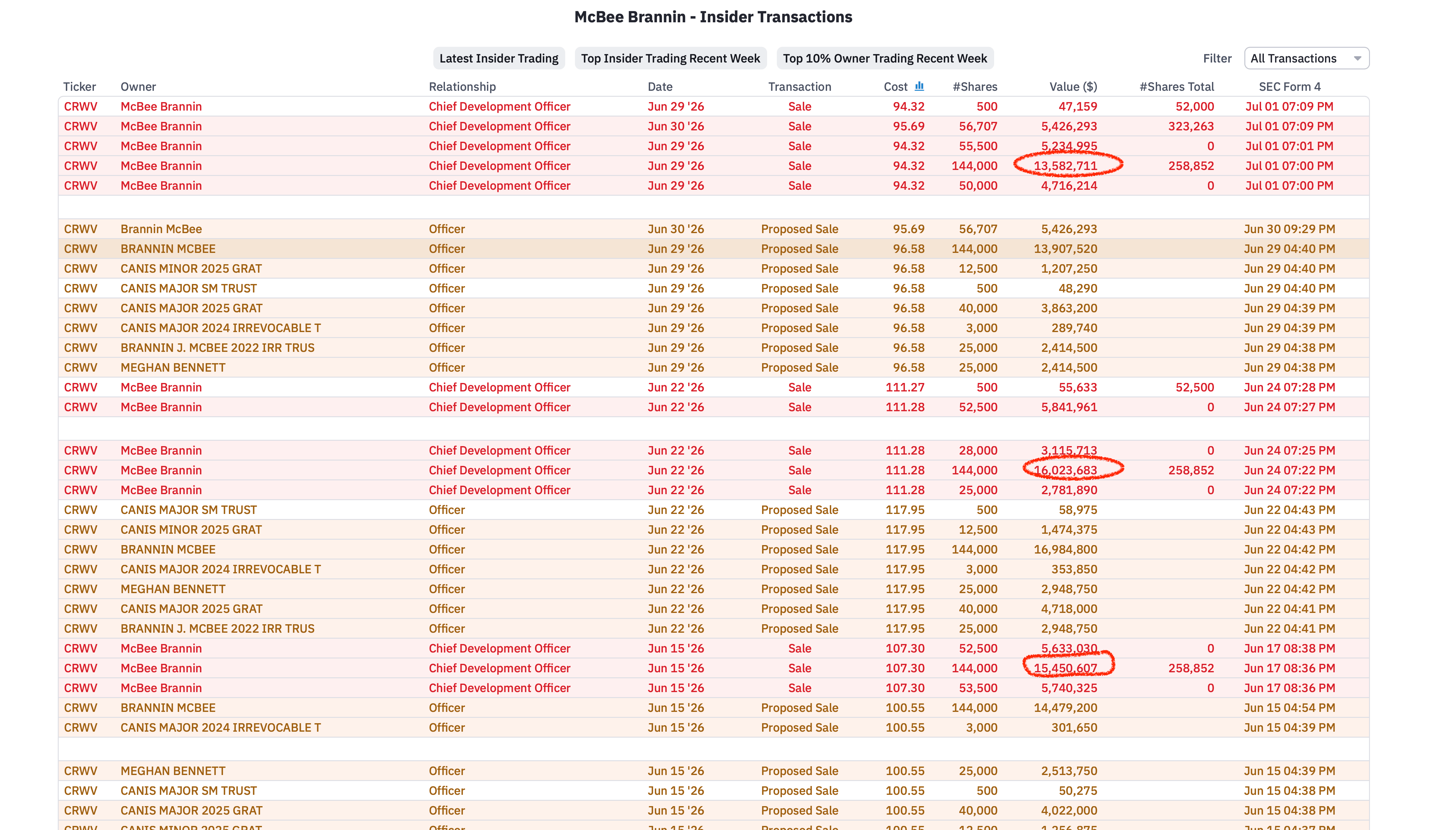
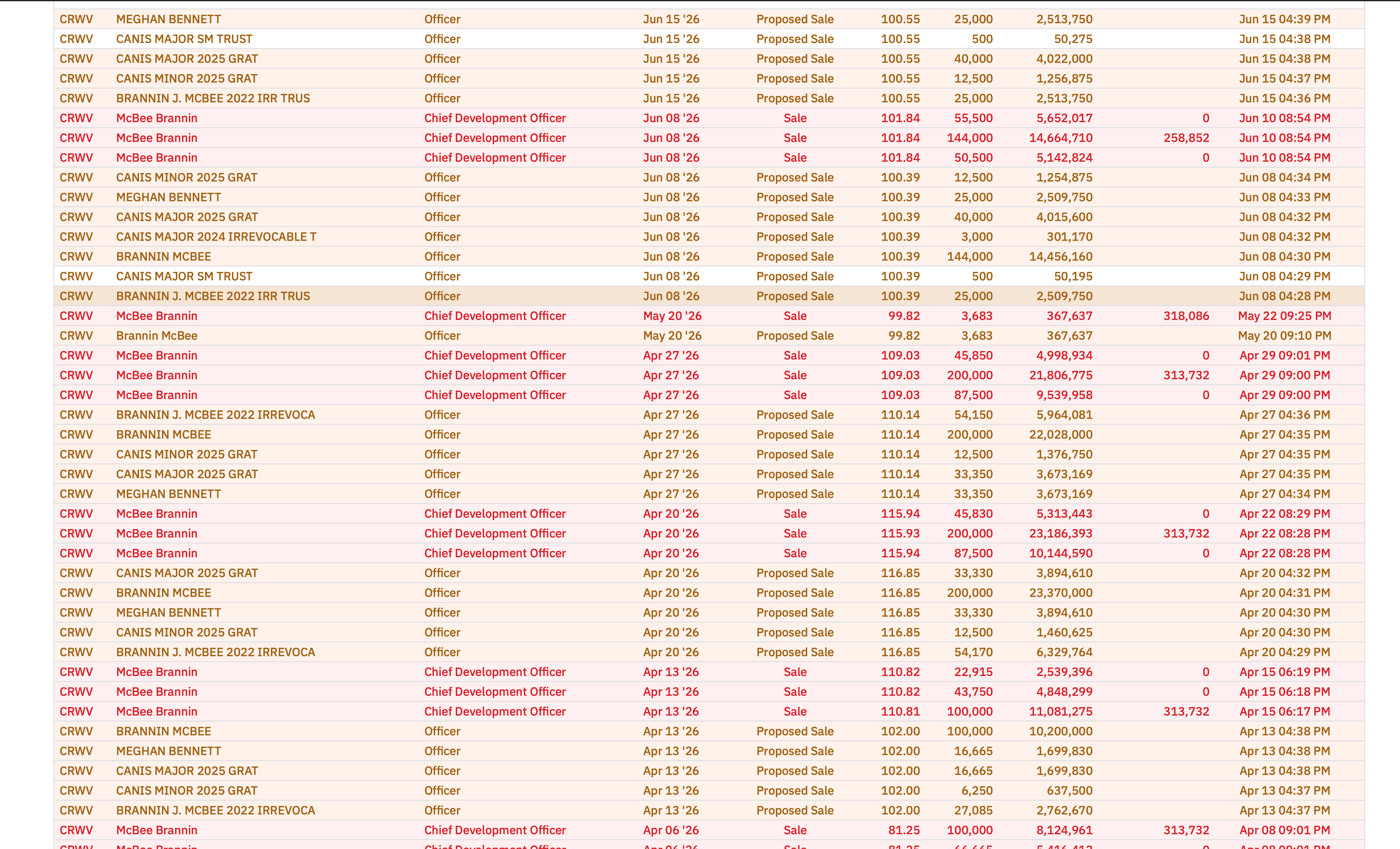
Has been one of the most active insider sellers, offloading over $57 million in stock in a short window, and is named as a defendant in the pending securities fraud suit.
Jack Cogen: Early believer, early exiter.
Jack Cogen was a director and early investor in CoreWeave. He was an early investor in Atlantic Crypto, which ultimately shuttered / pivoted into becoming Coreweave.
Coreweave went public in 2025 at an approximately $23 billion valuation; Cogen owned approximately 5% of the company. Jack D Cogen has an estimated net worth of at least $1.6 Billion, is a private investor in early-stage companies. Before that, he was the founder and CEO of greenhouse gas asset manager Natsource. He was also a director at natural gas hedge fund Hudson Ridge Asset Management, where two of CoreWeave’s cofounders worked.
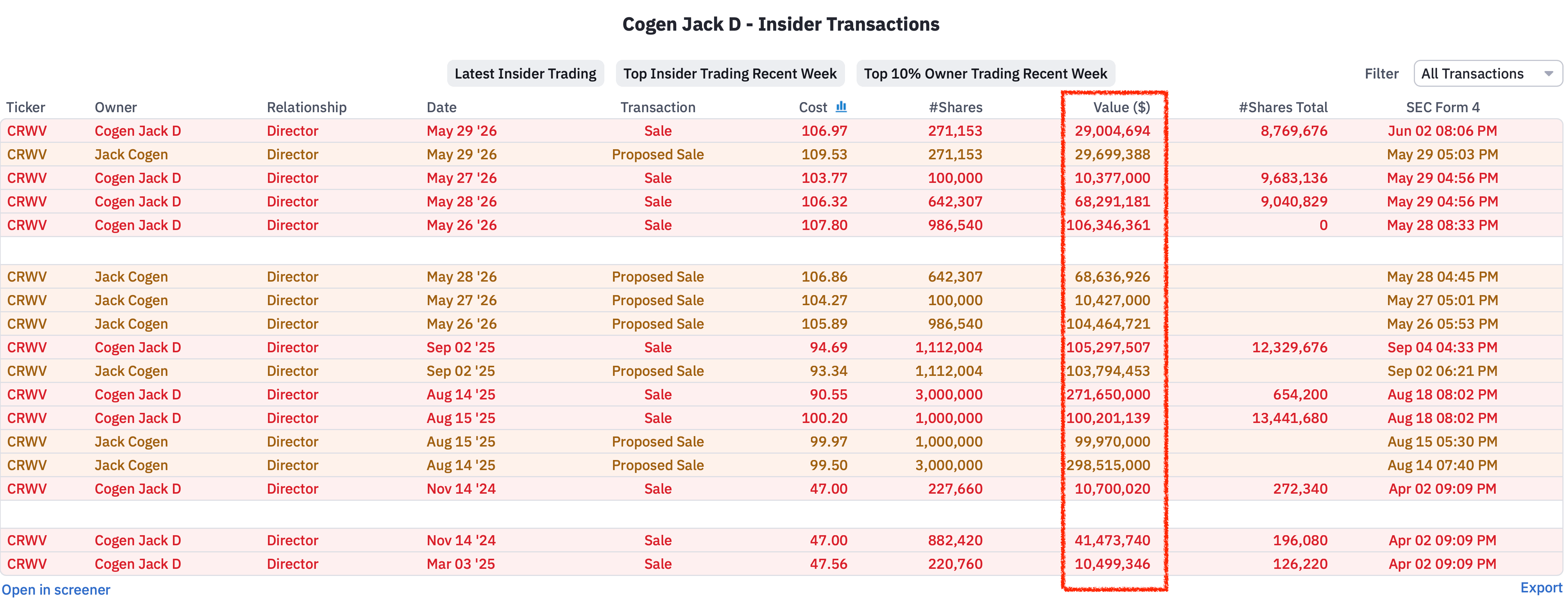
Jack Cogen has sold an estimated total of 8.4 million shares of CRWV 0.00%↑ stock since 2021, bringing his total sales value to approximately $753 million.
Over the span of just a few days in May 2026, Jack Cogen cashed out exactly 2M shares for a total value of $221M.
He also chose not to renew his seat on the Board of Directors and effectively resigned as a Director on June 8th, 2026.
Magnetar Financials:
is a multi-product, multi-strategy alternative asset management firm based in Evanston, Illinois. The firm was founded in 2005 and invests in alternative credit and fixed-income, quantitative investing, venture, and fundamental and event-driven investing strategies
Magnetar Financial is the largest institutional investor in CoreWeave, owning a multi-billion-dollar stake built from early-stage convertible notes and major debt financing. Magnetar has been a crucial backer, helping fund CoreWeave’s pivot from crypto mining to specialized GPU cloud computing.
Magnetar invested $50 million in convertible notes as early as 2021 when CoreWeave was focused on Ethereum mining.
In 2023 and 2024, Magnetar partnered with Blackstone to lead multi-billion-dollar debt and credit facilities to help CoreWeave rapidly expand its data center footprint.
When CoreWeave (NASDAQ: CRWV) went public, Magnetar’s initial $50 million investment grew into a massive equity stake worth over $12.5 billion.
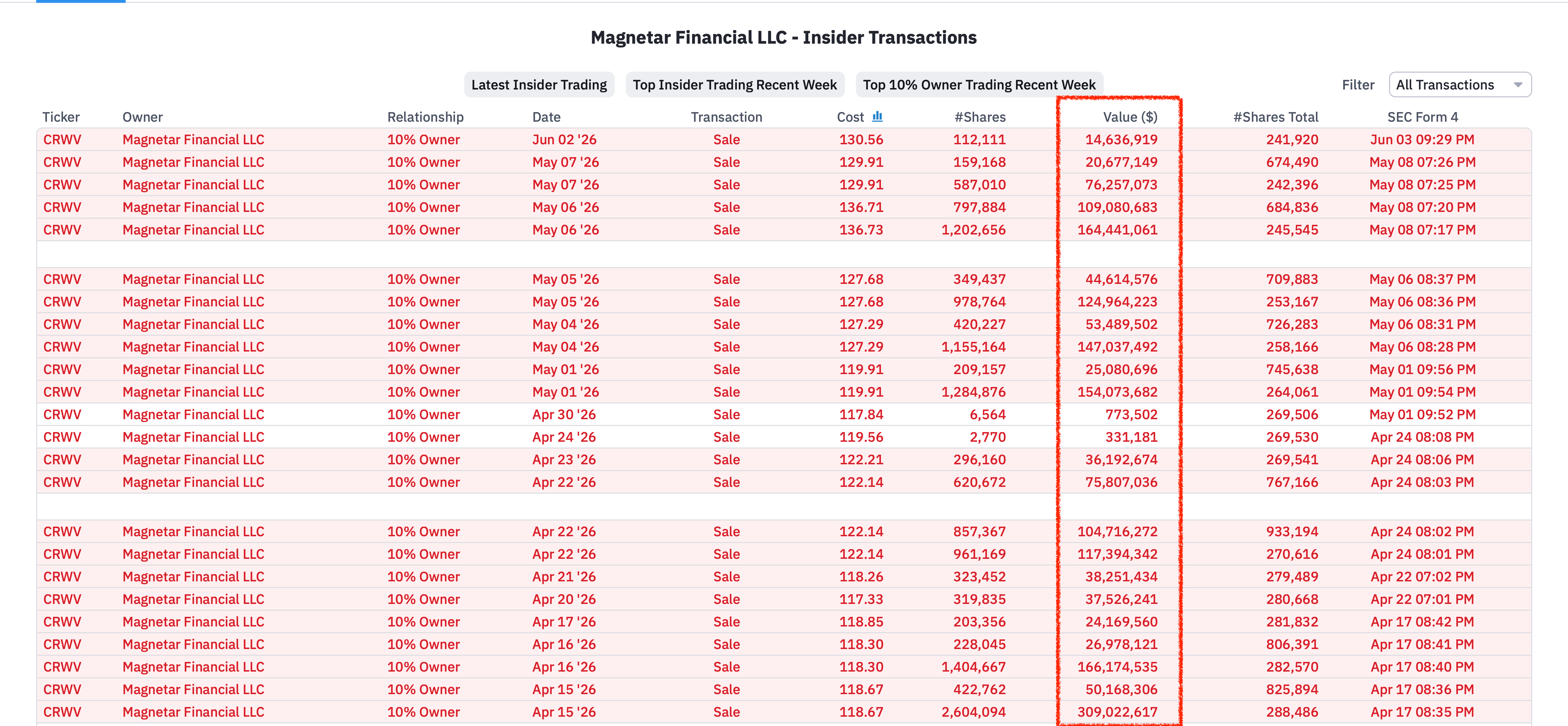
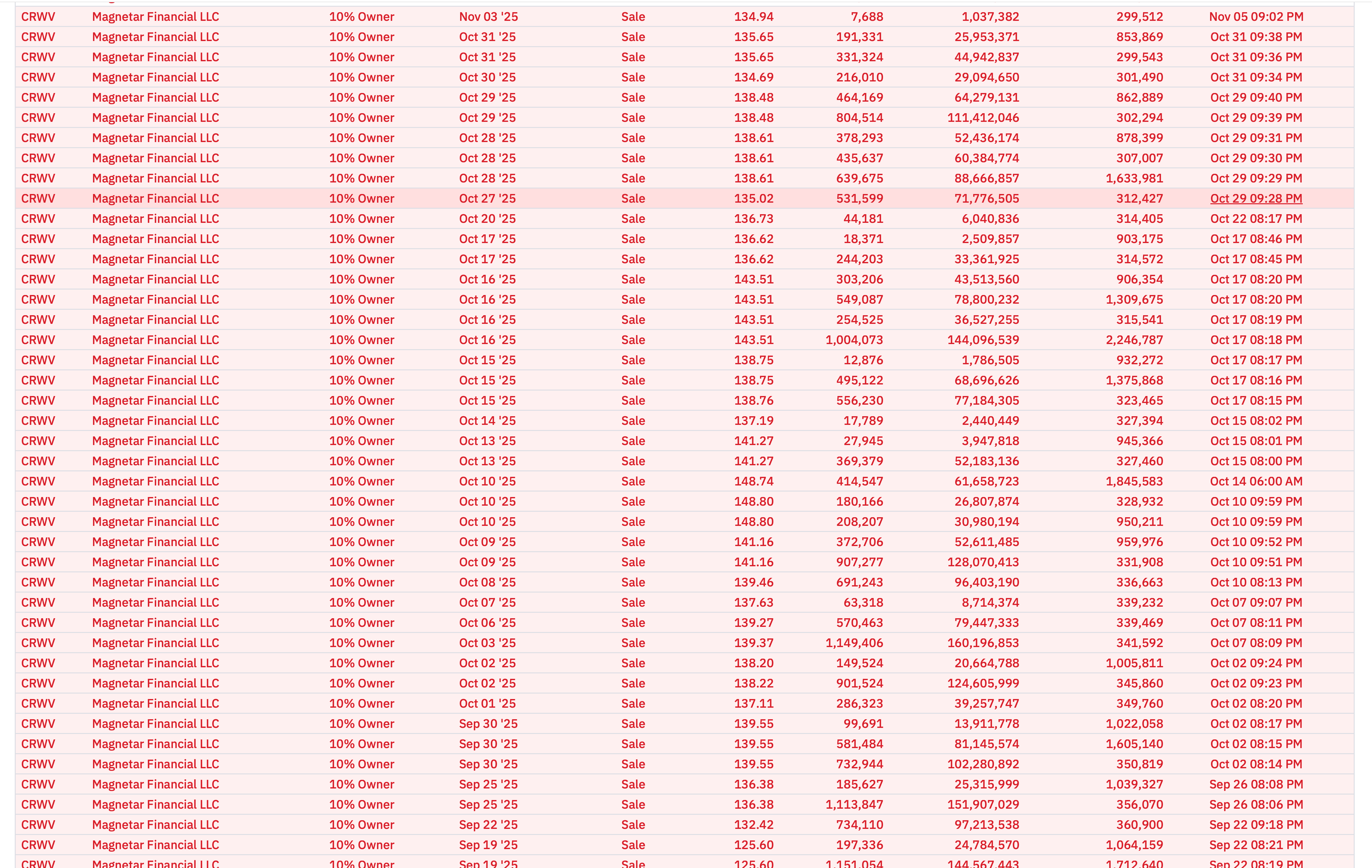
Although executives initially stated they had no plans to sell, SEC filings revealed that Magnetar and its affiliates later divested hundreds of millions of dollars in CoreWeave shares, while retaining a majority of their holdings.
Magnetar Financial has reportedly sold more than $5 Billion worth of stock in the AI infrastructure company, reducing its stake by 1/2 since the IPO lockup expiration.
CoreWeave Inc. might be a relatively new company to most investors, but its origin and its founders’ ties can be traced to an unknown natural gas commodity trading entity named Hudson Ridge Asset Management in 2013.
The story of a failed Natural Gas prop firm turning into a multi-billion-dollar AI infrastructure company would be the stuff of legend were it not for its questionable business model and suspect capital structure.
The concentration of related-party circular transactions and links with financiers of doubtful repute involved in past financial scandals, as well as aggressive insider stock sales, raise significant issues about the economic validity of the entire enterprise and even mark the company as a potential scheme for its connected parties’ share-exit enrichment.
A small “ gang” of former commodity traders/financiers has essentially gotten rich by successfully riding the AI hype and left enough juice in the bag for retail to hold.
It is a small club indeed, and you weren’t invited the first time around. Will you take the bait for a second go around?
CoreWeave, Inc.'s aggressive insider share exit is not a random coincidence; it is just a tree that hides a venomous snakes filled forest. But the issue of related-party circular financing warrants a thorough breakdown. My short perspective could not possibly do the matter Justice.
https://io-fund.com/ai-stocks/nvidia-coreweave-nebius-circular-financing-gpu-boom
AI infrastructure financing, An extension cord plugged into itself?
Critics have explicitly compared the CoreWeave-Nvidia relationship to the telecom bubble of the late 1990s, in which vendor financing masked weak underlying demand.
The mechanics: Nvidia owns roughly 7% of CoreWeave and supplies it chips, which CoreWeave then rents largely to Microsoft and OpenAI — two of Nvidia’s own largest direct customers.
In September 2025, Nvidia committed to purchasing up to $6.3 billion of CoreWeave’s unsold cloud capacity through April 2032 — effectively acting as a financial backstop for its own customer/portfolio company.
CoreWeave’s own prospectus discloses extensive related-party transactions: Magnetar funded early convertible notes, Nvidia is simultaneously a supplier and an equity holder, and OpenAI’s capacity contracts were partly paid for with CoreWeave’s own private shares.
OpenAI invested $350 million into CoreWeave via private placement at the same time it was signing an $11.9 billion compute contract, a deal later expanded to roughly $22.4 billion in total commitments through 2031, with CoreWeave financing a dedicated $2.6 billion debt facility specifically to build the infrastructure for that same contract, using the contract itself as loan collateral.
Legendary short-seller Jim Chanos has flagged the deeper assumption underpinning all of it: Nvidia’s six-year depreciation schedules for GPUs are, in his view, unrealistic given the pace of chip obsolescence, and if the hardware loses value in three to four years instead, CoreWeave and peers like Oracle face what he calls “massive financial risk.”
Every dollar of “investment-grade” CoreWeave debt rests on two unproven assumptions: that hyperscaler demand for capacity is durable rather than circular, and that yesterday’s Nvidia silicon retains tomorrow’s collateral value. Both assumptions are, not coincidentally, the same assumptions that made the dot-com fiber-optic buildout look rational in 1999.
CoreWeave's stock (NASDAQ: CRWV) tumbled nearly 14% after a Bloomberg report revealed Meta Platforms is developing a cloud business to sell its excess AI computing capacity. This news sent specialized AI infrastructure providers—including CoreWeave and Nebius Group—sharply lower.

Magnetar Capital, CoreWeave, Inc. CRWV 0.00%↑ largest institutional backer, faced major controversy for its role in the 2008 financial crisis through a strategy dubbed the “Magnetar Trade.” The hedge fund allegedly helped create and finance risky Collateralized Debt Obligations (CDOs) while simultaneously betting that these same investments would collapse.
The Magnetar Trade generated significant backlash and media scrutiny, most notably through an investigative series by ProPublica. Critics accused Magnetar of intentionally encouraging investment banks to bundle the riskiest, lowest-quality subprime mortgages into CDOs.
Because Magnetar had protected itself against losses by purchasing credit default swaps, it stood to make massive profits when the housing market inevitably crashed and the CDOs became worthless:
“ In late 2005, the booming U.S. housing market seemed to be slowing. The Federal Reserve had begun raising interest rates. Subprime mortgage company shares were falling. Investors began to balk at buying complex mortgage securities. The housing bubble, which had propelled a historic growth in home prices, seemed poised to deflate. And if it had, the great financial crisis of 2008, which produced the Great Recession of 2008-09, might have come sooner and been less severe.
At just that moment, a few savvy financial engineers at a suburban Chicago hedge fund helped revive the Wall Street money machine, spawning billions of dollars of securities ultimately backed by home mortgages.
When the crash came, nearly all of these securities became worthless, a loss of an estimated $40 billion paid by investors, the investment banks who helped bring them into the world, and, eventually, American taxpayers.
Yet the hedge fund, named Magnetar for the super-magnetic field created by the last moments of a dying star, earned outsized returns in the year the financial crisis began.
How Magnetar pulled this off is one of the untold stories of the meltdown. Only a small group of Wall Street insiders was privy to what became known as the Magnetar Trade.”
The Magnetar connection is a serious red flag that ought to be a major issue of concern for potential investors.
CoreWeave, Inc. (CRWV 0.00%↑) fits the “fiat oligarchy” lens particularly well. The company has benefited from a series of macroeconomic and speculative themes that have helped it grow into an influential AI hyperscaler and infrastructure provider and to sign multi-billion-dollar contracts with giant tech companies such as Microsoft, Meta, and OpenAI.
Loose post-pandemic monetary conditions, abundant venture and growth capital, and the powerful AI narrative enabled rapid scaling, leading to lofty private valuations and culminating in a successful IPO.
Its small cadre of founders—most of whom had transitioned from failed energy trading and crypto mining ventures—has captured billions in paper wealth on liquidity-driven hype while retaining decisive voting control.
With a combined net worth hovering around $21 Billion, they have been the clear winners by effectively capturing the AI narrative in their stock holdings and selling to the public despite their company’s derelict capital structure, mediocre earnings, and questionable related-party circular transactions.
In fact, there is high uncertainty about the company’s ability to become profitable in the near future, and the stock has even begun to feel the effects of the winding-down AI bubble.
CoreWeave, Inc. is now defending a federal securities fraud class action alleging it concealed known construction and supplier risks from public investors during the same window when insiders were selling — resulting in a roughly 34% stock decline and a $14 billion market-cap loss for the shareholders left holding the bag.
While it is clear that CoreWeave's equity holders are betting the entire enterprise on hyperscaler demand remaining durable and on GPU collateral retaining its value for six-plus years — an assumption contested by credible skeptics — the people who built the company have already extracted well over 7 billion dollars in pre- and post-IPO liquidity.
If that isn’t a form of Fiat Oligarchs shares exit dumping I don’t know what else it is.
Official Company & Regulatory Filings
CoreWeave Investor Relations (Quarterly Results, Earnings, Presentations): https://investors.coreweave.com/financials/quarterly-results/default.aspx
CoreWeave Governance / Executive Bios: https://investors.coreweave.com/governance/executive-management/default.aspx
IPO Prospectus (424B4, March 2025): https://www.sec.gov/Archives/edgar/data/1769628/000119312525067651/d899798d424b4.htm
SEC Form 4 Insider Transactions: https://www.secform4.com/insider-trading/1769628.htm (detailed filings) and https://finance.yahoo.com/quote/CRWV/insider-transactions/
10-K / 10-Q Examples: Searchable via SEC EDGAR (e.g., https://www.sec.gov/edgar/browse/?CIK=1769628)
Financial Data & Stock Information
Yahoo Finance CRWV Quote & Data: https://finance.yahoo.com/quote/CRWV/
Nasdaq CRWV Page: https://www.nasdaq.com/market-activity/stocks/crwv
Insider & Founder Wealth Profiles
Forbes Real-Time Net Worth (Michael Intrator): https://www.forbes.com/profile/michael-intrator/
CoreWeave Leadership Bios (e.g., Intrator, Venturo): https://www.coreweave.com/leadership/mike-intrator and https://www.coreweave.com/leadership/brian-venturo
Critical Research & Short Reports
Kerrisdale Capital Short Thesis (PDF, Sep 2025): https://www.kerrisdalecap.com/wp-content/uploads/2025/09/Kerrisdale-CoreWeave.pdf
New Constructs IPO Analysis (Hidden Debt / Valuation Critique): https://www.newconstructs.com/ipo-report-valuation-rotten-to-the-core/
News & History Coverage
IPO Announcement & Details (e.g., CNBC, Company PR): https://investors.coreweave.com/news/news-details/2025/CoreWeave-Announces-Pricing-of-Initial-Public-Offering/default.aspx
Crypto-to-AI Pivot Article: https://finance.yahoo.com/news/coreweave-turned-crypto-crash-ai-173700140.html
Insider Selling Coverage: Various, including MarketWatch and Investing.com articles on specific Form 4s (e.g., https://www.marketwatch.com/story/coreweaves-stock-slides-as-insider-selling-sparks-investor-concerns-fef032fe)
Lancaster PA Data Center Opposition: Community sites (e.g.,
https://pastandsup.org/
) and local news (e.g., FOX43, GovTech reports on zoning fights)
This report is for informational and educational purposes. It is not investment advice. I write for intellectual stimulation only. Conduct independent due diligence and consult a licensed financial advisor before making any investment decision.
Comments
Nothing yet. Say the first thing.
Sign in to join the conversation.