
Back in October 2019, when my book Making a Life: Working by Hand and Discovering the Life You Are Meant to Live was first published, I sat down for a Q&A that ran as part of the press release. Re-reading it recently, I was struck by how much of the content still feels urgent — maybe even more so now than it did then. The questions about slowing down, about what we lose when we outsource our hands’ work, about defining success on our own terms — these aren’t questions that expire.
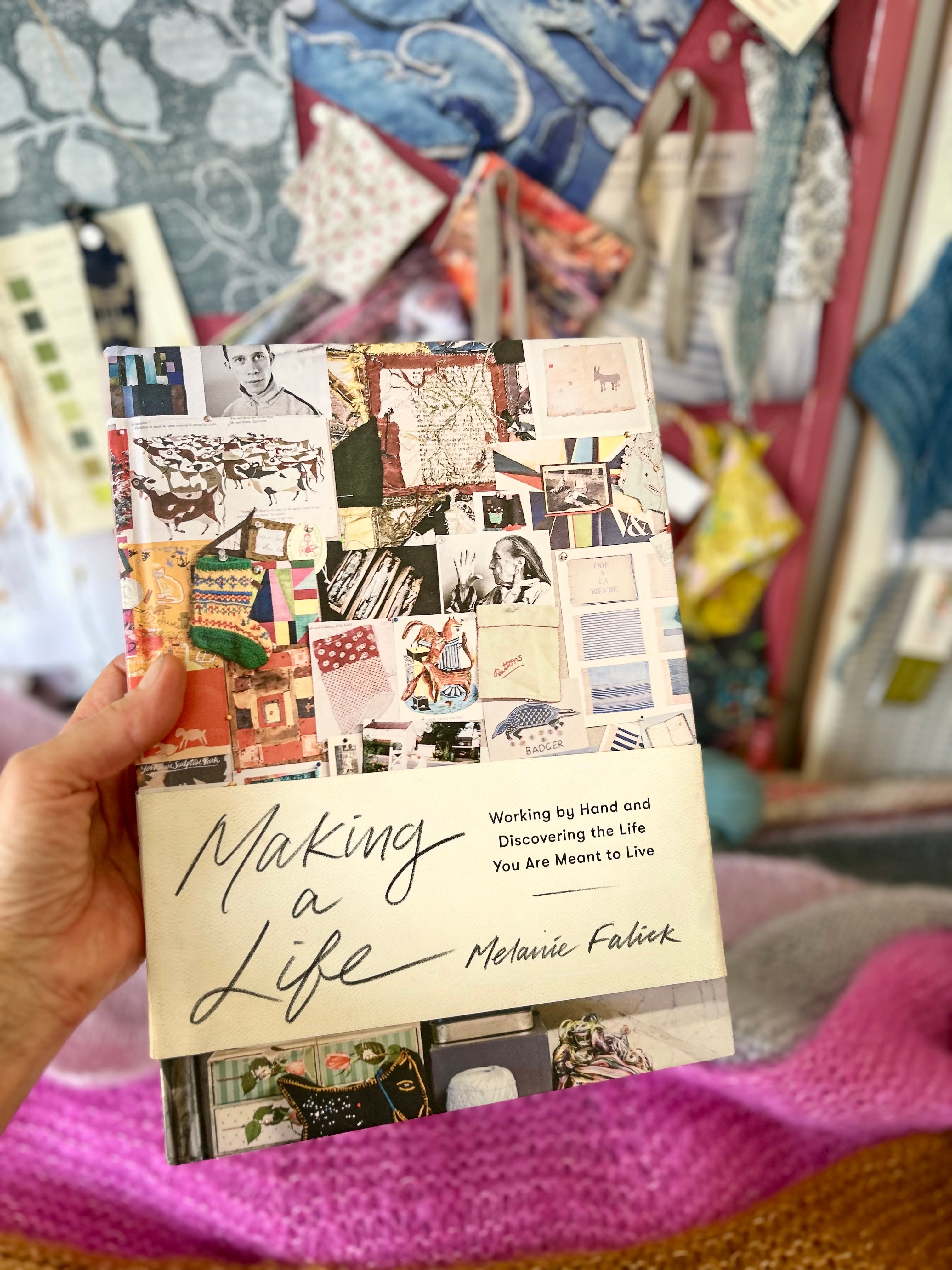
I’m sharing that original Q&A here as a kind of time capsule. It captures where my head was at the moment the book entered the world: what drew me to write it, the makers who shaped my thinking, the lessons I didn’t expect to learn, and the leap of faith that got me there in the first place. If you’re new to Making a Life, consider this an introduction. If you’ve read it already, I hope it offers a little behind-the-scenes look at the questions and ideas that shaped it.
Here’s the conversation, just as it was back then.
You have been an author, an editor, and a publisher in your lifetime. What inspired you to write Making a Life, and how does it differ from your previous work?
I have spent much of my career in publishing celebrating the value, beauty, and importance of making by hand. Many of the publications I worked on in the past were technique- and project-driven, meaning that they mostly taught people how to make things. For Making a Life, I wanted to focus on why we make things with our hands and why doing so is vital in the 21st century.
How did you become involved in the textile / crafts world? And why is making by hand so important to you?
I grew up in a home where making by hand, sometimes out of necessity but more often for the sheer pleasure of it, was an ordinary part of our lives. As a young adult, I became passionate about knitting. I loved what I could create with my hands, how I felt in the process of making, and how I could travel the world--learning about and connecting with people and cultures--by way of their yarns, techniques, patterns, traditions, and so on. Gradually, my interest in knitting as a creative medium and as a lens through which I could learn about the world and, ultimately, myself, extended to other types of making.
In a broad sense, I see making by hand as a portal through which all of us can become better attuned to our true selves and our relationship to the people around us and the planet we live on. On a personal level, making by hand has helped me to slow down and feel peaceful, grounded, and fulfilled—and, at the same time, fully alive—in a world that often moves too fast and is too loud for me. In addition, it engages me in a tactile and visual experience that bring me great pleasure and leads to a tangible object that becomes part of my life. The more I am able to make or repair in order to take care of my own needs—or at least understand the services others are providing to me—the better (more resilient and safe) I feel overall.
What do you think we are in danger of losing when we stop making things by hand?
I think the importance of making by hand is generally underestimated in our culture—and we do so at our own peril. As Renate Hiller (featured in Chapter 1: Remembering) expressed so powerfully, when we stop knowing how to use our hands to meet our most basic needs, we become estranged from nature, from the value and meaning of things, and from the empathy we need to care for one another and our world.
Think about it: For tens of thousands of years being able to make by hand was the key to survival. It gave life purpose. People used their hands to make their shelters, clothing, and tools and, of course, they also foraged, grew, and prepared their own food. Over the past few hundred years, since the start of the Industrial Revolution, we have gone from being a culture of makers to a culture of consumers. Somehow “success” has become so tied to the idea of making more money and acquiring symbols of wealth that it has become very easy to lose sight of a deeper, ultimately more life-affirming, purpose.
‘How did you begin your research and decide on makers to include in Making a Life?
I began by making lists: individuals and groups to talk to, books to read, podcasts and lectures to listen to, ideas to investigate, themes to consider, places to visit. I explored as best I could and reached out to people whose stories, perspective, and process caught my attention and resonated with me—and who I thought I could travel to meet in person given the reality of my schedule and financial resources. The book recounts my experiences with the cross-section of makers I happened upon. I could continue to write this book for the rest of my life and never run out of subjects. In many ways, I would enjoy that.
Of course, every one you wrote about has their own unique story. Did you also find them to be similar in some ways?
Yes. They all love what they do. They have come to making in many different ways. But they all see it as integral to their sense of self. They have challenged the status quo and built a life for themselves in which the impulse to work with their hands informs not only how they spend their time but also how they relate to the world around them and how they define success.
How did you decide on the book’s organization?
The chapters are divided into themes based on some of the key ways making by hand can contribute to a fulfilling life. There’s Remembering (connecting with the practices of our ancestors and with the natural world), Slowing Down (easing our pace rather than trying to adapt to the speed of machines), Joining Hands (gathering with others who share our passion), Making a Home (creating comfort and meaning in the places we inhabit), and Finding a Voice (discovering a satisfying means of self-expression).
You wrote about trips to India and Mexico in the introduction to the book but you didn’t write profiles of makers in those places. Why did you make that decision?
Early on in this project, I traveled to Jaipur and New Delhi, India, and Oaxaca, Mexico, places with long, rich histories of handmaking. Beforehand I wondered if I could write about the makers I would meet there, but once I arrived, I realized that I would need much more time and a much deeper understanding of their cultures to fully comprehend their stories and relate them with real sensitivity and authenticity. I chose to write about both of those trips in the Introduction because they were an integral part of my own education, helping me to gain perspective on the complicated relationship between handmaking and economic development and globalization. That’s a relationship that I’d like to explore further.
What important lessons did you learn about making by hand through your research? What surprised you the most about the journey of writing it?
Over the course of writing this book I became much more attuned to the dangers of capitalism when it isn’t practiced with compassion and, instead, allows the goal of making money to take precedence over the wellness of people and the environment in which we live.
While in Paris visiting Natalie Lete (Chapter 5: Finding a Voice), she said to me, “I make, therefore I am,” a play on DesCartes’ famous pronouncement, “Je pense, donc je suis” (“I think, therefore I am”). Then, after leaving her studio, on the way back to my hotel, I saw “Je depense, donc je suis” (I spend, therefore I am) scrawled on the wall at the metro stop. In a way, those three statements track (pretty pessimistically) the changes that have transpired in how we live and what we focus on. I see what I call the DIY renaissance as a positive sign for the future.
In Making a Life you mention the DIY renaissance occurring as part of the same impulse that drives slow food and slow fashion. Can you expand on this thought?
All of these movements reflect a growing sensitivity and ethical concern about how, where, and by whom what we consume is produced, whether that is food, clothing, or anything else, and a sense of responsibility for how our choices affect our daily lives, people near and far, and our environment.
If you had to pick one story from the book that really impacted your way of thinking about making by hand, which one would it be and why?
It’s very hard to choose, but if I must: the conversation with Ellen Dissanayake about making by hand and art-making being universal biological impulses inherited from our hunter-gatherer ancestors. Recognizing that these impulses are wired into me genetically has helped me to understand why I feel so strongly about their power as tools to build emotional wellness.
In your intro, you say you reached a certain point in your publishing career in which you were making a good living, but no longer making a good life. Did writing this book change any of that for you? What is your hope for the future?
Writing this book definitely helped me on my quest to sync the way I spend my time with my values and goals. I now have a clearer sense of what success means to me and am more aware of how the choices I make on a daily basis impact my ability to make both a good living and a good life.
The more time I spend taking care of my own needs rather than outsourcing them and connecting with people and places in a sincere way, the more vibrant and empowered I feel.
I expect that I will spend the rest of my life exploring creativity, spending time with other makers, and hopefully making a positive contribution.
You left your full-time, salaried job without knowing exactly what you wanted to do next, just feeling sure that you needed a change. What 3 pieces of advice would you give to someone who is thinking of taking that leap?
Define what success and happiness mean for you personally.
Tune into the decisions, small and large, that you make each day that align (or not) with those beliefs.
Make a list of all of the little messages your internal voice whispers to you about what you want to be doing.
Don’t put any pressure on yourself and let it be stream of consciousness. When you’ve finished, take a look at your list and think about what those whispers are telling you about yourself. Share it with people you trust and talk to them about it. My first “whisper list” included learning to make pickles, traveling to India, participating in a writing residency, learning to change a tire and build a shelter, and taking a graphic design class. So far, I’ve done all of them except for the tire and the shelter.
Ask yourself: If not now, when?
In my last year at my full-time, salaried job, I thought a lot about the regrets I would have if I didn’t leave and pursue some other dreams. I knew I would do freelance work to make money and meet my financial obligations while I was figuring out my next move, but I was scared: I spent a lot of time worrying about giving up my employer’s contribution to my retirement savings. Then I realized that I needed to balance saving for retirement with making a good, purposeful life in the here and now.
In the intro, you say you were moved by a lecturer who reminded his audience to never let the lure of technology or business overshadow the value we place on working with our own hands. What are some concrete ways we can be most conscious of this?
In terms of technology, I think we need to pay attention to how it is changing our lives and assess when it is for the better and when it isn’t. As Judith MacKenzie (Chapter 1: Remembering) said to me while showing me a collection of handmade textile tools, some of them hundreds of years old: our brains and our hands shape tools and then, the way we use those tools changes our brains.
In terms of business, mainstream culture would have us believe that salary and status, profit and market share are the metrics by which success should be judged. In Chapter 5: Finding a Voice, I wrote about woodworker Alex DeVol who was educated at a prep school about which he said, “Not for a second were we encouraged to question the idea that financial success and a good title were what we wanted.” That’s a pretty common experience these days. Certainly, having enough money for and access to nutritious food, safe housing, education, and healthcare are essential but, beyond that, I think it is beneficial to examine what we are seeking and why and whether or not the path that has put us on is positive in terms of how we are living and what we are contributing. Making by hand provides us with an alternate lens through which to investigate these questions and a different kind of insight into what we are capable of changing in our own lives and in the wider world around us.
What do you hope readers take away from Making a Life?
I hope readers will feel compelled to investigate, celebrate, and honor the vital role of making by hand, and creative expression more generally, in their own lives and in the lives of others all over the world. And I hope the stories and ideas I present will inspire them to believe in and reach for their dreams, even when that means starting with one very small step at a time. The journey is, indeed, the destination.
I’ve been quiet here lately because I was in Portugal for two weeks, and now I’m prepping for a class I’m filming as part of KnitStars — the crew is coming to my house in a few weeks to shoot it.
The class, called The Maker’s Way: A Roadmap to Joy, actually picks up right where this Q&A leaves off. We’ll explore the connection between creativity, authenticity, and personal fulfillment — approaching making as a lifelong practice rather than a destination. As a guide, I’ll be returning to the basics of knitting, using the simple triangle as the foundation for a personal capsule collection, and inviting participants to build a framework for one of their own. It’s very much an extension of the same questions I was contemplating when I wrote Making a Life: What does it mean to make a good life, not just a good living, and what role can our hands play in the process?
As it happens, KnitStars is running a flash sale from June 28 through July 5, with a discounted rate to join and a previous season thrown in if you sign up early. (Full transparency: I do earn a commission if you enroll through my link.) If the themes in this Q&A resonated with you, this might be worth a look.
Back to our regularly scheduled making, soon.
No posts
Comments
Nothing yet. Say the first thing.
Sign in to join the conversation.