
While learning Bavli Avoda Zara, I recently came across an interesting passage. The context is a discussion of the permissibility of doing business in pagan fairs (i.e., markets officially dedicated to idolatry). In the discussion on 13a, the stam resolves a contradiction between two baraitot — one, in the name of Rabbi Nathan, forbidding it and an anonymous opinion permitting it — by explaining that buying at a fair is prohibited when purchasing from a merchant, who is subject to a tax whose proceeds go to idolatry, but permitted when buying from a homeowner, someone who is not subject to this tax. On 13b we are presented with the likely source of this explanation:
רבי יעקב זבן סנדלא רבי ירמיה זבן פיתא אמר ליה חד לחבריה יתמא עבד רבך הכי אמר ליה אידך יתמא עבד רבך הכי ותרוייהו מבעל הבית זבון וכל חד וחד סבר חבראי מתגר זבן דאמר רבי אבא בריה דרבי חייא בר אבא אמר רבי יוחנן1 לא שנו אלא בלוקח מן התגר דשקלי מיכסא מיניה אבל בלוקח מבעל הבית דלא שקלי מיניה מיכסא מותר
The Gemara relates: Rabbi Ya’akov bought sandals and Rabbi Yirmeya bought bread at a pagan fair. One said to the other: Orphan, i.e., one with no guide, would your teacher act in this manner? The other likewise said to him: Orphan, would your teacher act in this manner? The Gemara explains: Actually, both purchased these items from a homeowner, i.e., a private individual, and each one thought that the other had purchased his item from a merchant. As Rabbi Abba, son of Rabbi Ḥiyya bar Abba, said that Rabbi Yohanan said: The Sages taught that it is prohibited to buy from a gentile at a pagan fair only in the case of one who buys from a merchant, as a tax is taken from him and used for the benefit of idol worship. But with regard to one who buys from a homeowner, when a tax is not taken from him, it is permitted to make the purchase.
אמר רבי אבא בריה דרבי חייא בר אבא אילמלא היה רבי יוחנן הא זימנא באתרא דקא שקלי מיכסא אפילו מבעל הבית הוה אסר אלא אינהו היכי זבון מבעל הבית שאינו קבוע זבון
Rabbi Abba, son of Rabbi Ḥiyya bar Abba, says: If Rabbi Yoḥanan had been present at this time and age, in a place where the tax is taken from all sales, including those conducted with private individuals, he would have prohibited buying items even from a homeowner. The Gemara asks: But if so, how did these Sages, Rabbi Ya’akov and Rabbi Yirmeya, purchase items at the fair? The Gemara answers: They purchased the items from a homeowner who sells solely on a temporary basis.
After citing Rabbi Yohanan for the distinction between purchasing from merchants and from homeowners, Rabbi Abba adds another observation or argument of his own: if Rabbi Yohanan had been around to see the new situation, in which the authorities have started to levy a tax on everyone, he would have prohibited purchasing even from a homeowner. An interesting observation, but does it have any practical significance? After all, Rabbi Yohanan wasn’t there to see the new situation.
The answer depends at least partly on one’s legal theory. A positivist might argue that the rule laid down by Rabbi Yohanan, permitting buying from a homeowner, is still the law because it hasn’t been modified. What Rabbi Yohanan would or would not have said is not relevant, because he didn’t say it. This is the kind of response embodied by Faurist legal theory: if the Sanhedrin made a ruling, that ruling remains the law now unless subsequently altered by another Sanhedrin. If a new phenomenon or situation comes about on which the Sanhedrin never made a ruling, then that means there is no law, which usually implies there is no prohibition. But as we saw, the Gemara does not take that approach: what Rabbi Yohanan would have said according to Rabbi Abba implies there is indeed a prohibition.
Of course, the positivist might argue a number of ways about who actually had the (formal) authority in this situation; in other words, who represents the ‘Sanhedrin’ here. A positivist might argue that only the original law was created by the Sanhedrin, was followed by non-binding discussions interpreting that law, and it was only at the time of the ‘Sealing of the Talmud’ that the rest of the discussion was codified into law. But this fails to explain the discussion in the Gemara. If the original law banned any purchase, how did later rabbis carve out exceptions? If the original law already had exceptions built into it, why is there a question about the rabbis in the story making use of those exceptions?
Alternatively, the positivist might argue that when Rabbi Abba (citing Rabbi Yohanan) said the Sages enunciated the initial rule prohibiting purchasing from a merchant at a pagan fair, he meant the Sanhedrin made this ruling. When he refers to Rabbi Yohanan’s ruling, he means Rabbi Yohanan’s court (a Sanhedrin) upheld the distinction in his time. When Rabbi Abba referred to Rabbi Yohanan would have done, it was just his way of arguing for dropping the distinction, which was indeed dropped by the Sanhedrin of his day at his proposal—and this is why the Gemara takes this observation seriously, not only as a hypothetical or proposal, but as existing law (otherwise, the story recounted in the beginning, concerning two Sages of Rabbi Abba’s generation, would have posed no difficulty).
Such an answer obviously involves reading quite a lot of additional meaning into the text in a way which demands additional evidence. But we can come to a more straightforward explanation by switching legal theory.
The declaratory theory of Common Law posits that Common Law judges do not make law,2 they merely ‘declare’ or expound the law, applying pre-existing principles to new cases. Their precedents are also not ‘law’, but instead serve as evidence attesting to the law itself. I contend that a similar theory applies very well to halakha.
Similarly, setting aside gezeirot and takkanot, rabbis3 do not make law, they derive, expound and apply it to new cases. Their statements and rulings (unlike those of some Common Law judges) generally do not even have the formal authority of any kind of formal court, national or otherwise. Instead, they have epistemic authority, as reliable evidence of what the law is.
But in every legal system, there are two types of law (unfortunately, in English, they are both called ‘law’, which can be confusing). While ius embodies the general principles of the law, lex is a specific application of a law. Every rule of law lex has a ius principle behind it. The distinction between these two concepts is (for our purposes, at least) essentially relational; their formal status or authority (ruling, statute, national, local) of each is not crucial.
When the Sages forbade doing business at a pagan fair, their ruling was an application of that principle. Rabbi Abba, citing Rabbi Yohanan, said that the original Sages did not mean to include homeowners who do not pay the tax, not necessarily because they said so explicitly but because this was the application of the ‘real’ law—the principle (ius) embodied in their ruling. When he said Rabbi Yohanan would have applied the law differently had he been alive to see the new situation, he means the correct application of the law (to the new situation) is different from what it was during Rabbi Yohanan’s time.
In this context, the rulings of Rabbi Yohanan and Rabbi Abba are lex. The real legal rule (ius) behind these more specific rules is the principle: ‘it is prohibited to benefit idolatry’,4. This is the ‘real’ law—not that one is allowed to buy from homeowners but not merchants and not that either one is prohibited. This was ‘the’ law all along. The rabbis make different rulings at different times as different realities demand different applications of that law.
It is not surprising, therefore, that the Gemara opened the entire discussion of the Mishna on this very point (12b-13a). There, it is a mahloket between Reish Lakish, who understands the Mishna’s ratio decidendi5 as being that it is forbidden to derive benefit from idolatry, whereas Rabbi Yohanan argues that that it is not only forbidden to derive benefit, but even to cause benefit. We are not told explicitly how the disagreement was resolved (was there a formal vote?), but the way the stam and Rabbi Abba discuss the matter suggests that Rabbi Yohanan’s view came to be accepted. Unlike positivism, a declaratory theory usually doesn’t require assumptions about the presence or absence of formal authority; it just requires the availability of precedents.
This account may also explain the Gemara’s ultimate resolution of the difficulty of Rabbi Yirmiya and Rabbi Yaakov having made purchases as a pagan fair, reportedly from a homeowner. Rabbi Abba’s observation implies in their contemporary context, this is forbidden as homeowner sellers also pay a tax. The Gemara’s solution, as Rabenu Hananel and Rashi both explain, offers a type of homeowner who would not have to pay the tax and whose wares would therefore still be permitted. Far from arbitrarily carving out an exception to the previously stated law (lex), the stam is simply providing another application of the ius which is the real subject of the discussion.6
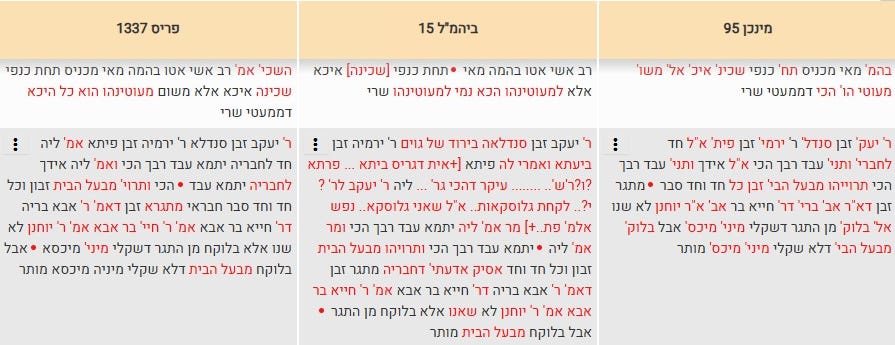
The Vilna edition does not include this attribution to R. Yohanan, but most manuscripts do:
This is something of a simplification, but a useful one for the matter at hand.
Both past and present, although the later the period, the easier it is to see this.
Perhaps also more specifically that paying a tax dedicated to idolatry counts as benefiting idolatry.
i.e. the underlying reason for the ruling it presents.
Of course, we see this kind of ukimta everywhere in Talmud, and I don’t claim this kind of theory can account for all of them, but it’s nice when it does.
No posts
Comments
Nothing yet. Say the first thing.
Sign in to join the conversation.