
Hi all — I’m happy to be back after a long silence, and looking forward to posting regularly over the next weeks to make up for it. A bit of business, first. I’m teaching a Zoom workshop today for the Conscious Writers Collective on what I call the palimpsest narrator — one of the most important concepts, I think, for any narrative nonfiction (or fiction) whose narrator toggles between a past in which things are happening and a present in which she’s reflecting on them. A few spots may still be open: register here. I’ve written about the palimpsest narrator before here — the workshop is a chance to go deeper if you’re interested.
I’ve been quiet because I was at MacDowell for a stretch, finishing a draft of a book that I started writing this winter and spring as a kind of “secret” book. I was supposed to be writing a different book. But this book kept wanting to be written and creeping into the pages of the other one (where its aims and goals and tone didn’t make sense). Before that I was deep in the semester and trying to protect The Yale Review, which I run, from the effects of the new endowment tax passed by Congress, which has cut / touched every department and program at a place like Yale.
Now I’m home, trying to re-enter ordinary life, which (as anyone who’s done a residency knows) is its own strange transition. You go from a little cabin in the woods, fed three times a day by expert chefs, with a staff there to help with anything you need, back to a world that needs you to do everything for yourself (and your kids, as the case may be) - it’s disorienting to have to figure out how to be a person with responsibilities other than writing again. Nothing like life in my cabin with my big window and desk, and the picnic basket lunch that had just been delivered:
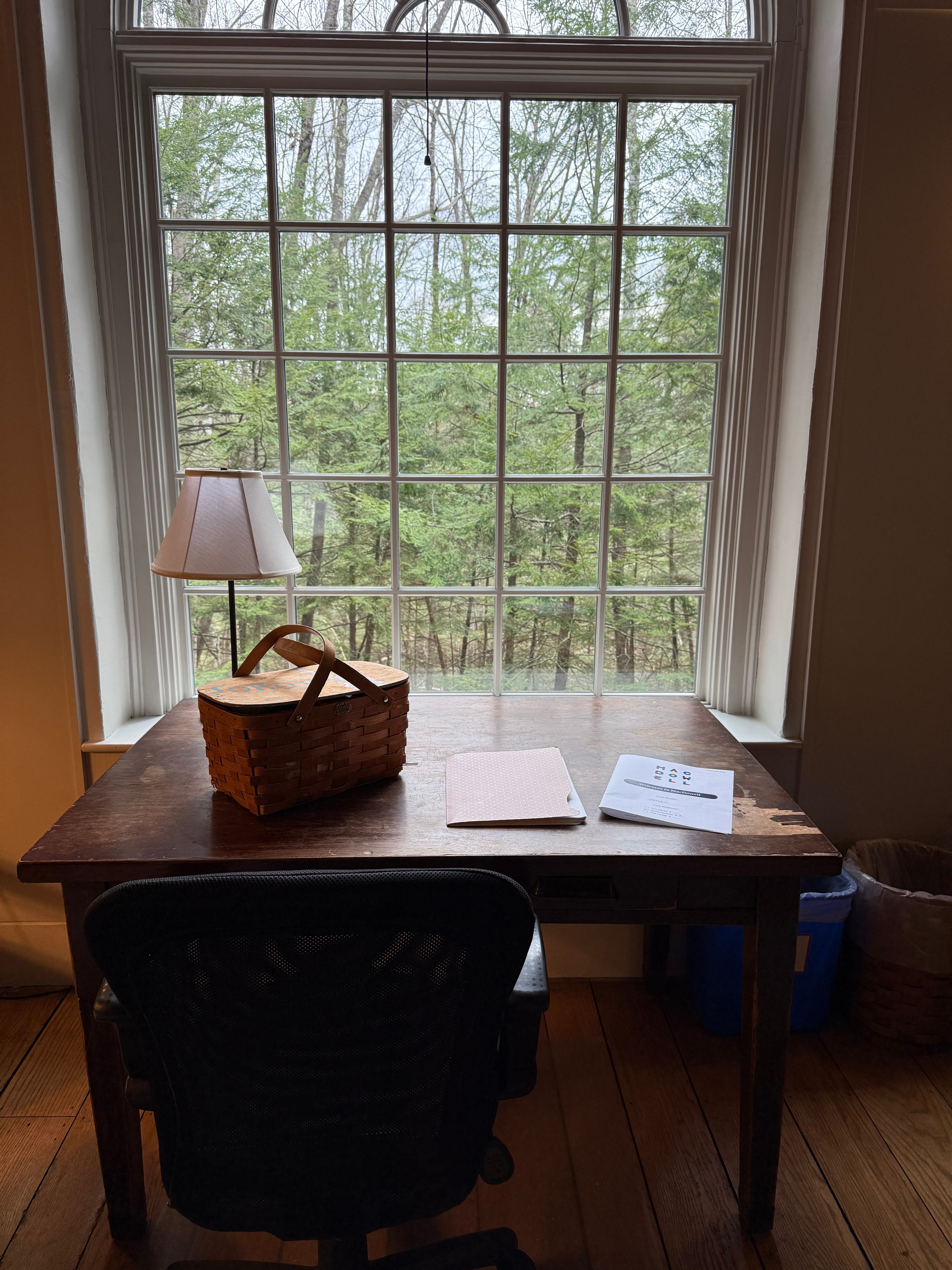
So today I wanted to write about residencies. I had nearly forgotten what they’re really for, and what they can do for you if you need it.
We often talking about needing time to write, though we what we most mean, as I’ve talked about before, is protected time: time defended from all the pressing (or not-so-pressing) that weigh on one’s mind, and make it hard to write. Small tasks like calling a plumber to fix a minor leak, the email, the dishes, clothes for your kids’ dance concert, the slow administrative drip of responsibilities, which also require a constant, draining, switching of internal identities. But until I went back to MacDowell in April—this was my third time, but my first residency since the kids were born—I’d forgotten that time and space are only part of the gift a residency offers. The real gift is being taken seriously as an artist, and the deep nourishment of your identity as an artist. I did not know how depleted I was until I spent two weeks somewhere where I was an artist, and that was it. It allowed a deeper kind of focus.
I had persuaded myself I didn’t need any of this. I have two young kids; going away for two weeks seemed hard, even indulgent. But within three days at MacDowell, I realized how wrong I’d been. My older son is nine and a half, and I suddenly thought, I have not really been writing for nine and a half years. On the third day, I’d done all the small edits I owed and I thought, What should I do now? — and realized, Now I can think. In that moment I made discoveries about the form of the book I was working on and wrote three sections I hadn’t anticipated, sections that I think made the book immeasurably better. What a residency offers is not all lightness and wonder; sometimes, that time allows grief and fear to intrude, which are also, like boredom, important parts of writing that I almost never experience because my available time is in such short supply. I have had pockets of time to work: I do travel a lot, in my life as a writer, and often get to write in hotels, or in places where I won’t be interrupted by small voices asking for more mango— but what MacDowell offered, over nearly three weeks, with all necessities taken care of, offered a level of concentration that I have not had in a decade.
I realized that forevermore I’ll be making a two-week residency part of my practice. After all, though it seems indulgent, it is essential to have the focused time; I realized that if you’re an actress and you’re in a play on Broadway or off-Broadway, you go every night to the theater. You just have to do it to make your art. A film actress travels to her set. The same is true for being a writer. We do need to go to our set (our mind), and for me it was a transformative experience that I will be carrying forward. And: although I was nervous about leaving my kids, it was definitely manageable for them at this age (9 and 7). In fact, they wrote a murder mystery while I was away and texted it to me in installments — as if they were having their own private MacDowell.
Below is a working list of residencies I’d recommend, organized loosely from most well-known and selective to lesser-known and more accessible. One issue is that some residencies have a minimum time amount that is pretty long, like four or six weeks (which I find astonishing in this day and age - it’s not at all friendly to working parents, or primary caregivers of any kind, especially those who are the bearer of the mental load of caregiving, which is usually a kind of artist who most needs a residency. What can we do to make this inequity issue much more visible to institutions? I’ve been thinking a lot about this and talking about it with some. I see that Saltonstall has special one-week caregiver residencies, which is a fantastic model, one that more places need to embrace.
A note: deadlines, fees, and stipends often change, so confirm everything against the residency’s own site before applying. Remember: there is always something arbitrary about applying. Apply more than once—consider this my words of encouragement to keep trying (and keep working on your application, making it stronger each time.)
Comments
Nothing yet. Say the first thing.
Sign in to join the conversation.