
Common Sense Media recently released Teens in the AI Era: Pornography and Sexual Content, a report I had the privilege of serving on as a Scientific Advisor. The team surveyed more than 1,300 teenagers across the United States about a new reality that many adults haven’t even considered: How is AI changing the sexual world our kids are growing up in? The answer? Faster than any of us expected. And perhaps more importantly, teens are figuring this out mostly on their own.
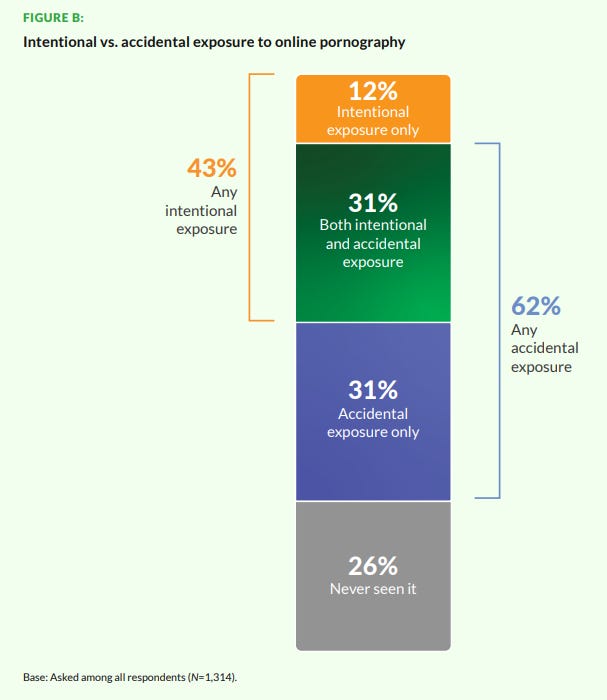
First, we can’t understand AI-generated pornography, without first returning to what teens are seeing in “regular pornography” land. As seen in the figure below, 74% have seen online pornography either accidentally or intentionally. Of note, this survey shows that the majority of exposure now occurs by age 12, compared to age 13 in the 2022 Common Sense Media Report on Teens and Pornography The gender gap in who is seeing pornography continues to close. Ten years ago boys were substantially more likely to see pornography than girls, but now it is only around a 10% difference. Although there are inconsistencies in what participants might consider pornography, it is important for adults to know that several reports (included here and others) indicate that teens are seeing violent pornography that contains choking, slapping, name-calling, hitting, punching, and forced gagging on penises, to name a few.
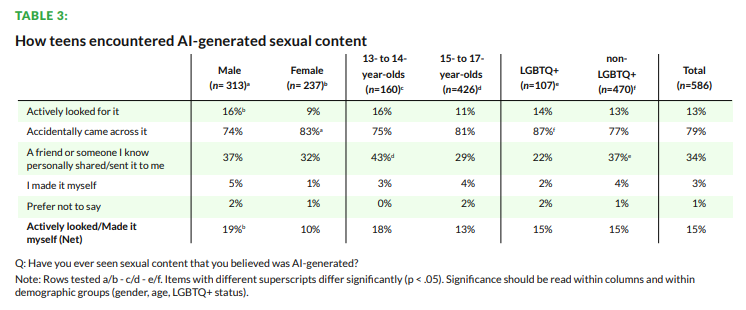
Nearly half of teens in this study have seen nude or sexual content that they believe was generated by AI. Of those, 1 in 4 participants saw sexual depictions of themselves or someone they knew personally. A lot of the content is shared in social media spaces, group chats, etc.
To understand the scope of how this technology is shaping adolescent sexual development, we first need to understand the basics about what this technology is. Now, am I a leading expert on this tech? Absolutely not! But I will attempt to explain a few things that may be relevant to understanding some of the new trends.
Deepfake technology is not new. Remember Deepfake Tom Cruise? Image-based content can be fed into ai-generators with instructions to have the content engage in different actions, wear different clothing, have different hair colors, etc. Thus, “undressing” or “nudify” apps are fairly simple technology which use a database of images to alter whatever image you submit to it. In the case of most ai-generated sexual content, it is typically made from images that you would find in a yearbook or social media profile. The app turns the pictures into a nude based on the database of nude images it has been fed.
But guess what? Are you as surprised as me to learn that there are TONS of nudify apps, more than 100 and counting?? An investigation found 31 of them were even deemed appropriate for minors in app stores for Apple and Google. But here’s the kicker, many of these apps can only nudify women and girls. Many do not even have the programming to make images of men nude. So you may wonder: who is creating and profiting from these apps? You guessed it! Not women.
One of the most striking findings from the Common Sense Media study on Teens and AI-generated Pornography wasn’t simply that AI-generated sexual content is becoming commonly viewed and even created. It was how differently boys and girls experience it.
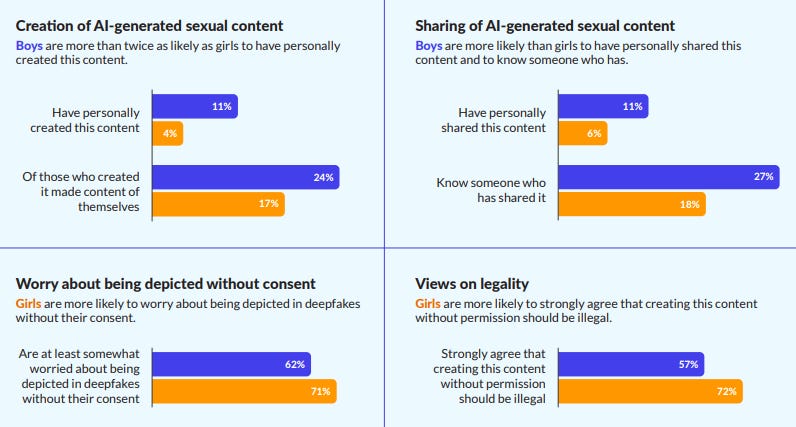
Boys were (sometimes substantially) more likely than girls to:
intentionally seek out pornography
encounter AI-generated sexual content
create AI-generated sexual images (nearly 2x more likely)
share AI-generated sexual content with others
know someone who has shared it
Whereas girls were more likely than boys to:
encounter AI-generated sexual content through social media rather than pornography websites
strongly believe creating sexual deepfakes without permission should be illegal
worry that they themselves could become victims of AI-generated sexual images without consent
That last point is important to note. Nearly three out of four girls reported worrying about being depicted in a sexual deepfake without their consent. Imagine being sixteen and having to wonder not only whether someone might take an embarrassing photo of you...but whether someone could simply invent one. This is the world today’s teenagers are growing up in.
Despite several gender differences in how AI-generated sexual content impacts teens, boys and girls actually agreed on something important: Both believed AI-generated sexual content changes how teenagers think about what bodies should look like and what relationships and sex should be like. The kicker is that they know it impacts attitudes, but they can’t escape or avoid it.
Sexual content is everywhere, regardless of who produced it.
That is the heartbreaking aspect of all of this. In sex positivity, we understand that there is both “freedom to experience…” and “freedom from experiencing…” In today’s digital landscape, there is less and less freedom from experiencing sexual content before one wants to and less and less freedom from ever experiencing nonconsensual sexual content. In other words...This isn’t just a “girls’ issue.” It isn’t just a “boys’ issue.” It’s a human development issue.
Teens also know that it is difficult to get help. If there are nudes out there (AI-generated or not), many fear that they cannot seek help because they will be accused of or blamed for sending a sexy or nude pic in the first place.
Only one in five teens say a trusted adult has ever talked with them about AI-generated sexual content. Yet over one-third wish they could have that conversation and simply don’t know how to start it. They are worried about getting in trouble. Facing consequences for looking at pics, sending pics, knowing about pics being used to extort others, you name it.
In our research on teens and discussions about pornography with parents, we learned that teens really do want their parents to talk to them about porn. Maybe not the details, but to acknowledge that it is there and something they have to navigate. It’s unavoidable and they want some advice.
What do teens think would help? Parents being clear that a teen’s phone won’t be confiscated, that they won’t be getting a lecture. Being sure that they know that they will NOT be blamed if they send a nude and that nude ends up going viral. They want adults who understand and can actually help. It is tempting for adults to warn teens of all the ways their lives will be messed up if they do something, but that almost guarantees that if they do that thing, we will never know about it.
Every generation of parents has had its “this is ruining our children” moment. Over the years, many innocuous and some pernicious aspects of culture have been blamed for the “ruin.” Comic books. Rock music. MTV. Video games. The internet. Smartphones. Social media. If parenting came with merit badges, “Survived a Technological Moral Panic” would probably be stitched onto every generation’s sash.
What’s different about AI isn’t that it’s another scary technology. It’s that it changes the speed and scale of how young people encounter sexually violent imagery. A teenager no longer needs technical expertise to create a convincing nude of a classmate. They don’t even need a real photo. They don’t have to logon to a porn website, let alone wait for the latest pornographic magazine or DVD. AI can generate personalized sexual content in seconds on their phones without even being detected as adult content.
The technology has changed dramatically. Human development has not.
Adolescence is still a time when young people are figuring out who they are, how relationships work, what attraction feels like, how to navigate peer pressure, and what kind of person they want to become. AI hasn’t replaced those developmental tasks. It’s simply become another environment where they play out.
That’s why I don’t believe parents need to become experts in every app, every AI image generator, or every new platform that appears between now and next Tuesday. Our job has never been to outsmart technology. Our job is to help our kids become the kind of people who can navigate it wisely.
How can we possible help teens navigate something with wisdom that we ourselves know so little about? We help them ask questions that algorithms never will:
Is this real?
Is this respectful?
Did everyone involved actually consent?
How might this affect another person’s life?
Does this reflect the kind of relationship I want someday?
Technology can answer almost any question. It cannot teach wisdom. That’s still a profoundly human job.
Instead of opening with, “Have you ever seen AI porn?” (which is a fantastic way to end a conversation before it begins), try something like this:
“How do people talk about AI pornography or deepfakes at school?”
You’re asking about their world, not interrogating their behavior.
“If someone made a fake nude of another student, what do you think should happen that might actually have a positive impact?”
You’ll learn a tremendous amount about your teen’s values before you ever have to share your own.
“If someone ever used AI to make a fake image of you or one of your friends, what would you want adults to do about it?”
That question communicates something powerful: I’m someone you can tell.
“If AI can create pictures that never actually happened, how do you think we’ll know what’s real online five years from now?”
Then listen just listen to what they say. You may be surprised by how much your teenager has already been thinking about AI-generated content.
"If anyone ever creates, shares, or threatens to share a nude image of you, whether it's a real photo or something made with AI, I need you to know one thing first: you can come to me. You will not be blamed. We may have some difficult things to work through together, and there may be real consequences we can't control, but you won't have to face them alone. I will work hard to be part of the solution and not add to the problem.”
The most important piece to communicate in all of this is the good that can come from seeking help from us.
Thanks for reading Teen Talk Tuesday! This post is public so feel free to share it.
No posts
Comments
Nothing yet. Say the first thing.
Sign in to join the conversation.