
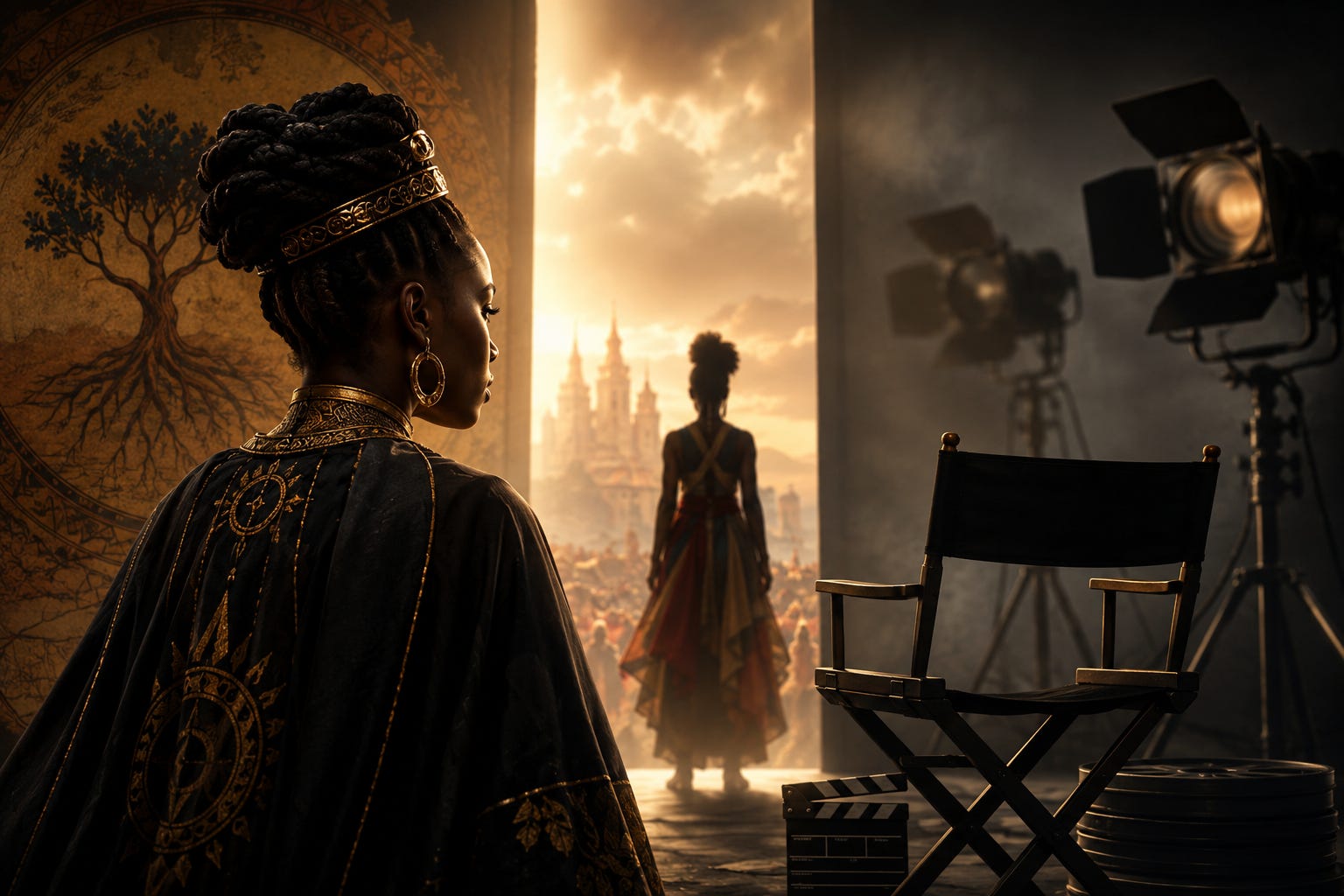
I wasn’t going to write about Tomi Adeyemi and the Children of Blood and Bone saga. In fact, I’d made a conscious decision not to be a part of the drama. But the more I saw, the less I could stay silent.
I first read Children of Blood and Bone in 2021, not knowing it was a young adult novel. By the time I realized it was, it didn’t matter because I was hooked on the story. Tomi put her whole foot into that book! When I’d heard that her amazing book would be made into a movie but she wouldn’t be supporting it, I was both confused and conflicted. I was later saddened when I learned she has since publicly severed her relationship with Amandla Stenberg, who plays Princess Amari.
This is the kind of movie we’ve been demanding from Hollywood, and the author responsible for it was sitting it out? As someone who’s spent years working with authors and advocating for Black voices in publishing, Children of Blood and Bone felt like a win. Here was a bestselling novel written by a Nigerian-American woman being adapted into a major film production directed by Gina Prince-Bythewood, a Black woman, with a predominantly Black cast that includes Viola Davis, Regina King, Idris Elba, Chiwetel Ejiofor, Cynthia Erivo, Lashana Lynch, Damson Idris, and Thuso Mbedu. This was huge!
This movie isn’t just another streaming special; it’s a major theatrical release, which signals confidence in the project. Tomi was even brought on as a screenplay co-writer and an executive producer. This level of investment—unheard of for most debut authors—shouldn’t be taken lightly.
Like many people, I immediately wanted to know why. I just couldn’t fathom spending years creating a world that millions of readers embraced only to walk away from its film adaptation feeling hurt. I watched Tomi’s videos and read the comments and many think-pieces in search of an answer. But the more I watched the conversation unfold, the more conflicted I became. While I felt for Tomi, I didn’t understand what was true and what was public conjecture.
Now, don’t get me wrong. If Tomi says the experience was painful, I believe her. She doesn’t owe the public every detail of what happened behind closed doors, and I’m certainly not entitled to them. Yet, almost overnight, social media filled in the blanks. Some people said the issue was colorism because the actress playing Princess Amari is lighter-skinned than many readers imagined from the novel. Others insisted it was because the cast wasn’t Nigerian enough, despite the fact that Hollywood has a long history of actors portraying characters whose nationality differs from their own. Others were convinced the studio ignored Tomi’s vision completely.
People began calling for a boycott of the movie to stand with Tomi, which I felt was admirable. However, I wrestled with the fact that this seemed to have less to do with Tomi, and more with us as a community. When did we become so comfortable making decisions based on information we don’t actually have? Blame the journalist in me, but I cannot support either side based on an assumption.
Before I became a literary strategist, coached authors, or talked about AI visibility, I spent years as a military journalist. My job wasn’t to repeat rumors; it was to separate facts from assumptions. That’s probably why I don’t get overly emotional over Instagram videos or swept up in groupthink. I ask questions and look for context. If we’re going to take a public position—especially one that could affect hundreds of Black creatives beyond the person at the center of the story—I think we owe ourselves more than speculation.
Here’s what we know. Tomi Adeyemi has said the filmmaking process was deeply painful, and she’s chosen not to support the finished film. What she hasn’t done is publicly explain exactly what happened. That’s her choice, and I respect it, but we’re not just talking about one author’s experience. We’re talking about whether an entire community should support—or refuse to support—a film that represents something much bigger than itself.
According to UCLA’s Hollywood Diversity Report, examining 2025 data, films with casts that were 41–50% people of color generated the highest median domestic box office, the highest median worldwide box office and the highest median return on investment among major studio releases. At the same time, the report found that 80 percent of directors and more than 91 percent of screenwriters working on those films were White. Think about that for a moment. Audiences have consistently demonstrated that they will support diverse stories, yet the people who get the opportunity to tell those stories at the highest levels still don’t reflect that same diversity.
That’s exactly why Children of Blood and Bone matters.
Whether the final film reflects Tomi’s original vision is a separate conversation. The reality is as readers, we often want film adaptations to recreate the book exactly as it was written, but that’s rarely how Hollywood works. Stephen King famously disliked Stanley Kubrick’s adaptation of The Shining. P.L. Travers never embraced Disney’s version of Mary Poppins. Alan Moore has spent years distancing himself from adaptations of his graphic novels. Even the characters in the Ava DuVernay’s highly popular TV series Queen Sugar were dramatically changed from Natalie Baszile’s novel.
I don’t know what happened behind closed doors and I won’t pretend I do, but I also know Children of Blood and Bone represents the possibility of more Black fantasy stories finding their way to the big screen. If this movie fails, will it make it harder other Black fantasy authors like Torrie Q. Jones, Ayana Gray, or Jamison Shea?
Sadly, we’ve seen this happen too many times with big budget Black films such as Harriet, Birth of a Nation, Woman King, and many others. Too often, our conversations about Black films become dominated by what they got wrong before many of us have even seen them. These conversations can often determine a film’s box office success because they shape public perception. I don’t want to see that happen this time. Not when so much is at stake. I’m afraid if we’re not careful, if we continue holding Hollywood to a zero-sum standard, we may win the battle but lose the war.
I won’t pretend I have all the answers. But what I do know is Hollywood doesn’t remember our hashtags, it remembers our ticket sales. For this reason, I support Tomi in her decision, and I pray that she heals from whatever the experience was that hurt her. However, I also choose to support the film and the hundreds of Black faces involved with it because it could potentially open doors for the next generation of Black fantasy storytellers. We need this one to succeed.
Thanks for reading Team MTW! This post is public so feel free to share it.
No posts
Comments
Nothing yet. Say the first thing.
Sign in to join the conversation.