
I’ve been thinking a lot about the future of conflict — not necessarily in a hot war capacity, but in the sense of slowly boiling the frog. It’s a theme that’s developed across my reporting in recent months, most notably in my conversation with Gen. Gagnon of the U.S. Space Force and with recently retired Pentagon CIO Leslie Beavers, who told me that we are facing a sustained cyber-invasion.
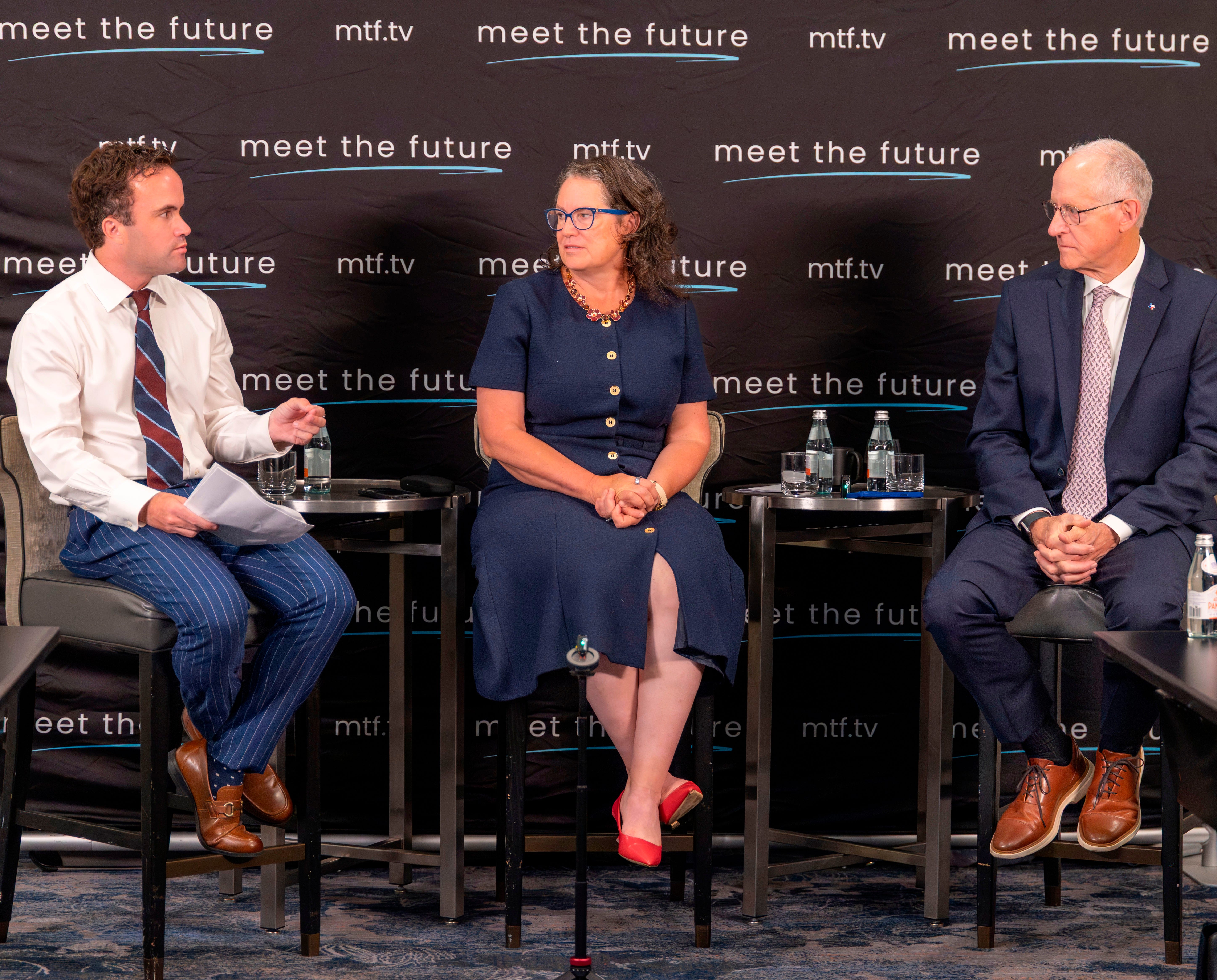
With this on my mind, I sat down with former Congressman Mike Conaway, who was a member of the House Intelligence Committee and chaired the House Agriculture Committee. I also wanted him joined by Christine Bordine, who's 37 year career spanned across several administrations from Regan to Trump and most recently served as the Dep. Director for the Defense Intelligence Agency.
I wanted to better understand how the Strait of Hormuz was impacting Americans at the grocery store — and whether the pain millions are still feeling can be connected to the geopolitics of that narrow waterway.
The answer: Yes, it can.
But it also teaches us something powerful: our adversaries know that food security is national security. And national security includes food security. What’s happening at the Strait of Hormuz directly impacts both.
If you’re looking for partisan analysis, this is not the piece for you. This is a piece about America’s exposure to the world’s critical straits and how those vulnerabilities reach our kitchen tables.
The disruption in the Strait of Hormuz is already driving up costs for the food Americans buy every week. Conaway laid out how farmers face higher costs they cannot fully pass along because they are price takers on both ends of the market. Transportation expenses, which already make up a significant share of final food prices, climb when energy and shipping markets are disrupted.
—> KEY QUOTE, Bordine: “The really interesting thing that happened with the Strait of Hormuz closure is that it wasn’t necessarily the mines or the blockades that really impacted it — it was the decision of the insurance companies not to insure the ships transiting the Strait, because there’s no way to guarantee a ship won’t be hit by a mine.”
While the United States produces much of its own food, we operate in a global system where disruptions anywhere create price pressure everywhere. This is not just about empty shelves in other countries — it is about higher costs showing up at checkout for American families right now.
Last month, the government stopped extra taxes on fertilizer from Morocco for eight months. Critics of this approach say that this might make fertilizer a little cheaper for now, but it hurts American companies that make fertilizer here at home. Relying on other countries for important farm supplies is not a smart plan and can put our food and national security at risk later.
Conaway said phosphate fertilizers depend on sulfur — with roughly half the world’s supply moving through the Strait — while nitrogen fertilizers rely on natural gas and LNG that also transit the region. When those routes are threatened, he explained, input costs for farmers rise sharply.
—> KEY QUOTE, Conaway: “What China has done — to self-protect — they have historically been a large exporter of fertilizer, and they’ve never restricted it significantly to protect their own growing season. But now that supply is no longer in the market. So fertilizer prices have gone up high.”
—> BOTTOM LINE: China’s decision to restrict its own fertilizer exports to protect domestic supply has tightened global availability even more. The result is steady upward pressure on grocery bills at a time when many households are already feeling squeezed. “A nation that can feed itself is certainly more secure than a nation dependent on getting food from other parts of the world,” Conaway told me. “…If we depend on bringing in food, and the disruption happens, it’s not just higher costs in grocery stores — people get empty shelves. Something no American has experienced since the Dust Bowl in the 1930s.”
The crisis shows how adversaries can use relatively cheap tools to disrupt global trade at key maritime chokepoints. Bordine explained that mines combined with anti-access capabilities — and especially the private sector’s reaction through insurance companies withdrawing coverage — can effectively shut down vital waterways without triggering full-scale war. This low-cost, high-impact approach is now being studied closely by other actors.
—> KEY QUOTE, Conaway: “Each of these choke points — the rest of the ways the world can resist a closed strait — each is different. There are potential workarounds, and the capital system will find a way to fix those issues.”
The lessons extend well beyond one strait. Similar tactics could be applied at other vulnerable passages around the world, forcing the United States and its allies to rethink how we defend and harden critical trade routes. Conaway noted that while workarounds exist and markets are nimble, the underlying vulnerability remains. This is not traditional naval warfare — it is asymmetric pressure that exploits our dependence on open sea lanes. Detractors are watching and learning how to turn geography into leverage without firing a shot.
—> KEY QUOTE, Bordine: “This is very instructive for Taiwan. There are scenarios for trying to get a repatriation — China ‘retaking’ Taiwan — and being able to watch a second-tier country essentially block off a major waterway with mines and anti-access/area-denial capabilities, controlling a waterway without ever really having to fire a shot, is instructive for what they could do relative to Taiwan.”
Beijing is not sitting on the sidelines. Bordine pointed out that China has received preferential treatment from Iran, including discounted shipping and the ability to pay in yuan rather than dollars. This arrangement gives China both short-term energy security and a longer-term tool to chip away at dollar dominance in global trade. At the same time, China is accelerating alternative routes — such as the Siberia pipeline and Arctic shipping lanes — to reduce its own future exposure to similar disruptions.
—> KEY QUOTE, Bordine: “The reason China didn’t necessarily prevent it, I think, is because of the special treatment that China receives from Iran. Iran, Russia, and China have all been sort of helping one another. ... it allowed China to continue to work with Russia to build out the Siberia pipeline, a land-based fuel line that will get fuel from that region into China in an effective manner, sidestepping any blockade concerns.”
Bottom line: These three takeaways make one thing clear: the Strait of Hormuz is not a distant problem. It is a live demonstration of how geopolitics, supply chains, and everyday affordability are now tightly linked. The prices families pay at the grocery store are increasingly shaped by decisions made far from home. Paying attention is no longer optional.
Subscribe to HELLO FUTURE: iHeart | iTunes | Spotify | Amazon | Pandora
Comments
Nothing yet. Say the first thing.
Sign in to join the conversation.