
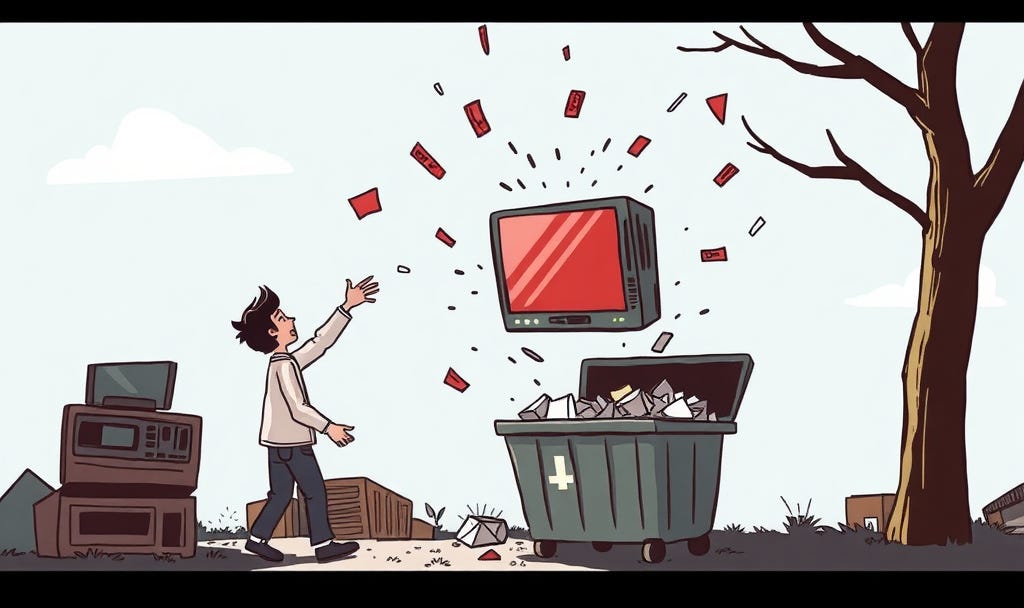
I got rid of my television a few months ago. Not because I stopped caring about the news. The opposite. I cared enough to admit the return on the time I spent with the machine no longer seemed worth it.
Television has become so reductive that the tabloid section in the checkout line at the grocery store reads like Thornton Wilder and Arthur Miller. For me, Willy Loman’s briefcase in 2026 might as well be a flat screen TV.
I report a lot on space exploration and futurism, but that does not mean I want technology to make us less human. Quite the opposite, really.
Recently, I was back in Washington, D.C., and walked right past the birthplace of television — not metaphorically, literally. Dupont Circle, the 1500 block of Connecticut Avenue NW, in one of those unassuming old Washington buildings that looks too sturdy to advertise itself. It is easy to miss if you are checking your phone, hurrying to brunch or doing what Washington does best: pretending proximity to power is the same thing as purpose.
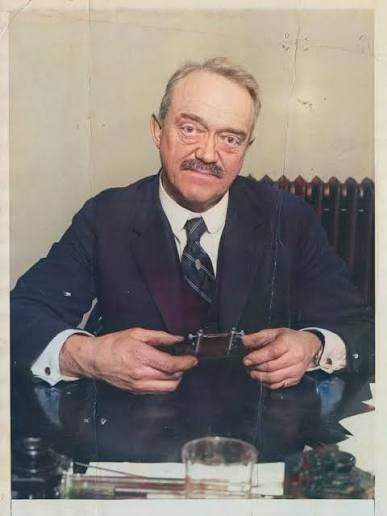
Inside that building, 103 years ago this month, Charles Francis Jenkins helped prove that moving images could travel through the air. He was not the sole inventor of modern television; no serious history of television belongs to one American. But Jenkins was one of the medium’s essential pioneers: a farm kid turned American inventor, a former stenographer with a workshop mind, more than 400 patents and the temperament of someone who saw a limitation and took it personally.
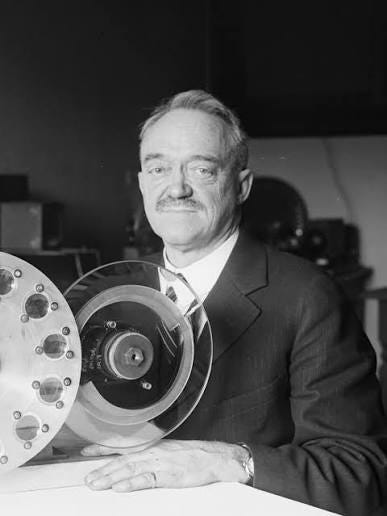
The story that survives is uniquely American: A deaf child wrote to Jenkins asking whether he could create a device that would allow deaf people to see sign language from a distance. Think about what had to go right for that letter to matter. A child had to believe the future might answer back. An inventor had to open the mail. A country had to produce institutions, laboratories, radio engineers and military research serious enough to turn imagination into hardware.
And then? The future happened fast:
In June 1923, from his Washington laboratory, Jenkins demonstrated wireless moving pictures in front of senior military leaders, investors, and policymakers.
On June 13, 1925, he publicly demonstrated what he called radiovision, transmitting the silhouette of a rotating model windmill from a Navy facility in Anacostia to a receiver at his Connecticut Avenue lab.
And by 1928, his Jenkins Television Corporation opened W3XK, widely regarded as the first television broadcasting station in the United States.
The military saw the implications of Jenkins’s work, and rightly so. If images could be transmitted without wires, information could move differently. Armies could coordinate. Ships could communicate. Government could see farther. A serious country invests in communications technology because communications technology shapes power. But the child saw language.
Jenkins saw both.
All because a deaf kid wrote him a letter and he found the courage to answer back.
Flash-forward to today: The evidence against television’s current leadership is not subtle. Americans’ confidence in mass media — newspapers, television and radio — has fallen to 28%, the first time Gallup has measured it below 30%.
In May 2025, Nielsen reported that streaming accounted for 44.8% of total television usage, surpassing broadcast and cable combined for the first time.
Traditional pay-TV penetration, once above 80% of U.S. households in 2011, had fallen to 34.4% by the end of 2024.
Pew found that 21% of Americans said in 2025 that they follow local news very closely, down from 37% in 2016.
Executives can blame technology, a politician, fragmentation, TikTok, YouTube, Netflix, the phone, the algorithm or the American attention span. Some of that is real. But it is also a dodge. The internet did not make television news shallow. It exposed how shallow the incentives had become.
We rightly ask what social media executives have done to children’s attention, mental health and sense of reality. But why don’t we ask cable news executives a version of the same questions? What did they do to the American nervous system? What did they know about fear, anger and compulsive viewing? What did they reward because the ratings worked?
I believe in free speech with all my heart. Asking hard questions about media incentives should never become an excuse for censorship. But the First Amendment is not a shield against scrutiny. Too often, media executives seem to invoke free speech not to defend open debate, but to avoid one.
I am from Delco, so I will put this plainly: People can smell bullshit. They know when television is informing them, and they know when television is trying to keep them angry enough not to change the channel.
Americans know when television is garbage.
Television news does not need another graphics package, another ideological cage match, another panel of professional certainties or another host confusing airtime with authority.
It needs to recover its first obligation: help people see. That was the beginning. A child asked for help. Jenkins built toward that request. A century later, the people running television should walk past 1517-1519 Connecticut Avenue, look up from their phones and ask a simple question:
Would that kid recognize what we did with the machine?
With gratitude,
Kev
ABOUT mtf.tv’s meet the future: mtf.tv’s meet the future is a cutting-edge platform focused on addressing key challenges at the intersection of national security, technology, and business. With a mission to embrace freedom to meet the future’s challenges and opportunities, mtf.tv offers forward-thinking media offerings and forums. mtf.tv produces the daily HELLO FUTURE show on iHeart Media’s Premiere Network, which reaches 9 in 10 Americans. iHeart | iTunes | Spotify | Amazon | Pandora


Comments
Nothing yet. Say the first thing.
Sign in to join the conversation.