
A central tenet behind today’s understanding of diversity is that everyone is effectively the same in their minds and spirits despite being different on the outside.
I’m not here to argue for or against diversity, just to challenge the tenet. What if people are different on the inside? And what if that difference is necessary for love to exist between people at all?
Before the social media internet, there was the bulletin board internet. Users would “post" information or queries in specific areas and return later to see responses, fostering thoughtful, threaded discussions. This approach was common in early web forums, newsgroups, and some early social platforms.
All content was user-organized — no algorithms or “for you” pages that decide which content to show you, on your behalf.
On the arrival of the social media internet, writer Robin Sloan recalls “Twitter was once a generous router of attention, with an ecology friendly to links; as the years have ticked by, the circle has tightened, and today, Twitter points mostly into itself.”
That’s right. To itself.
Sloan wants something other than recursive content. He says it’s “a colossal bummer that Twitter eked out a local maximum; that its network effects still (!) consumes the fuel for other possibilities, other exploration.”
Even more critically, he stresses the following:
There’s a way of thinking about, and with, the internet of that era that isn’t mere nostalgia, but rather a conjuring of the deep opportunities and excitements of this global machine. I’ll say it again. There are so many ways people might relate to one another online, so many ways exchange and conviviality might be organized.
Perhaps this is easy for Robin to grasp because of his age, 44 years old. Old enough to appreciate RFC 865, an early internet protocol, from 1983, for sharing a Quote of the Day.
What about all those who are too young to remember? Are they now too young to imagine as well?

The bulletin board internet was mostly a spatial revolution — you could distribute content globally. The social media internet is now a temporal revolution. You can connect instantaneously and simultaneously with anyone and everyone.
The inevitable outcome of combining both global and synchronous reach?
Homogeneity.
Pioneers set out on a frontier, looking for treasure. The frontier encompasses the unknown. It could be dangerous. Perhaps even empty. Yet, to the pioneer, it’s still worth it to venture out.
In a globally connected and synchronous online world, there is little room for a true frontier. At best, people retreat to walled gardens and “the cozy web:” group chats, Discord and Slack servers, Urbit communities, etc.
People are starting to believe that the choices being given to them are the choices they should have. They’re starting to believe that no other choices should exist.
Social media algorithms look at we have liked in the past and use that information to predict what we will like in the future. Paul Skallas says this explains how we are culturally stuck and why everything is a remake these days. He says “[c]ulture is no longer made. It is simply curated from existing culture, refined, and regurgitated back at us. The algorithms cut off the possibility of new discovery.”
People are getting sick of reading the same dating app profiles, of receiving the same canned messages. Businesses are assuming that AI will make everything, including dating apps, better. Can predictive AI actually solve the problems caused by homogeneity? Or are consumers just willing to cooperate with the businesses because they believe they have no choice in the matter?
Are you using the tool or is the tool using you? Either way, the curiosity of a pioneer persists, even if unfulfilled.
The combination of global reach and synchronicity gave us wonders — conveniences that were heretofore unimaginable — like Zoom calls and Venmo requests and DocuSign for closing on a mortgage while you are still eating lunch.
It allowed us to be virtually anywhere and also to be at many places at once. It really did allow us to be Everything Everywhere All At Once.
If I could be anything, anywhere, why would I be something, let alone something with you?
The palliative pleasures of the internet have given us a false sense of infinite choice. We believe there’s a more interesting Tinder match to be had, a few more swipes away. Or we find there are just many more entertaining things to do, reels and shows to watch, VR games to play, than to commit to anything at all.
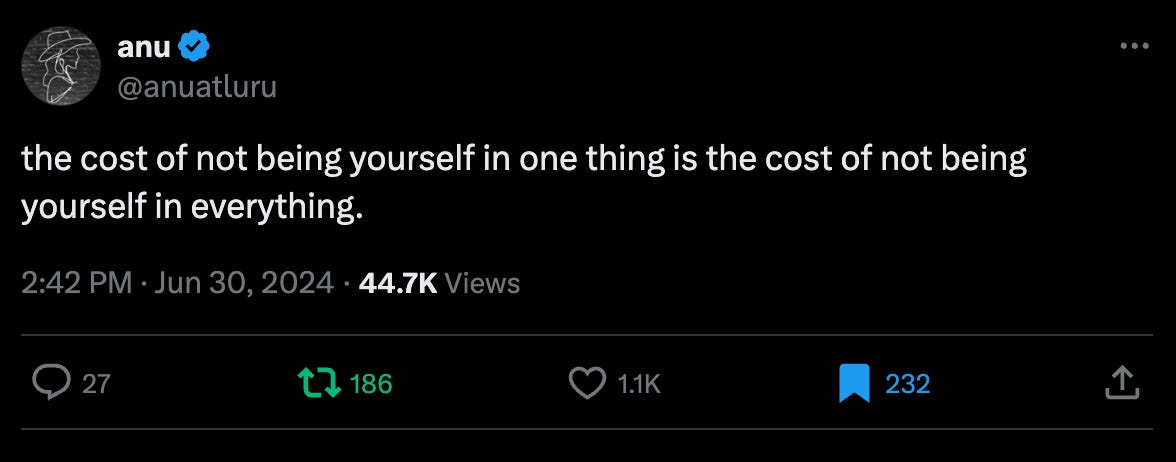
People try to rebel against homogeneity by putting up filters and barriers. They do it all on sides of all spectrums. Someone on the left might refuse to date you unless you are BLM and ACAB and this and that. Someone on the right might refuse to date you unless you’re a Catholic and open to becoming a neoreactionary and that and this.
Unfortunately, they all just opt back into sameness.
When and where is there an opportunity to be truly surprised by someone? Information and ideas are now fully decoupled from people and cultures. They exist now only as mimetic abstracts, propagating across timeliness and trends. Who is truly willing to divulge heterodoxy to anyone anymore, let alone to themselves?
The erotic depends on someone being partially alien to you. The erotic requires people allow themselves to be, at least partially, exotic to one another. It requires the opportunity to be truly curious. To be genuinely interested in getting to know someone.
Find out where you disagree with someone who you otherwise perceive yourself to be very similar to, and have a discussion about it. Express and honor your heterodoxy without being attached to the dopamine of going viral or the shame of being canceled.
Difference creates the conditions for curiosity. And curiosity is the catalyst to love.
No posts
Comments
Nothing yet. Say the first thing.
Sign in to join the conversation.