
Note: After four years of writing this newsletter, I turned paid subscriptions on for those who’d like to directly support it.
If you’d like to support me in a different way, you can also purchase a book, write a review, share my work with someone you know, or hire me for your next project.
MONDAY
I don’t want summer to be my least favorite season, but at nine o’clock a.m., it’s already 94 degrees outside, and the four of us are sweating it out in a parking lot. After weeks of resistance, we’d finally packed up the bikes, the knee pads, and both girls. Like it or not, N was going to learn how to ride a two-wheeler.
T holds the bicycle while N tries to find her balance. When his entire shirt is damp and his back feels like a foreign idea, we swap out. I approach N timidly, knowing her fuse is already short. I tell her what I think we should do, but she argues back. She tells me to let go; she wants to do it her way. That’s not going to work, I tell her. You haven’t found your balance yet. I see the frustration in her eyes. I know it’s unjust to teach her using a method that only makes sense to me, but I don’t know how to do it differently. How can I be what she needs?
After 20 minutes of trying, I find myself crouching behind a giant maple tree with my screaming, sobbing child. I reach for N’s hand, but she pushes me away. I want her to be resilient; I want her to try again. The bike’s on the ground. The helmet’s filled with sweat. I take a good look at my frustrated kid, her face flushed with the angry July heat, and I stop trying to find the lesson.
You wanna go home? I ask her. It’s a hot one. She shakes her head.
You wanna have a drink of water? I ask her. I’m thirsty, too. She shakes her head.
All right. I’ll just sit here with you, and if you decide you wanna hug, I’m here.
N hesitates, holding onto her anger, and then she falls into my arms. I say nothing, remembering that as a parent, I often say too much. I say nothing, remembering that as a person, many of the memories I treasure most took place in silence. Maybe this is the lesson.
After a few minutes, N gets up and has a drink of water. She puts the helmet back on; She wants to try again. Yes, she’s sure. No, she doesn’t need my help. She wants to do it her way. I watch from one end of the parking lot, while N and her bike sit on the other. Make sure you let go when I tell you to, she instructs, and T solemnly nods.
I watch her, feeling sharply insignificant. I want to be a good parent. I want to be someone who knows, who can give her what she needs in order to learn and grow.
N pedals slowly—too slowly, I think, to keep her balance. After a few feet, she tells T to let go, and he does. She wobbles around the parking lot, riding her bicycle. Pedaling slowly. She is alone, and the smile on her face is very, very big.
My own smile begins as a spark, then grows wider. A feeling of insignificance increases in my heart, but it feels softer, brighter now. It feels like confidence—confidence in my kid. I don’t have to know what N needs: she already knows. I don’t have to ask her to try again: she’s going to try again on her own. She’s going to do it her way, the fire inside her already stronger than mine, and I love her all the more because of it. Maybe this is the lesson.
TUESDAY
On the wall of her office at Princeton University, where she is a professor, her enormous leap looks like a short, straight line -- a natural progression from one to the other, when in fact she’s sacrificed a great deal for what she’s loved the most.
“I said, ‘Okay, what is it I have to do that’s so important that I’ll die if I don’t?’” she says. “There were two things, and the first one was mother my children. And the second one was write.”
—Toni Morrison, from an interview with CBS titled “Toni Morrison: Words of Love”
WEDNESDAY
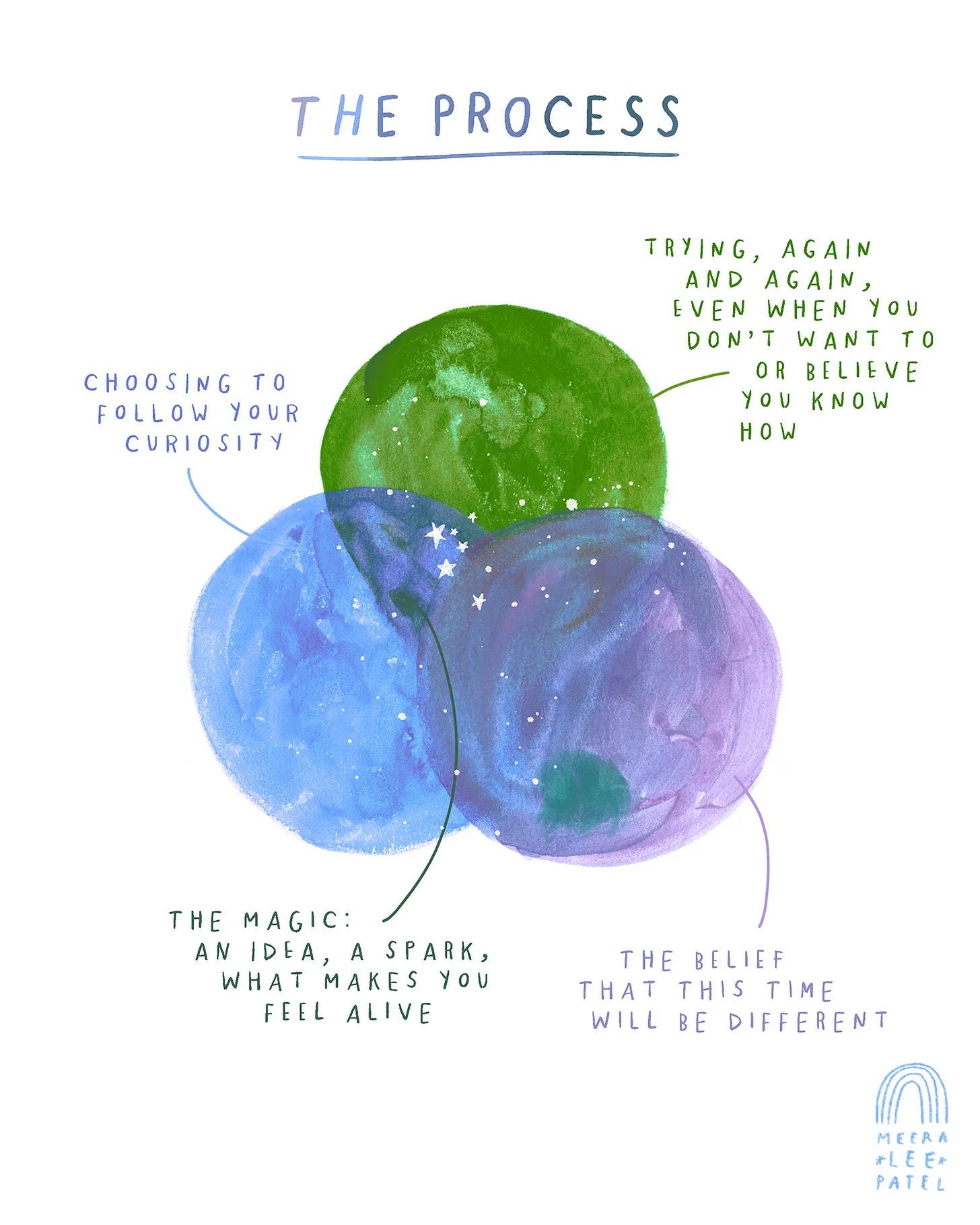
In my column Being for Issue #70 of Uppercase Magazine, I adapt an essay from How it Feels to Find Yourself, my latest book of illustrated essays. The process of creating creative work can feel cumbersome. It often generates disappointment, too. After all, it’s rare that anything I draw will resemble the picture that lives inside my head.
In the past, disappointment won regularly. I convinced me to put my pencil down. I asked myself again and again: What’s the point? Why do any of us insist on turning ourselves inside out for art when the process requires so much internal reckoning, generates very little interest (or income), and may not lead us anywhere at all?
Over the years, I’ve learned to accept the creative process more readily. I hold onto my spark tightly. I step over the disappointment and existential dread…not easily, but with less resistance. What changed? It turns out that curiosity, developing an affection for failure, and holding onto hope had a lot to do with it.
An excerpt from my essay reads:
“If you are a pragmatic person, like me, it’s easy to trick yourself into believing that hope is reserved for the naïve. Over the years, I’ve interrogated the concept of hope within myself: Why does it feel foolish to hope, to hold hope, to allow it to comfort me? I’ve discovered that hope itself isn’t the problem, it’s hope without action that strikes me as naïve. Believing that past mistakes aren’t endlessly doomed to repeat themselves is necessary for moving forward, for taking any sort of action towards beginning something new.
We must remain childlike if we want our creativity to strengthen. This means giving ourselves permission to hope, to embrace irrationality, and to push against the boundaries of the way we believe things ought to be. Like a child, we must care less about fitting in, or being on time, or what others think of our process—and dive deeper towards what frightens us most.
Consider the following: In your practice, what are you most afraid of? If it could take you anywhere, where would your creativity take you? What does a state of creative flow feel like for you?”
—from The Process, my latest essay for Issue #70 of Uppercase Magazine
THURSDAY
Octavia Butler once said to a despairing young student: “There’s no single answer that will solve all of our future problems. There’s no magic bullet. Instead, there are thousands of answers—at least. You can be one of them if you choose to be.”
If nothing is owed, then everything we offer becomes a choice. That choice is the closest thing we have to meaning. It exposes the architecture of who we are: what we notice, what we ignore, what we are willing to do for one another—especially when we don’t have to.
No matter how hard my brain tries to logic me into a prophylactic depression, it is, in fact, necessary to choose to be good. And thus to do good. We show who we are by what we do. Sometimes, we show who we would like to be by what we do. Just because life lacks objective meaning does not mean I have to find it meaningless. The abyss can remain a desolate void, or it can be a space in which to fill in with my values of community, love, care.
—from What We Owe Each Other by Jun Chou in The Creative Independent
FRIDAY
Talent is what they say
you have after the novel
is published and favorably
reviewed. Beforehand what
you have is a tedious
delusion, a hobby like knitting.
Work is what you have done
after the play is produced
and the audience claps.
Before that friends keep asking
when you are planning to go
out and get a job.
Genius is what they know you
had after the third volume
of remarkable poems. Earlier
they accuse you of withdrawing,
ask why you don’t have a baby,
call you a bum.
The reason people want M.F.A.’s,
take workshops with fancy names
when all you can really
learn is a few techniques,
typing instructions and some-
body else’s mannerisms
is that every artist lacks
a license to hang on the wall
like your optician, your vet
proving you may be a clumsy sadist
whose fillings fall into the stew
but you’re certified a dentist.
The real writer is one
who really writes. Talent
is an invention like phlogiston
after the fact of fire.
Work is its own cure. You have to
like it better than being loved.
—from The Sun is Still A Part of Me by Marge Piercy


Of all the things you can put in front of your eyes, I’m grateful that my little letter is one of them.
If you’d like to support me, please buy my books. My art prints and line of greeting cards make excellent gifts for yourself or a friend. You can also hire me for your next project—I’d love to work together.
xx,
M
Comments
Nothing yet. Say the first thing.
Sign in to join the conversation.