
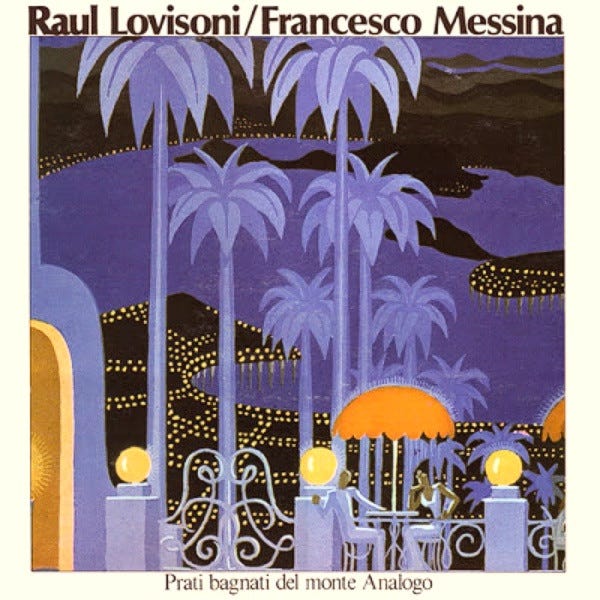
Prati Bagnati del Monte Analogo [The Wet Meadows of Mount Analogue] is the record that inspired me to start Mediterranean Minimalism. For me, minimalism à la Mediterranea is a gentler version of American repetitive music, less focused on rhythm and more on harmony, as exemplified by a string of (mostly overlooked) albums produced in Italy in the 1970s. Italian minimalists are less upbeat and more classical, balancing experimentalism with a distinctive melodic sensibility. With its classic flair and a dreamy atmosphere that veers towards kosmische Musik, Prati Bagnati del Monte Analogo embodies this approach at its best.
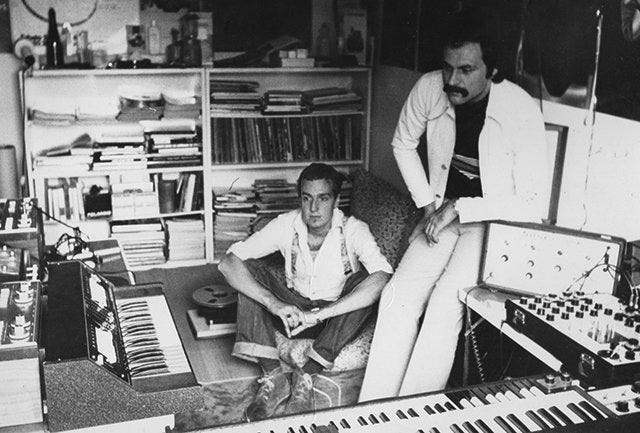
Raul Lovisoni and Francesco Messina met at a Franco Battiato concert in 1978. They both shared a deep admiration for the artist and began making music together soon after. At the time, Raul Lovisoni (b. 1954) was a mystically inclined art student playing the flute in various local bands in Udine, northern Italy. He had first met Battiato at a prog-rock festival in Naples in 1973 - the start of a lasting friendship rooted in their mutual interest in spirituality and Eastern philosophy. An Udine native as well, synth enthusiast Francesco Messina (b. 1952) had recently founded his design studio in Milan when he began collaborating with Battiato in 1974. Messina created many of Battiato’s most iconic record covers and became his lifelong partner on a myriad of art, music and video projects.
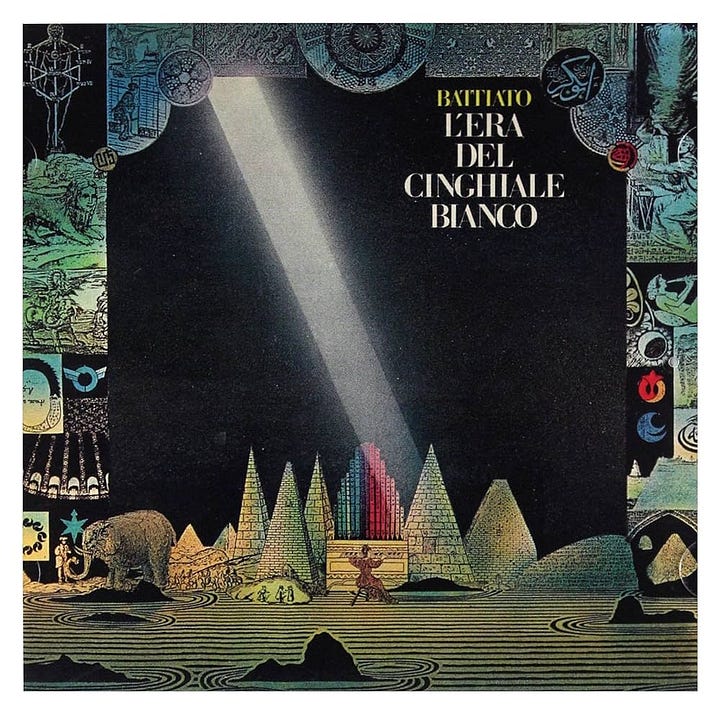
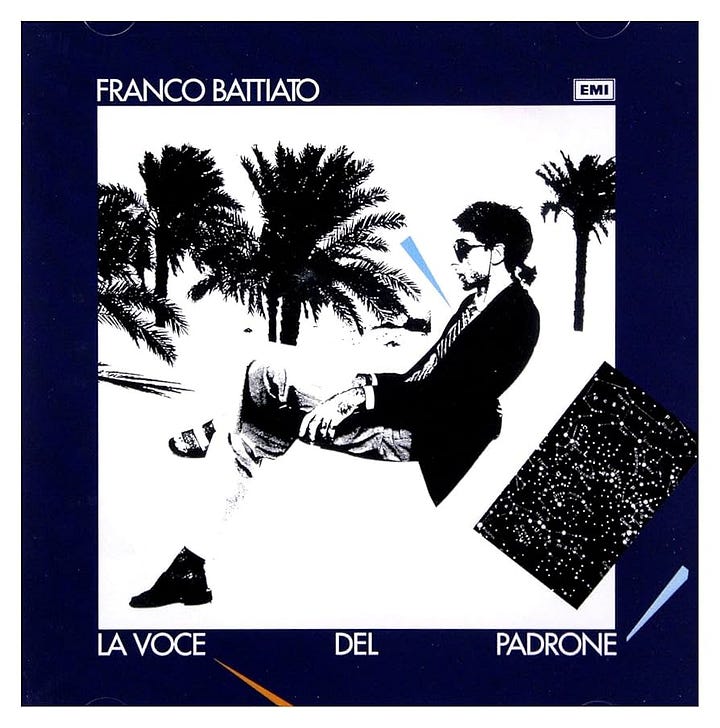
Not only did Battiato play a key role in bringing them together, he was also instrumental in making their first and only record happen, as he pitched Prati Bagnati del Monte Analogo to Gianni Sassi, founder of the renowned avant-garde label Cramps, and took on the role of lead producer.
The LP title refers to Rene Daumal’s unfinished novel Mount Analogue: A Novel of Symbolically Authentic Non-Euclidean Adventures in Mountain Climbing (1952), which famously inspired Jodorowsky’s cult movie The Holy Mountain. The book recounts the journey of a group of spiritual seekers attempting to climb the invisible Mount Analogue and is based on the teachings of Gurdjieff, spiritual master of both Daumal and the Battiato crew. In a recent interview, Francesco Messina recalled:
In him [Daumal] I felt a very strong assonance with what we were studying under Henri Thomasson, who had been a direct student of Gurdjieff. Especially when it comes to meditation practices […]. The connection with The Mount Analogue was closely related to the expression of that spiritual path.
At its core, Prati Bagnati del Monte Analogo is a record of devotional music, anchored by a deep quest for harmony. Fittingly, Lovisoni graduated from art school with a dissertation about the literal unhealthiness of serial music. He cited greenhouse experiments on bean plants, which suggested that Indian and Baroque music encouraged growth, while atonal compositions inhibited it. Lovisoni went so far as to argue that twelve-tone music was unhealthy for the whole of humanity, whereas he associated tonality with the natural order of things and the release of "joyful endorphins".
In line with these premises, which parallel the minimalists’s rebuke of serial music, Prati Bagnati del Monte Analogo is made of reduced elements, strictly tonal, gently repeating themselves to set the listener in a meditative mood. Each artist contributed one composition to the record: Messina’s title track fills the entire A-side, while Lovisoni’s two shorter compositions feature on the B-side.
Messina's piece is an elegant, proto-ambient suite of repeated piano scales, sparsely accompanied by synths, changing ever so slightly and opening up to a distant melody in loop at mid-piece. There’s an ascending energy to the track, its gentle progression towards its peak of sustained synth notes mimicking the pilgrim's way to the mountaintop. Heavily influenced by the piano work in Battiato’s L’Egitto Prima delle Sabbie, the title track sets out to explore the spaces between the notes, highlighting hidden harmonics that each instrument generates as a consequence of reiterated repetitions.
Lovisoni's pieces similarly thrive on patterns and resonances, their atmosphere, however, less ethereal and more earthly than Messina's composition. In the original liner notes, the musician describes his work as one of a cathedral builder creating "architectures of experience" made of sounds:
These sounds are a mere means: their order, either strict (Hula Ohm) or hopefully abandoned (Amon Ra), aims at the feeling they can evoke in the heart or at the synthesis they can inspire. Once, the rational spirit controlled the musical structure (it has been called "architecture of music"); today we are able to reconstruct sound environments (so-called "architecture of experience").
The first sound environment, ‘Hula Ohm’, evokes Ancient Greece, reimagining the classical roots of the Mediterranean. The harp piece is tuned to the Pythagorean scale and arranged in a mathematical pattern which shifts slightly as the piece progresses, moving from the initial melody to a vertical sequence of chords.
The closing 'Amon Ra', described by Lovisoni himself as "an act of devotion to the sounds that surround our sleep", is a gentle invocation to abandon oneself to oblivion, featuring the raga-inspired vocals of Juri Camisasca, another friend and close collaborator of Battiato's. A very restrained piece, it sounds as if it were made of thin air, vibrating to the delicate tones of the Glasspiel - crystal glasses made to resonate by the touch of wet fingers.
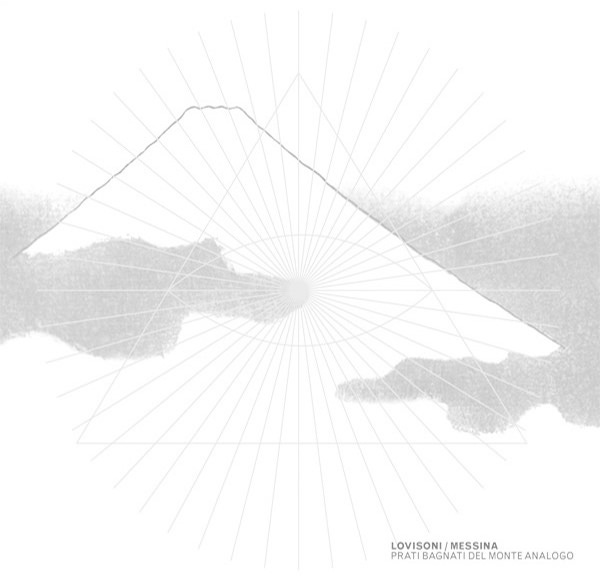
The album wasn’t particularly successful upon its original release, but it slowly and steadily grew to achieve well-deserved international cult status. A 2007 Japanese bootleg introduced the record to new audiences and some notable endorsements helped along the way - from Porcupine Tree to, more recently, Marta Salogni, who opened Messina’s first-ever live performance of the piece in Milan in 2023. Die Schachtel reissued the LP in 2013 with a new, more somber design concept, while Superior Viaduct followed in 2018, preserving the original artwork.
Funnily enough, the image on the cover was at the centre of a heated debate that almost prevented the record’s release. As he revealed in his autobiography L'Uomo del Fiume [The Man of the River] (2021), Lovisoni hated the illustration by Cramps’ manager Gianni Sassi with a passion: "This was a record of sacred music and the night party proposed by Sassi was, what should I say, blasphemous. Sassi became furious, threatening to stop the LP pressing". Once again, it was Franco Battiato who reconciled their differences “with his intelligence and mediation skills”. Four decades later, Lovisoni admitted that the artwork was a great choice, echoed by Messina who also expressed his appreciation for Sassi’s art deco sensibility.
I think the cover is just perfect. Its enigmatic Dolce Vita night-time scene captures the atmosphere of the record flawlessly: it’s an image of classic beauty, subdued and sophisticated, alluding to something that remains unseen - just like the music of Prati Bagnati del Monte Analogo.
This article was originally published at https://mediterraneanminimalism.com/lovisoni-messina-prati-bagnati-del-monte-analogo/
Comments
Nothing yet. Say the first thing.
Sign in to join the conversation.