
RSVP to join us on Tuesday, December 9th, 2025, for a screening with the director of Rise Of The Geshe-Ma with the producer, Edward Sczudlo.
It’s 4:30 am and I am in a hazy room, incense clogging the air, chanting surrounding me. I was 14 years old and full of the social anxiety, angst, and anger you might expect from a young teen. My dad had been on his “not quite a midlife crisis” journey for the past few years during which he tried to find his faith. This meant taking my brother and I to Buddhist sanghas, Mormon services, and now bringing us to a weekend monastic retreat at Mepkin Abbey, a community tucked in a small coastal South Carolina town. I was by far the youngest person there, but took to it with gusto. I loved the solitude, intention, and meaning placed on each activity. Rather than being alone in a crowd in a rock-band blaring mega-church stadium, I felt at home with myself in that quiet monastic corner.
Monasticism sucked me in and has never spit me back out. In the 13+ years since that retreat I’ve visited monasteries in China, India, Japan, Italy, and across the US. They’ve been places where I’ve deepened my connection to Self/Other, but I’ve also been reminded too many times that they are microcosms of life, not escapes from it. They’re spaces where the tensions of gender, class, sexuality, and culture can become an amplified chorus, rather than a quiet hum.
I’m always delighted by monastic communities who take on the mantle of change and was recently inspired by a project led by my colleague Edward Sczudlo: a documentary following the journey of Tibetan Buddhist nuns earning the highest monastic degree, the Geshe, a milestone traditionally reserved for men. The degree is equivalent to two PhDs in terms of years of study, memorization, and immersion- an 18+ year journey.
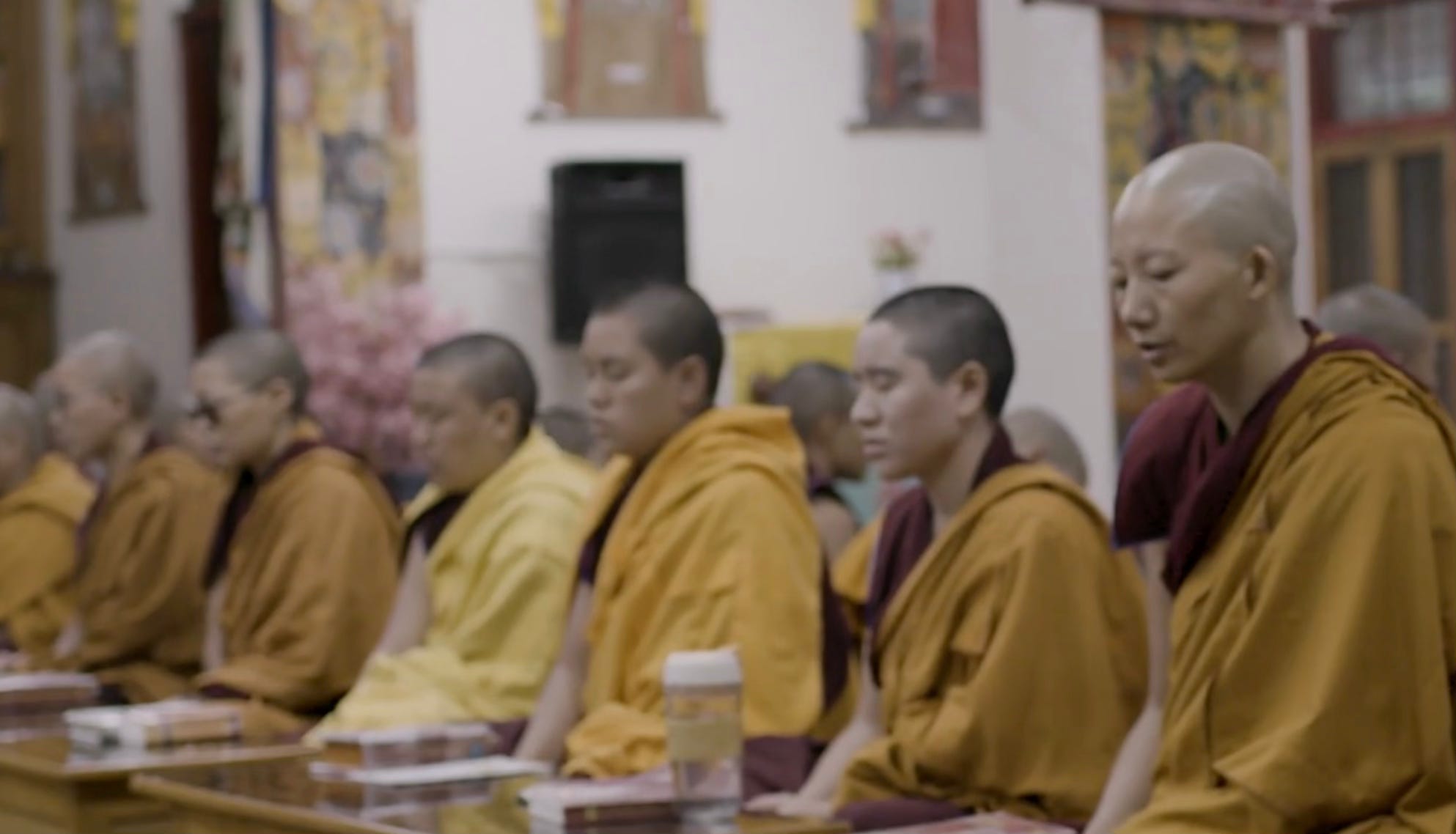
Image from Rise of the Geshe-Ma short film.
Hearing these women speak about their work I’m struck by the quality of their dedication. It’s something I’ve studied through the years across Saint Teresa of Avila’s interior castle, Catholic nuns fighting for environmental justice, and Mormon women theologizing about body/suffering/heaven in the Utah desert. The dedication must be translated through gendered norms and institutional expectations, often manifesting in mild self-deprecation and overly modest summations of work. It doesn’t fit into the bold and confident framework of success that we have today, which can make these achievements easier to overlook.
Progress and change within monasticism, especially among female monastics, is not an invention of our modern society. In the 1500s Teresa of Avila was creating clandestine homes for women to practice their faith, in the 1800s Mormon women were writing theologies of a Mother in Heaven, and now these Geshe-Ma are expanding who hold the keys of knowledge. Changes to religious infrastructure not only speak to a new understanding of how men and women can inhabit the earthly religious world, but also build new ontologies of gender. In the documentary the first recipient of the Geshe-ma degree states “My hope is there will be a shift in Tibetan society that women have the same standing as men and so that many of the great lamas will also be reborn as women”. The Geshe-ma degree is unlocking spiritual leadership in this life and beyond.
Monasticism is a microcosm of life in the good, the bad, and the human. It holds the same biases and struggles as our larger systems. However, there are also glimmers of light within that are magnified within these austere containers. The Geshe-ma movement is just one of the many glimmers that deserve to be seen.
Events like this are made possible by the support of our community. Consider joining the Meditation Artifacts community and being part of more events like this.
No posts
Comments
Nothing yet. Say the first thing.
Sign in to join the conversation.