
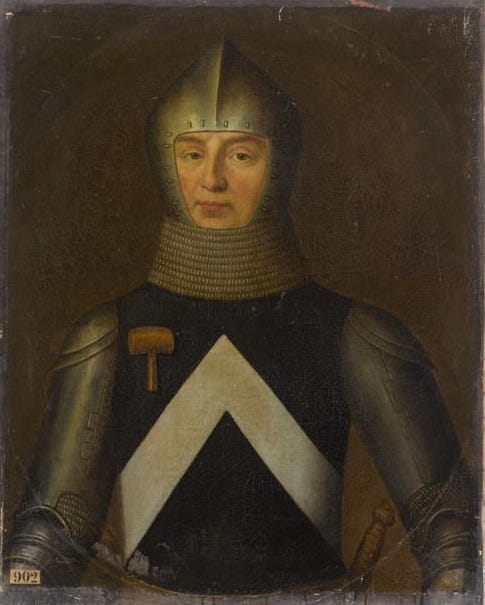
Born in the 1350s into the minor nobility of the Pays de Caux region, near Dieppe in Normandy, Robert de Braquemont belonged to a family with three brothers who took their name from the parish of Braquemont; their modest fortune was built upon the traditional military service of the Norman nobility of the sword, a path they all followed for the Kingdom of France. In his youth, he served under Admiral Jean de Vienne and later alongside the companions of the great French commander Bertrand du Guesclin in Castile; there, he fought for the kings of the Trastámara dynasty against the Portuguese at Aljubarrota and subsequently against the Duke of Lancaster. The Castilian monarchs rewarded him with lands that still bear his name, Rubí de Bracamonte and Peñaranda, and he forged marriage alliances with the great houses of Mendoza and Toledo, becoming almost as much Castilian as he was French. His personal standing at court was such that, when the alliances between France and Castile needed renewing amidst a civil war, he was the only one able to move freely between rival factions and secure the necessary signatures. Upon returning to France, then in the throes of civil war between the Armagnac and Burgundian factions, he entered the service of the House of Orléans and the Dauphin Charles. Appointed as a naval commander, he met with a tragic fate that would radically shape his future: during the naval battle of Chef de Caux on August 15, 1416, which ended in a French defeat by the English navy, Robert de Braquemont lost his son, Jean. On April 22, 1417, he was appointed Admiral of France; Early the following year, the Council of Paris appointed him to the additional post of Lieutenant General of Upper Normandy, his native region, comprising the bailiwicks of Rouen, Gisors, and Caux, as well as the enclave of Honfleur, all of which were threatened by the English invasion. Normandy was then torn between the Dauphin’s supporters (his faction the Armagnacs), and those of the Duke of Burgundy (the Burgundians), while English armies under King Henry V advanced northward from Harfleur and Caen, threatening both warring factions. Braquemont immediately realized that only the Seine could serve as a defensive line to delay the English army and offer a final hope of rallying both factions in the region behind a unified defense. In June 1418, leveraging the authority of his dual roles and his network of family ties and old comradeships, he persuaded the captains of twenty-five strongholds, including Neufchâtel, Pont-de-l’Arche, Louviers, Arques, and Longueville on one side, and Rouen, Dieppe, Caudebec, Fécamp, and Montivilliers on the other, to enter into a formal mutual-aid agreement against the English. They agreed to set aside faction partisan hatreds in the name of a common defense of Normandy and, by extension, the Kingdom of France. A united armed force was raised: a thousand men were stationed at Pont-de-l’Arche town under the command of Jean Malet de Graville, and another two thousand were deployed along the north bank, while a reserve force was held at Étrepagny. For a brief moment, the province stood united, holding the English at bay for several months. However, the triumph of the Burgundians in Paris cost him his position as Admiral; Charles de Lens succeeded him on June 6, 1418. However, Braquemont continued to serve the Dauphin Charles as an advisor and negotiator. In March 1419, upon learning that Scottish reinforcements under the Earl of Buchan were ready to embark, he was tasked, alongside Bertrand Campion, with diverting the large Castilian fleet then being assembled toward Scotland. His very name opened the doors to the court of John II of Castile. Yet, after this final glimmer of hope, he died in Mocejón, near Toledo, on April 4, 1419. His brothers continued the fight in the years that followed; among them was Louis, who would die at the Battle of Verneuil in 1424. Thus, a Norman nobleman who had distinguished himself beyond the Pyrenees moutains returned at a critical juncture: first to preserve the unity of his province, Normandy, in the face of invasion by uniting two rival factions, and then to reopen the maritime routes essential for transporting Scottish reinforcements. It was a remarkable feat, especially given his factional allegiance, to join forces with a hated rival faction in 1418. Traumatized by the death of his son at the hands of the English, he embodied the adage: “the enemy of my enemy is my friend.”
No posts
Comments
Nothing yet. Say the first thing.
Sign in to join the conversation.