
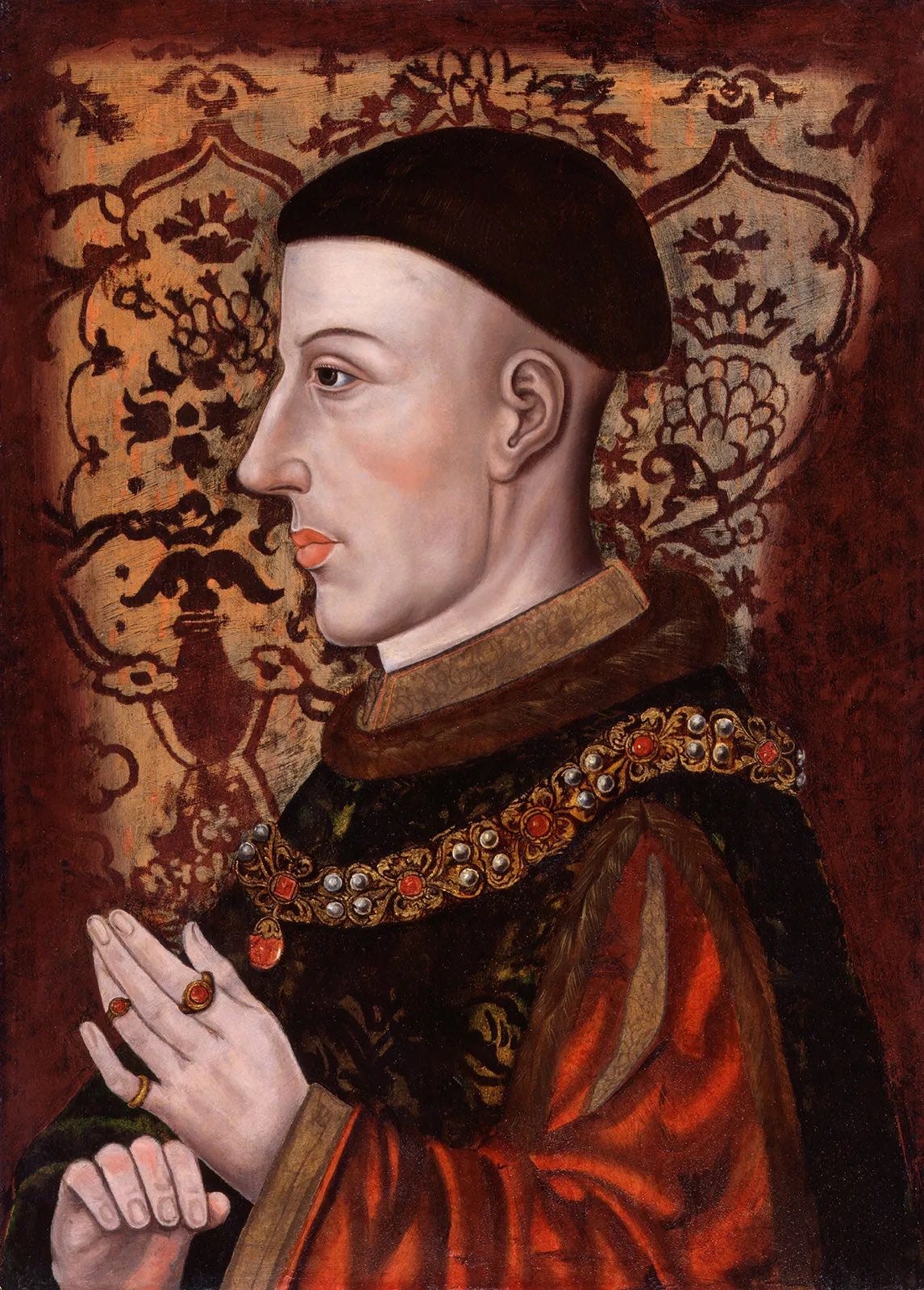
Kings were tested, often long before they ever wore the crown. Many tests came for the young princes through warfare. Few figures embody this truth more clearly than Henry V of England. Henry is often portrayed as a warrior king who emerged fully formed upon the fields of France. Who made the French bend to his will after a series of military victories that resulted in the conquest of northern France. Yet this image obscures a far longer and more demanding process. Agincourt was not the beginning of Henry’s greatness. It was the apex of a life shaped by nearly two decades of continuous warfare, beginning in Wales, tempered in the brutality of civil conflict which nearly cost him his life, and refined through hard earned experience. To understand Henry V is not to begin at Agincourt, but to trace the long path that made such a victory possible. Agincourt was earned by Henry, not a miracle.
Henry’s education in war began when he was young. At just thirteen years old, he was entrusted by his father, Henry IV of England, with authority in Wales during the rebellion of Owain Glyndŵr. From 1400 to 1404, Henry commanded part of the English troops and conducted the duties of High Sheriff of Cornwall. The appointment was as much a necessity as confidence. Glyndŵr’s forces burned towns, ambushed supply lines, and vanished. For the young Henry, this was no ceremonial title but instead was a trial by fire that demanded adaptability.
By March 1405, the prince had been campaigning in Wales for years. That month, a Welsh raiding force under Rhys Gethin struck the town of Grosmont, where they began burning and looting before ultimately withdrawing. Henry, operating from Hereford, responded with a targeted force under experienced commanders. The raiders were caught and defeated, their retreat turned into a rout. The only account we possess of that battle comes from this letter. In the aftermath, Henry wrote to his father to report the engagement. The letter survives, and in it we see the voice of a young commander. He reported the numbers, noting that some said eight hundred Welsh had fallen, others a thousand. He credited the victory to God and to his men, not to himself.
Yet Wales was only the beginning. In 1403, he faced open rebellion at the Battle of Shrewsbury against forces led by Henry Percy (Hotspur), a famous knight in his own right. The Percys were supporters once of Henry IV and were by his side to aid him to the throne against Richard II. They even fought on his behalf against the Welsh. However after these wars had ended, lands that were once promised to the Percys were instead given to a rival of theirs as well as previously promised money never being paid. The Percys revolted against the king. Sir Henry Percy raised a force and marched southwards, recruiting men from Cheshire along the way. King Henry IV, learning of this only 9 days before the battle took place, marched to Shrewsbury. The king and his forces, joined by his son Prince Henry, captured Shrewsbury before the Percys could arrive. They both arrived on the 20th of July and set up camp.
The next day, on the 21st, both armies began the bloody Battle of Shrewsbury. Both armies numbered around 14,000 and were bolstered by the skilled and equally feared English longbowman. Two hours before dusk, the king gave his signal for his forces to engage which began with a barrage of arrows. According to chroniclers, Percy’s archers of Cheshire were superior in skill and said “the King’s men fell like leaves in autumn and every one arrow struck a mortal man”.
Shrewsbury was a brutal, direct confrontation, a clash between armies on open ground. It was here that Henry came closest to death. During the fighting, he was struck in the face by an arrow that lodged six inches deep in his skull. The wound was severe, potentially fatal, and for a time it appeared that the young prince might not survive. Yet he refused to leave the field, continuing to fight and command despite his injury until the battle was won.
Henry was lucky to be a royal and be able to have access to the best possible care one could have but also incredibly lucky he was not killed outright as the arrow narrowly missed his brainstem. John Bradmore, the royal surgeon, treated the prince for several days. He even needed to craft a special tool just for this occasion. He used honey as an antiseptic to make sure the wound did not become infected.
This moment is critical, not simply for its drama, but for what it represents. Shrewsbury was not a victory won at distance. Henry fought, bled, and endured alongside his men. The injury marked him physically, but it also reinforced a model of kingship grounded in shared hardship and visible courage. In a world where authority depended as much on perception as on legitimacy, such experiences mattered.
Comments
Nothing yet. Say the first thing.
Sign in to join the conversation.