
Gruffudd ab Yr Ynad Coch was a Welsh poet who composed the moving elegy for Prince Llywelyn the Last, killed in 1282. The elegy is widely considered one of the finest poems in Welsh and European medieval literature.
Below is an extract from the elegy, in Welsh and English.
‘Oer calon dan fron o fraw allwynin
Am frenin, dderwin ddôr Aberffraw.
Aur dilyfn a delid o'i law,
Aur dalaith oedd deilwng iddaw.
Eurgyrn eurdëyrn ni'm daw llewenydd,
Llywelyn, nid rhydd im rwydd wisgaw.
(Cold is my heart in a fearful breast
For the king, the oak-door of Aberffraw.
Gold was freely given from his hand,
Golden was the brow-band worthy of him.
No joy comes to me from golden-horned kings;
Llywelyn, I can no longer wear my accustomed dress.)’
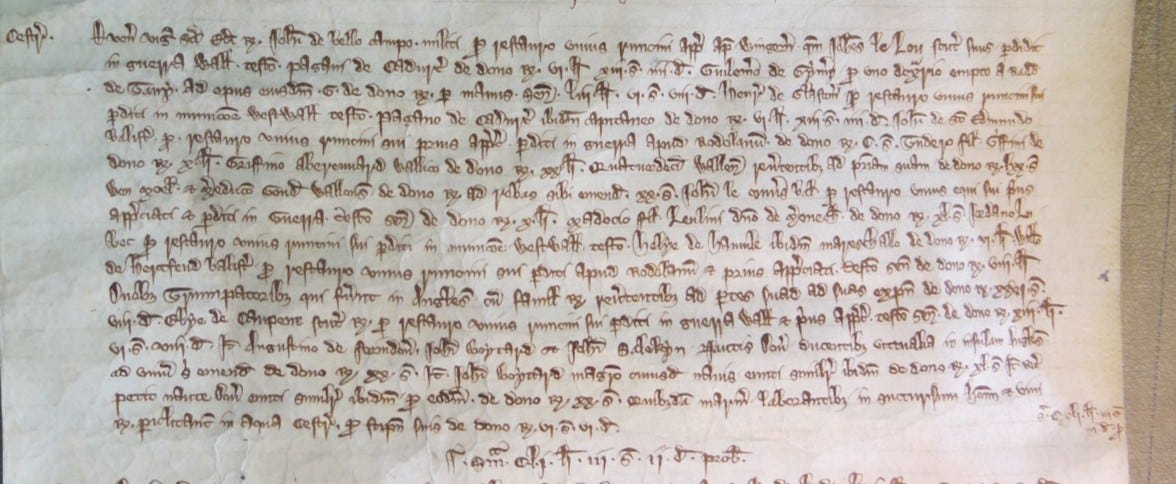
In his biography of Prince Llywelyn, the late J Beverly-Smith noted that Gruffudd took money from Edward I during the Welsh war of 1277. I always thought that was odd - why did Gruffudd desert his prince, and what use would Edward have for a Welsh poet?
I followed up the reference, and it checks out. See attached. Gruffudd appears six lines down taking a fee of £20 ‘de dono regis’ - a gift of the king.
Gruffudd is one of several Welshmen in this entry who took financial rewards from Edward. The others are Tudur ap Gruffudd and Madog ap Llywelyn, styled as lord of Meirionydd.
I cannot identify Tudur ap Gruffudd, though he may have been of the Penmynydd Tudors that gave rise to the Tudor royal dynasty. Madog ap Llywelyn was Prince Llywelyn’s cousin: he and his family had been driven into exile by the prince. He would later, famously, lead a revolt against Edward.
There are also several English captains on the list, also being awarded sums of money as gifts - John de Beauchamp, Pain Chaworth etc. These men were presumably being rewarded for good service in the war.
It is difficult to understand why Gruffudd should appear in these accounts. He was not a military man, and had only one talent to sell - his poetry. The fee of £20 was very high, twice the annual income of an English county knight in this period.
One dark suggestion is that Edward paid Gruffudd to compose the famous elegy, as a way of reminding the Welsh that Llywelyn was dead and not coming back. That doesn’t fit with the dates: the payment was made in 1277, and Llywelyn was not killed untuil 1282.
On the other hand, the bards of Wales were professionals who sang for money, and they did not care who paid them. A later poet, Iolo Goch, composed works in praise of Edward III and Owain Glyndwr.
Thus, it is open to interpretation. We should, however, sweep aside the later folk-tale that Edward had the bards of Wales rounded up and burnt at the stake. In reality they were on his payroll, or appear as taxpayers in lay subsidy rolls.
No posts
Comments
Nothing yet. Say the first thing.
Sign in to join the conversation.