
I wrote recently that I’ve become deeply fascinated by the ancient world - partly through reading The Lost Voices of Pompeii by Dr Jess Venner, and partly through seeing a beautiful new hardback edition of Robert Fagles’ classic translation of The Odyssey. I also recently read Elif Shafak’s There Are Rivers In The Sky, drawing on the ‘Epic of Gilgamesh’, something I had not read much about before.
As a medieval historian, whose last experience of any classics education was close to two decades ago, I knew that I needed help to develop any sort of personal curriculum to build my knowledge of the ancient world and how it might interact with the early medieval cultures I spend my days researching.
I reached out to Maggie Desbaillets, who I connected with on Substack through her beautiful work on classic texts. She is a historian and educator from Pennsylvania, who graduated from the University of Pennsylvania with a degree in History and Classics. Much of her writing and research focuses on the intersection of literature and history, and this influences a large part of her work in curriculum development. Currently, most of her attention is on Russian history and the ancient world. She is passionate about helpful people find their own inspired routes into our shared past.
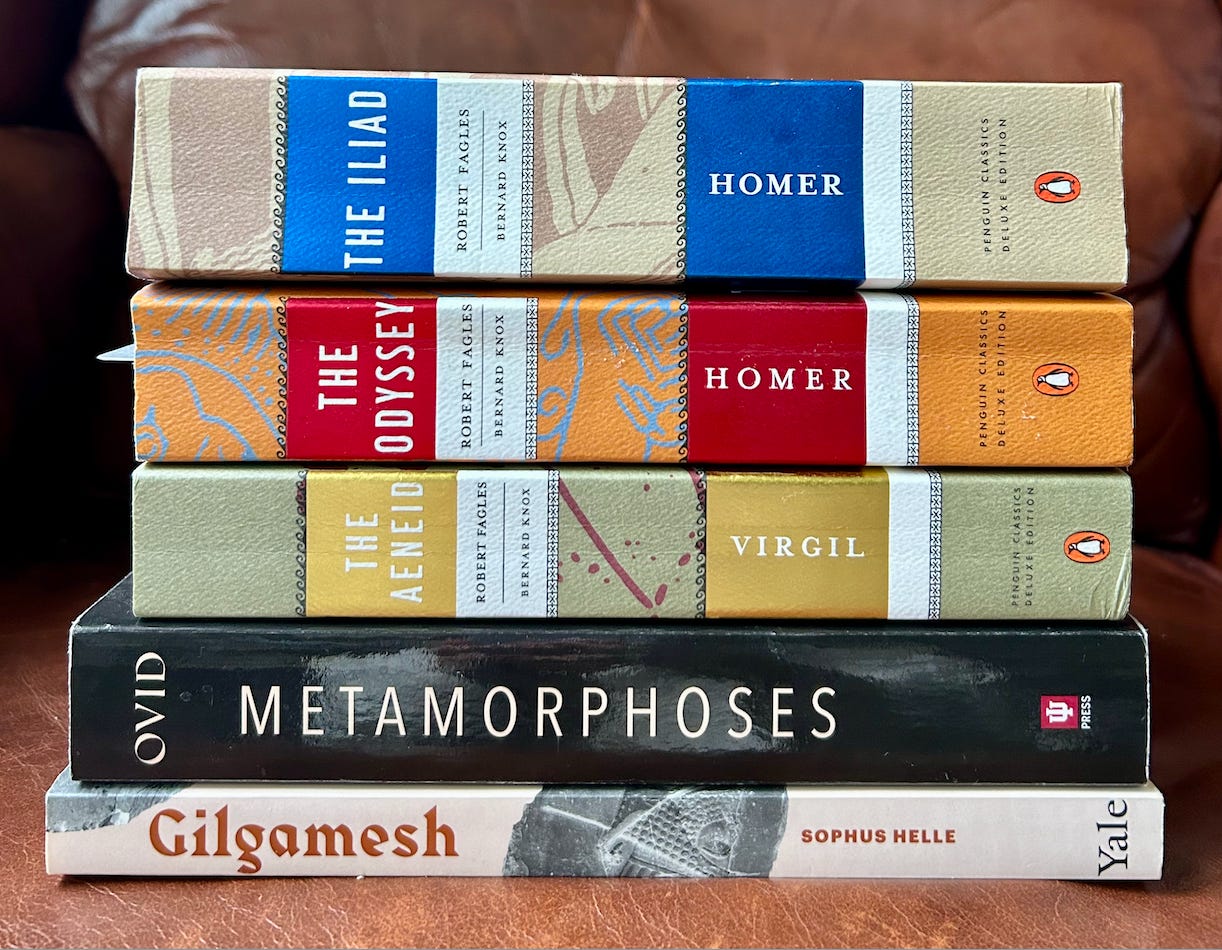
To that end, she has collated for us ‘A Personal Curriculum to the Ancient World’, through five key texts:
The Iliad by Homer
The Odyssey by Homer
The Aeneid by Virgil
Metamorphoses by Ovid
The Epic of Gilgamesh
She also shares some of the ways in which medieval writers were inspired by and engaged with ancient texts.
From here on, all the words you’ll read will be Maggie’s. I am so grateful for her time and willingness to share her expertise with us, and can’t wait to get started on my own journey into the ancient world!
“Rage – Goddess, sing the rage of Peleus’ son Achilles.” The iconic 2,700 year-old opening begins the Homeric epics. The story of the Achaeans’ ten-year siege against the hallowed heights of Troy forms the foundation of ancient history, myth, and culture.
Understanding a culture means understanding its values and how these were implemented into daily practice. The Iliad, as oral poetry, served as shared history for the ancients to better understand themselves and their culture. Today, we read the epic not only to learn about the ancient world but also to connect with it on a deeper level, through the complexity and nuance of shared human emotion.
Important topics to explore while reading include the debates around the identity of Homer (Was he one person or multiple? Did he write both The Iliad and The Odyssey? Was he a woman? Did he write down the poems?) and the historical Troy. Also notable is its handling of important cultural elements, such as warrior culture, glory (kleos), honor, grief, fate vs. free will, and legacy.
Supplemental Material:
Essays:
“Whose Homer Is It Anyway?”, James I. Porter, Lapham’s Quarterly
“On Translating Homer,” Matthew Arnold
“Digging Up Troy,” Eric H. Cline, Lapham’s Quarterly
Art Appreciation:
“The Shield of Achilles,” W.H. Auden
On Greek pottery, The British Museum
“Ode on a Grecian Urn,” John Keats
Memorial: An Excavation of the Iliad, Alice Oswold
Books:
The Ancient Greek Hero in 24 Hours, Gregory Nagy
The Trojan War: A Very Short Introduction, Eric Cline
The Singer of Tales, Albert Lord
Homer and His Iliad, Robin Lane Fox
War and The Iliad, Simone Weil
The man of twists and turns, the cunning hero, the man of many ways – Odysseus, the famed warrior (who is becoming famous all over again today), returns home from the Trojan War. It takes him nearly twenty years to see Ithaca again, and his journey takes us into the world of Greek monsters, magic, and myth. It is, to the ancient Greeks and to us, an epic of storytelling.
Important topics to explore while reading include the ancient art of hospitality (xenia), storytelling, identity, the relationship between men and women, loyalty, cunning vs. strength, and the significance of homecoming (nostos). Also notable is its emphasis on the physical journey as a spiritual journey.
Supplemental Material:
Essays:
“A Winelike Sea,” Caroline Alexander, Lapham’s Quarterly
“Xenophilia: Golden Rule of the Stranger,” Matthew Wills, JSTOR Daily
“Is Clytemnestra an Archetypically Bad Wife or a Heroically Avenging Mother?”, Natalie Haynes, LitHub
“Laughing Shores: How the ancient Greeks played with language to express a seaborne imagination,” Giordano Lipari, Aeon
Art Appreciation:
The Odyssey in paintings, The Electric Light Company
Odysseus, Max Bruch
“On First Looking into Chapman’s Homer,” John Keats
“Odysseus to Telemachus,” Joseph Brodsky
Nobody: A Hymn to the Sea, Alice Oswold
Books:
The Greek Hero in 24 Hours, Gregory Nagy
The Hero with a Thousand Faces, Joseph Campbell
Poetics, Aristotle
Agamemnon, Aeschylus
The Voyage of Argo, Apollonius of Rhodes
Moving into ancient Rome, Virgil’s Aeneid was written as a counterpoint to the Greek epics of Homer. It deliberately incorporated the structure of both The Iliad and The Odyssey and serves as the foundational epic of ancient Rome. The first six books follow the wanderings of Aeneas, driven from Troy in the aftermath of the Trojan War, and his attempt to establish a new home in Rome.
The book was highly intentional: Virgil wrote the epic under the direction of Emperor Augustus. Such a past means that the book serves as both insight into the national consciousness of Rome and deliberate historical fashioning, as Augustus attempted to imbue the Roman Empire with specific values, notably a duty towards the gods, state and family (pietas). There is debate around whether The Aeneid includes subtle criticism of Augustus or whether it should be considered Augustan propaganda.
Important topics to explore while reading include the formation of national values, duty, ideals for men and women, and the influence of history on myth. Also notable are the differences between Homeric and Virgilian heroes.
Supplemental Material:
Essays:
“Reading like a Roman: Vergilius Vaticanus and the Puzzle of Ancient Book Culture,” Alex Tadel, The Public Domain Review
“An Emperor for all Seasons,” John Weeds, Aeon
Art Appreciation:
The Aeneid in paintings, The Electric Light Company
Les Troyens, Berlioz
Dido and Aeneas, Purcell
Augustus, John Williams
Books:
The Georgics, Virgil
Twelve Caesars: Images of Power from the Ancient World to the Modern, Mary Beard
The Storm Before the Storm: The Beginning of the End of the Roman Republic, Mike Duncan
Perhaps more than any other text, Ovid’s Metamorphoses has given us our common conceptions of ancient mythology. The Roman epic poem stretches from creation to the deification of Caesar, and includes foundational myths such as the Flood, Apollo and Daphne, Echo and Narcissus, Jason and Medea, Hercules, Adonis, and Orpheus and Eurydice.
The stories center on the idea of transformation across Roman and Greek myth. They are clever, captivating, and controversial, blending comedy and tragedy. The tales have been depicted in countless forms over the centuries – drawn, sculpted, painted, and written in imaginative new ways.
Important topics to consider while reading include the process of transformation (both physical and emotional), transformation as punishment or salvation, love, the mythology of nature, and the differences between Greek and Roman heroes.
I would also encourage an exploration of the artwork inspired by the text. Notable artists include Titian, Rubens, Caravaggio, Bernini, and Waterhouse.
Supplemental Material:
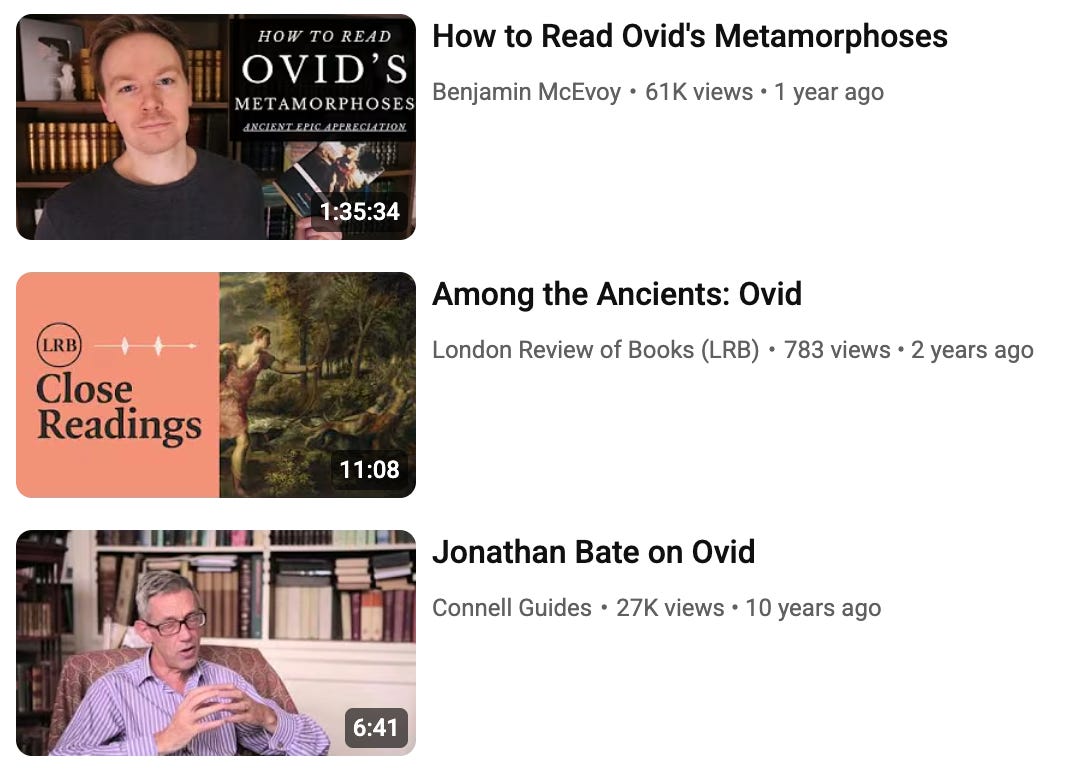
Art Appreciation:
Ovid in paintings, The Electric Light Company
Orpheus in the Underworld, Jacques Offenbach
Venus and Adonis, Shakespeare
Books:
Ovid: A Very Short Introduction, Llewelyn Morgan
The Ars Amatoria, Ovid
Mythology, Edith Hamilton
Tales From Ovid: 24 Passages from Metamorphoses, Ted Hughes
Commonly referred to as the world’s oldest story, Gilgamesh originated in ancient Iraq, preserved on clay tablets and written in cuneiform. The story was claimed by multiple cultures in Ancient Mesopotamia, including Sumeria, Babylonia and Assyria.
It tells the story of the King of Uruk, Gilgamesh, who befriends a wild man named Enkidu. They embark on adventures together until Enkidu is killed by the gods. Gilgamesh then undergoes an epic quest for immortality, which ultimately evolves into a quest for self-knowledge. It preserves foundational stories that have influenced cultures and artists for centuries.
Important topics to consider while reading include the hero’s journey, the division between civilization and savagery, flood myths, grief and death, love and friendship, and cultural memory.
Supplemental Material:
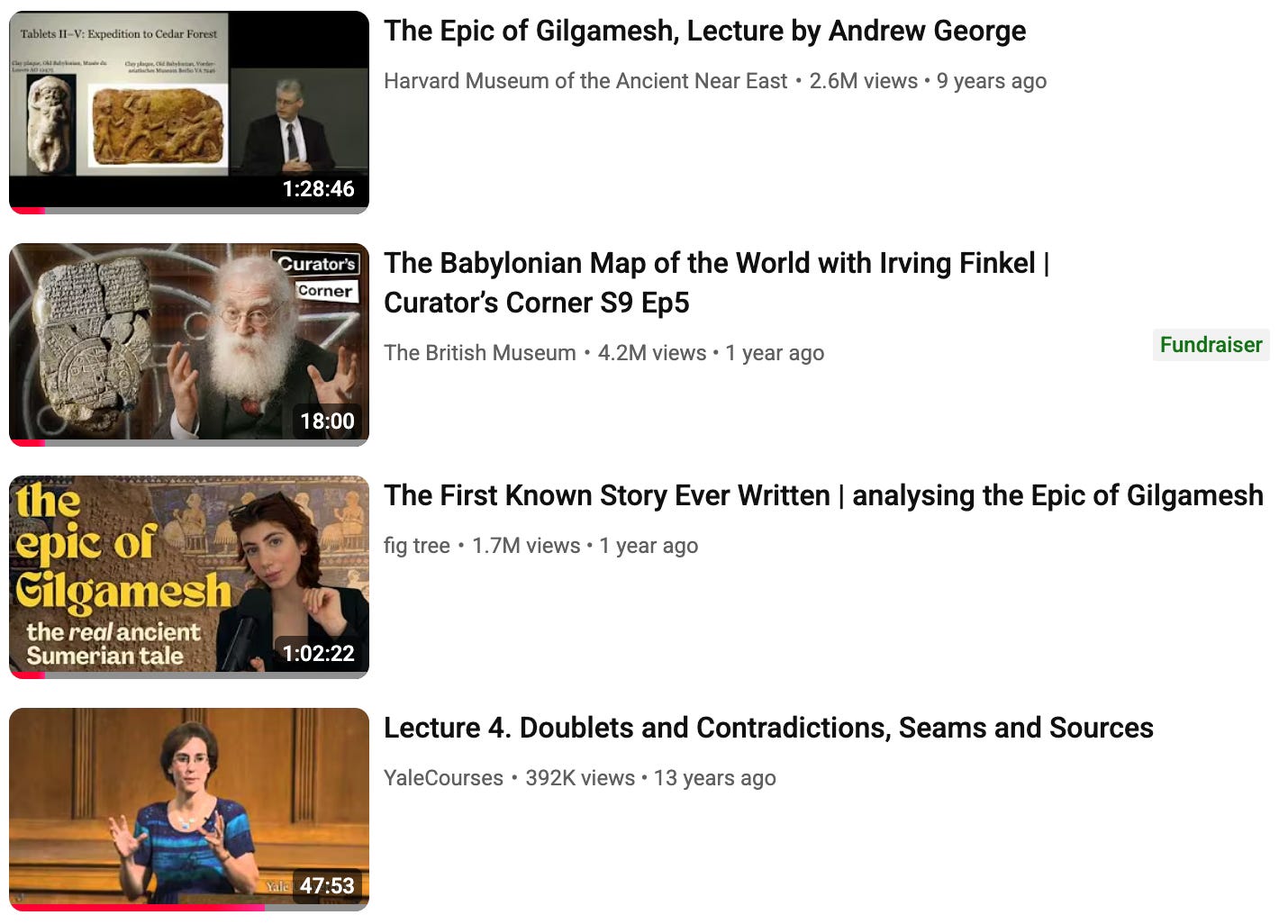
Essays:
“Doom Scrolling,” Justin Germain, Works in Progress
“Gilgamesh in the Twenty-first Century,” Sophus Helle, Yale University Press
Art Appreciation:
Joseph and His Brothers, Thomas Mann
Symbols of Transformation, Carl Jung
“Gilgamesh and Enkidu in the Cedar Forest II,” Anselm Kiefer
Books:
Myths from Mesopotamia: Creation, the Flood, Gilgamesh, and Others, trans. Stephanie Dalley
Gilgamesh Among Us: Modern Encounters with the Ancient Epic by Theodore Ziolkowski
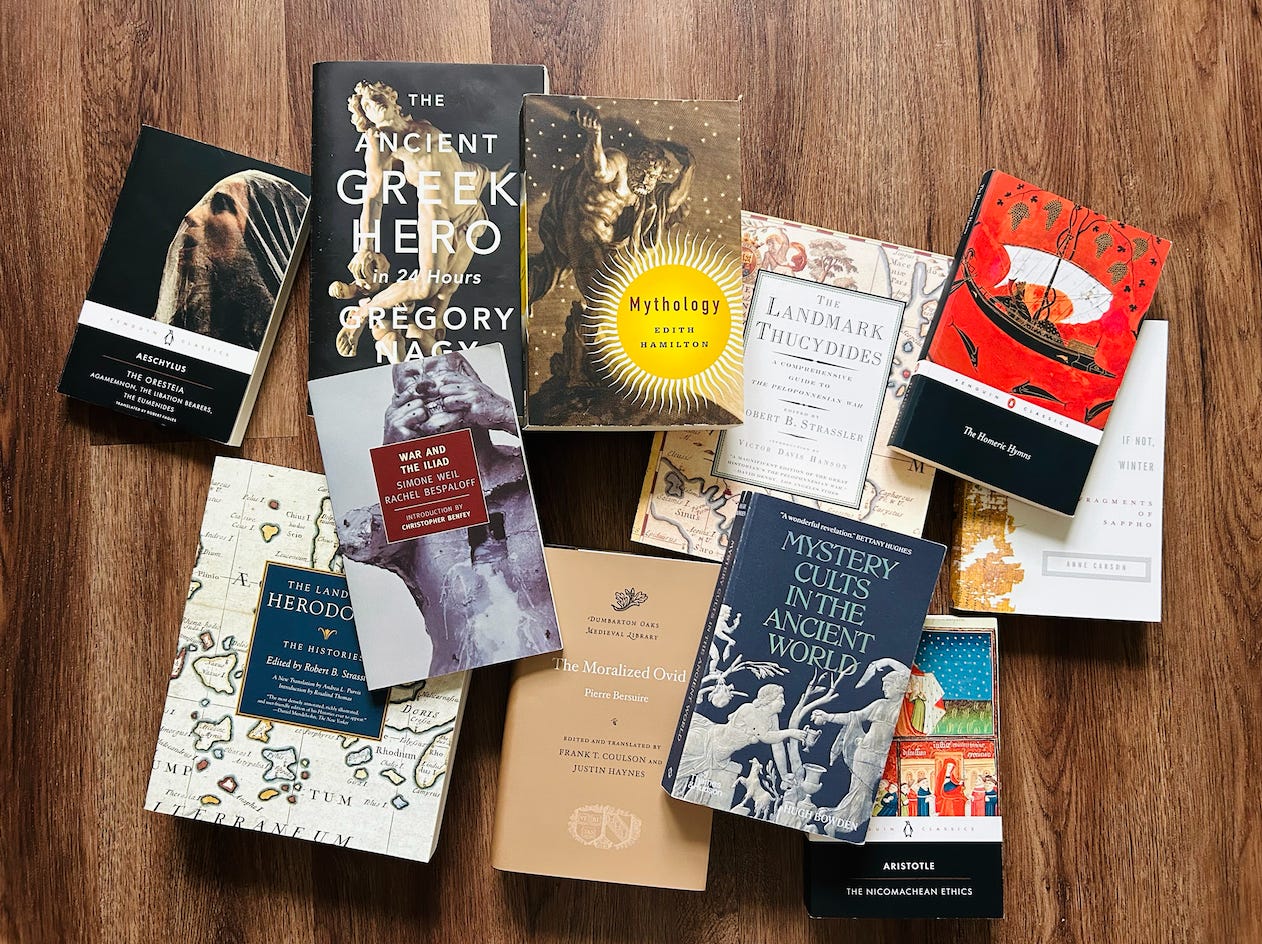
If you want more on ancient mythology…
The Homeric Hymns
Theogony by Hesoid
Mystery Cults in the Ancient World by Hugh Bowden
Hamlet’s Mill: An Essay Investigating the Origins of Human Knowledge and Its Transmission Through Myth by Giorgio de Santillana and Hertha von Dechend
If you want more on ancient women …
If Not, Winter: Fragments of Sappho, trans. Anne Carson
The Complete Poems of Edhuanna, trans. Sophus Helle
If you want more on ancient history …
The Landmark Herodotus: The Histories
The Landmark Thucydides: The Peloponnesian War
Creators, Conquerors, and Citizens: A History of Ancient Greece by Robin Waterfield
On Writing History from Herodotus to Herodian by John M. Marincola
If you want to learn about the reception of the ancients in the medieval world …
Although Odysseus was portrayed as a great hero in the Homeric epics, medieval audiences were much more hostile to the man of twists and turns. As a result of their Roman connections, they took on Virgil’s critical view of him from The Aeneid.
History of the Fall of Troy (De excidio Troiae historia) by Phrygius is a 5th or 6th c. Latin work that claims to be a translation of an eyewitness account of the Trojan War by a Trojan priest. Historians are dubious regarding its origins, but it was the relied-upon source in the Middle Ages for information about the Trojan War, even more than The Iliad. Its descriptions of Troilus and Criseyde would inspire both Chaucer and Shakespeare.
Alexander the Great was a popular subject for medieval scribes, but they added embellishments to his life, including a visit to England and an underwater adventure.
Medieval writers would often need to find ways to make pagan texts more digestible to Christian audiences. Once such effort was John Tzetzes’ (ca. 1110-1180) Allegories of The Iliad / The Odyssey. Commissioned by the Byzantine Empress Irene, the Allegories served as an introduction to Greek culture with added allegorical interpretations. Tzetzes transforms the pagan gods into kings or astrological signs, adding moral adaptations along the way.
Christine de Pizan’s Epistre Othéa (Othea’s Letter) (c. 1400) was a letter “from Wisdom” to Hector. It presents moral advice to Hector to help him become an ideal “knight.” The text was widely commissioned and popular in France and England.
In a fascinating retelling of Ovid’s Metamorphoses, Pierre Bersuire wrote an allegorical interpretation of the myths that “finds” their moral messages. The Moralized Ovid (c. 1340) became one of the most influential texts about Ovid in the Middle Ages. It presents a captivating look at the way medieval society adapted ancient texts for their time.
There are also a number of poems ascribed to Virgil and Ovid from the 6th to 15th centuries. Both can be found in the Appendix Ovidiana and the Appendix Vergiliana.
💬 Have you been inspired to begin a personal journey through the ancient world? Or is it somewhere you are already deeply familiar with? Do leave a comment to join me in thanking Maggie for sharing her expertise, as well as letting us know your own experiences with ancient literature.
Here are a handful I’ve shared previously. Do make sure to follow me on Substack Notes, as that’s where I post this type of content most regularly!
Comments
Nothing yet. Say the first thing.
Sign in to join the conversation.