
I met a tree the other day and, a bit like Alice, thanks to it I fell down a (reading) rabbit hole of tales of religious upheaval, civil war, and an ancient monastic space. All thanks to this solitary and huge tree that was planted hundreds of years ago to celebrate a controversial new king. The tree in question is a lime tree and it stands on the village green in Duleek, County Meath. It is (to put it mildly) an imposing figure, standing on a slight rise at the heart of the village.
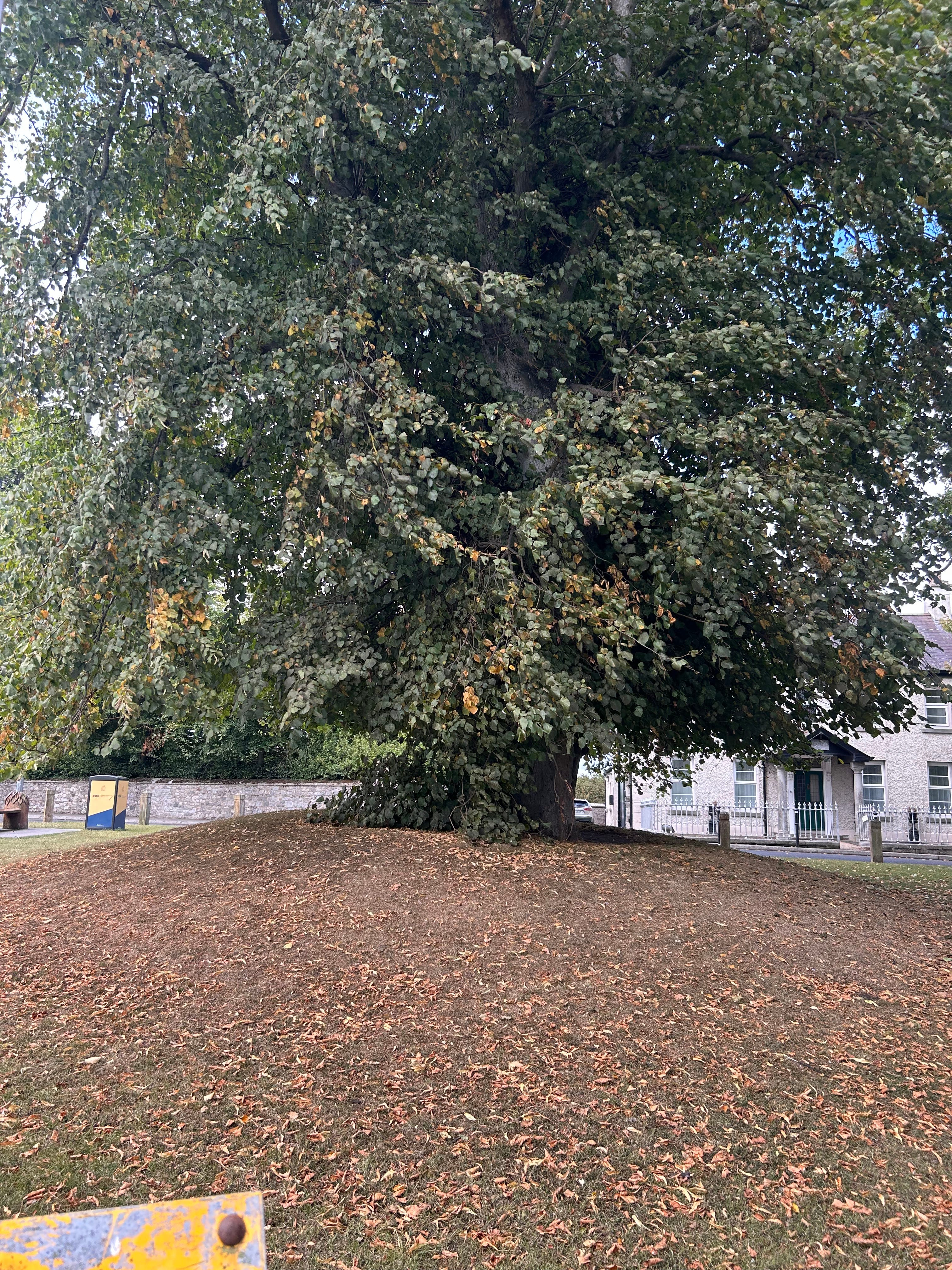
Local tradition says it was planted around the year 1700, to mark William III’s victory at the Boyne. If that tradition is correct, the tree is more than three centuries old. If true that would make it the oldest and largest lime tree in Ireland.
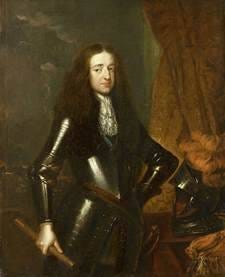
Despite its age it’s actually a fairly recent addition to an ancient settlement that was fought over, burned, plundered, and rebuilt for well over a thousand years before anyone even thought of William III.
Duleek is among Ireland’s oldest ecclesiastical settlements. Its foundation tradition attributes the erection of an early stone church to St Cianán, the ‘damhliag’ that gives the town its name. In Irish, damhliag means “house of stone.” A stone church at Duleek is securely attested by the eighth century.
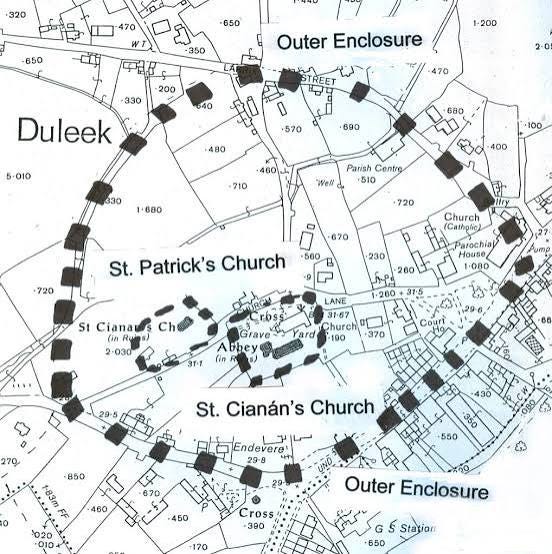
The Annals list various abbots and bishops of Duleek from that century onward, and by the early medieval period the settlement included a number of substantial ecclesiastical monuments, including a round tower and high crosses. Such importance and resources made it a tempting target. Duleek was repeatedly raided during the Viking period, with attacks recorded from the ninth century onward, and the church was demolished outright in one such raid in 918.
Irish kings burned it too. In 1123 the Gaileanga (a very powerful local ruling family) burned eighty houses in an attack and in 1149 Diarmait Mac Murchada plundered it alongside the Vikings of Dublin. When Brian Bóruma’s body was carried north for burial after Clontarf in 1014, Duleek was one of the places where he and his son were said to have lain in state on the journey to Armagh.
After the Anglo-Normans started arriving in Ireland in the later twelfth century, Hugh de Lacy, the new lord of Meath, established a manor and motte at Duleek, choosing the site of the existing ecclesiastical settlement just outside its old monastic enclosure. The present street pattern is generally understood to follow the broad line of that old ecclesiastical enclosure. It was a farming community during the post-Norman period and is generally quiet but, as with the rest of the country, things heated up considerably during the sixteenth and seventeenth centuries.
Local historical accounts record that Duleek was burned by Hugh O’Neill’s rebel forces in 1601. Later that century it sat in the path of the retreating Jacobite army in 1690. James II apparently heard Mass in St Mary’s church there on the morning of the Battle of the Boyne, and the town became a strategically important crossing on the Jacobite retreat across the river Nanny.
So the lime tree was planted fairly recently into an area that had seen recent and major upheavals. The sleepy village that Duleek is today with that magnificent tree at the heart of it had, by the time it was planted, survived Vikings, warring Irish kings, Norman conquest, and experienced a civil war fought around it.
The great lime tree stands alone today but originally it was designed to intertwine with an ash tree.
The story is that two saplings were planted on the green: an ash, associated with Ireland, and a lime, understood locally as foreign or exotic, planted so their trunks grew entwined. The ash stood for Queen Mary of England and the lime for her husband, William. The symbolism is very much of its time, a Protestant horticultural allegory of the joint monarchy that the Williamite victory at the Battle of the Boyne helped secure. The ash survived until sometime after 1942. You can apparently still see the scar on the lime’s trunk where the two were once joined, an indent on its north side where a second tree used to be. I went looking but as I had a boisterous dog on a lead I wasn’t able to peer closely enough.
The local history of Duleek, compiled by Noel French, says that the lime and ash trees were planted by local Huguenots. As he says, there is “a strong local tradition of Huguenot settlement in Duleek although there is no documentary evidence” for it.
Huguenots were French Protestants who fled after Louis XIV revoked the Edict of Nantes in 1685. Apparently (so local lore says) some of them came to Duleek and brought their spinning and weaving skills. They then lived in rows of small houses along a lane called Larrix Street, possibly named for the French surnames La Rochelle or Laroux. This tradition has about two hundred and fifty weaving families arriving in Duleek which is a lot. Now, Duleek did have a real, substantial weaving industry that lasted into the 1930s, whatever its origins. But there is a problem with the Huguenot story specifically: when people in the parish applied for a flax-growers’ subsidy in 1796, not one of the applicants had a Huguenot surname. So there is no evidence for a still-distinct Huguenot community by 1796, though we cannot rule out fully assimilated families. If there was ever a distinct French Protestant weaving community here, it seems to have left no trace in that particular record. Perhaps there were a couple of Huguenot families in the village and subsequent years exaggerated their presence somewhat?
So, even though it is a wildly romantic idea that hundreds of Huguenots turned up in a quiet corner of Meath, it does seem unlikely (to say the least). That tale of the tree being planted by grateful refugee Huguenots, thankful for the victory of their Protestant Majesties does not seem to hold up to scrutiny. Perhaps there were a few Huguenot families living there but that detail may have grown in the remembering.
Whoever planted it, that lime has seen quite a bit of history even if it is a junior member of the village. It stood through Duleek’s severe population decline that followed the Famine, when the town’s recorded population fell from 1,158 in 1841 to about 200 in 1861. It was there when a German aircraft dropped about ten incendiary bombs in the rural area north of the town on New Year’s Day 1941, and it was still standing when its companion ash tree died sometime after 1942. This marvellous tree is only the latest signifier of the changes of Irish history in a small but very old place. It was planted by people who wanted to forever mark the victory of King William, in a village that was old by the time the Vikings arrived and ancient when Norman knights first appeared there.
Trees though are very good at outlasting the reasons people plant them. The lime doesn’t know or care what it was meant to represent. It has just kept doing what a lime tree does, for over three hundred years. When we approach and take a closer look it kindly leads us into the story of our turbulent past, as the cars speed by and the locals sip lattes and worry about very different things than the people who planted it three hundred years ago.
For me, meeting a brilliant tree is one of the many bonuses I get when I traipse all over the countryside looking for our old stuff and stories. Always take the time to stop when you see a wonderful tree. They often have secrets they don’t mind sharing.
French, Noel. “Duleek – History and Development.” Meath History Hub. This is particularly useful for the local traditions surrounding the King’s Tree, Duleek’s Huguenots, weaving industry, and the history of the town.
Giraldus Cambrensis. Expugnatio Hibernica: The Conquest of Ireland. Edited by A. B. Scott and F. X. Martin. Dublin, 1978.
Meath County Council. “Duleek Heritage Trail.” An accessible guide to the surviving historic landscape and monuments of Duleek.
O’Boyle, Enda. A History of Duleek. Duleek, 1989.
Swan, D. Leo. “Monastic Proto-Towns in Early Medieval Ireland.” In The Comparative History of Urban Origins in Non-Roman Europe, edited by H. B. Clarke and Anngret Simms. Oxford, 1985.
Todd, James Henthorn, ed. Cogadh Gaedhel re Gallaibh: The War of the Gaedhil with the Gaill. London, 1867.
Comments
Nothing yet. Say the first thing.
Sign in to join the conversation.