
I was driving through the village of Dunsany the other day and remembered a woman who not many know of but who was once Lady of the castle there. She popped into my head and the more I thought of her the more I realised she kind of embodies what I am trying to do with Unruly Ireland. Because her life, marrying six (SIX) husbands, looks pretty unruly but, really, it was anything but. There is purpose and logic behind those marriages, as we shall see.
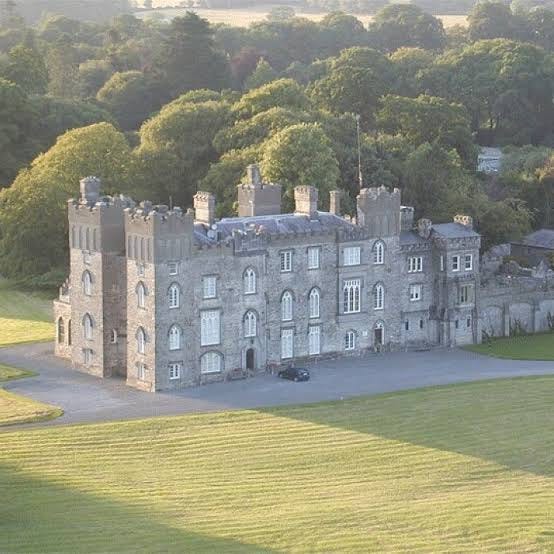
Jenet (sometimes Genet) Sarsfield was a merchant’s daughter from the flat farming country north of Dublin, part of the English Pale in Ireland, and she grew up to be a woman who took marriage very seriously. So seriously, in fact, that she did it six times and benefitted each time. Amid the turbulence of sixteenth century Ireland she managed to marry upwards multiple times and accumulated a large fortune. Because she treated her marital life with the seriousness and tenacity a modern woman needs to treat her chosen career in order to be a success, she died in February 1598 as ‘Lady Dowager of Dunsany’, a title she had picked up from one husband and kept for the rest of her life. Very unusually she chose to be buried alone, next to none of her husbands. Maybe she felt she needed some time alone. Like, an eternity.1
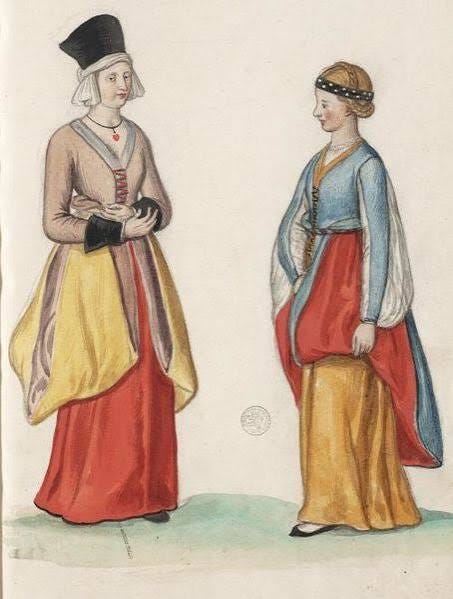
As is usual with women of that period in Ireland, we don’t have any images of her, but we do have an idea of how she might have appeared. This period saw Lucas de Heere paint images of Anglo-Irish Paleswomen, of whom Jenet was one, prim and orderly in layered gowns and headcloths.
The marriage market
In the Pale, like everywhere else for elite families, marriage lacked an emphasis on love. Among the gentry and the merchant families who ran Dublin and the surrounding areas, a match was a contract. You married to pull land holdings together, to clear debts or to social climb. Therefore, choosing a spouse was a piece of business, and nobody pretended otherwise. Jenet appeared to embrace this philosophy wholeheartedly and was wildly successful at it.
Her father, John Sarsfield of Sarsfieldstown in County Meath, was a man of some standing, and one of her brothers ended up an alderman of Dublin. Her first husband, Robert Schillingford, had been mayor of the city. They are successful, but not perhaps on the top rung of society. But from there she climbed rapidly. James Luttrell was her next husband, then Robert Plunkett, the Baron of Dunsany who was a real catch.
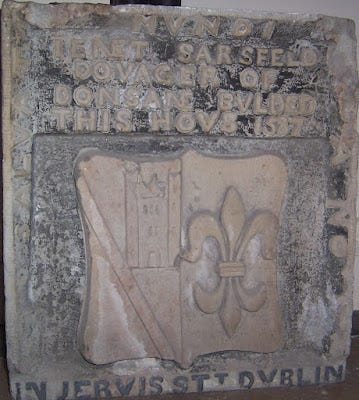
It was Dunsany who gave her the title she’d take to her grave. Each marriage moved her a little further up, and she seems to have treated the whole sequence the way a shrewd investor treats a portfolio. One can only imagine what she would have been like unleashed today. A successful entrepreneur, running multiple businesses maybe.
Sir Thomas Cusack, and the price of a husband
Her fourth husband was another big fish to land, Sir Thomas Cusack. He had been Lord Chancellor of Ireland since 1550, a heavyweight of Pale politics, and well into his mid-fifties or even older by the time he married Jenet in 1559. She was probably in her late twenties or early thirties by then. We are not entirely sure when she was born but it was likely the late 1520s or early 1530s. A May-September match which benefitted both, perhaps transactional but everyone seemed happy. The marriage produced no children, but they were never really the point.
How do we know it was probably quite transactional on both their parts? Well, in a feoffment (legal instrument) drawn up on 2 November 1564, Cusack settled lands on Jenet, and he handily outlined how much he owed to his wife and her accumulated wealth. Part of the reason he was pushing lands over to her was ‘the preferment’ he had gained by marrying her. The rest was money. Jenet had laid out sizeable sums to clear debts Cusack owed to Queen Elizabeth and to others, and the land was, in plain terms, repayment. This was a woman with capital, lending it to a former Lord Chancellor and securing herself against his estate. Romance doesn’t come into it, and I don’t think either of them expected it to.
A widow in the Pale had two ways of drawing income from a dead husband’s estate.2 The older was dower, her right at common law to a third of the lands her husband had held during the marriage after he died, to be held for the rest of her life. The trouble with dower was that it only attached to land the husband actually held in his own name. If the land had been enfeoffed, that is, conveyed to trustees to hold to his use, a device families increasingly favoured, then strictly speaking there was nothing for the widow’s dower to fasten onto. The answer was the jointure. Instead of waiting to claim a third after his death, the wife often had land settled on the joint use of herself and her husband for their lives, so that when he died she simply carried on holding it, and it passed to his heir only when she in turn died. A jointure was surer than dower, it could be fixed in advance, and it could be made as generous as the bargain allowed. Cusack’s 1564 feoffment was exactly this kind of instrument, tilted heavily in Jenet’s favour because she had paid for the privilege. Do that five or six times over, each marriage adding another life interest, another settlement, another set of goods to be claimed as a widow, and you begin to see how a merchant’s daughter ended her days a wealthy, elite woman. Jenet knew how to use the system and she did it remarkably well.
A wicked stepmother, or maybe just a very good businesswoman? Or maybe a bit of both?
Thomas Cusack died in 1571, and then the trouble started. His son Edward looked at his father’s widow sitting on the family property and convinced himself that she was the wicked stepmother of every folktale. Jenet inherited a great deal, including the old nunnery of Lismullin, which Cusack acquired after the dissolution of the monasteries. Edward wanted it all back and decided not to wait for a court’s agreement.3
So, he broke in while Jenet was away, Edward made off with goods and a hundred and twenty-five head of cattle. She sued him in chancery and also claimed that Edward had grabbed his father’s will, run off with it, thrown it into a field of standing corn, then fished it out and blotted the thing in sixteen separate places to smudge the parts he didn’t like. He was found guilty of stealing a casket of jewels from her and, unable to pay what he owed, had to hand them over.
The jewels had been left by Edward’s own mother, Maud Darcy, to her children, and the children had never actually received them. However, Edward was a thief in the eyes of the court not simply a young man chasing his inheritance. Jenet held the legal advantage but may well have been keeping jewellery that was never meant to be hers. History rarely hands us a clean victim or villain, and it doesn’t here.
The fight between them ground on. By December 1573, Edward obtained a chancery decree against Jenet and her new, fifth husband, John Plunkett (a Privy Councillor and judge), forcing them to give up Lismullin. Later in the decade, while over in England, Edward sent William Cecil, Elizabeth’s secretary, a careful genealogy of Jenet’s connections across the Pale, as he complained that he was at a disadvantage in his legal battled with her as she was tied by blood and marriage to half the powerful families in the country. This was nonsense, he was a powerful and wealthy landowner and these were stratagems designed to strengthen his case against her. When Jenet finally left Lismullin, Edward claimed she left it stripped. There was lots of bitterness there.
The sixth husband
Still, Jenet continued to acquire notable husbands. John Plunkett, husband number five, died in 1582. Jenet was by now well into middle age but she wasn’t finished her marital journey yet. Her sixth and last marriage was to Sir John Bellew of Castletown, County Louth, a landed man from an old Pale family. This time she had chosen a husband hardier, than herself. Bellew would outlive her, the only one of the six to do so, which after five funerals must have felt like a novelty.4
Jenet was Bellew’s third wife. His second, Ismay Nugent, was the one he had loved: together they built a memorial at Dundalk in 1588, and Ismay was buried, probably there, in the early 1590s. Bellew married Jenet after that, at some point between the death of her fifth husband in 1582 and his wife in the early 1590s. When he came to make his will in 1600, two years after Jenet’s death, it was Ismay he wanted at his side. He asked that, should he be buried at Duleek, Ismay’s body be brought there and laid beside him. Bellew was proposing to have her dug up and moved to lie with him. Jenet, notably, does not appear in these plans at all. Her last husband’s heart, so far as a will can show it, lay with the wife before her. Jenet, I suspect, was unbothered by this.
Buried alone
Why do I suspect that? Because she chose to be buried alone. In eternal and quiet repose. Jenet died in February 1598. In Moor churchyard in County Meath her slab names her: ‘Dame Ienet Sarsfield Lady Dowager of Donsany’. It’s a curious monument. She lies under it by herself, not beside any of the six men she married.
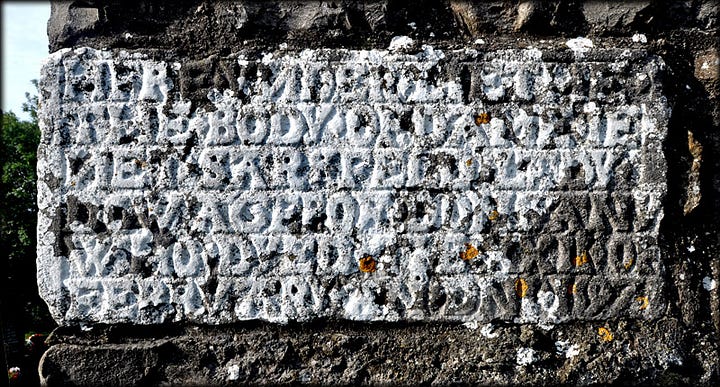
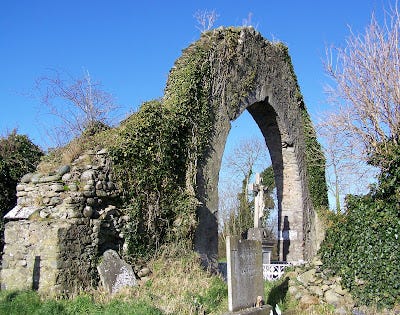
The historian Clodagh Tait reads that solitary grave as a kind of statement. Most women of the period who got their own monument, or who stood at the centre of one rather than off to the side as somebody’s wife, tended to be the ones who defied easy definition. To be buried alone, in your own right, under your own hard-won title, was not the ordinary fate of a Pale widow. This act looks a great deal like autonomy, which Jenet achieved over six marriages and displayed in her death.
Her death choices and memorial epitomised her life. For a woman with limited options, Jenet took what she had and ran with it. In an unstable and capricious world Jenet was going to ensure stability and wealth and build her own route to power. She strategized and used her marriages and her wealth and leverage to climb the social ladder and become ever wealthier and more respected. It merited a toughness and resilience which in turn allowed a level of autonomy that was remarkable. And all accomplished during one of the most turbulent and divisive periods of Irish history. She left one daughter, Katherine from her first marriage. Katherine, no doubt to her mother’s pleasure, also married well. She married Thomas Talbot and had several children. One of whom, a girl named Jenet, married Robert Barneweall, the 7th Baron Trimleston.
The climbing continued…
Thanks for reading Unruly Ireland! This post is public so feel free to share it.
On dower, jointure and the widow’s share see Mary O’Dowd, A History of Women in Ireland, 1500–1800 (Harlow, 2005), ‘Widows, dower and jointures’, 89–95. O’Dowd notes that enfeoffing land to a husband’s use blocked a common-law dower claim, so a jointure, land enfeoffed to the joint use of husband and wife for life, became the surer provision.
On the Cusack family see, H. Galley, ‘The Cusack family of Counties Meath and Dublin’, The Irish Genealogist 5, no. 6 (1979), 673–84.
Clodagh Tait, Death, Burial and Commemoration in Ireland, 1550–1650 (Basingstoke, 2002), 5, 114–15. Tait identifies Jenet as Bellew’s third wife; his second, Ismay Nugent, was buried ‘probably’ at Dundalk in the early 1590s. Bellew’s will is dated 1600
Comments
Nothing yet. Say the first thing.
Sign in to join the conversation.