
A crusade song written around 1189, expressing the agony of leaving his lady behind to join Philip Augustus and Richard the Lionheart on the Third Crusade
— Ahi! Amours, Conon de Bethune, a trouvere of Philip Augustus’ court.
Guillaume le Breton (William the Breton) was a poet / chronicler in service to King Philip Augustus, the longstanding “frenemy” of Richard the Lionheart. William’s Philippide is a Latin epic poem in 12 books recounting Philip’s exploits. It contains incidents not covered by other contemporary histories of Richard and the Third Crusade. (I have produced eBook versions of the other major chronicles of the Third Crusade, see here. While our focus on this blog is Philip’s role in Richard’s life, Philip was deeply influential on France’s history. For example, he constructed the first incarnation of the Louvre (as a fortress), built Les Halles, was influential in the construction of Notre Dame, and, after Richard’s death, defeated Richard’s brother John, increasing the boundaries of France more-or-less to today’s borders.
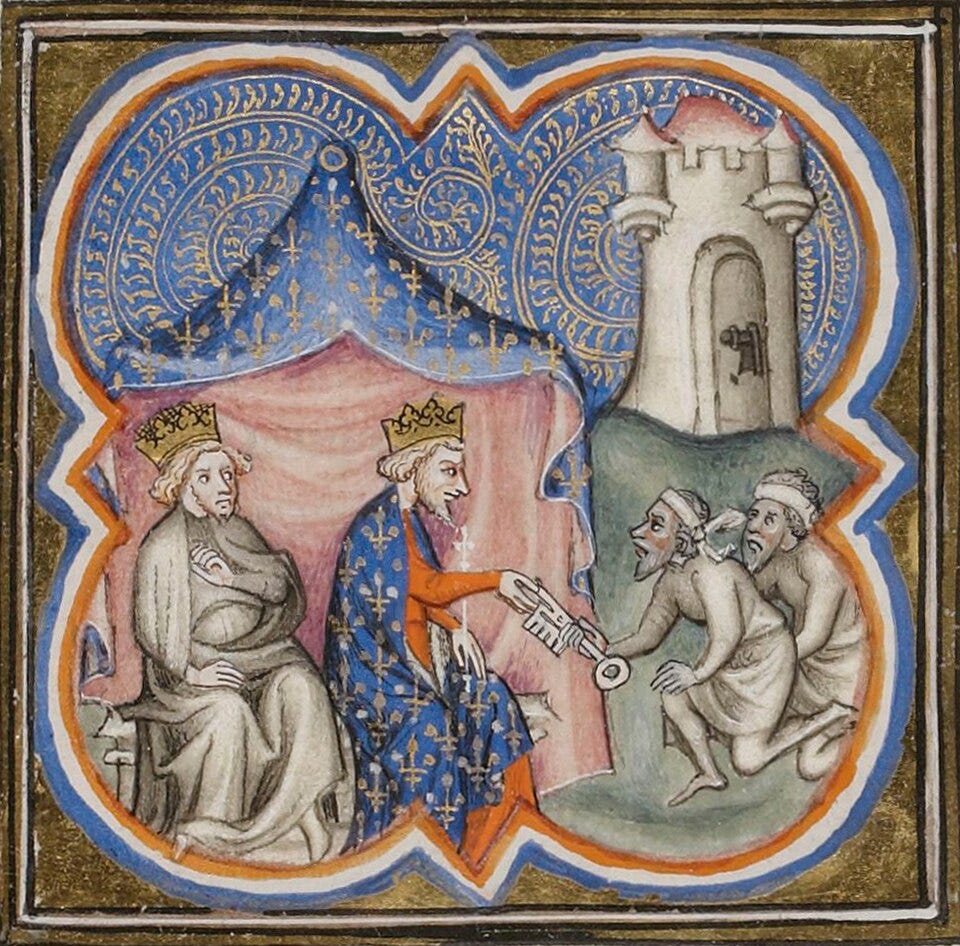
The composition date of the Philippide is unknown, but it was somewhere between 1214 and 1225, when William died. Of even more interest is the wealth of detail on the war between Richard and Philip that ensued after the Crusade.
I was particularly interested to read Books IV and V of the Philippide, as it covers the period from when Richard became King of England after his father’s death until the time he died at Chalus. As it turns out, there is no full English translation of the Philippide. The Latin original (see on Internet Archive) was translated into French by François Guizot in Collection des mémoires relatifs a l’histoire de France (Internet Archive) in 1825. Recently, I created Bookxlate, which uses Gemini’s AI APIs to OCR and translate books from the Internet Archive. I used it to translate Books IV and V; as far as I am aware, it is the only English translation of this work. Yay for AI!
The translation is posted below. I based my work on the French version; this is a translation of a translation. The translation presented below is generated by AI; and I do not speak French or Latin, so I cannot strictly vouch for the fidelity of the translation, but everything I have checked by hand seems correct enough. Caveat emptor.
The full translation below may be a bit much for many people, so let me point out some things I find interesting from it: for example, the language is flowery and metaphorical at times, almost Odyssey-like (which I am also re-reading at present in preparation for Nolan’s new movie).
and when his fleet was all ready, abandoning itself to the breath of the zephyr (the wind),
…
(during a storm at sea:) No one tried to contradict him; each on the contrary hastened to throw his belongings into the water, preferring to lose what belonged to him than to lose life without receiving burial, and to feed the fish with his possessions rather than his person;
Richard and Philip are quite friendly in this account, often in contradiction to other accounts:
Here are two kings whom the same affection, the same spirit, the same faith unite and bind so closely to one another, that one loves or does only what the other loves or does equally…
and further, after their break, there was a time which Richard presented as quite friendly to Philip, again in contrast to other accounts:
(after the siege of Acre:) But the Catholic king (Philip) did not want to enjoy such a great triumph alone before the arrival of the King of the English, to whom he had promised to always be a faithful companion as long as both consecrated themselves with the same zeal.
…
…Richard renounced remaining armed, and without any other warning, if not from him who holds in his hands the hearts and arms of powerful men, he placed himself at the disposal of his lord (Philip) and declared himself ready to obey him in all things.
William the Breton is also very complimentary to Richard, surprisingly (his boss is Richard’s enemy), recalling his “brilliant valor” and “lion-hearted” speech, amongst other compliments.
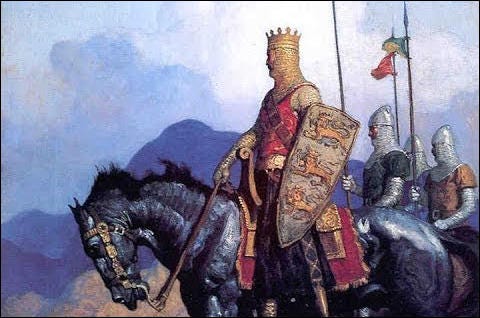
But rest assured, Richard and Philip will become enemies for life; here’s Philip:
I grant you a truce of safety as long as you bear arms for the service of the cross; later, fear me and mine.”
The account of Richard breaking his betrothal to Alice, Philip’s half-sister (how wild, to be engaged to your enemy’s sister!), and subsequent marriage to Berengaria, is different than usually recounted, and a bit, ahem, direct, about the state of affairs between them (and this account suggests Richard and Berengaria are already married by the time Richard is in Sicily, whereas all other accounts have them getting married in Cyprus):
I return your sister to you, and, I beg you, please do not ask me the secret motive1 that leads me to this step. She was married only by betrothal; there is nothing more, I have never known her according to the flesh. Bérengère has already united with my bed, Bérengère daughter of the king of Navarre; already the union of the flesh has confirmed the holy sacrament, and we are no longer but one flesh.
We find here listed the account where Richard tramples the Duke of Austria’s banner at Acre, creating another lifelong enemy, an event only alluded to in other accounts.
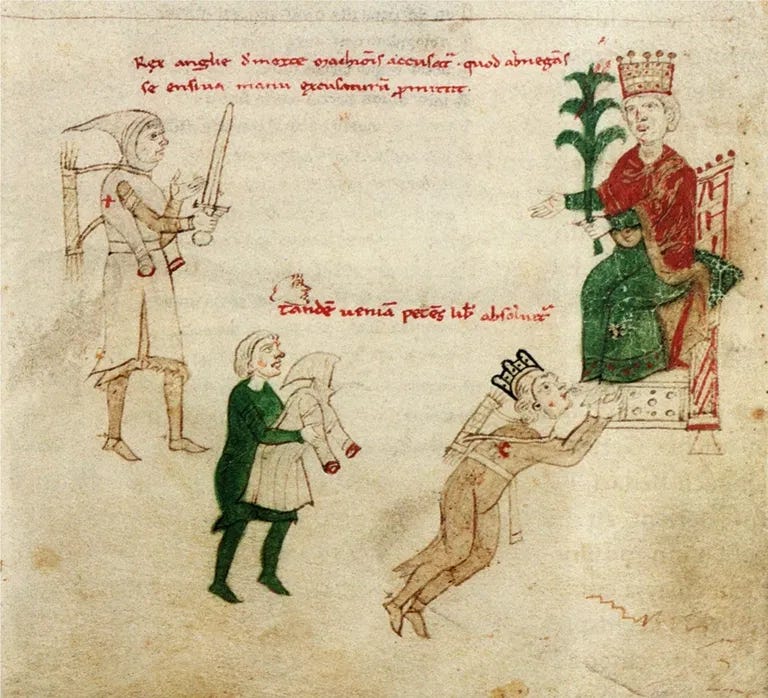
The Philippide also contains the only account (so far as I can remember) of the words Richard spoke at his “trial” at the hands of Henry VI the Holy Roman Emperor (and where he is referred to as “lion-hearted” ), and also claims Richard himself proposed the famous ransom of 150,000 marks. The account is particularly valuable as William is believed to have been present at the trial.
Richard could not bear this language any longer; and, as if he were seated on the throne of his ancestors, or in the court of Lincoln, or in the midst of the city of Caen, as if he had forgotten the garment under which he was held prisoner, with a royal and eloquent mouth and a lion’s heart, he suddenly spoke:
“Let him who accuses me of treason appear, let him present himself fully armed, let him consent to a duel with me, to try if he can convince me on this point.”
The Philippide also recounts the story of the treasure at Chalus which allegedly lured Richard to his death, an account which most historians do not credit.
I hope you enjoy the translation. This post contains Book IV, and our next post will contain Book V. (The footnotes in the text are the original footnotes from the 1825 edition, not mine.)
CANTO FOURTH.
ARGUMENT.
The death of Henry passes the scepter into the hands of Richard, who soon after sets out for Jerusalem with King Philip. — They spend the winter in the territory of Sicily, from where their quarrels prevent them from departing together. — Cyprus submits to the English, the city of Acre to the children of France; the cities of Gaza, Ascalon and Jaffa submit to the two kings. — Philip falls ill and returns to his homeland. — Richard, returning also, is taken prisoner, but he is ransomed from captivity and resists with great valor the French who wage war against him. — John causes Frenchmen to perish through horrible treachery. — Gautier re-establishes the lost charters of the royal domain.
IN ACCORDANCE with ancient laws, the right of primogeniture made Richard king of the English, after the death of his father. Having ascended the throne, he remained firm in his love for Philip, and honored him respectfully as his lord. For an entire year, no discord arose between them, and sweet peace established good relations between the two kingdoms.
However, the king, eager to fulfill his vow to Christ, which he had offered with holy intentions, hastened to work on it, took all his measures with vigilant care, and prepared all the things that might be necessary for such a great enterprise and for a voyage of such long duration. He took with him warriors full of vigor, as much as he thought he needed for such a great affair, all elite men, and proven in their homeland for war as well as for peace.
It was in the year 1190 that King Philip departed for the kingdoms beyond the seas. Having had loaded onto his innumerable ships grains, vegetables, silver, meats, gold, goods, horses, weapons, hardtack and wine, and when his fleet was all ready, abandoning itself to the breath of the zephyr, he departed from the Italian city which illustrated the name of Genoa. Sailing for three weeks on the waves of the Tyrrhenian Sea, having Rome on his left, to his right the forts of Carthage, after having endured several storms, escaped from great perils, and suffered considerable losses, he finally landed on the coast of Sicily.
While the fleet was sailing along the Strait of Messina, a storm having suddenly arisen, the vessels were on the point of perishing, and would have been swallowed by the waves if the prudent pilot had not thrown into the sea horses, grains, provisions and barrels full of wine. No one tried to contradict him; each on the contrary hastened to throw his belongings into the water, preferring to lose what belonged to him than to lose life without receiving burial, and to feed the fish with his possessions rather than his person; and no one considered as a loss any means of delaying, even for a short time, the hour of his death. The ships thus unloaded, already past the middle of the night, the storm still raged with the same violence, the terrifying aspect of the atmosphere made them despair of any means of salvation; the thunder, the clouds, and thick darkness hid the sight of the stars; frequent flashes of lightning alone came to interrupt this scene and bring terror to all hearts; then the king, deploying the strength of his soul, consoled with these words those who were thus struck with stupor:
“Let all your fears cease; behold, God visits us from the heavens, behold, the storm is retreating; already the brothers of Clairvaux have risen for matins; already the saints who do not forget you, render their holy oracles in honor of Christ; their prayers reconcile us with Christ, their prayers will deliver us from this great peril.”
He had barely spoken, and already all the crashing and tumult of the atmosphere subside, the fury of the winds calms, the darkness dissipates, and the moon and the stars spread a brilliant light. Thus all having found salvation after the king’s words, the night retreats, a favorable wind pushes the fleet under the protection of God; and finally, after having suffered considerable losses, the travelers, filled with joy, escape the peril and enter the port of salvation, shouting cries of joy. Then the king, opening his treasures, distributed his gifts on all sides, in order to make the champions of Christ forget the losses they had suffered, and that none of them should lack horses or fodder to feed them.
On his side, King Richard, no less eager than Philip for the service of the cross (for he was bound, by right and by oath, to associate himself with this enterprise), departed from the city of Marseille so well supplied with goods and arms, and followed by so many elite men, that he seemed inferior neither to Philip nor for the forces nor for all the other provisions he might need. From there, rapidly led over the waves of the Tuscan sea, he landed with a numerous fleet in the ports of Sicily, having suffered no damage, and his arrival renewed the joys of the French and of King Philip, who had just gone to Messina, and had been staying in that city for a short time. The Sicilians then gave themselves over to their transports, all of Sicily rejoiced to welcome such guests, followed by so many armies. King Tancred paid them the greatest honors; he then held the scepter of rich Sicily, which he had skillfully seized by uniting artifice with violence.
King William had died very recently2, and his wife Joanna rejoiced to have Richard as a brother; but she had no child who could console her in her widowhood and serve as heir to the deceased king. His sister, Constance3, claimed after his death to have the right to succeed him, since he left no child; but Tancred, who was the uncle of the deceased king4, would not suffer Constance to seize the scepter of her fathers, claiming without any right to succeed his nephew, and having himself recognized as king, to the prejudice of his aunt. She, however, when she married King Henry, who a short time later was elevated to the Roman Empire, became Queen of Sicily, with the assistance of her new husband. Adorned at once with the diadem of an empire and that of a kingdom, she also managed to be reinstated in her rights: it is she who later gave life to Frederick, who now reigns and governs the Teutons, the Romans, and the Sicilians.
Alas! how easily the human heart is changed, how susceptible it shows itself to various movements, when it allows itself to be seduced by the artifices of the instigator of all iniquity! This one, always at war against love and always suffering hatred, sows division among friends, disunites by his cunning those he sees tenderly united, in order to subdue by separating those he cannot conquer when they are bound by a reciprocal love, and when they stand firm without imprudently bending to let pass him who has the power to deceive only those who yield before him to let him pass. We too are too easy to yield to him, to him who has no right over us other than that which we grant him; moreover, when we wish it, and as many times as we are tempted by him, we have enough within us to resist him with the strength that divine power lends us, and no one is pushed to be wicked if he does not voluntarily welcome the enemy: our will alone submits us to the tempter, and if we do not have this will, there is no sin in us.
Here are two kings whom the same affection, the same spirit, the same faith unite and bind so closely to one another, that one loves or does only what the other loves or does equally, so much does their reciprocal affection attach them to one another; but such great tenderness cannot long subsist between them. Richard, having found a favorable occasion, revealed what he kept hidden in the depths of his heart, and spoke to Philip in these terms:
“Good king, whom France obeys, whose knight I am, to whose arms my vows bind me, to whom I recognize myself as committed as to my lord, before whom Egypt and the land of Palestine tremble, whose cross and the Lord’s sepulchre await help, whose uttered name makes Saladin pale, to whom the already vanquished Parthians stretch out their arms, under whose banners the ramparts of Acre bow, I beg you, that the words I am about to tell you do not displease you. I return your sister to you, and, I beg you, please do not ask me the secret motive that leads me to this step5. She was married only by betrothal; there is nothing more, I have never known her according to the flesh. Bérengère has already united with my bed, Bérengère daughter of the king of Navarre; already the union of the flesh has confirmed the holy sacrament, and we are no longer but one flesh. There is absolutely no reason for me to send her away, since she is now bound to me both by flesh and by law. But there are counts, there are barons, O venerable king, to one of whom your sister may be united by a stronger bond.”
The king remains struck with stupor and keeps silence, so great is his anger. Soon however he responds to Richard in a few words:
“If you return my sister to me, you must likewise return to me all of my sister’s dowry. It was given to you with her as a dowry; now it must be returned to me, since my sister is returning to me. But for the moment I make no complaint and do not demand anything; I do not wish to threaten. A greater work calls us. Let us finish without quarrel the enterprise that urges us, let us devote ourselves unreservedly to the service of the cross and to the glory of him who took away the sins of the world, and for the love of whom we have come as pilgrims to foreign shores. I grant you a truce of safety as long as you bear arms for the service of the cross; later, fear me and mine.”
The king’s words are accepted by Richard, he does not ask for anything more; the truce granted to him suffices. From that moment, however, he no longer showed himself openly to Philip nor to his men, and on his part Philip no longer had the same goodwill towards him. After they had spent five winter months in the country of Sicily, our king invited the King of England to set out with him and go to bring aid to the Sepulchre of the Lord, as he had pledged by oath. But Richard did not want to leave, and remained in Sicily, lending his assistance to King Tancred for the wars in which he was engaged on all sides. At the beginning of spring, King Philip, followed by his Frenchmen, thus entrusted his sails to the breath of the zephyrs, and leaving Greece to his left, Paros island to his right, happily passing the islands of Crete and Cyprus, he went to disembark in the city of Accaron, on the eve of Holy Easter, thus guided by divine grace, so that he could celebrate on solid ground the solemnity of this sacred day. Already he had been preceded in Accaron by the illustrious Jacques d’Avesne, of brilliant valor, who, having with him only a small number of men, had audaciously besieged this city, placing all his confidence in the Lord, who, in his goodness, did indeed send him timely and very precious aid, for the Lord is always favorable to those who trust in him.
The French, having disembarked from their ships, rejoice to set foot on solid ground, and go leaping and stretching their bodies on the sand. Joyful after the prolonged weariness of a sea voyage, they eagerly seize the shore, and breathe a purer air which restores their health within, and the air of gaiety and vigor without. At the same time, they hasten, vying with each other, to pitch their tents in the plain and in the valleys, and they invest the city from all sides, so that no one can leave, and no one can come to relieve it by bringing arms or provisions from outside; then they proceed to enclose the entire perimeter of their camp behind deep entrenchments and ditches, and at the same time they erect at various points tall three-story machines and wooden towers, so that Saladin cannot attack them by surprise, for he did not cease to engage in frequent battles with the servants of Christ, and to harass them night and day, although he always retreated vanquished and overwhelmed with confusion; he had no shame in being constantly beaten, in fleeing shamefully after a defeat, and in losing in these successive engagements the men who were dearest to him, only grieving that he could not give the besieged any salutary advice, nor relieve them in an advantageous manner.
Richard, however, did not stay long in Sicily. From there he went to Cyprus, and having besieged this island for two months, he subdued it by his brilliant valor and for his own account, and having seized it, he also took prisoner the prince who governed it. Although Christ was recognized and adored there according to the Greek rite, the country of Cyprus nevertheless repelled the servants of Christ who had taken the cross, refused to bring aid to the Lord’s sepulchre, and favored the Saracens. After thus triumphing over Cyprus, Richard, laden with gold and spoils, hastened to Acre, whose walls were already overthrown on all sides, and whose inhabitants urgently demanded to surrender, under the sole condition of having their lives saved. At this price Saladin had already committed to the King of the French, Philip, to return all the servants of Christ held in harsh captivity by the Saracens, and to restore the holy cross. But the Catholic king did not want to enjoy such a great triumph alone before the arrival of the King of the English, to whom he had promised to always be a faithful companion as long as both consecrated themselves with the same zeal. in the service of the Cross; and he awaited his companion to share with him the honor that the clemency of Christ had granted to him alone, by the invincible force of a race invincible in war, and which had covered itself with its own blood for the service of Christ.
After this the Syrian did not want, or perhaps could not keep his word and fulfill the promises he had made to Philip. Consequently Richard, his heart swollen with righteous anger, had (without Philip offering any opposition) all the servants of Mahomet whom he found imprisoned in the city, to the number of twelve thousand6, beheaded and sent to Tartarus.
The city having been repaired and provided with defenders, all the streets and the surrounding countryside were distributed among the servants of Christ, and the pilgrims built new churches in which they could adore the name of Christ. Affairs and these places immediately took on a cheerful and entirely new aspect: soon the name of Mahomet was banished from all mouths, and throughout the land the cult of the Catholic faith was openly established everywhere.
Eleven hundred ninety-one years had passed since God had become man, when the French race, led by its king Philip, seized the city of Accaron, which surrendered on the eleventh day of July.
The army, having departed from this place, advanced joyfully to overthrow the walls of Ascalon, where was born formerly that Herod who delivered to death one hundred forty-four thousand children, fearing to lose his kingdom by the birth of the eternal prince, and believing he would cause Christ to perish among so many other children. From there, and under the leadership of Richard, the pilgrims triumphed over Joppa and Gaza, cities formerly illustrated by brilliant exploits. The former was once made famous by that centurion who, yielding to the invitations of the angel, adopted the teachings of Peter, and deserved to be purified and reborn in the sacred waters of baptism; the other city was often attacked and beaten in illustrious battles by Samson, endowed with a strength that had never been and was never, in the sequel, given to any man. After having struck it with numerous calamities, Samson carried away in his arms the leaves of its gates, all resplendent with brass and covered with banners, and went to stop on the summit of a high mountain; then, blinded by the artifices of his wife, he finally died, killing by his death a greater number of men than he had overthrown enemies during his life.
This event shows us that Christ, by giving us life through his death, crucified our death on his own cross; that by dying for his church, which he chose himself among the nations, he broke the barriers and the iron gates, and that seizing in his strength the weapons of the armed and vigorous enemy, he then ascended into the heavens, victorious and laden with spoils. But Judea has not not yet deserved to see the face of the new Moses, since it gathers from the law the straw and not the good grain.
Amidst these events, Philip, surrounded by a small number of his own, afflicted with a strong fever, and often overwhelmed by a painful trembling, was sick and confined to his bed in the city of Acaron. Violent sweats, terrible fevers, wrought such great havoc in his bones and in all his limbs, that the nails fell from all his fingers, and the hair from his head, so that it was believed, and this rumor is not yet dispelled, that he had tasted a deadly poison. Divine goodness, however, spared him for us, so that mutilated France would not have to deplore so promptly the loss of its prince, whose assiduous care was to make it enjoy in the future the benefits of a long peace. Nevertheless, he languished for a long time: by force of time, however, he began to recover little by little and slowly in convalescence, and as he could not fully recover, he finally decided, upon the invitation of the great lords, his friends, and the advice of the doctors, to return to his country and to the places of his birth; but before departing, he gave to five hundred knights, and from his own treasury, the necessary sums to cover all their expenses for three years, taking care in addition to add ten thousand foot soldiers, wishing them all to work with the same zeal and the same fidelity to fight in his place for the sepulchre of the Lord, and entrusting to the Duke of the Allobroges7 the care of commanding them.
After having provided with a vigilant spirit for all these arrangements, the king, taking advantage of a favorable wind, resumed his sea route. Arrived in Rome, he was received with the greatest honors by Pope Celestine, the third of that name, who governed in that city, and who, born of the illustrious blood of kings, was also united to the king, in the third degree of kinship. After he had been very honorably entertained by the fathers and the sacred college, he finally took leave, and crossing the steep peaks of Radicofani, passing over hills all covered with mud and impassable, where a traveler can barely go or return, leaving behind him the laurels of Montecchio and the summit of Mount Bardon, close to the sky, he entered the plain of Liguria; from there, painfully crossing the ladders of Mount Cenis and the Maurienne valley, difficult and dangerous passages, he finally discovered Burgundy. After having taken some rest in this country to relax from his journey across dreadful rocks, along the Cottian Alps and beyond the rivers Isère and Rhône, where no ford is found, he finally arrived home around the middle of November (for which we give thanks to God), safe and sound, his face smiling, and having regained the usual glow of his complexion.
Meanwhile, the King of England had lost Gaza and Jaffa, either by voluntarily abandoning them, or because they had been taken from him by force, for he sent writings to Saladin, and the latter sent them to him in turn, and even Saladin often succeeded in appeasing him with numerous gifts. Already the counts Thibaut of Blois and Philip of Flanders, already Count of Vendôme8 and those sent by Gien9, Clermont10 and Perche11, had seen their blessed souls depart from their earthen vessels. Sancerre had grieved over the funeral of the illustrious Stephen; Burgundy had mourned the loss of Hugh. Cruel death would not even spare James, and Avesnes was saddened by this deplorable death. Throughout the kingdom, one could barely find a place where someone did not have some reason to weep, either for the loss of their lord, or for that of a brother or some close relative: this one had to regret his children, that one his father; one lamented the death of his relatives, the other that of his friends; this one wept for his servant, that one his companion; one his uncles, the other his nephews, so great was the disaster that precipitated our great lords into the tomb, when they were all struck by death in the city of Accaron.
Then King Richard, having become odious to many men, thought of secretly abandoning this land. Hiding his royal dignity, and followed only by a few ships, he furrowed the sea, and having left the Ionian Sea he entered the Adriatic; then, sailing to the right, he landed on the coast of Illyria, and there, leaving his ships, he entered the territory of the Empire in the simple habit of a Templar, in order to travel with greater safety under this disguise. Indeed, he had offended many great lords, and as he feared a great number of them, he hid from many of them. He was recognized however by your duke121, of Austria, by this duke whose tents he had broken in the land of Syria, and whom he had overwhelmed with unworthy affronts13.
Alas! who can escape the unforeseen blows of fate and avoid the perils that destiny has assigned to him in advance? Often one falls by chance into violences worse than those prepared by cunning, and often it happens, by the chain of destinies, that an enemy encountered unexpectedly is more dangerous than one who seeks on all sides. What good is it to prepare dishes, to serve in the kitchen? What good is it for the lord to debase himself to the functions of a slave? What good is it for this king to have deviated from his path, to have changed clothes, to have made himself smaller than the least of servants? Marius found no profit in hiding in the marshes of Minturnae, nor did the son of Thetis, covered in shameful clothes, in mingling with the choirs of young girls in the court of Lycomedes. A king does not conceal himself any more than a mountain hides: royal majesty does not allow itself to be thus denied; whatever he did, the person of the king was revealed everywhere, and refusing to envelop itself in the desired darkness, it betrayed itself, not even finding a retreat amidst the shadows, and shining with all the splendor that is proper to him even in the most secret asylum. Thus, while hiding, the king was made prisoner by the very one he feared the most, and whom he most wanted to avoid; thus he was captured while hiding from one who was not looking for him at all, and who certainly had no hope of meeting him.
The previous year, the great Frederick, abhorring the long troubles of the sea, had set out for Jerusalem across the plains of Cilicia, having taken the cross with innumerable thousands of Teutons. As he was hastily heading towards Nicaea, after leaving the land of Antioch, burned by the sun and having wanted, during the midday heat, to imprudently bathe in the depths of a certain river, swallowed by the waters he suddenly became the prey of death. He thus having died, his son Henry, successor and heir to his paternal rights, ascended to the Empire. However, he was promoted there less by virtue of his rights of succession than by the aid of the election of the clergy and the magnates, for such is the order established among the Teutons that no one reigns over them unless he is first elected by the unanimous consent of the clergy and the magnates. Henry had thus succeeded his father in this manner, and he was staying in the city of Mainz when the Duke of Austria came to present the King of the English to him, and Henry spoke to him in these terms:
“Recently, friend of a usurping king, you waged war against us, having bound yourself by oath to the impious arms of Tancred, and you wanted to strip our wife of her father’s throne; recently also, groping in Syria for the treasures of Saladin, you delivered the servants of Christ to the enemies of the cross of Christ, suffering willingly that Gaza, Joppa and Ascalon were overthrown, without coming to blows and without combat, and you did not blush to cause some of the great men of my empire to die and to ill-treat a greater number. What’s more, you wanted to deliver to the Parthians your lord, the friend of our father and our brother, so that France, thus mutilated, would have to grieve the loss of its leader, and could not reclaim the things that belong to it by right and that you unjustly withhold.”
Richard could not bear this language any longer; and, as if he were seated on the throne of his ancestors, or in the court of Lincoln, or in the midst of the city of Caen, as if he had forgotten the garment under which he was held prisoner, with a royal and eloquent mouth and a lion’s heart, he suddenly spoke:
“Let him who accuses me of treason appear, let him present himself fully armed, let him consent to a duel with me, to try if he can convince me on this point. Certainly, my courage has not abandoned me to the point that someone could defeat me, when I trust in my right and in my accustomed vigor. Let what is prescribed by law be done. If the law does not favor me, I will not say another word to avoid death. If I fought for the rights of a sister, and if by You, Tancred finally returned to her what was due to her, I have not, by such conduct, offended your empire. Have pity, I beg you, of my travels and my fatigues; have pity of my homeland, which my brother devastates, alas! by wickedly inciting against me the arms of the children of France! While I remain here captive, King Philip overthrows my castles at will, destroys the ramparts of Gisors; already he has subjugated Pacy and Ivry-sur-Eure, already he has taken Beaumont-le-Roger and the castle of Lions. You are prince recently, wars threaten you, I see that you have a very great need of considerable sums and much money: if you wish to triumph over as many enemies as are now present, all ready to show themselves rebellious against you, I will give you one hundred thousand marks of silver, and I will recognize myself and my scepter as your vassals. My captivity is of no advantage to you; there is no glory in winning a victory over an unarmed king. Allow me then to go and bring aid to my kingdom, already too desolate.”
The prince approved these words and softened, and his consent was manifested by these few words:
“Do then as you have said, and go in liberty.”
Then the king confirmed his words by deeds; and, retiring free, he finally saw Sandwich again, after a long absence. England rejoiced at the arrival of its king; John then exiled himself from this country, and secretly attached himself to the King of the French. But already the Vaudreuil, at the point where the river Eure bathes the meadows of its divine waters, up to the places where, falling into a river of greater renown, it adopts itself a greater name, from places where far from there it receives into its bosom the graceful Orne, and gives it its name, up to the places where the Risle, flowing in the midst of smiling meadows, waters with a smile the countryside of Brionne, and all the territory finally which extends from there to the fountain of Serens, which takes its source from the river Epte, and fertilizes the gardens and the fields, before losing itself far away in the river Seine, already all this region had submitted to the powerful arms of the descendant of Charles. In his foresight, he filled the castles with arms and men, he had the moats surveyed, he rebuilt the overthrown citadels, so that every fortress would become much stronger than it had ever been before, and so as not to lose in an hour what he had acquired at the cost of so much effort. However, having fortified Evreux with even greater care, after having filled this city with a large number of arms and warriors, and with many provisions, he gave it to John, out of love for him, and so that he would keep it for him, without however delivering the citadel to him. This man, full of cunning, who had betrayed his father and more recently his brother, could not fail to betray the king as well. Surpassing all the tyrants of Sicily in wickedness of soul, John therefore invites to a feast all the children of France whom he could find in Evreux, and the knights, and the men-at-arms, with the exception of a small number, whom chance had kept in the citadel. These men therefore, having laid down their arms, the prince, after having gathered them all in a single house, where they believed they were gathering for dinner, suddenly calls, from the depths of their retreat, his armed Englishmen, and envelops three hundred men in a single massacre. Then, having had their heads attached to burning pikes, he parades them all around the city (a frightful spectacle), in order to add even more to the king’s grief by such a monstrous act, declaring by such deeds what gratitude he had for the thousand marks the king had given him.14
Formerly Horse and Hengist massacred in a similar manner all the Breton patricians whom they had treacherously invited to a feast, and whom they had surrounded with Englishmen: only one of them escaped, Eldon of Salisbury, who, having found, by a happy chance, a strong spear, and overthrowing a thousand enemies before him, saved himself, and, subsequently resuming the war, won victory over his enemies.
Stained by such a horrible carnage, John hastened to his brother; but such a criminal act could not please him. What man, indeed, unless he is possessed by the devil, absolutely abandoned by God, and that no virtue compensates for his vices, could delight in such cruel artifices, or pursue peace at the price of such a crime? But, as he was his brother, and as he detested an action equally detestable to all, Richard did not refuse him, although he was unworthy of it, his fraternal alliance, and did not withdraw his love from him who had recently wanted to strip him of his scepter.
At that time, the king had already been besieging the castle of Verneuil for three weeks, whose inhabitants, a race infinitely wicked and accustomed to provoking the French with their tongue, had, on the very gate of the castle, painted the figure of the king, armed with a mace, never ceasing to overwhelm this mute image of a living man with their insulting mockery. But in the end, they entirely renounced these bravadoes and all these grand speeches, and, with bowed heads, they respectfully honored the king, and humbly bore the yoke of the French, grieving to see themselves deprived of their walls and their superb towers, which the king had razed, in order to teach them, at their own expense, to repress the malice of their tongues.
However, as soon as the king was positively informed of John’s treason and the massacre of his people, he lifted the siege he had undertaken; and, spurred by the sting of anger, burning with the desire to exterminate his enemy, he first set fire to Evreux, and reduced that city to ashes, so much so that the flames devoured all the houses and all the churches. From there, setting fire to all the habitations, and devastating the countryside, he entered the country of Caux, and forced Richard to lift the siege of Arques. While the latter fled, the knights sustained fierce battles with the French, and defended themselves in the forest. In one of these battles, the illustrious John of Leicester, very renowned in the world for his fine exploits, gathering all his strength, struck Matthew of Marle and pierced his two thighs with his lance; and Matthew, striking him in turn in the chest, with the iron point of his spear (although blood flowed in abundance from his two thighs), forced him to mark the earth with the imprint of his immense body, and to suffer captivity, confessing himself vanquished. The other children of France did not emerge from this combat without glory, having taken twenty-five illustrious knights prisoner for their exploits and a large number of other enemies, and having killed even more.
Not far from there, was a very famous port and a city powerful in riches named Dieppe. Around the same time, the French went to plunder all its treasures, and, after having stripped it, they reduced it to ashes. Thus enriched, the army corps withdrew in triumph, as no one could say that there was any place or city that contained so many riches or such precious objects. As the French were returning from there, Richard, having positioned himself at the mouth of a certain forest, with many knights and lightly armed servants, in a place favorable for an ambush, inflicted much harm upon them, and took many men from their rearguard, all laden with spoils and booty. From there, quickly retreating towards Beaumont-le-Roger, on his territory, he entered Berry; the descendant of Charles followed him there with a rapid pursuit, and the Englishman, informed of his approach, prepared to set new ambushes for him.
Between Fretteval and the castle of Blois, there is a little-known place called Beaufour, somewhat lost in the middle of the woods, and deep in dark valleys. The king happened to be in this place with his barons; and towards the middle of the morning, he was taking his meal, while the troops marched with the chariots and horses laden with arms, with vases and with all other things necessary for the use of a camp. Suddenly the King of England rushes from his retreat, and easily disperses this unarmed people and all laden with provisions and effects: he kills, carries off, removes the chariots, the baggage, the horses, the baskets and the vases from the kitchens and tables, vases that gold and silver made brilliant and more precious than all others. The plunderer did not spare the small barrels full of écus, nor the sacks that contained ornaments, the tax registers and the fiscal papers; the royal seal itself was carried off as well as all the other effects; and the king suffered such a considerable loss in this place, that one might believe that this village had truly received its name from war and fraud15.
They had not yet reached the first moment of rest, when suddenly the cry “to arms!” was heard; all the men rush to arms pell-mell; no one asks if he is seizing the arms that belong to him or those of his companion, and each takes for himself those he finds most within reach. But already, laden with spoils and booty, the plunderers had prudently dispersed into the woods and into distant valleys, where the king could not lead men-at-arms. When he recognized that there was no means of pursuing the enemies, he continued his journey, and ordered that everything that had been lost be remade and guarded henceforth with greater care. In place of all the lost things, it was easy for him to have better ones made, or at least equally precious; but it was only with infinite difficulty that the registers could be re-established by which one knew in advance what was due to the treasury, what they were, and how much the subsidies amounted to, what each was obliged to pay, by way of census, taille, or for feudal right, who were exempt and who were condemned to corvées, who were the serfs of the glebe and the domestic serfs, and finally by what dues a freedman was still bound to his patron. Gautier the younger presided over this work; he took on this arduous task, and, guided by his natural spirit and by a judgment full of vigor, he re-established all things in their former and legitimate state, enlightened in advance by him who taught Ezra to remake the Books of the Law and the Prophets, the Books of Psalms, and finally all the writings of the Old Testament, which Chaldean impiety had entirely delivered to the flames, when the holy city was taken by the prince of the butchers, under the orders of the king of Assyria16, who, having put out the king’s eyes17, had him led to Babylon, along with all his people. The latter, having taken, in the midst of a feast, a laxative drink that was treacherously presented to him, suffered terribly in his stomach, and this beverage gave him, in his prison, sorrow and death.
During this time Renaud, Count of Dammartin, to whom the king had also given the countess with all the county of Boulogne, and Baldwin, invested with the first honors of the palace, proud of his ancestors, brother of Queen Elizabeth, and Count of Flanders and of Hainaut, having abandoned the King of the French, had gone over to the party of the King of the English. In addition, many barons, secretly become his friends, favored him by dissembling in their hearts, for this king attached all the great lords, and pursued the eager hearts of the children of France, by the abundance of his presents and the allure of his promises, generously distributing gold and silver to them, and giving them ornaments, provisions, domains and farmsteads. However, he could not succeed in corrupting by his presents the lord of Barres.
It happened, a short time after these events, that the Virgin Mother of God, who teaches us by her words and by the facts that she is the lady of Chartres, wishing to re-establish in a more splendid form the church that this city had specially consecrated to her, permitted by a marvelous dispensation that the fires of Vulcan should unleash at her will against this church, so that such a remedy might put an end to the languishing illness that consumed the house of the Lord in the place where it was situated, and that this destruction might become the principle of the new construction, which shines today with a greater splendor than any other church in the world. This church having therefore been demolished, a new church rises, already perfect in beauty, whose entire body is enclosed under a vast vault, and which has nothing to fear from fire until the day of judgment. From this fire also resulted in the salvation of many people, by whose help the new work was undertaken and completed. Indeed, the enemy of the human race, always unjust, always delights in adding a new misfortune to a misfortune, and can never wish for or love good. He himself, however, never does any harm without the Lord himself permitting it, and the Lord permits it so that he may always sin in all things. Nevertheless, through all these acts, God always has in view the advantages that can result for the human race: He punishes sin or else He represses in the hearts of men the feelings of pride, so that the just may be further justified by the present afflictions, and that he who is defiled may be further defiled by a just judgment; for patience, guardian of virtue, strengthens the just, and the will once chained to vice makes the unjust persevere. By this it happens that, good and bad at the same time, the enemy is equally useful to us by the same action, while he is harmful to himself and his own; and this is not because he can or wants to be simply good, but because, even in being bad, it is an occasion for the development of our good. Thus, bad for the Jews and good for us, the passion of Christ was transformed for us into life, for them into death. The same event which was so greatly useful to the world, in that the passion saves us, in that the action committed by the Jews condemns them: the first pleases the eternal Father, the second displeases Him.
But as our journey through such a harsh path takes away the breath of our steed, may it be allowed to stop for a moment, so that after this fourth pause it may run with more lightness.
Part II of the translation can be found here: https://medieval.substack.com/p/the-philippide-translation-part-ii.

The secret motive is that Richard’s father was rumored to have slept with Alice while she was engaged to Richard
William the Good, King of Sicily, died in November 1189.
Constance was the aunt of William the Good, and daughter of King Roger.
He was the son of a concubine of Roger, Duke of Apulia, and the elder of King Roger.
Public opinion accused King Henry of having seduced his son Richard’s fiancée.
William of Newburgh says: about two thousand six hundred (Bk. IV, ch. 3). Rigord speaks of five thousand men, and even more.
Baosi, Count of Clermont.
Rotrou, Count of Perche.
In the vicinity of Acre, Richard removed from a certain chief the banner of the Duke of Austria, and after having broken it, he threw it shamefully into a deep mire, to the great dishonor of the duke. See the Life of Philip-Augustus by Rigord, in this Collection.
Rigord recounts this same event, but without attributing it to Prince John.
Bad pun on the name Belfogia (Beaufort): Bel for bellum, and fogia for fraus.
Comments
Nothing yet. Say the first thing.
Sign in to join the conversation.