
Over the last few years of research, there is an apocryphal (?) story that has stuck with me: the legend that Richard the Lionheart brought home a company of Muslim mercenaries to aid him in his fight against King Philip Augustus, who we met in our last two episodes as we translated the Philippide, the chronicle of Philip’s history written by William the Breton.
Could this really be true? It sounds, as they say, “too good to fact check.” Did Richard really bring home warriors allied with his mortal enemy Saladin?
I could never remember where I’d encountered the legend (if legend it was), and a few attempts to track it down previously had failed. Yesterday I decided to try again; I found it. I am grateful to Andy Staples blog for pointing the way; he references F. M. Powicke’s short note in the 1911 Scottish Historical Review1. Powicke’s note is out of copyright and only available as page images so far as I can find; so I’m going to publish a transcription/translation here, making use of some of the OCR tools I have developed recently.2 3
It is not too hard to credit that Richard might have used Muslim warriors in spite of the presumed cultural contradiction and his failed but hard-fought Third Crusade to retake Jerusalem from the Muslim forces of Saladin. He often spoke highly of the valor of his enemies while he was in the Holy Land, and appreciated and feared their skill as horseback archers. Readers of this blog will recall that Richard was surprisingly friendly with his enemies, negotiating with them extensively, and writing very cordial letters to Saladin. Still, it has all sound of a medieval “urban legend,” so to speak. But reading Powicke’s note, it seems there a reasonable amount of evidence for the story: it is contained in a 14th century manuscript of one of the continuations4 of William of Tyre’s chronicle of the Third Crusade. There it is recorded that Richard brought such a company back with him, and further, there are entries in the Norman Exchequer (essentially the royal expense reports) for payments to a company of Saracens in Richard’s territories, so we have corroborating evidence of a sort.
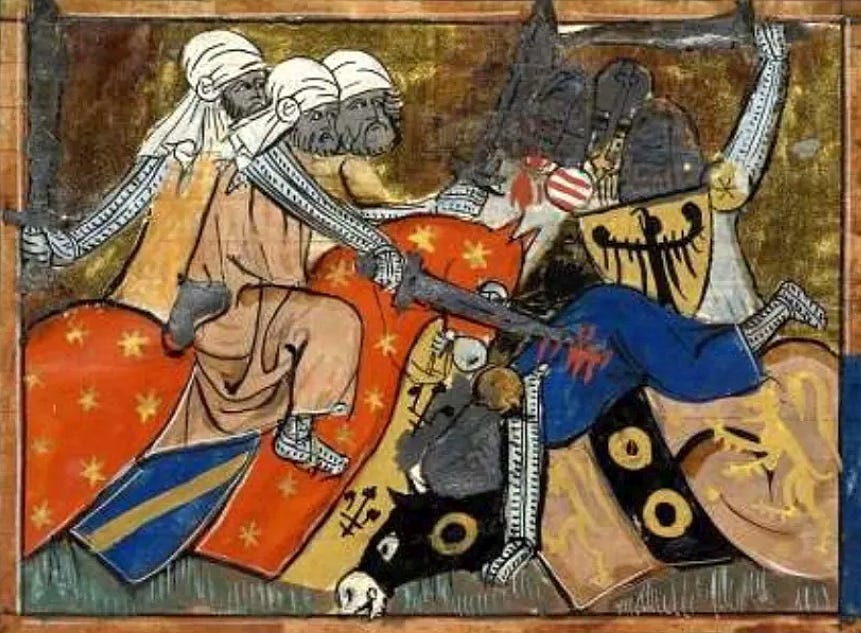
It is worth noting that most contemporary histories recount that Richard shipwrecked on his way home, and tried to cross Europe with just a handful of compatriots, so if he did bring a company of Muslim mercenaries back with him, they were traveling in different ships or a different time.
[Update: in re-reading the definitive biography of Richard, Gillingham’s Richard I, I find that Gillingham briefly mentions this account and supports the story—so maybe this is not a legend after all].
Enjoy the short note below. The Old French and Latin passages in the original note have been translated using Gemini AI and rendered in the footnotes.
M. Dieulafoy, in his essay upon Château-Gaillard (Mémoires de l’Institut ; Académie des inscriptions et belles-lettres, 1898, vol. xxxvi. pt. i. p. 371, note), has called attention to a passage in one of the continuators of William of Tyre, in which King Richard is said to have brought away one hundred and twenty Saracens (Mamelos5) from the Holy Land. The passage occurs in a manuscript of the fourteenth century, which has been printed as text D in the edition of the so-called Histoire d’Heracles, published by the Académie des Inscriptions (Recueil des Historiens des Croisades, Historiens Occidentaux, vol. ii. (1859) p. 196):
Puis que l’ost fu venus et le rei ot rescousse Japhe, un grant descort sorst entre Salhadin et ses amiraus. Dont nos gens ne s’aparsurent jus ques a tant que les Sarasins furent deslogies devant Japhe et alerent herbergier au Chastel des Plains. Salhadin oi dire que le roi veneit apres lui. Il douta son frere Seif Eddin et les autres amiraus, si ne l’osa atendre, a escheriement envers la Surie Sobal, por garnir le Crac et Montreal que il aveient novelement conquis. Le rei et l’ost alerent herbergier pres d’un Chastel dou Temple que l’on nomeit la Toron des Chevaliers. Les Bedoyns s’acointeterent dou rei : si pristrent de lui fiance, et li jurerent que il serviroient leiaument et fereient assavoir le covine (?) et l’estre de Salahadin et de toute la payenisme, et les Memelos des am iraus oirent parler de la largesse et des dons dou rei. Chascun qui se corouseit a son seignor, il s’en fuioient et veneient au rei d’Engleterre. Il fu aucune fois que le rei aveit des Memelos bien trois cens, dont il mena o lui bien cent et vingt Memelos outre mer quant il s’en parti de cest pays.6
The version (D) from which this account is taken comes from a MS. of the 14th century. In the opinion of its editors it is of eastern origin, like some other continuations of William of Tyre, including the famous Colbert manuscript, and was written in Cyprus before 1267 (Hist. Occid. ii. p. vii). Although of no value in determining the text of the original chronicle of Ernoul, upon which, as M. L. de Mas Latrie has shown (Chronique d’Ernoul et de Bernard le Trésorier, Paris, 1871), the widespread continuations of William of Tyre are largely based, this Cypriot version is well and specially informed.7 The allusion to King Richard’s Saracen mercenaries cannot therefore be set aside summarily, in spite of the fact that it is not found elsewhere. The context is corroborated by Beha-ed-din8, whose narrative shows that Richard was in close communication with Saracen prisoners and ambassadors, after the relief of Jaffa on July 31st, 1192 (Palestine Pilgrims’ Text Society’s translation of Beha-ed-din, p. 371 seqq.). Beha-ed-din also refers to the anger of Saladin on his retreat to Yazur (the Castle of the Plains). The friendship between Richard and the Sultan’s brother (El-Adel Saphadin, or Seif Eddin) is a theme of historians on both sides.
The story that Richard took some Mamelukes away with him is confirmed by the Norman Exchequer rolls. On the roll of 1195 the following entries occur (ed. Stapleton, I. 221):
In liberationibus Saracenorum morantium apud Domfront per preceptum Regis, a die Lune proxima post festum Sancti Michaelis usque de die lune post festum Sancti Egidii, c. li. ix. li. vj. so. per breve Regis. . . . Gibelino Saraceno in solta pertas equi sui l. so. per idem breve.9
Two other entries on this page refer to the Saracens. Again, on the roll for the year 1198 (ii. 301):
Soubressailant et Saracenis suis c. li. xxxv. li. de liberatione sua per breve Regis.10
Stapleton, whose caution was as great as his general accuracy, regarded these Saracens as ordinary mercenaries. ‘The bands of whatever country,’ he says, ‘who fought for him, were known by the name of Saraceni, and in this instance [i.e. in 1195] appear to have been Walenses‘ (Observations, i clix). The word Saracen is certainly found either as a second name or a nickname in documents of this period. Besides the well-known chamberlain of St. Louis, Jean Sarrasin, we have the Roman citizen, Peter Saracenus, whose name occurs frequently in the Patent Rolls of John (Rot. Pat. ed. Hardy, p. 126, etc.), and the Alexander, son of William, Sarazein, who was a hostage of John of Courci in 1205 (Rot. Pat. 55b). But the term in its general sense was the usual term for the Arabs and Turks in Spain, Sicily, and Syria — and there is no reason to suppose that Richard’s Welsh mercenaries were called Saracens. The names given in the Exchequer Rolls add an element of certainty. Under the curious Soubressailant an Eastern name might well lurk. Fortunately Gibelinus can be traced more definitely. Professor Margoliouth has been so kind as to inform me that ‘persons are known to have been called Jibrīnī on the ground that they were natives of Bait-Jibrin. The name Gibelin[us] in Frankish documents is a transliteration of the Arabic Jibrīn, in ‘Bait-Jibrin.’ Professor Margoliouth adds, ‘the individual to whom you refer may well have come from this place.’ I would suggest, then, that the garrison of Domfront in 1195 contained some of these Saracens who had been attracted in Syria by the tales of Richard’s generosity.11
F. M. POWICKE.
The University, Belfast.

Powicke, FM, The Saracen Mercenaries of Richard I (The Scottish Historical Review, vol 9, 1911)
https://www.viking2917.com/translating-internet-archive-books-on-the-fly/
https://github.com/viking2917/ocr-workbench
An extension by a new author.
Today often referred to as ‘Mamluks’.
“When the army had arrived and the king had rescued Jaffa, a great discord arose between Saladin and his emirs. Our people did not perceive this until the Saracens had decamped from before Jaffa and went to pitch camp at the Castle of the Plains.
Saladin heard that the king was coming after him. He mistrusted his brother Saif ad-Din and the other emirs, so he did not dare wait for him, heading off secretly toward Syria-Sobal to garrison Kerak and Montréal, which they had recently conquered.
The king and the host went to camp near a Templar castle called the Toron of the Knights. The Bedouins acquainted themselves with the king; they took oaths of trust with him and swore to him that they would serve loyally and keep him informed of the dispositions and state of Saladin and all of heathendom.
Furthermore, the emirs’ Mamluks heard talk of the king’s generosity and gifts. Whenever any of them grew angry with his master, he would flee and come to the King of England. At one point, the king had as many as three hundred Mamluks, of whom he took fully one hundred and twenty overseas with him when he departed from this land.”
(Footnote in original) See Mas Latrie’s Essai de classification (Chronique d’Ernoul, p. 486) for the place of this MS. in the series of continuators. It is now at Lyons.
Readers of this blog know him as Baha al-Din.
“For the maintenance [or liberation/allowance] of the Saracens staying at Domfront by command of the King, from the Monday next after the feast of Saint Michael until Monday after the feast of Saint Giles, 159 pounds, 6 shillings, by royal writ. . . . To Gibelinus the Saracen, in payment for the loss of his horse, 50 shillings, by the same writ.”
“To Soubressailant and his Saracens, 135 pounds for their maintenance [or allowance], by royal writ.”
(Footnote in original) It is hardly necessary to point out that the presence of Saracens in Richard’s army would help to spread belief in the current stories about the Assassins who were supposed to be employed by him. Richard would be most likely to use the mercenaries in siege works and for the manipulation of the Eastern crossbows, etc., which so attracted him. The Exchequer Rolls give at least one indication of travellers of another sort in an entry for 1195: ‘Cuidam feminae moranti apud Almanesches quae venit de ultra mare x. li. per idem breve’ (i. 184). The phrase ‘ultra mare’ had almost a technical meaning, to describe journeys to and from the Holy Land.
Comments
Nothing yet. Say the first thing.
Sign in to join the conversation.