
The work of Rainer Werner Fassbinder remains a subject of fascination for cinephiles because he was so incredibly prolific in a tight 13-year span. The most important thing, though, is not that he made so many films in that time, but that so many of them were superb.
He also was an overtly political director who learned from his heroes — first, Jean-Marie Straub and Godard and then Douglas Sirk — how to deliver political messages in a dramatic framework. His prime-time soap opera Eight Hours Are Not a Day (1972) is a perfect illustration of this, as it fulfills the functions of a mainstream TV drama while also subtly delivering messages about the way a working-class family lived in the Germany of its time.
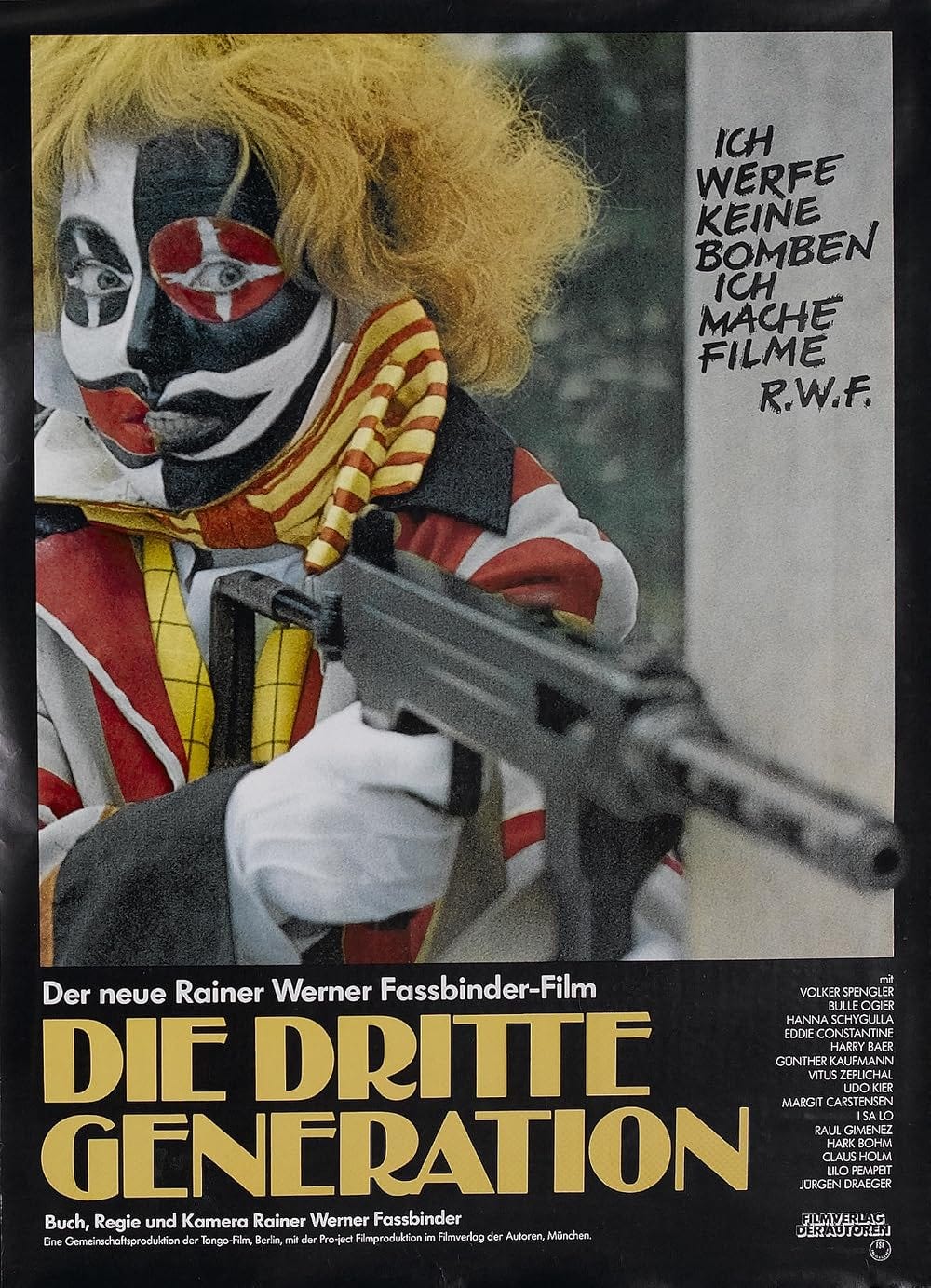
By the time he made The Third Generation (1979), Fassbinder was more cynical about the possibility of change in German society; he clearly felt that forces on higher levels were conspiring to suppress dissent by encouraging the dissenters to go in more extreme directions. (Watch this interview to see him speaking about the right-wing drift in the country.) The film was made following his participation in a non-fiction anthology feature called Germany in Autumn (1978), which was made as a reaction to the deaths in jail of the Baader-Meinhof Group.
In that film, Fassbinder reflected on his own feelings about politics through conversations (fictionalized but seemingly based on real opinions) with the people closest to him. In The Third Generation, he created an ensemble piece in which he gathered most of his unofficial repertory company of actors and had them portray a group of mostly bourgeois terrorists who seem to playact as radical terrorists — a sort of hobby that takes them away from the mundanity of their daily existence.
The reason I’m writing about the film here is that, while it is indeed firmly rooted in the time and place in which it was made, it also says a lot about the timeless truth of political (read: corporate) forces from above controlling the lives of the people below. This theme was recently seen in the film Eddington, which seemed to outrage some viewers — most of them political Centrists — and was a bit too on the nose to succeed at the box office. The main goal of the villains in the film? To get a data center built that was opposed by the populace.
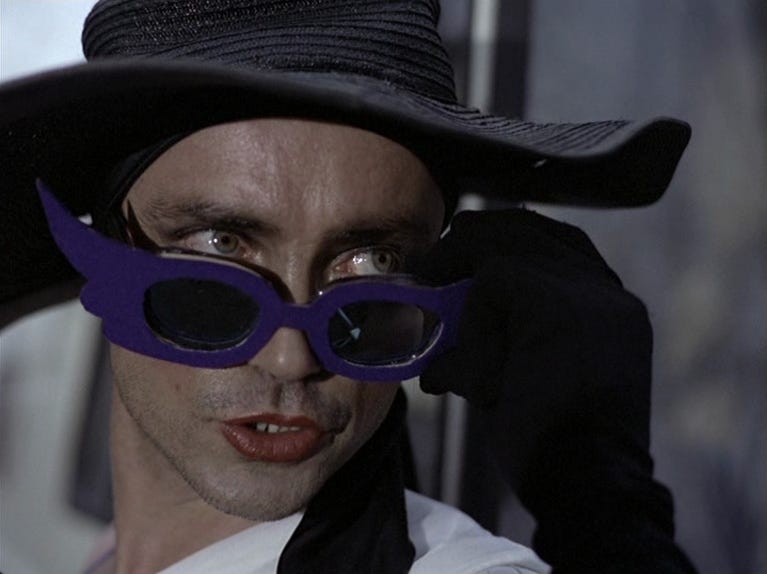
So, Fassbinder’s film is both a satire and a none-too-subtle statement about the machinery of control in a Democratic country. Like many films of the Seventies, it stands as a reflection on the radical politics of the Sixties and what it had devolved into. In the bourgeois radicals here we can see an older version of the bourgeois Maoist students in Godard’s colorful and very influential La Chinoise (1967). Here the radical hobbyists are now working people who have partners and children, but who still want to keep their hand in the political sphere by the occasional radical act.
Godard criticized the college-age Maoists in his film (but they were still incredibly charismatic, thanks to the cast); Fassbinder gives the bourgeois characters here a cartoonish edge that shows his opinion of them. He also clearly draws a distinction between them and the three working-class characters who are part of the group, although only one becomes part of the radical actions undertaken at the end of the film.
The bourgeois group are all good-looking and have respectable jobs. The actors playing these roles are Fassbinder’s romantic leads from other films: Hanna Schygulla, Harry Baer, Udo Kier, Margit Carstensen, Jürgen Draeger. There’s also a new face: Bulle Ogier (who had a very memorable lead role as an ex-political theater group head in Rivette’s brilliant Out 1.)
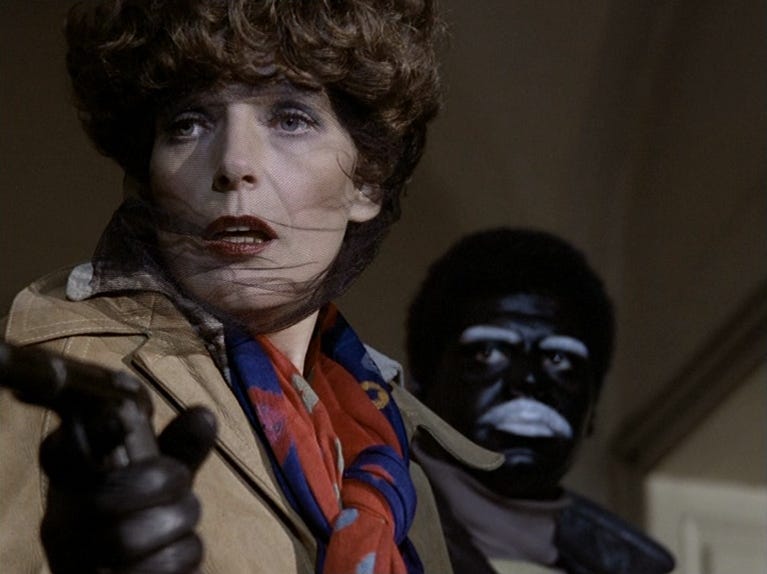
The three working-class characters all have a fatal flaw: Ilse (Y Sa Lo) is a junkie; Franz (Gunther Kaufmann) is madly in love with Ilse; and Bernhard (Vitus Zeplichal) is actually more politically engaged than the bourgeois characters, but he’s also a timid soul, who is more into the theoretical study of politics. (He is in fact mocked for this by the bourgeois characters — at one point they play “saluggi” with his copy of a book by Bakunin.)
Three other characters are the ones in control of the whole charade: the seemingly “engaged” August (Volker Spengler), the spy in the group, is determined to sell out the whole bunch. He works for P.J. Lurz (Eddie Constantine), a millionaire businessman who is running the whole show from the very beginning. Lurz’s other “infiltrator” is a police chief (Hark Bohm).
As is evident from the quote at the opening of this piece, Fassbinder wanted to show that terrorists end up playing into the hands of the authorities because their activities cause the police to crack down on the populace in general — and thus, the corporate bigwigs get what they wanted all along.
That message, of capitalism needing terrorists so that it can make sure it is better protected, is one that only grows more profound as years go by, and is particularly profound in the era where oligarchs run much of the world. And the notion of infiltrators being used heavily continues, of course, to this day — to cite just one example, the 2020 plot to kidnap Governor Gretchen Whitmer was seen to be the product of a great degree of “government instigation” (read: FBI informants riling up the members of the group to commit the kidnapping).
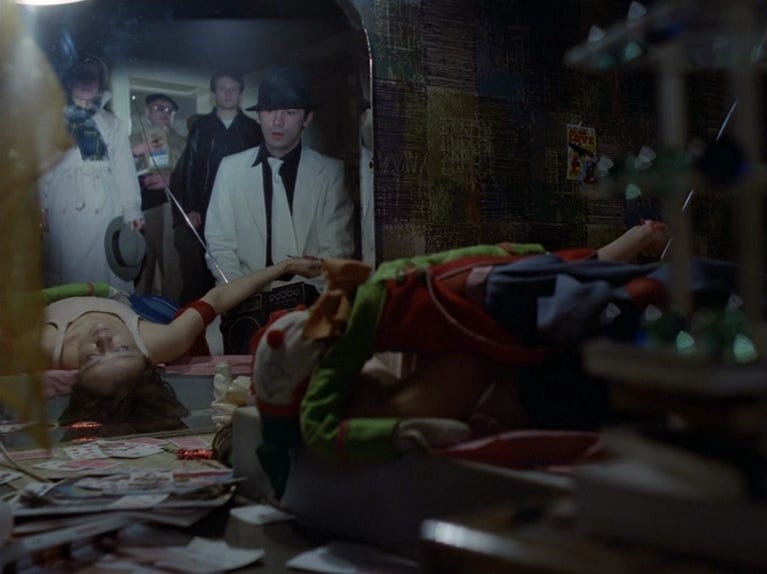
As with the case with some of Fassbinder’s later works, the film is memorable because of the overlay of elements visually and on the soundtrack. Fassbinder couldn’t find funding for this particular project (amazing, considering The Marriage of Maria Braun had recently come out and was a worldwide hit). So he took on the d.p job himself, while many in the cast served other functions and some of the crew (including his editor, as well as one of his partners and the later legacy keeper as the head of the Fassbinder Foundation, Juliane Lorenz) have roles in the film.
While the striking visuals point back to Fassbinder’s interest in images that blur the lines of reality (with strategically placed mirrors and other surfaces deceiving the viewer as to which character is standing where), the film’s audio is even more layered, with up to three or four sound elements being heard at the same time. The sound of a TV newscaster’s voice is heard throughout all the scenes in the apartments of the radicals; added on top of that are the voices of a few characters at once conducting different conversations. Add on top of that what seems like Peer Raben’s most alienating score, with electronic sounds that jar the viewer; usually, Raben’s music moves the viewer with emotional melodies and instrumentation.
Add to this media blitz a series of intertitles that start with profundities that Fassbinder came up with (“Dedicated to someone who truly loves. So to no one — probably.”) and also offer obscenities written on bathroom walls. Some characters also speak in an epigrammatic fashion, as when the corrupt cop makes the remark at the top of this article. Or when Lurz notes to Susanne (Hanna Schygulla) that “as long as films are sad, life isn’t.” Or when a grandfather informs his family, “Every generation needs a war.” (One of Fassbinder’s favorite themes was to focus in on the inherent Nazism inherent in the German character.)
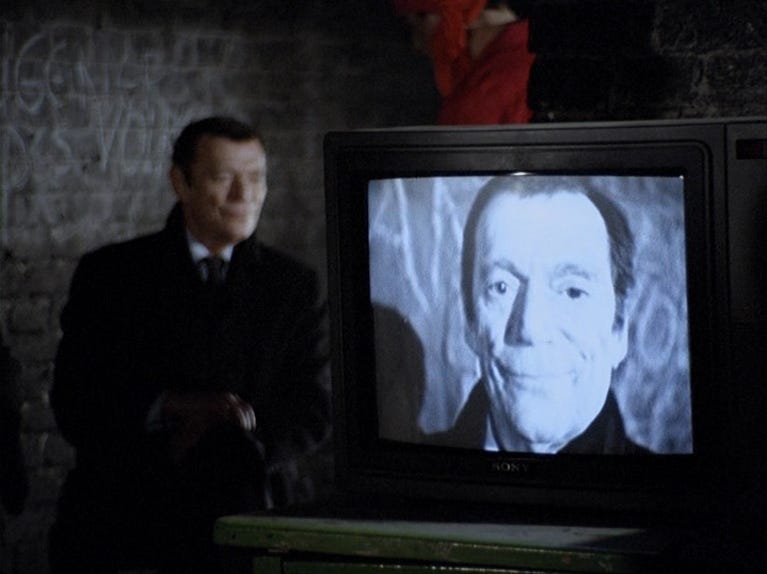
The Third Generation is one of those films that moves quickly, since so much is happening and much is being said and written onscreen. The characters behave as if they are capable of independent thought, but throughout, we know that Lurz and the corrupt police chief are going to wind up on top. And rather than show that, Fassbinder just ends the film on a great image of Lurz smiling widely. Capitalism wins because the corporate chieftain is able to use terrorists to convince the heads of government that the police must crack down. The cycle continues….
No posts
Comments
Nothing yet. Say the first thing.
Sign in to join the conversation.