
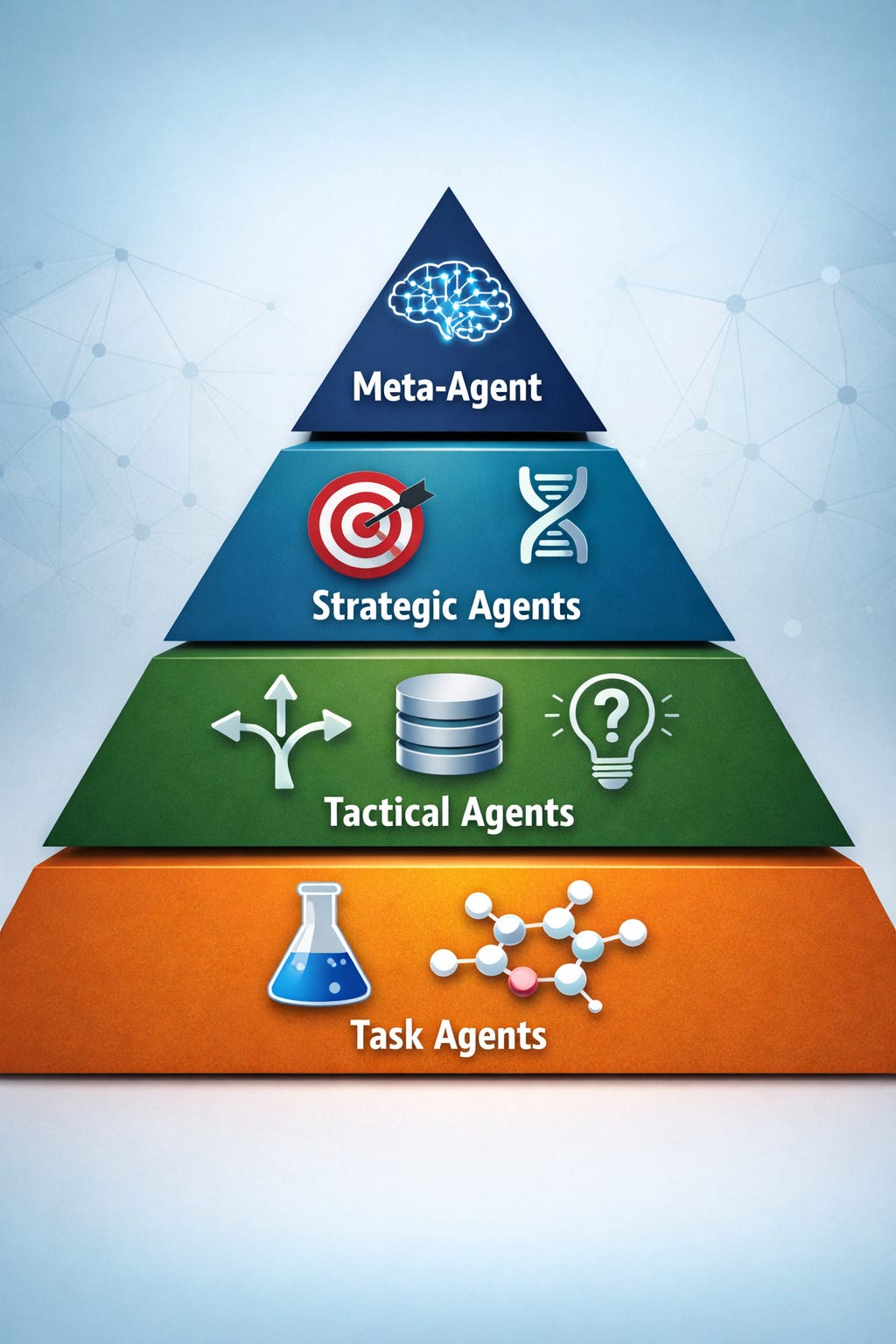
I’ve been thinking about a potential framework for AI agents, especially in the context of chemistry, drug discovery, and biology. While my examples come from those fields, I suspect the framework is much more general. The way I currently think about agentic AI is as a hierarchy. The names I’m using are placeholders, but they help clarify the levels of capability. I see four levels: task agents, tactical agents, strategic agents, and meta-agents.
The first level of agentic AI is what I call the task level. These are agents that perform well-defined tasks. In drug discovery, examples include:
Running a docking simulation
Performing a molecular dynamics simulation
Calculating binding affinity
Generating analogs
Training a machine learning model
This sounds simple, but it’s more complex than it appears. A true task agent must:
Handle dependencies correctly
Manage file formats
Catch and fix runtime errors
Choose appropriate fallback options
Retry intelligently when something fails
In other words, it has to operate like a careful junior computational chemist who understands the plumbing of the workflow. The fascinating thing is - and I could not say this reliably even a year ago - that we are already here. It is absolutely possible today to write agents that execute such workflows reliably. I’ve done this repeatedly and was astounded the first time Claude or GPT wrote me scripts that picked common tools like Open babel, RDKit and OpenMM, seamlessly falling back on one or more of these, all without me ever explicitly stating the names of any of them. These agents can also chunk and chain tasks to complete a basic closed-look cycle of computational design. For example:
Start with a molecule.
Search for analogs.
Dock those analogs.
Build a machine learning model to predict affinity.
Combine ML predictions with docking scores and rank.
Dock or predict binding affinity and search analogs again.
Loop until a desired molecular profile is reached.
All of that is achievable now. That’s the task level and it’s admirable that we are already there. But these task level agents are only the trailer for the real movie, which starts with tactical agents.
The second level is what I call the tactical level. This is where elementary decision-making begins. Suppose you ask an agent to predict binding affinity. There are at least two broad approaches:
Structure-based (e.g., docking)
Ligand-based (e.g., machine learning models built from known data)
You could hard-code the choice at the beginning. But then you’re still at the task level. What you really want is an agent that can decide intelligently between approaches. A simple way would be through an if-then decision tree.
For example:
If high-resolution protein structures are available, evaluate them, prepare them and run docking.
If not, check whether sufficient ligand data exists to train a predictive model.
If neither exists, reassess feasibility.
Critically, this should not be a rigid, hardcoded if-then decision tree. A truly tactical agent should:
Examine available data
Evaluate data quality
Draw on a knowledge base of literature and patents
Infer the implicit rules that human experts use
The literature makes certain things clear: structure-based campaigns require sufficient high-resolution structural data; ligand-based models require sufficient and relevant compound data. A tactical agent should learn these principles and apply them without being explicitly hard-coded. That’s the difference: the agent chooses how to execute a goal based on context. It should learn the task needed to accomplish the goal based on the data.
We are approaching this level. Tactical agents can increasingly select between alternatives, but human guidance is still often needed. For example, a human may still need to specify:
Which structural database to query
What counts as “high resolution”
Which affinity dataset to trust
Which ML framework to use
So we’re getting there, but tactical autonomy is not yet complete. Once that autonomy is achieved, things start to get really interesting.
The third level is what I call the strategic level. Even in the tactical case, the goal is assumed. You told the agent: “Predict binding affinity.” But what if that’s the wrong goal? In drug discovery this happens constantly. The hardest thing - especially when we are faced with incomplete data and tight resource constraints and deadlines - is to decide which goal to pursue rather than how to pursue it. Suppose the biological target has not been properly validated. In that case:
You compute binding affinities.
You synthesize compounds.
You optimize analogs.
You generate beautiful SAR.
And none of it matters, because the biology kills the program. Most drug discovery campaigns fail because of biology (efficacy and toxicity), not because we can’t optimize affinity.
A strategic agent would ask:
Is this target actually validated?
Is modulating this target likely to affect the disease?
Is affinity prediction even the right problem to solve at this stage?
It might conclude:
Instead of docking, we need pathway validation.
We need knockout experiments.
We need site-directed mutagenesis.
We need data from natural genetics experiments in patients
We need mechanistic clarification.
In other words, it proposes or redirects the problem definition itself. This is qualitatively different from task or tactical agents. It’s not about executing a task or choosing between two tasks. It’s about deciding whether the task is meaningful at all.
Even more interestingly, a strategic agent should be able to propose tasks the human user did not explicitly specify. That’s where it jumps out of the initial search and decision space that the user is thinking about and where things become transformative.
The final level is a meta-level agent — an agent of agents. At this level, groups of agents work autonomously, communicating with each other and with a “super-agent” that oversees and plans the group behavior. This is different from what would more typically be expected to be a kind of agent swarm intelligence which is fully distributed.
This agent:
Knows when to deploy task agents
Knows when tactical reasoning is required
Knows when strategic reassessment is necessary
Coordinates interactions between all of them
It operates at a high level of abstraction, deciding which other agents to activate and when. But apart from these high level decisions, it largely leaves the agents themselves alone, only judging their work based on outcomes rather than their internal working.
The reason this level is the most interesting is because once multiple agents begin interacting, you can imagine emergent behavior: outcomes not explicitly programmed into any single agent, but arising from their interaction. This behavior won’t be explicitly programmed into the agents, nor can it be predicted - or controlled. This is where the agent-of-agents framework starts behaving more like swarm intelligence, a flock of starlings in which every starling is only provided simple rules of interactions but has no knowledge of the overall shape of the flock. That is where things could become especially powerful and exciting - and unpredictable.
So where are we today?:
Task agents: These are already here. Reliable. Iterative improvements underway. Easily built with modern LLMs.
Tactical agents: These are emerging. They are capable of conditional choice, but still often require human scaffolding.
Strategic agents: These are nascent and we can barely see their structures emerging. This is where the real intellectual challenge and excitement begins.
Meta-agents: Conceptually plausible, but not yet deeply realized. They would take us into some wild territory.
The excitement, in my view, lies primarily at the strategic level, and secondarily at the tactical level. That’s where agents move beyond execution and into reasoning about relevance, problem framing, and scientific direction. That shift - from “doing” to “deciding what to do” - is the real inflection point.
While I’ve framed this in the context of drug discovery, I suspect this hierarchy applies broadly across science and any domain where multiple tools, models, and experimental strategies must be chosen and sequenced intelligently. That’s the framework as I currently see it. It’s still evolving, but I think this hierarchy captures something useful and actionable about where agentic AI is and where it might be going. Whatever else, I think this future is exciting.
No posts
Comments
Nothing yet. Say the first thing.
Sign in to join the conversation.