
ZekNova currently stands as a working browser-based shared-world and colony-simulation prototype.
Players can enter the planet, move through its biomes, gather resources, construct infrastructure, communicate with teammates, encounter ZekNovans, and make decisions that affect the condition of the broader world.
The build is not yet a finished game. Some systems are significantly more mature than others, and several player-facing mechanics still require refinement. However, the project has reached an important stage: its major systems are no longer operating as isolated features.
Resource extraction affects the environment. Environmental choices affect diplomatic tension. Tension changes ZekNovan behavior. Hostility threatens players and infrastructure. Infrastructure depends on location, power, and available materials. The strategic intelligence system can observe those conditions and recommend what the colony should do next.
The current build is therefore best understood as a connected simulation foundation.
Planet ZekNova latest shared gaming experience: https://medallionxln.com/zeknova/
Contribute to ZekNova’s latest code base updates: https://github.com/medallion-xln/zeknova-shared-gaming-experience
Hackathon onboarding instructiions: https://medallionxln.substack.com/p/emergency-deployment-order-zeknova
ZekNova is divided into four primary biomes:
Forest, Desert, Highlands, and Arctic.
Each region is intended to present different resources, terrain conditions, risks, and strategic advantages. Players are expected to develop their assigned area while contributing to the progress of the larger colony.
The current gameplay loop includes:
Exploring the world
Gathering natural resources
Mining iron
Cutting down trees
Earning credits
Constructing infrastructure
Managing water and energy
Completing missions and objectives
Communicating with teammates
Responding to ZekNovan activity
Making diplomatic or military decisions
The world tracks resources, buildings, missions, tension, diplomacy, ecology, enemy activity, area-of-operations progress, and officer status.
These values are not merely displayed to the player. They also form the state used by the strategic intelligence system when it evaluates the colony.
The tension system is active and persistent.
ZekNovans consider the trees of their planet sacred. Cutting down a tree increases tension by one point. Killing a ZekNovan increases tension by three points.
As tension increases, ZekNovan behavior changes.
At higher hostility levels, active ZekNovans transition from guardian or negotiated behavior into combat behavior. When tension falls below the hostility threshold, some groups may return to a less aggressive state. ZekNovans associated with force-based diplomatic decisions may remain permanently hostile.
This connects environmental extraction to political and military consequences.
A tree may provide useful construction materials, but cutting it down can also destabilize relations with the local population. Attacking a ZekNovan may remove an immediate threat while increasing the probability of broader conflict.
The player is therefore not only managing resources. The player is influencing the social and ecological state of the planet.
The colony’s infrastructure systems now depend more directly on environmental conditions.
Water Works must be installed inside the river channel. They can be constructed before power is available, but they remain offline until a Solar Grid is placed within the required distance.
This creates a clear dependency between geography, construction, and energy:
Locate the water source, install the Water Works, establish nearby power, and activate the system.
The iron supply has also been expanded. The world now contains additional mineable formations across the Desert and Highlands, providing more material for construction and ammunition.
Outposts are being incorporated into the conflict system as destructible structures. ZekNovans can attack them, and outposts are designed to have 1,000 health. Damaged installations can be repaired for approximately half of their original construction cost.
The siege system still requires additional migration and persistence testing. Older structures used a different integrity format, so they must be converted into the new health model without receiving incorrectly reduced durability.
Combat is now available regardless of the current diplomatic state.
ZekNovans can be targeted, damaged, and killed. At maximum hostility, active units can transition into aggressive behavior and attack the player rather than continuing to patrol or circle nearby.
Enemy movement has improved through smoother turning, better terrain handling, and more stable animation blending. A previous emergency teleport behavior that caused enemies to visibly jump between positions has been removed.
However, combat remains one of the least complete parts of the experience.
Weapon grips are still inconsistent because the current models rely on manually estimated attachment offsets rather than dedicated grip anchors. Two-handed weapons do not yet have reliable support-hand inverse kinematics.
Auto-aim is also incomplete. The current system does not consistently retain a target, and player movement can interrupt its rotation. A more complete targeting controller still needs persistent target selection, smooth rotation, range checks, line-of-sight validation, target-loss behavior, and visible lock-on feedback.
Damage exists in the underlying system, but the player-facing feedback remains limited. Hit reactions, impact effects, enemy health indicators, cooldown displays, and clearer target identification would make combat easier to understand.
The pistol is currently being positioned as the permanent fallback weapon, with unlimited ammunition and a three-second cooldown. More powerful weapons can continue to depend on mined and crafted ammunition.
SCOUT-01 currently serves as the player-facing advisor.
Regular conversational questions are handled through the configured language-model provider. Before those requests are sent, the server can add relevant game context, including the player’s rank, objectives, missions, online teammates, shared infrastructure, and colony conditions.
SCOUT-01 also has persistent conversational memory. Previous exchanges can be restored when a player returns in a new browser session.
The system includes per-user cooldowns and team-level usage limits to control repeated requests and provider costs.
SCOUT-01 can also post into team communications when a player explicitly asks it to relay a message. The server validates and sanitizes the message before adding it to the shared communication channel.
This makes SCOUT-01 more than a conventional chatbot. It acts as an interface between the player, the strategic engine, and the shared colony state.
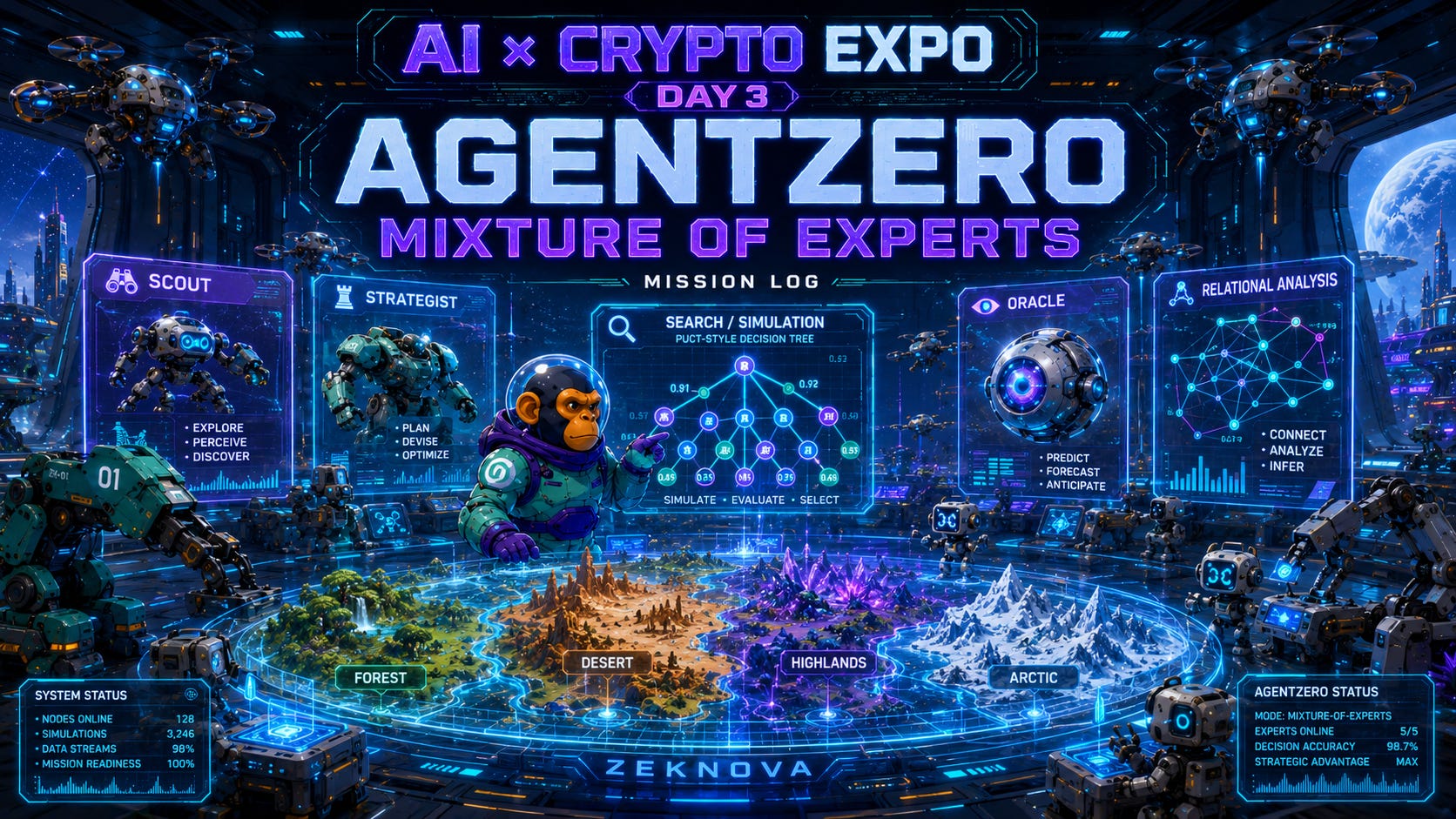
The most significant intelligence upgrade in the current build is the establishment of a mixture-of-experts architecture.
Rather than relying on one model to interpret every aspect of the colony, the system separates strategic reasoning into specialized components.
Each expert examines the world from a different perspective.
One expert may focus on immediate action value. Another may evaluate long-term infrastructure. Another may identify environmental decline, accelerating threats, or unstable resource trends. A relational expert can examine how one decision affects several other systems over time.
A routing layer then combines those perspectives.
The current strategic mode is identified in the interface as:
AZL-MOE · PUCT 320 · D7
This represents:
AgentZero Light
A mixture of strategic experts
PUCT-guided search
Up to 320 simulations
A maximum search depth of seven
The live adapter currently represents the colony through 56 state features and 13 strategic actions.
It can examine resources, buildings, missions, threats, tension, diplomacy, ecology, area-of-operations progress, and officer class.
The mixture-of-experts system can be understood as a small strategic committee.
The Scout provides fast initial judgment.
It examines the current colony state and identifies which actions appear most promising. Its role is not to make the final decision. It narrows the search toward choices that are more likely to matter.
The PUCT search engine tests those possibilities.
Instead of trusting the first recommendation, it simulates hundreds of possible futures. It explores actions that have performed well while continuing to investigate alternatives that have not been tested as often.
This is the central reasoning process.
The search does not simply ask, “What looks good now?”
It asks, “What may happen after this action, and what choices become available after that?”
The Strategist evaluates longer-term consequences.
An action that improves the colony immediately may create a larger problem later. The Strategist is intended to compare near-term survival with medium- and long-term development.
For example, spending all available resources on defenses may reduce immediate danger while delaying water, energy, or mission infrastructure.
The Oracle examines recent trends.
It can identify patterns such as declining food, increasing threat, worsening diplomacy, excessive resource consumption, or ecological instability.
The Oracle is less focused on choosing an action directly and more focused on warning the rest of the system that the colony may be moving toward a dangerous condition.
The relational layer examines chains of consequences.
For example:
Cutting trees increases tension.
Higher tension increases hostility.
Hostility increases attacks on outposts.
Damaged outposts consume repair materials.
Repair spending delays development.
Delayed development affects mission readiness.
The relational expert helps the system evaluate these linked effects rather than treating each variable as an isolated number.
The router determines how much influence each expert receives.
This is an important part of the architecture because expert confidence is not always the same as expert correctness.
A model may strongly prefer an action while misunderstanding the current state. A trend detector may identify a real problem while overestimating its strategic importance. A long-term evaluator may recommend a theoretically strong plan that does not address an immediate threat.
The router is therefore constrained.
The actual PUCT search retains the largest guaranteed influence. Individual experts can guide and improve the result, but they are not allowed to dominate it without support from simulated consequences.
This is intended to reduce the risk of the system becoming confidently wrong.
The mixture-of-experts model is not separate from ZekNova’s world simulation.
It depends on the world being structured enough to observe and simulate.
The engine needs to know:
How many resources the colony has
Which buildings exist
Which structures are powered
Whether water infrastructure is active
How much tension has accumulated
Whether ZekNovans are cooperative or hostile
What missions remain incomplete
Which threats are approaching
What actions are currently legal
How the colony changes after each action
The better the world model becomes, the more useful the strategic intelligence can become.
At the same time, the intelligence system exposes weaknesses in the world model.
If the simulator incorrectly estimates how quickly enemies damage an outpost, the search may undervalue defenses. If ecological damage is scored too lightly, the system may repeatedly recommend harvesting sacred trees. If the mission-success calculation overvalues construction, AgentZero may build aggressively while ignoring diplomacy or survival.
The strategic AI will optimize the world it is given.
That makes the accuracy of the underlying simulation as important as the intelligence architecture itself.
The mixture-of-experts model is intended to help transform ZekNova from a collection of mechanics into a world that can explain itself.
A player may see a Water Works installation fail to activate. The system should understand that it is outside the river or lacks nearby solar power.
A player may ask why ZekNovans suddenly became hostile. The system should connect that behavior to accumulated tension, environmental damage, or previous diplomatic decisions.
A team may ask what to build next. The system should compare resources, threats, mission requirements, and infrastructure dependencies before making a recommendation.
A player may ask SCOUT-01 to relay the plan to teammates. The advisor can then communicate the result through the shared chat system.
The intended sequence is:
The world produces data. The experts interpret it. The search tests possible futures. The router combines the results. SCOUT-01 explains the recommendation to the player.
The current AgentZero system is an AlphaGo-inspired inference architecture, not yet a complete self-learning AlphaZero system.
It can observe, search, simulate, evaluate, and recommend.
It does not yet have a mature training loop that continuously improves its neural models from player outcomes.
The broader architecture supports future additions such as:
Replay-buffer storage
Policy-and-value training
Self-play simulation
Outcome-based model correction
Cross-player model aggregation
Candidate-model evaluation
Controlled production promotion
Those components represent the next stage of intelligence development. They are not yet the primary capability of the current live build.
ZekNova currently has a functioning shared-world foundation, connected colony systems, persistent environmental consequences, developing combat, location-dependent infrastructure, team communication, and a live strategic-search engine.
Its strongest area is the relationship between systems.
Its least complete area remains the clarity and polish of moment-to-moment gameplay, particularly combat and the presentation of complex simulation rules.
The mixture-of-experts architecture now gives the world a method for interpreting its own condition. It can compare specialized perspectives, simulate possible futures, and provide ranked strategic recommendations through SCOUT-01.
The build has reached the point where the planet is no longer only a space the player moves through.
It is becoming a world that can track what is happening, reason about what may happen next, and communicate that understanding back to the people building inside it.
No posts
Comments
Nothing yet. Say the first thing.
Sign in to join the conversation.