
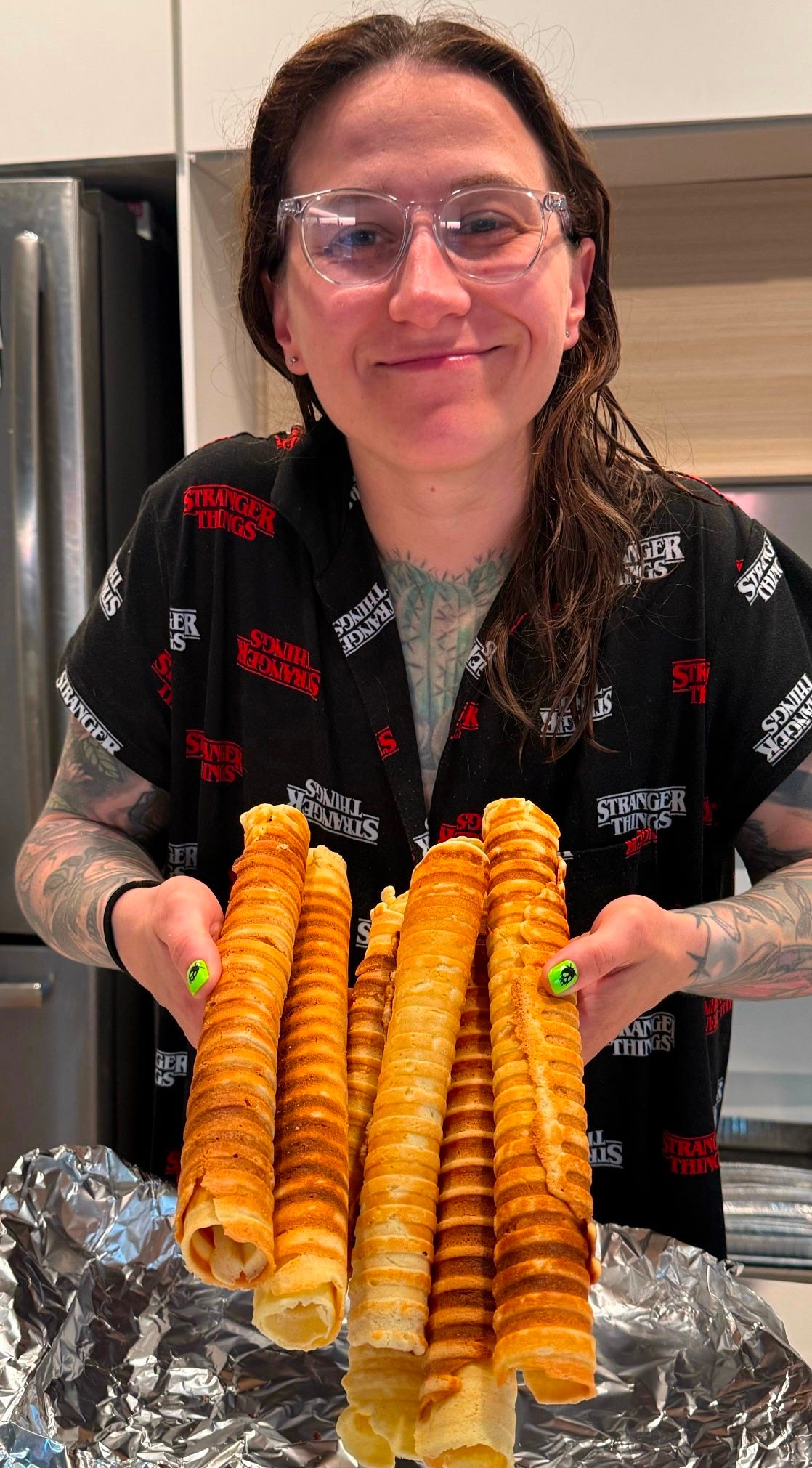
If you are a follower of Immigrant Kitchen, you know that in addition to our (delicious) dinner series, we always try to capture stories from our co-hosts illustrating whatever stories they would like to tell.
Often, these are legacy stories about mothers and grandmothers, sometimes they are about hardships and overcoming, and sometimes it’s about immigration journeys.
This year, we will be adding an auditory and visual oral history component, where we are taking inspiration from the incredible work at StoryCorp, giving our community another platform to tell their own stories, which has always been the mission of Immigrant Kitchen.
Soon, we will publish a the pilot episode of our first Oral History from Our Biracial Table, so you can see what to expect in the coming months.
In the meantime, Viktoriia was gracious enough to give us a sneak peek of what she plans to talk about in her full oral history, which we will be releasing next month.
Viktoriia’s dinner is full, but save the date for August 10 when we invite LaToya Mbayu from Cameroon to tell her story! More details coming soon.
And a reminder, thanks to generous support from the Minnesota Humanities Center and money from the Arts and Cultural Heritage fund created with the vote of the people of Minnesota on November 4, 2008, we are offering free events through the end of 2026.
Here’s Viktoriia:
“Hi everyone. My name is Victoria. I came to the United States through the Uniting for Ukraine program about three years ago because my home was taken from me.
In 2014, when the war began, I lost my home in Donetsk. Years later, after the full-scale invasion, I had to start over again. That’s how I came to America, hoping to build a new life one more time. When I arrived in Minnesota, I spoke almost no English. Everything was new—the language, the people, the culture, the way of life. One of the first places that helped me was the Ukrainian Center. They helped me take my first steps here, and that’s also where I met my future business partner, Walter. At that time, neither of us knew that one day we would open Kozak Corner together. Under the United for Ukraine program, we received work authorization right away. And honestly, that’s exactly what Ukrainians do when we come to a new country—we go to work. On my fourth day in America, I walked into Kramarczuk’s looking for a job. I said, “I don’t really speak English. Will you still hire me?” They smiled and said, “Friend, do you want to work?” I said, “Yes.” They said, “Then go work.” And that’s exactly what I did.
For the next year and a half, I worked very hard. Sometimes two jobs, sometimes three. I learned English, saved money, and built my life here step by step. All that time, I was helping my family. My mother and brother still live in occupied Donetsk. My father lives in Ukraine, and around that time he was diagnosed with cancer. Being able to work meant being able to support them, even from thousands of miles away. Then things became much more complicated. Like many Ukrainians, I found myself waiting much longer than expected for work authorization. My old permit expired, and the new one wasn’t approved yet. I was stuck in that gap. Time passed. My savings disappeared. My case wasn’t moving. I waited for more than a year, then more than a year and a half. I wanted to work. I was ready to work. But I couldn’t. Every day I checked my case status. Sometimes several times a day. I watched the money I had worked so hard to save disappear on everyday expenses instead of helping my family. I couldn’t sleep. I couldn’t stop thinking about what would happen next.
During that time, I started talking with many other Ukrainians. Families with children. Parents trying to build a new life. People who came here with hope and with the responsibility of taking care of their families. And I realized my situation wasn’t even the hardest. So many people were living through the same uncertainty. We wanted to work. We wanted to support our families. We wanted to build a future. Instead, we were waiting. That’s when I realized I couldn’t keep waiting for someone else to decide my future. I was tired of waiting. I wanted my future to depend on my own decisions.
At the same time, I kept thinking about my family. My father was sick. My mother and brother were living under occupation. I kept asking myself, “What if something happens tomorrow?” I wanted the chance to go to them if they needed me and to be able to come back to the life I had built here. My friends are here. My community is here. My life is here. America became my home too. I didn’t want to have to choose between my family and the life I had built. So I started building another path.
I hoped that through my own business, I could qualify for an investor visa, so I could continue building my life here, support my family, and if the worst ever happened, be able to go to them and come back. So I made one of the biggest decisions of my life. I invested everything I had—and even more—into opening Kozak Corner. Some people would call that brave. Some would call it crazy. Honestly, maybe it was both. But there was a plan behind it. And I couldn’t have done it without Walter. He believed in this dream from the beginning, and without his support, Kozak Corner would never have become reality. And somewhere along the way, I realized something important. We didn’t just lose our homes. We didn’t just lose our cities, our jobs, or our friends. We also lost the taste of home.
Everything is different here. The language. The people. The rules. Even the food. Even the fruit tastes different. Sometimes something as simple as an apple reminds you how far away you are. And I thought: I can’t give people their homes back. I can’t bring back their cities. I can’t bring back the lives they lost. But maybe I can give them back one small piece of home. The taste of home. The taste of childhood. The taste of family traditions. And yes, of course, potatoes. Because let’s be honest. You’re not really Ukrainian if you don’t love potatoes.
Potatoes are basically part of the family. We eat them for breakfast, lunch, and dinner. We have potato dumplings, potato pancakes, potato pies. Honestly, I think half of my childhood was made of potatoes. And if you grew up in Ukraine, there’s a very good chance you spent at least one weekend digging potatoes at your grandma’s house. That’s not a hobby. That’s a national tradition. Every fall, huge bags of potatoes would magically appear in our homes, and somehow they lasted all winter. So when people come to Kozak Corner and order our garlic potatoes, they’re not just ordering food. They’re ordering memories. They’re ordering childhood. They’re ordering a small piece of home. Today, Kozak Corner is more than a food truck. It’s a place where people can come after a long day, sit together, laugh, talk, remember, and feel connected.
Because food brings people together. And sometimes, when life feels uncertain, a familiar taste and a familiar tradition can mean more than people realize. If Kozak Corner can give someone even a few minutes of that feeling—of home, comfort, and belonging—then every risk, every long day, and every sacrifice was worth it. Thank you.”Donate to BFA + Immigrant Kitchen here.
Get a paid subscription to this newsletter here.
BFA has a ‘Zine! Order one here.
Comments
Nothing yet. Say the first thing.
Sign in to join the conversation.