
One of the most painful parts of being a good grantmaker is the cuts that inevitably need to happen. Every dollar granted to NGO A could have gone to NGO B, and that means the opportunity cost of funding anyone but the best NGOs in your portfolio is high. However, these conversations are hard, and can often mean affecting a relationship you may have had for years. Typically, the people running NGOs (even ones you should not fund) are great people who genuinely care about doing good for the world and are working hard at this goal. Cutting funding to them can feel like firing a beloved employee. Despite this difficulty, cutting grantees is something every grantmaker needs to do, and the best grantmakers probably do it more than average ones. So let’s talk about how to do it in the best way possible.
When to cut a grant is mostly connected to how it compares to others in your portfolio and other NGOs in the field. If you look at your grants from last year, a useful exercise is to break them into thirds. The top third of your grantees should consider funding more, the middle third might be a good call for steady stating. The bottom third are mostly who we are going to have to cut. And you might need to be even harsher if you are adding new grantees to your portfolio as you also need to make space for them.
It can be sad to cut a great organisation. If you fund 100 organisations and you’re cutting organisation number 75, they might still be fantastic on a bunch of dimensions. But at the end of the day, unless each of the 75 organisations above them has no more room for funding (which would be incredibly rare), your dollar is better spent on someone at the top of your portfolio.
Cutting a grantee can be done in four ways, and the way you choose depends more on your historical relationship and the % of funding you cover than it does on the grantee’s exact position relative to other grantees (your reason for cutting).
1) A Clean Cut
The straightforward way: a simple reduction from your past grant to $0 of grantmaking. Administratively and socially, this is often the easiest to do, as it means no further due diligence, M&E work or ongoing communications. This is a tool that makes sense if you have funded a grantee only once, or are less than 20% of their funding. In both cases, the NGO should not have had time to build around your steady state funding, and a clean cut is likely the way to go.
2) An Exit Grant
Expensive but thoughtful: if an NGO has been relying on your funding for a number of years (2 or more grants) or you are a large % of its funding (e.g. you are 20-50% of its funding) or both, the kindest move is often an exit grant. This communicates that you are planning a clean cut in the long term but you are giving some bridge funding to make the transition easier. Often this amount is 50% of the prior grant you gave for 1 year. This is a pretty high amount of money for a grantee who is in your bottom third, but it does make the transition much easier for them and sends signals to other NGOs that you are a kind funder who takes them into account.
3) A Large Reduction
Leaves the door open: this method is softer still than an exit grant and involves a large reduction in grant size. This move mostly makes sense when you are a very large % of the NGO’s funding supply (50%-100%) and you think they have a chance of getting into the top ⅓ of your portfolio in the future. This might end up looking like reducing by 50% for the first year and another 50% the next year. It’s less clear cut than an exit grant, so it is better suited for NGOs you think might turn it around and rise to your top third in the next year or two. For example if they have a great theory of change but execution has struggled. A con of this method is that the NGO will be strongly incentivized to change their work and spend effort to retain you as a funder. Where the exit grant and clean cut typically reduce the time you spend on an NGO, the large reduction often increases it.
4) A Change in Grant Format
One final option is to change the grant format to something that forces the NGO to diversify away from a single point of failure (if you were to cease funding them). The most common approach here is to offer e.g. half the funding you gave prior, but as a match instead of an unrestricted grant. Much like the reduction, this is best for NGOs where you are 50%+ of their funding, maybe even 75%+, and it forces the NGO to rightsize based on the supply of other funders who think it’s a good idea. It’s often a bad sign if you are the only funder who thinks a given NGO is worth supporting, and offering matching funding encourages the NGO to test that assumption.
A lot of the most important work comes before the call. Going into the call with an explicit goal and outcomes gives the call a chance of working out. For example, if you have a grantee you have given $1m to every year for the last 3 years, being clear on your desired outcomes (reducing to $0.1m over 2 years) provides a concreteness that, long-term, is better for both you and the charity. It’s best to come in with the facts of the relationship and a short explanation including mutual respect. The decision needs to be clear, but the execution can be kind. It’s worth going into the meeting thinking of it as a decision that has already been made; you are just communicating it to the grantee.
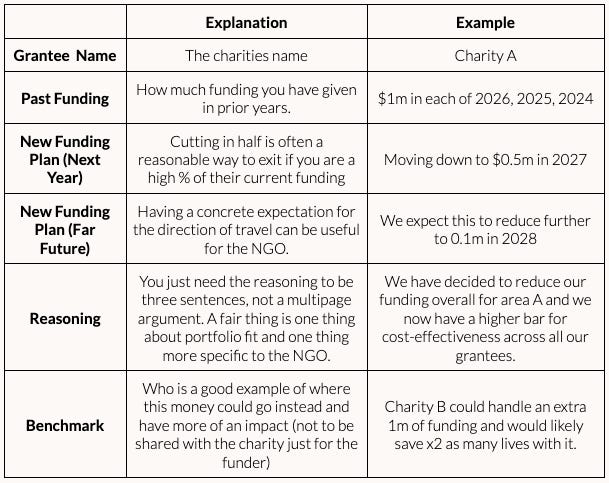
Having this light facts preparation work can make the call a lot easier, but the other thing that can really help is a template script (see below).
During the call there are a few top lessons to keep in mind, and below we have a template script of how a conversation could go. Key factors to keep in mind:
Every $ to charity A is a dollar that could have gone to charity B.
You as the funder are not obligated to keep funding anybody specific. Your obligation is to your mission as a foundation (e.g. saving the most lives). Both the NGOs and specific grants are just tools to accomplish that mission.
Keep the decision in the past tense (you have already made the call; you are just informing the charity on this call).
Be appreciative and respectful of the past relationship and the work this organisation has done. Most NGOs you cut will still be having a positive impact on the world.
Make the call short, respecting both the NGO’s and your time. The goal of the call is informative. I would do a 30 minute booking and try to end most calls in the 10-15 minute range.
A script like the one below could be a way to explain the above information.
Introduction: Hi Charity A team, glad you could make this meeting time and hope you are doing well. Sadly, this is going to be a tough meeting, as it’s a meeting to talk about a reduction in your funding that has been decided on. Given your history with us, I thought telling you over a call would be appropriate.
Concrete information: After considerable thought and with deep appreciation for all the amazing work your charity has done, we have decided to reduce the amount of funding that will be deployed to you from our organisation this year. We are reducing from our prior $1m grant to $0.5m this year and expect a further reduction to $0.1m the year after. I know this is hard news to hear, and we wish we had enough funding to support every project working in this area, but we had to make some tough decisions.
Reasoning: Normally decisions like this are multifactored and a lot goes into it, including more direct comparison to other organisations we could possibly fund and the needs that exist in the broader ecosystem. But two specific reasons I can give you: 1) We are reducing support for intervention area A in general, as so far the research has not convinced us on the space. 2) We have added some new criteria into our grantmaking evaluations around Y factor that have made certain other opportunities look more promising than they did in prior years.
Ending the conversation: I understand that this is bad news, and we will review your application in 12 months again. We deeply respect your team and what you are trying to accomplish in the world, and we continue to plan to work on our shared mission as allies, even if not at the same level of funding.
After the call you should be prepared for a follow up email or message from the NGO pleading its case. It’s important to make sure this does not affect you (otherwise it will incentivize every NGO you reduce funding to spend considerable time trying to engage). You as a funder set the incentive. The ideal response from the NGO is a short follow up message saying they have appreciated your time and funding in the past and hope to work together again in the future. That is the sort of NGO worth reconsidering in a couple of years. The NGO that gets pushy, aggressive or hostile is the sort of NGO you will thank yourself later for cutting off the relationship with.
Grantmaking can sometimes be a hard job, and cutting or reducing funding to NGOs is one of the hardest parts, but you can’t be a great grantmaker without it.
No posts
Comments
Nothing yet. Say the first thing.
Sign in to join the conversation.