
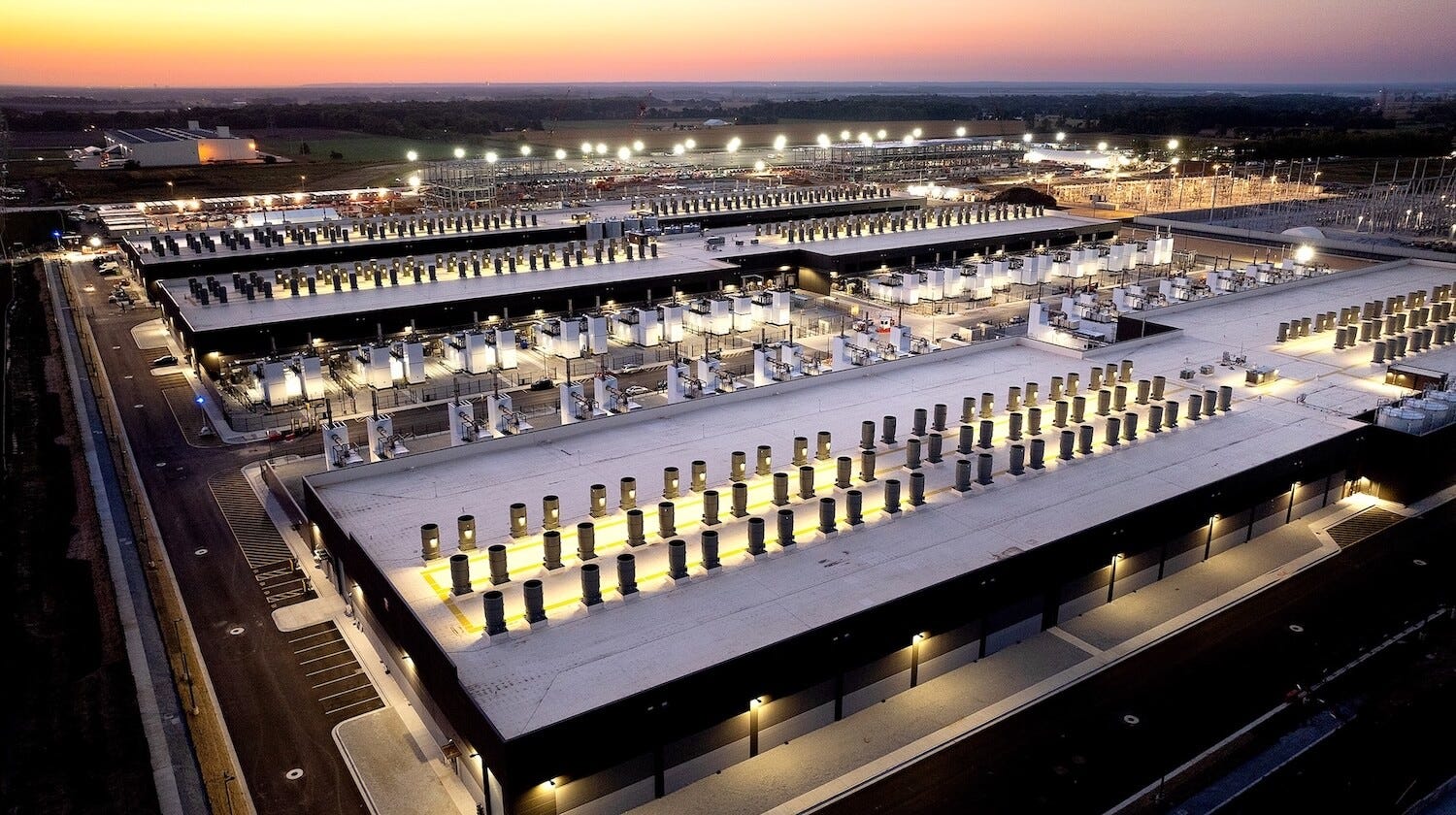
In October 2025, Amazon brought Project Rainier online: roughly 500,000 of its own Trainium2 chips, devoted to a single customer — Anthropic, which uses them to train and serve its Claude models. Effectively all of that compute sat in one place: a stretch of former farmland along State Road 2 in New Carlisle, Indiana, about 80 miles east of Chicago — now one of the world’s largest AI data center campuses.
Source: Amazon.
The campus reads as much like a utility project as an AI infrastructure deployment. Eighteen data center buildings are operating today, with fourteen more under construction. Finished, its 32 buildings will hold about 6.5 million square feet and draw 2.25 GW from the grid — about the electricity used by 1.5 million average homes, and enough to make the campus the single largest customer in Indiana Michigan Power’s 100-plus-year history. Behind them: a planned fleet of 878 backup diesel generators, an $11 billion price tag that ranked as the largest capital investment in Indiana’s history when announced, and a water debate that has filled county hearing rooms.
What makes New Carlisle worth a close read is that everything here is Amazon’s own — the land, the buildings, the chips, the network, and the deal terms around them — an unusually complete picture of how a frontier AI campus actually gets built. This overview walks that bet layer by layer: why the campus exists and who it serves, then the land and its three phases, the silicon and the network that make 32 buildings behave like one machine, the power, the water, the investment — and the markers that will test it.
Most frontier AI capacity is assembled from other people’s parts — a developer’s shell, merchant NVIDIA silicon, a shared tenant roster. New Carlisle is the opposite choice taken to its maximum: Amazon owns the land, the buildings, the chips, and the network that fuses them, and has pointed all of it at exactly one customer. Each layer of the campus expresses the same bet in a different way — acres, silicon, megawatts, water, deal terms.
New Carlisle is the flagship and largest site of Project Rainier, AWS’s large-scale AI compute cluster built with Anthropic.
Source: Amazon.
Project Rainier is deliberately distributed across multiple U.S. states — New Carlisle, St. Joseph County, Indiana, is its primary campus, with a second, smaller campus near Canton, Madison County, Mississippi, which has more than 350 MW of IT capacity today and is set to ramp past 1 GW, also on Trainium2.
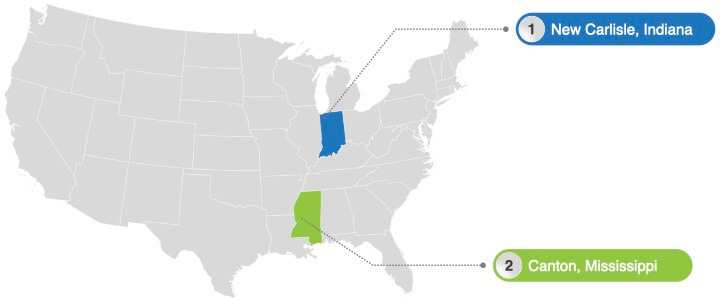
The Indiana and Mississippi campuses reflect a single strategy: AWS is building multiple large AI campuses around its own accelerator platform, Trainium. For training the current generation of frontier AI models, AWS treats the entire New Carlisle campus as a single unit of compute — one vast, tightly networked machine.
The New Carlisle data center campus is devoted to a single customer, Anthropic, which uses it to train and serve its Claude models. Amazon and Anthropic co-engineered both the site and the silicon inside it — Anthropic’s input on what to accelerate in the chip shaped the hardware. Project Rainier was sized to deliver more than five times the compute — the exaflops — that Anthropic used to train its previous generation of Claude models.
The Amazon–Anthropic alliance runs deep. Amazon invests in Anthropic: up to $25 billion more (a $5 billion equity stake plus a $20 billion milestone-gated financing facility), on top of the $8 billion already invested. Anthropic buys from AWS, committing to spend more than $100 billion on compute over 10 years and reserve up to 5 GW of Trainium, with roughly 1 GW of Trainium2/Trainium3 online by the end of 2026.
The first layer of the bet is land.
Ownership starts with the ground. The lots, the buildings on them, and the construction program are all Amazon’s own — and the phasing below is the bet: scaling in place, phase added onto phase, as Anthropic’s training demand grows.
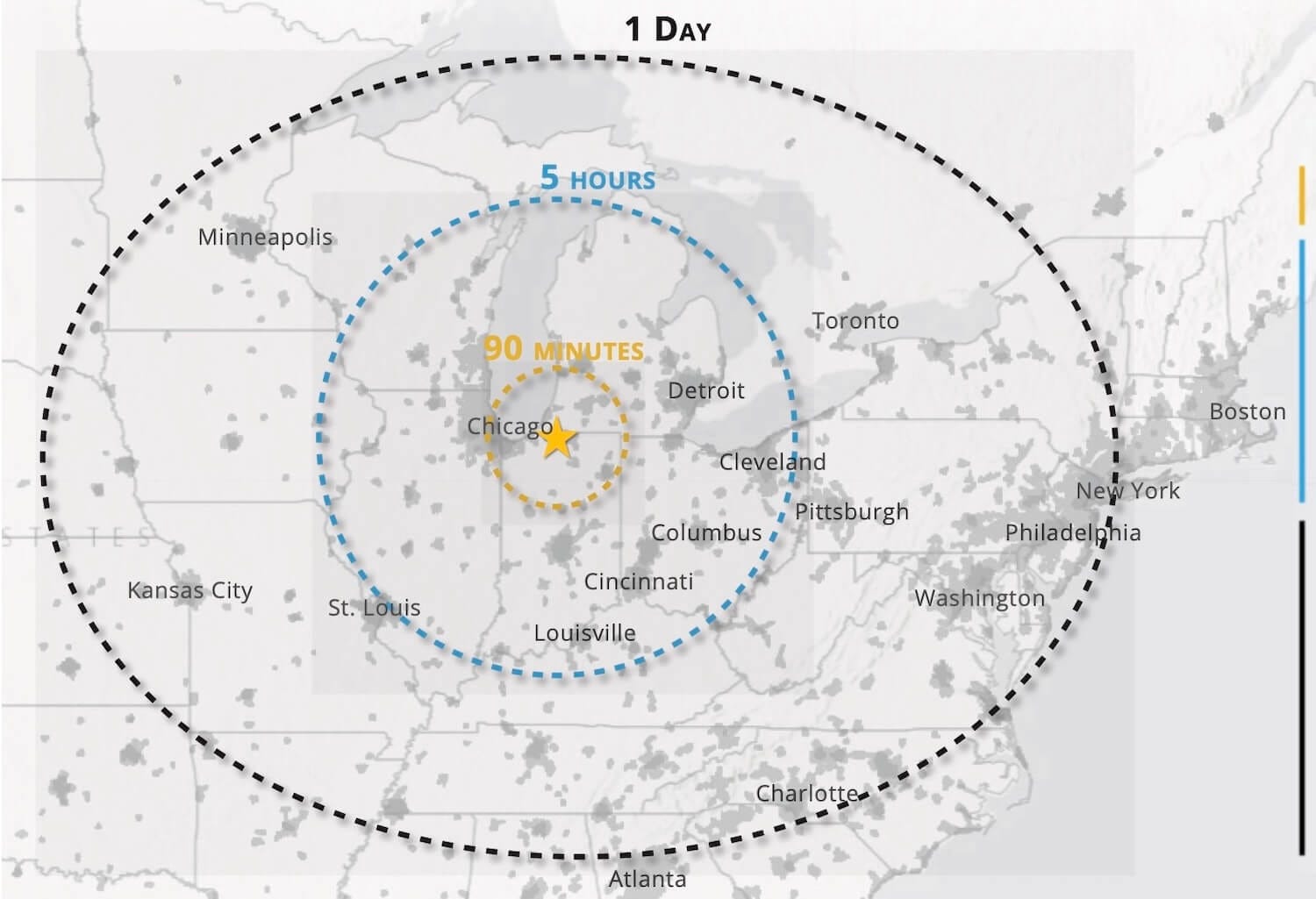
Amazon’s New Carlisle data center campus spans two subdivisions inside the Indiana Enterprise Center (IEC) that sit across State Road 2 from each other, in Olive Township, St. Joseph County, northern Indiana. New Carlisle is situated approximately 80 miles east of Chicago and about 15 miles west of South Bend, Indiana.
Source: St. Joseph County Office of Economic Development.
The data center campus is developed and operated by Amazon Data Services, Inc. This hyperscale self-build is organized into three phases:
Phase 1 is the North Campus, known as SBN100
Phase 2 is the South Campus, known as SBN201
Phase 2 Expansion, known as SBN210, is also part of the South Campus
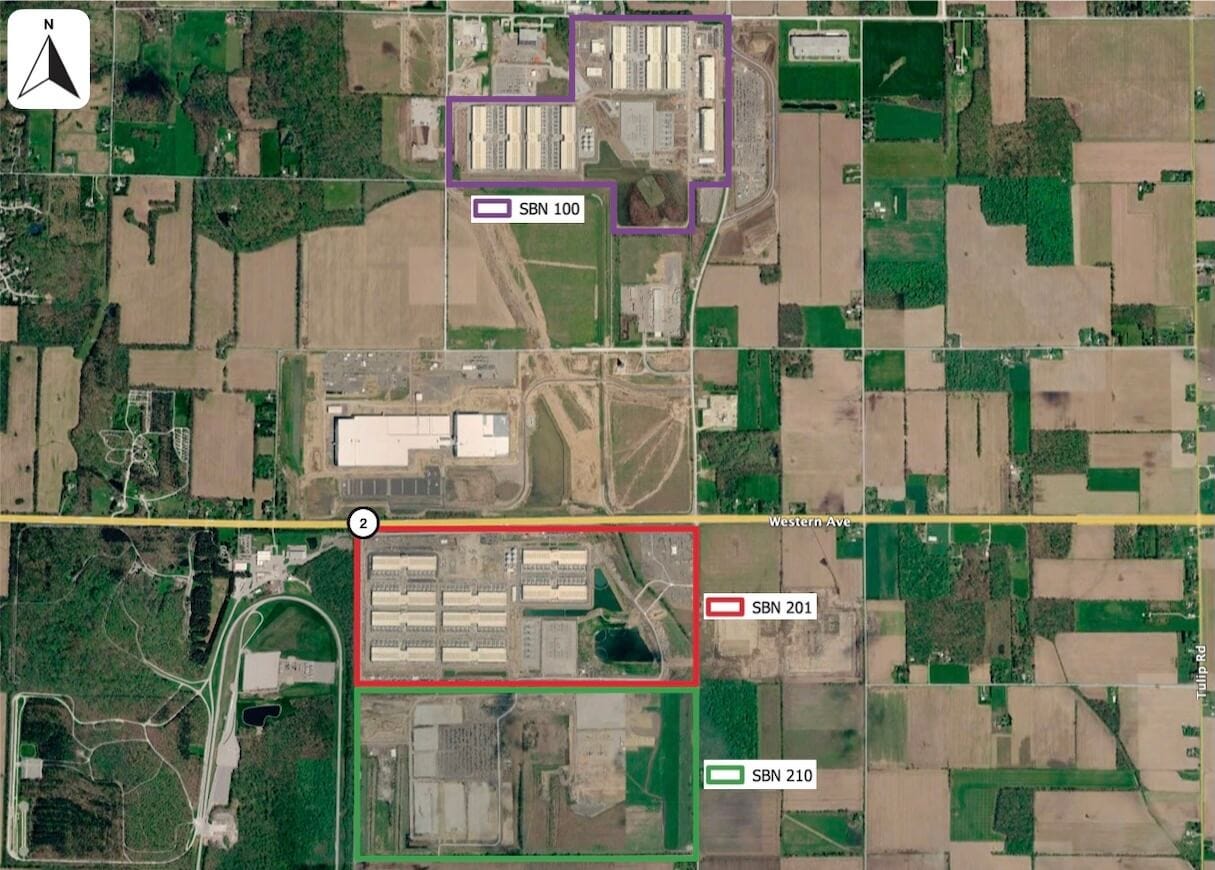
Source: Google Earth.
Fully built, the three projects will comprise 32 data center buildings on roughly 882 acres formally mapped for development, with about 6.5 million square feet of building area and a grid draw of 2.25 GW:
* The three building lots total ~805 acres (232 + 179 + 394); the remaining ~77 acres of the 882 mapped are dedicated road right-of-way carved out of the IEC-3 subdivision.
Phase 1 anchors the campus on the single IEC-2 lot north of State Road 2: nine data center buildings, each about 35 feet tall and 216,000 square feet in size — roughly the footprint of a Walmart — together delivering an estimated 590 MW of IT capacity, about 65 MW apiece. All nine buildings are operational.
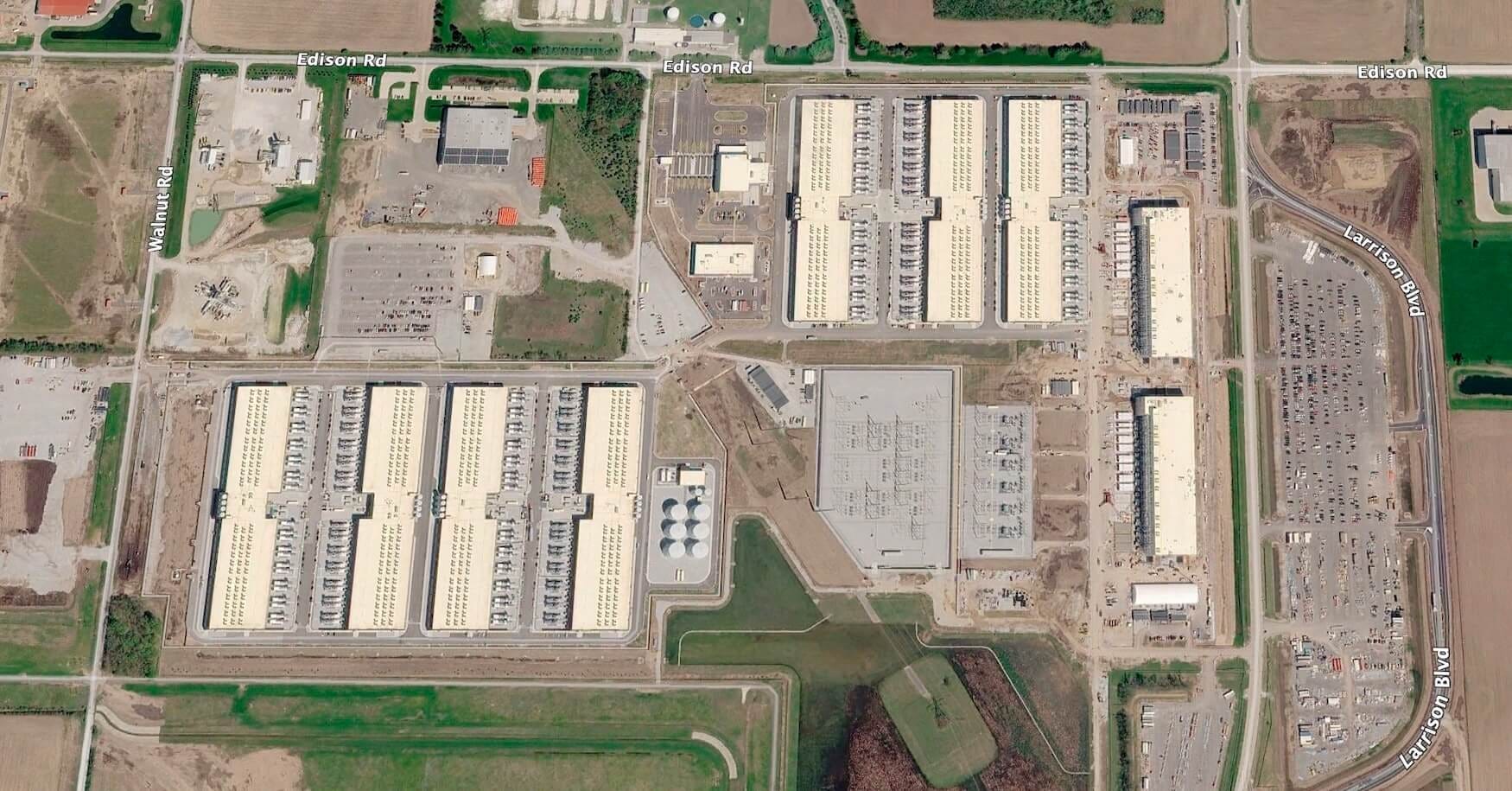
Source: Google Earth.
After applying in April 2024 and breaking ground in September 2024, Phase 1 received its Indiana Department of Environmental Management (IDEM) air permit in January 2025, drew first power that same month, was certified “construction complete” in December 2025, and had its operating permit validated in February 2026.
Just over a mile south, across State Road 2, Phase 2 sits on Lot 1 of the IEC-3 subdivision and mirrors the North Campus in form — nine buildings again, each slightly taller at about 39 feet.
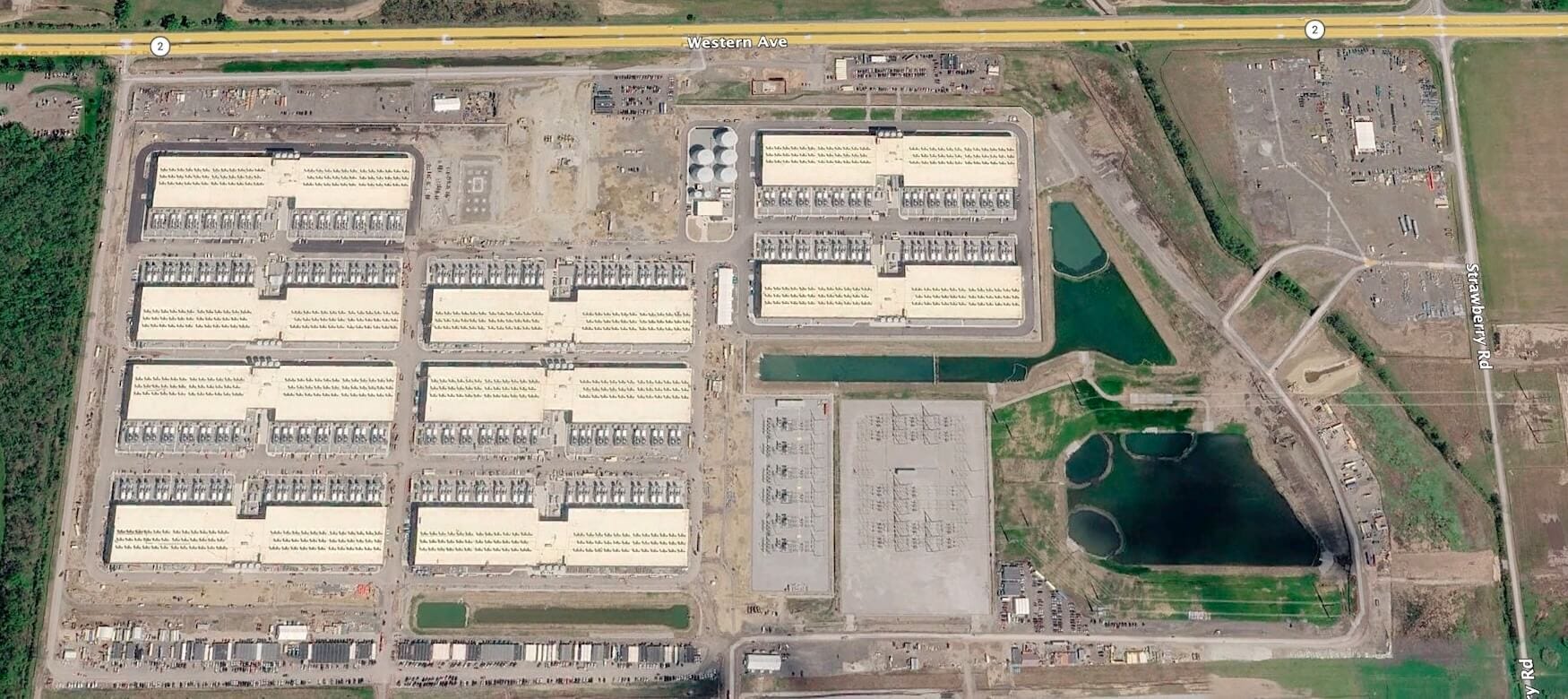
Source: Google Earth.
Phase 2 applied in September 2024 and received its IDEM air permit in May 2025, then mirrored Phase 1 — “construction complete” in December 2025 and operating permit validated in February 2026.
The campus’s next stage, SBN210, extends Phase 2 onto Lot 2 of IEC-3, directly adjoining SBN201 and forming one continuous South Campus. Its buildings vary in size (eight single-story, six two-story) and footprint (elongated linear, large-format rectangular, paired blocks) rather than repeating the earlier phases’ uniform design. AWS’ wetlands filings have put the expansion’s purpose in capacity terms: a stated minimum operational power capacity of 767 MW, with the preferred 14-building design rated at 775 MW.
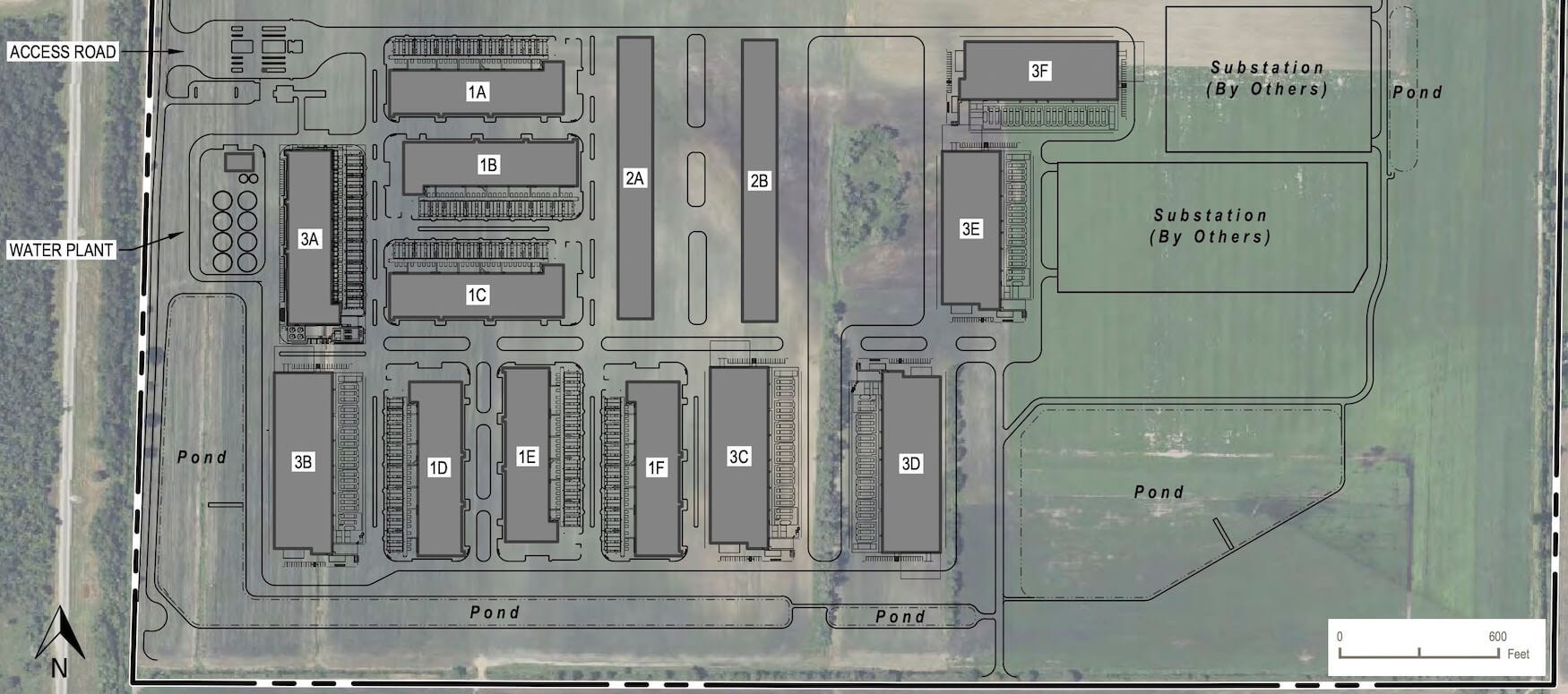
Source: Indiana Department of Environmental Management (IDEM).
Build-out of SBN210 is underway. Amazon began initial site prep in Q1 2026, including grading for laydown areas, a substation, and some building pads. The South Campus Expansion filed its IDEM air-permit application in May 2026 and its wetlands/dredge-and-fill permit application in June 2026.
Satellite imagery from June 2026 shows Amazon has begun constructing multiple data center buildings on the SBN210 site. AWS has previously projected full New Carlisle data center campus build-out no earlier than late 2027.
Behind the build-out is Amazon itself, building and operating the campus directly rather than contracting the project to a third-party data center developer. To hold an aggressive schedule, AWS’s team brought on four general contractors to construct the campus — Walbridge, Clayco, Ryan Companies, and Angelo Iafrate.
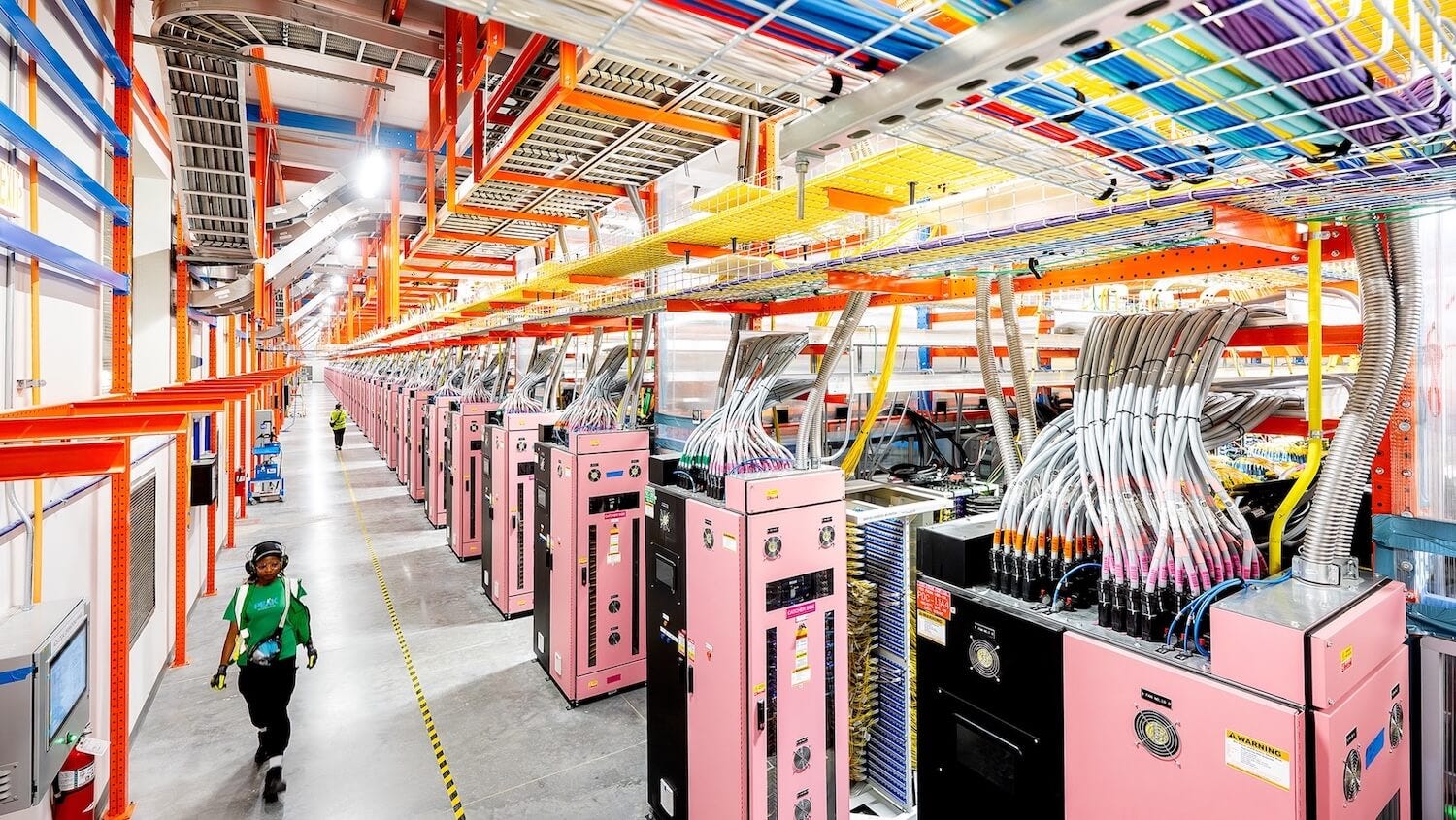
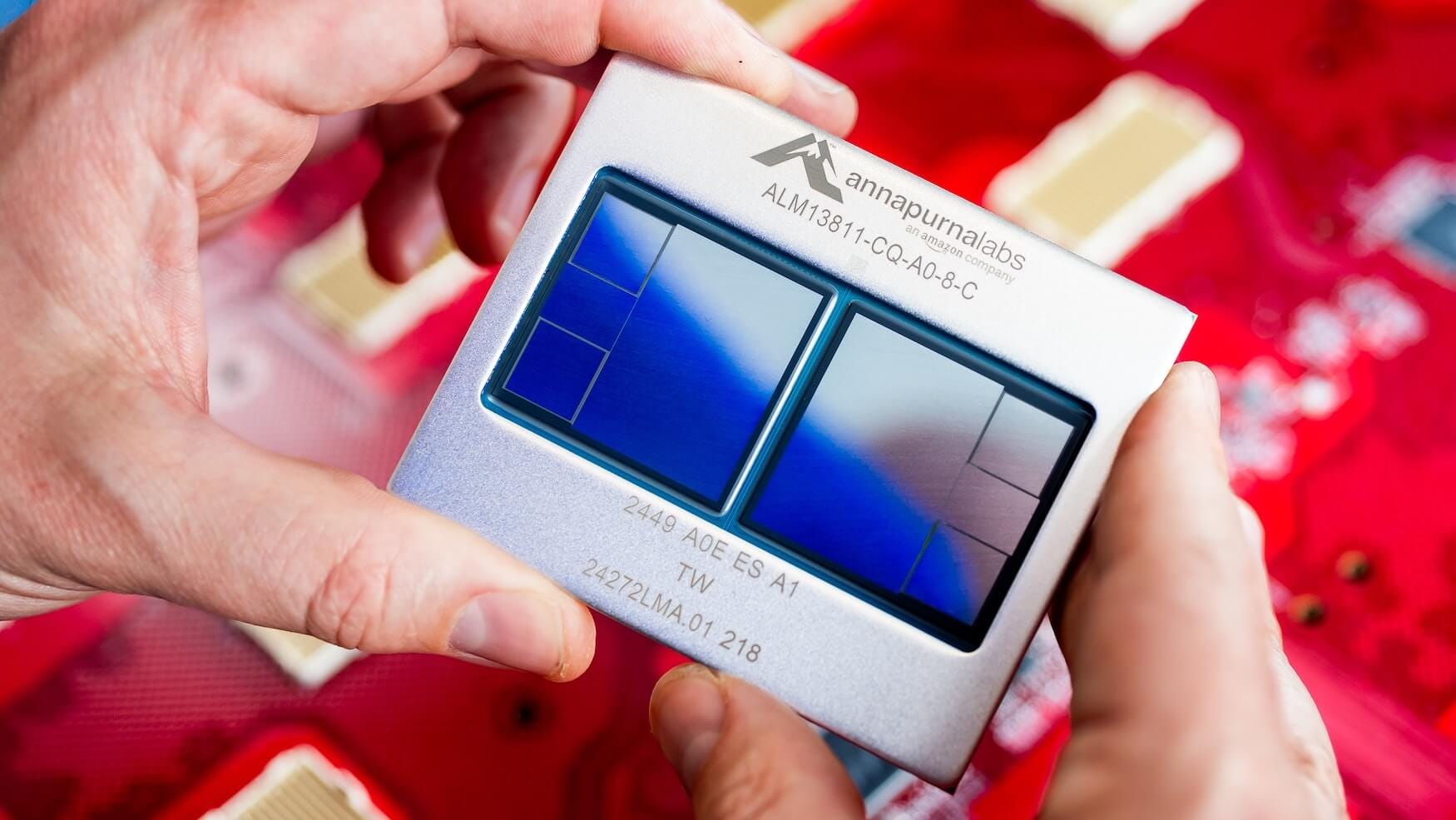
The compute layer is where the bet on vertical integration becomes physical: AWS owns and co-designs the entire stack — the chip, the server, the network, and the data center design itself — and every server on the campus runs its own Trainium2 accelerators rather than NVIDIA GPUs.
Source: Amazon.
The choice of silicon came down to price/performance — Trainium2 runs roughly 30–40% cheaper per unit of performance than comparable GPU instances — and supply control.
Because each Trainium accelerator is simpler and lower-powered than an NVIDIA GPU, AWS fits roughly twice as many of them per building, raising compute density while holding down electricity and cooling demand — the Trainium2 buildings run air-cooled, with no liquid loop.
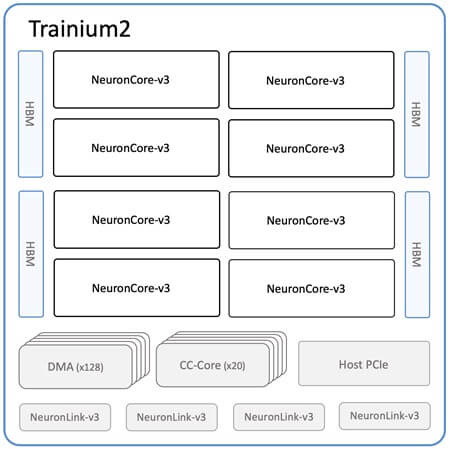
Each Trainium2 chip pairs 96 GB of HBM3e memory (2.9 TB/s of bandwidth) with eight compute cores for roughly 1.3 petaflops of dense FP8 performance at about 500 watts.
Source: Amazon.
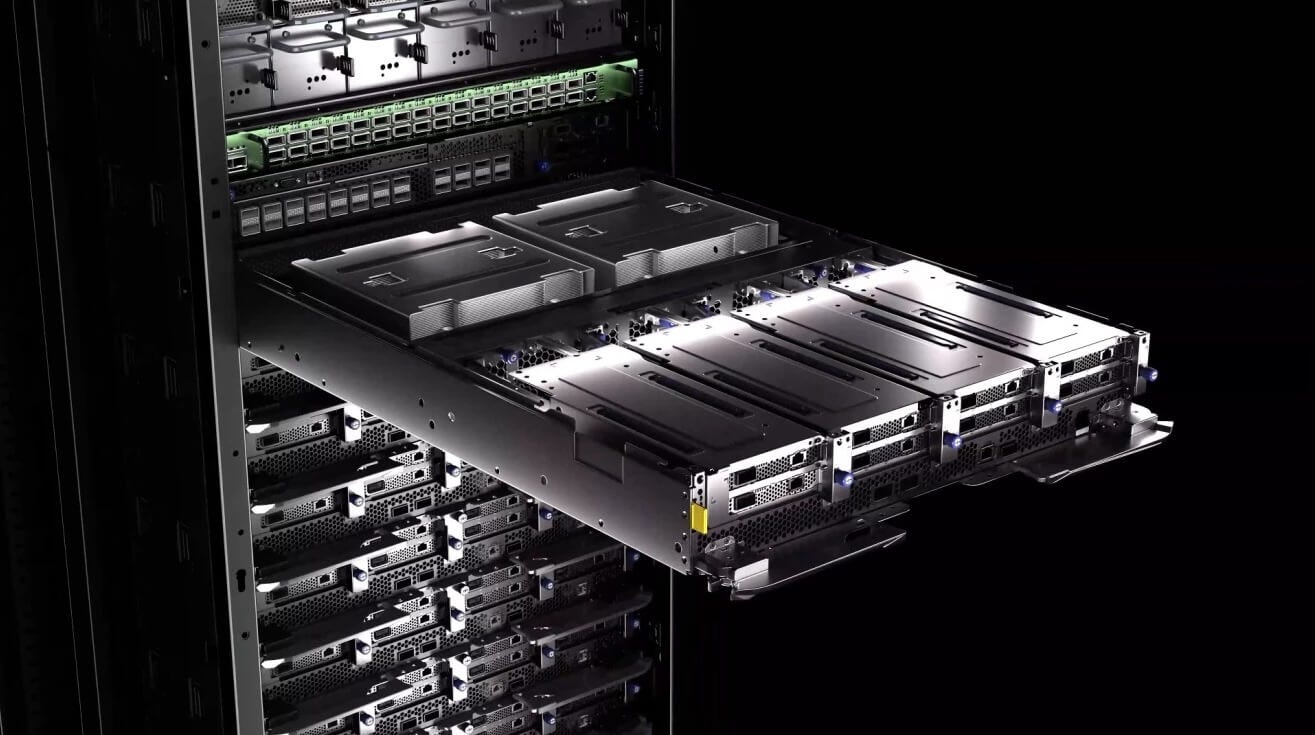
Sixteen Trainium2 chips are matched with only two Intel Xeon CPUs — an 8:1 accelerator-to-CPU ratio that optimizes cost per FLOP — and two of those 16-chip servers fill a rack drawing roughly 27 kW.
Source: Amazon.
The campus is assembled from Trn2 UltraServers, each joining four 16-chip instances into a 64-chip unit (512 NeuronCores) that delivers about 83 petaflops of dense FP8 compute (332 sparse), backed by 6 TB of high-bandwidth memory and 185 TB/s of memory bandwidth.
On the data center floor, two adjacent rack cabinets make up one UltraServer.
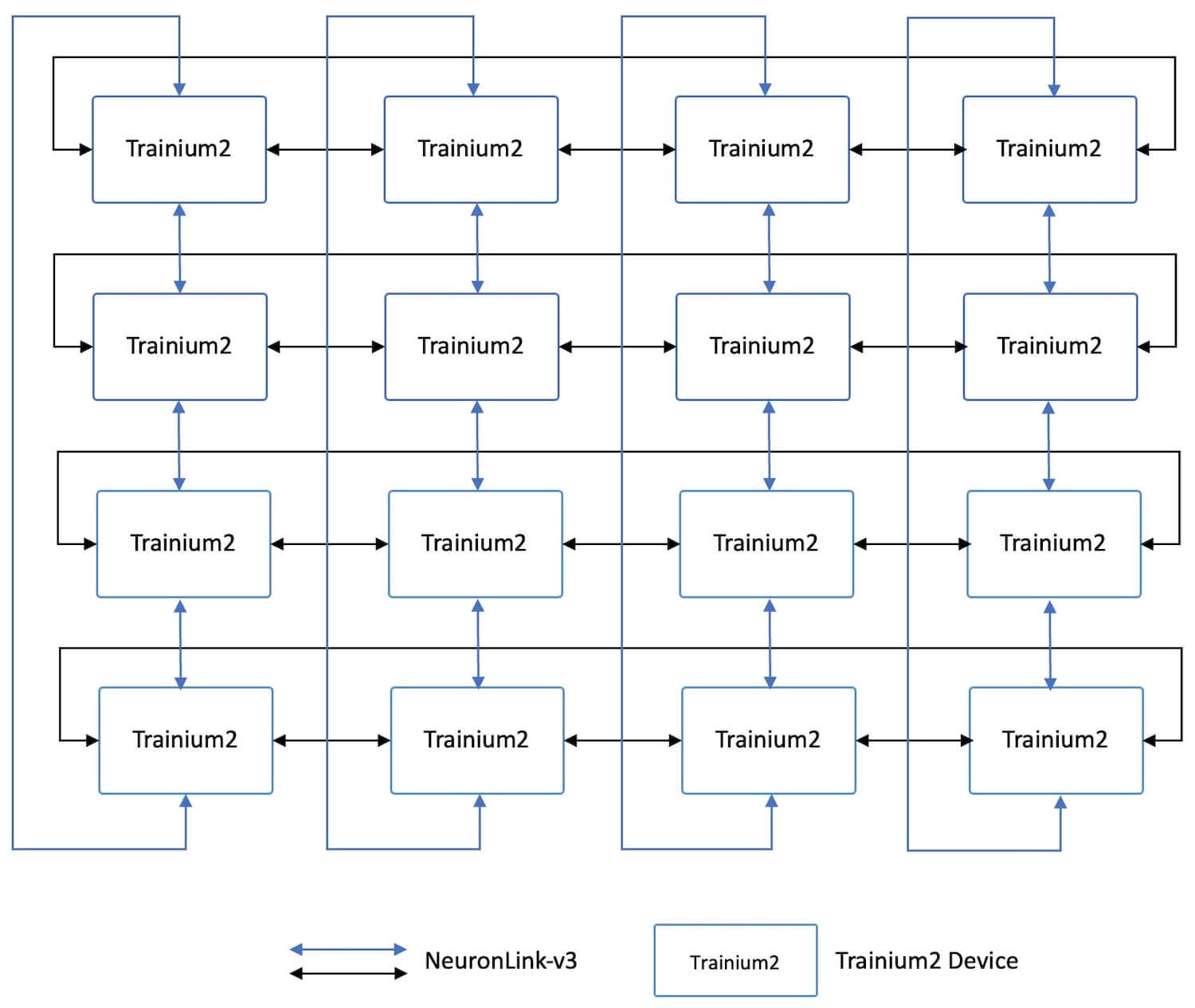
Trainium2 chips are interconnected by two complementary networks:
NeuronLink, a high-bandwidth scale-up interconnect that ties the chips within an UltraServer into a torus (wraparound mesh) network topology at roughly 1 TB/s.
Source: Amazon.
Elastic Fabric Adapter (EFA), the scale-out fabric that links UltraServers to one another — inside and across data centers — at 3.2 Tbps per instance.
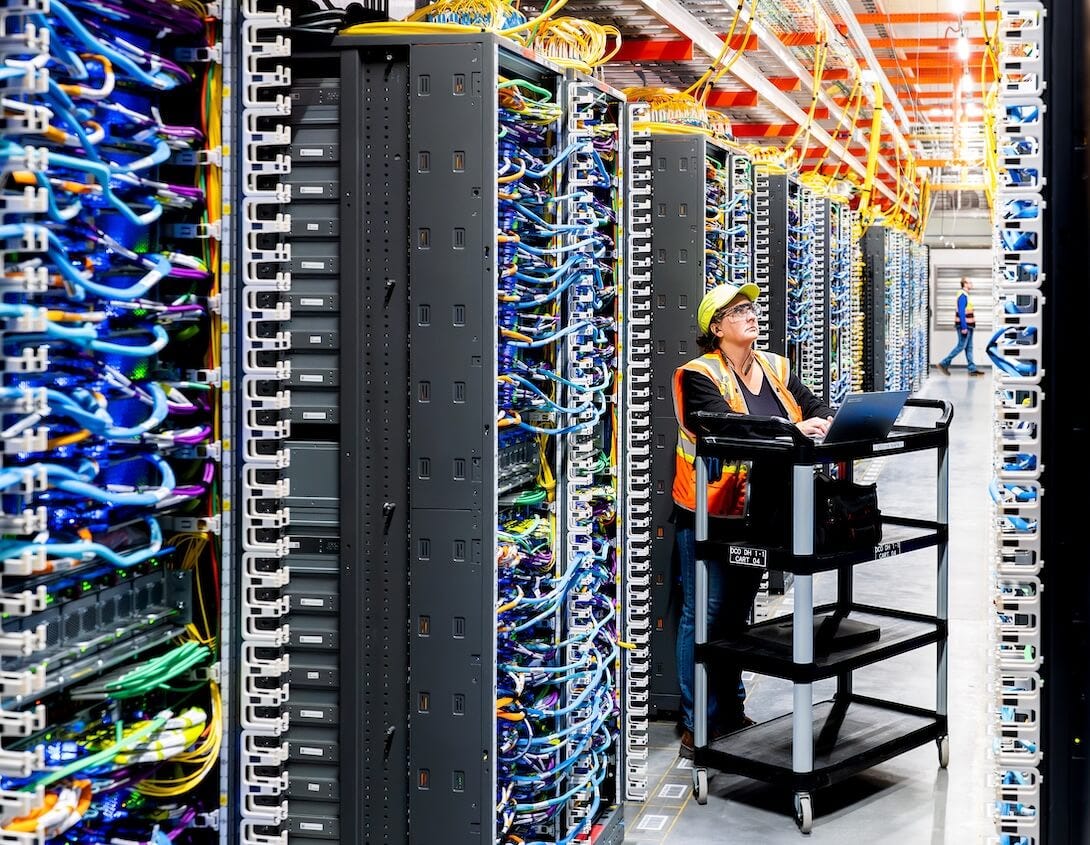
Source: Amazon.
Rather than a collection of independent server halls, the site is wired together as one EC2 UltraCluster — hundreds of thousands of accelerators that behave as a single training machine, fused by a petabit-scale, non-blocking network. It is the physical expression of an idea AWS CEO Matt Garman has stated outright — “the data center campus is the new computer“ — and it already represents Trainium2 infrastructure about 70% larger than any prior AI platform in AWS’s history.
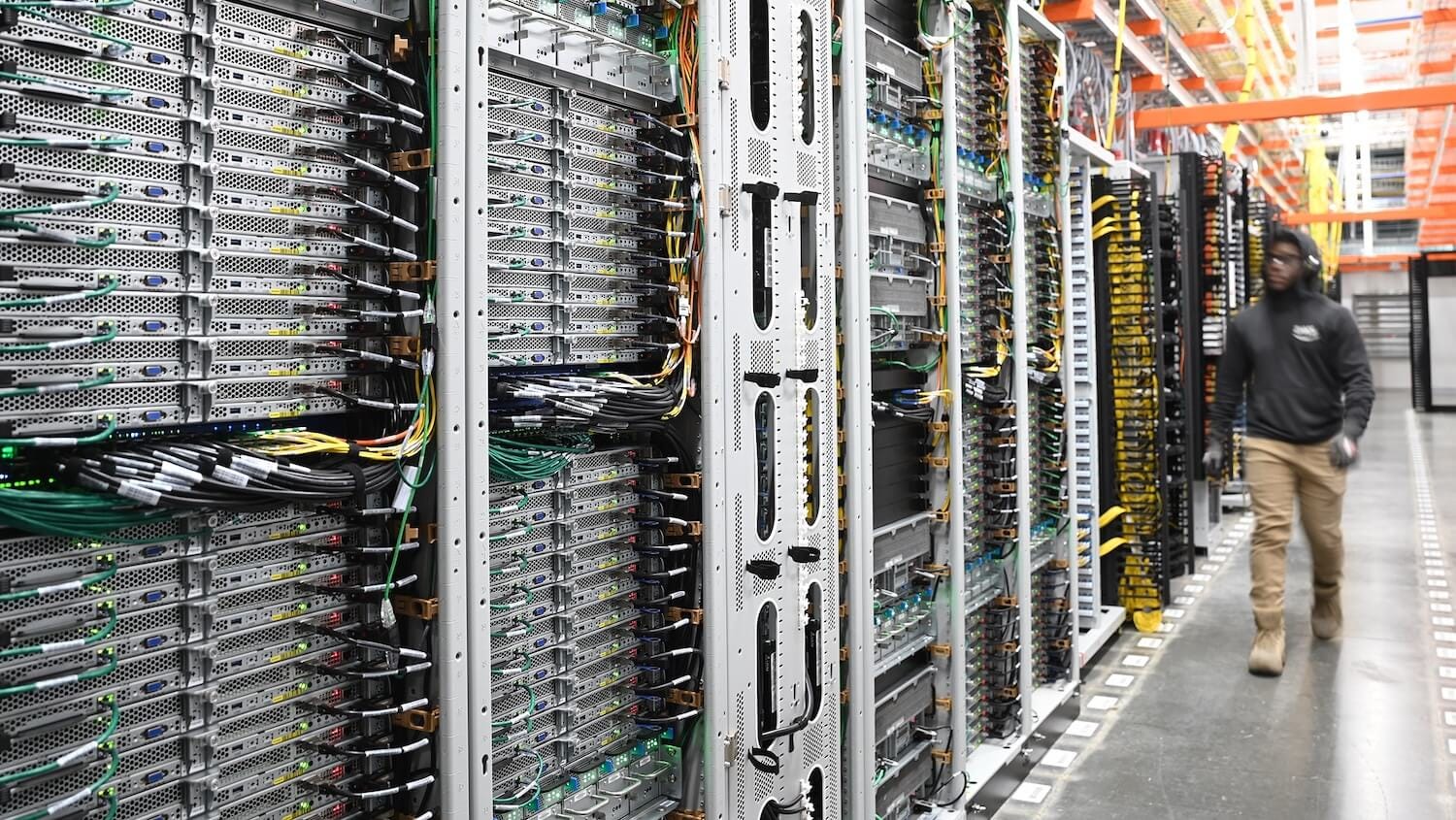
Source: Amazon.
New Carlisle held about 500,000 Trainium2 chips when it came online in October 2025 — a count AWS had recently doubled — and at that point effectively constituted all of Project Rainier. More broadly, Anthropic uses more than 1 million Trainium2 chips for its company-wide Claude fleet, and AWS has deployed 1.4 million Trainium2 chips across all customers — not specifically at the Indiana site.
Trainium3 — AWS’s first chip built on a 3-nanometer process and co-developed with Anthropic — is already being deployed at New Carlisle.
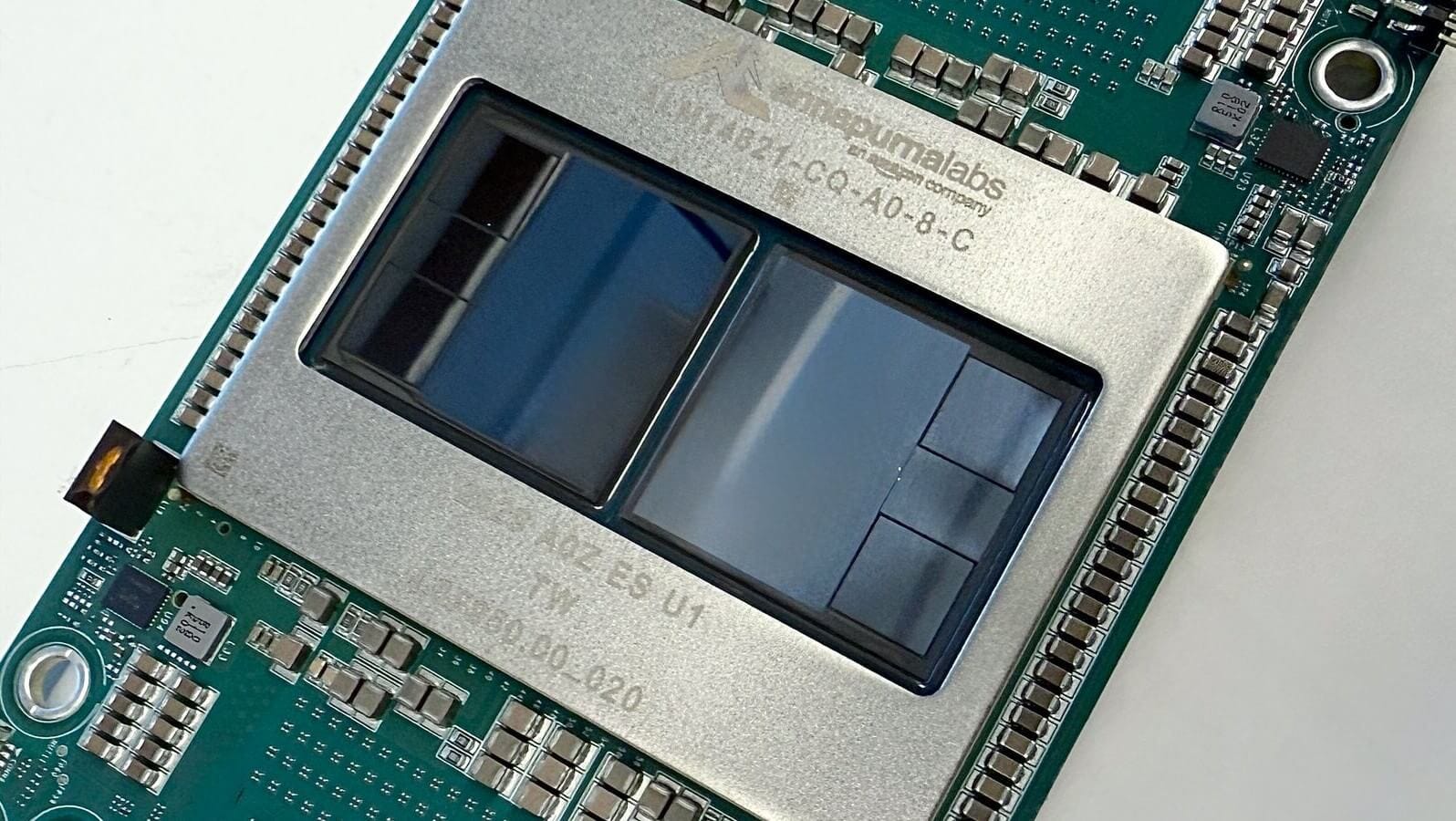
Source: Amazon.
Trainium3’s air-cooled variant drops into the existing buildings without redesign, and its UltraServers offer up to 4.4× the compute, about 4× the memory bandwidth, and about 4× the energy efficiency of Trainium2, scaling to 144 chips and 362 FP8 petaflops; the matching network generation can interconnect as many as 1 million chips in a single cluster.
AWS’ roadmap runs through Trainium4 and a multi-gigawatt reservation. Trainium4 is expected to begin delivering in 2027 with roughly six times the FP4 performance of Trainium3.
Power is the one layer of the stack Amazon doesn’t own — and it is the layer that sets the schedule. All operating power comes from the utility grid; there are no gas turbines, fuel cells, or behind-the-meter power plants. The only on-site generation is a diesel fleet held in reserve for emergency backup, so the utility interconnection is the sole supply layer for the data halls — tying the campus’s growth directly to the pace of grid and transmission build-out.
Across its three phases the campus reaches an estimated ~1.96 GW of IT capacity. Total draw from the utility grid runs higher, at 2.25 GW; the gap covers cooling, power conversion, and the balance of facility load layered on top of the servers — a thin margin reflecting the chiller-free, air-cooled design.
The campus is served by Indiana Michigan Power (I&M), an American Electric Power (AEP) subsidiary that operates in Indiana and Michigan, within the PJM grid.
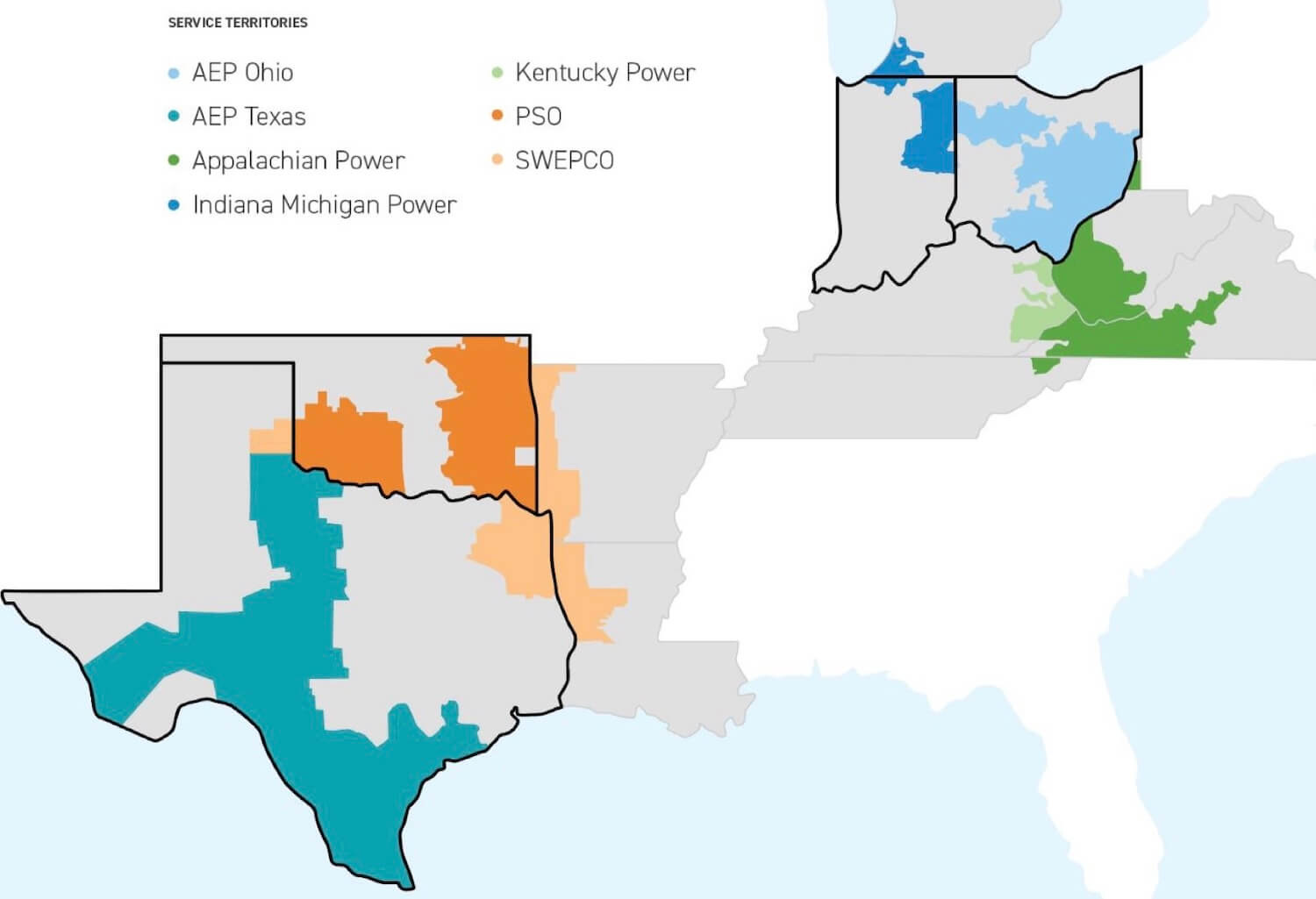
Source: American Electric Power (AEP).
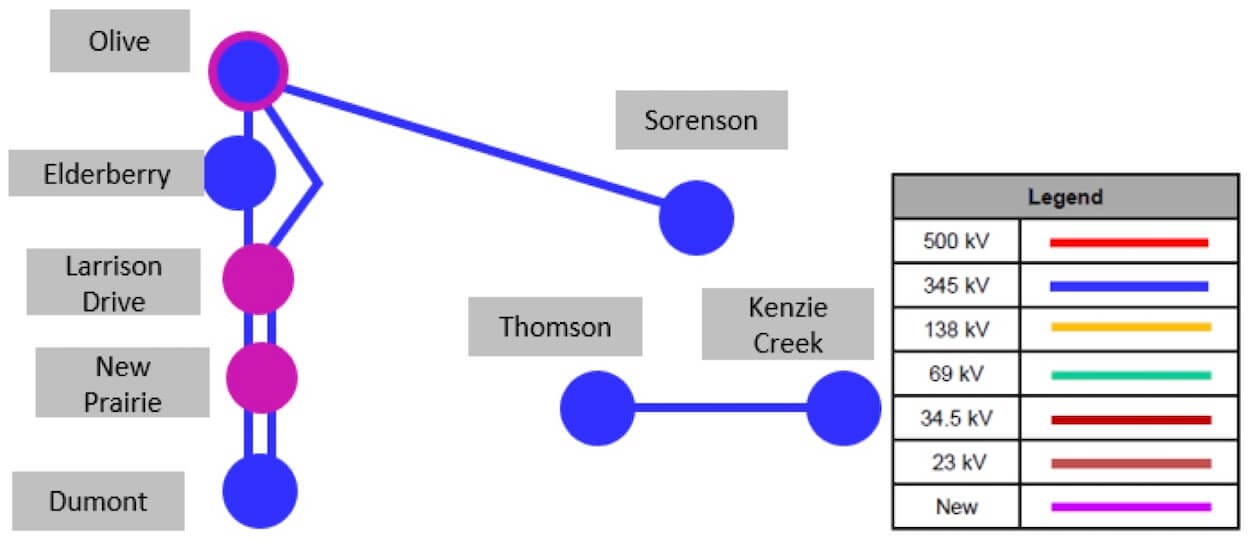
The New Carlisle site was selected partly because it already adjoined extra-high-voltage (EHV) transmission and a very substantial existing substation — the Olive 345 kV station — letting AWS interconnect at scale without first waiting on entirely new long-haul lines. Amazon’s investment was made expressly contingent on securing long-term energy-service agreements.
Connecting the campus required a purpose-built 345 kV transmission delivery scheme. AEP is building two new 345 kV delivery substations — Larrison Drive and New Prairie — plus fault-duty upgrades at the existing Olive station, a ~$185 million transmission package targeting an initial ~1.1 GW of service by December 2026.
Source: American Electric Power (AEP).
I&M’s own New Carlisle 345 kV interconnection station carries about a $68 million authorization, and power reaches the buildings through on-site substations.
At a planned 2.25 GW of demand, Amazon’s New Carlisle data center campus is the single largest customer in I&M’s 100-plus-year history — a load that by itself exceeds the combined demand of all of I&M’s existing Indiana retail industrial and commercial customers. I&M is phasing in this new system load over several years. More broadly, new large loads are projected to push I&M’s Indiana peak demand from about 2.8 GW (2024) to more than 7.0 GW by ~2030 — after decades of essentially flat demand.
Standby power is the campus’s defining electrical feature: 238 critical emergency generators at Phase 1 (SBN100), 234 at Phase 2 (SBN201), and 406 proposed for the SBN210 expansion — 878 critical units at full build-out. Each is a Caterpillar 3516E or Cummins DQLF rated at 2.75 MW.
SBN100’s fleet totals 654.5 MW of backup and SBN201’s 643.5 MW — each above the estimated ~590 MW of critical IT load it protects. The campus’s complete generator fleet provides roughly 2.4 GW of standby capacity, sized to carry critical load through any utility interruption.
The generators are engineered to stay just under federal Prevention of Significant Deterioration (PSD) review. The fleet’s size makes each phase a Title V “major” source for nitrogen oxides and carbon monoxide, but every critical unit carries selective catalytic reduction (SCR) plus a catalyzed diesel particulate filter (cDPF), cutting uncontrolled NOx by roughly 88% — from a potential ~2,060 tons per year to about 248, just under the 250-ton threshold for PSD review. Enforceable caps (NOx 220 / CO 205 / VOC 55 tons per source) lock it in, and the Tier 2-certified engines thereby reach “Tier 4-equivalent” performance.
To connect, the New Carlisle data center campus falls under a new “Large Load” tariff I&M created for customers of 70 MW or more (or 150 MW aggregated). Approved by the Indiana Utility Regulatory Commission (IURC) in February 2025, it requires a 12-year minimum contract term, an 80% minimum-billing-demand floor (the customer pays for 80% of contracted capacity regardless of actual usage), collateral equal to 24 months of the maximum non-fuel bill, and an exit fee exceeding $1 billion for a 1 GW customer that leaves early — terms designed to keep the cost of new infrastructure from shifting onto other ratepayers. The settlement was signed by I&M, the state consumer counselor (OUCC), the Citizens Action Coalition, Amazon, Google, Microsoft, and the Data Center Coalition.
Whether the deal raises or lowers everyone else’s bills is contested. I&M maintains that large-load revenue has a “moderating effect” on rates. By I&M’s own numbers, a 1 GW addition lowers residential and commercial rates about 7% apiece, while nudging industrial rates up about 4%. At the full ~4 GW of expected hyperscaler load, Amazon’s expert — extending I&M’s analysis — put the generation savings to existing customers at about $122 million per year. And with the system grown to ~7 GW, I&M acknowledges the transmission component of AEP-zone bills falls by roughly 15%.
The backdrop, though, is a decade of steep increases — the typical I&M residential bill rose about 47% from 2016 to 2025 — and critics warn the build-out risks stranded costs if a few concentrated customers scale back, with regional reliability tightening as PJM reserve margins are projected to fall toward 8% by 2028–2029.
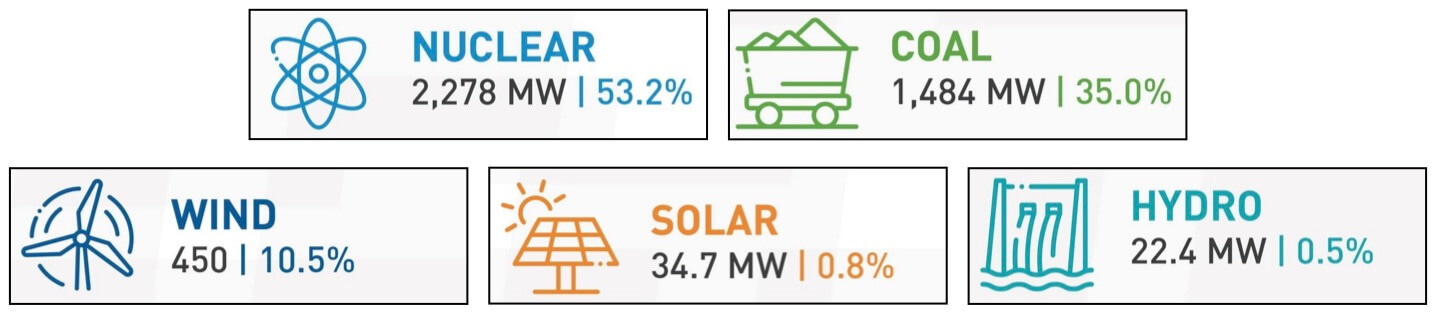
The campus draws from a nuclear- and coal-heavy mix that is shifting toward gas. I&M’s generation is roughly 53% nuclear (the two-unit Cook plant, licensed through 2034 and 2037) and 35% coal, with only about 11% renewables — mainly wind.
Source: Indiana Michigan Power (I&M).
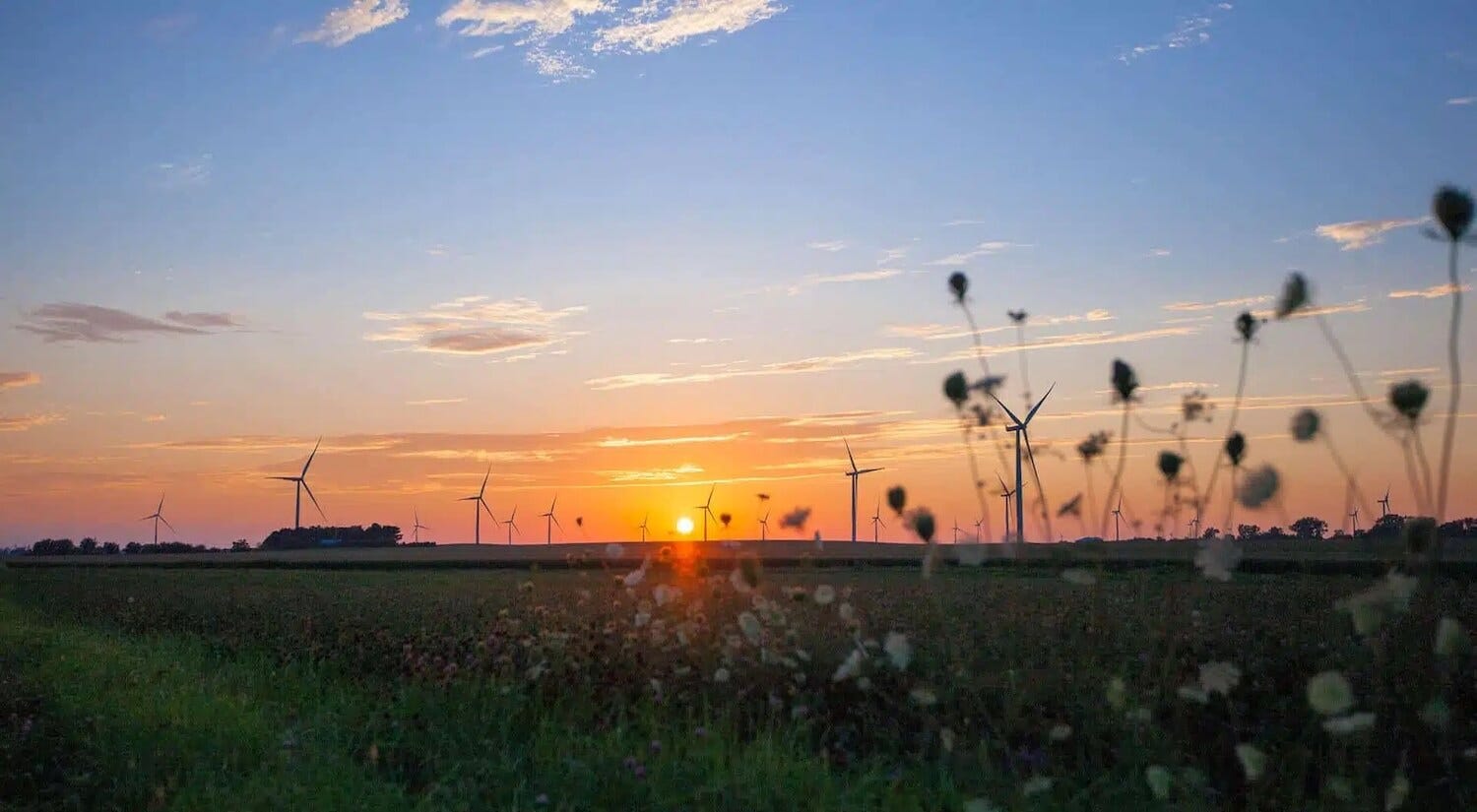
Amazon is adding its own renewable supply to the Indiana grid. Separate from the utility’s mix, Amazon has contracted roughly 635 MW across more than five Indiana wind and solar projects feeding the grid — including four solar farms and a wind farm.
Source: Pattern Energy.
The most recent is Riverstart Solar Park’s final 100 MW segment in Randolph County, energized in April 2025 under a 25-year power-purchase agreement (PPA) — Amazon’s first new Indiana renewable contract in nearly a decade.
Sustainability claims sit against a rising-emissions backdrop. Amazon reports that its operations were matched with 100% renewable energy in 2023 and 2024 and says its goal of net-zero carbon by 2040 is unchanged by Project Rainier. At the same time, Amazon’s total carbon footprint rose 6% in 2024, to 68.25 million metric tons of CO₂e, with the sharpest jump in the category that captures data center construction: capital-goods emissions, up 18%. And the company’s electricity-related emissions rose nearly 40% from 2022 to 2024 as it scaled AI infrastructure; renewable matching erases that growth on paper — the central tension in the debate over the build-out’s climate impact.
Cooling is where the bet’s economics show up in the buildings; water is where its politics show up in the county. The same design choice that holds down the cooling bill also shapes the water politics.
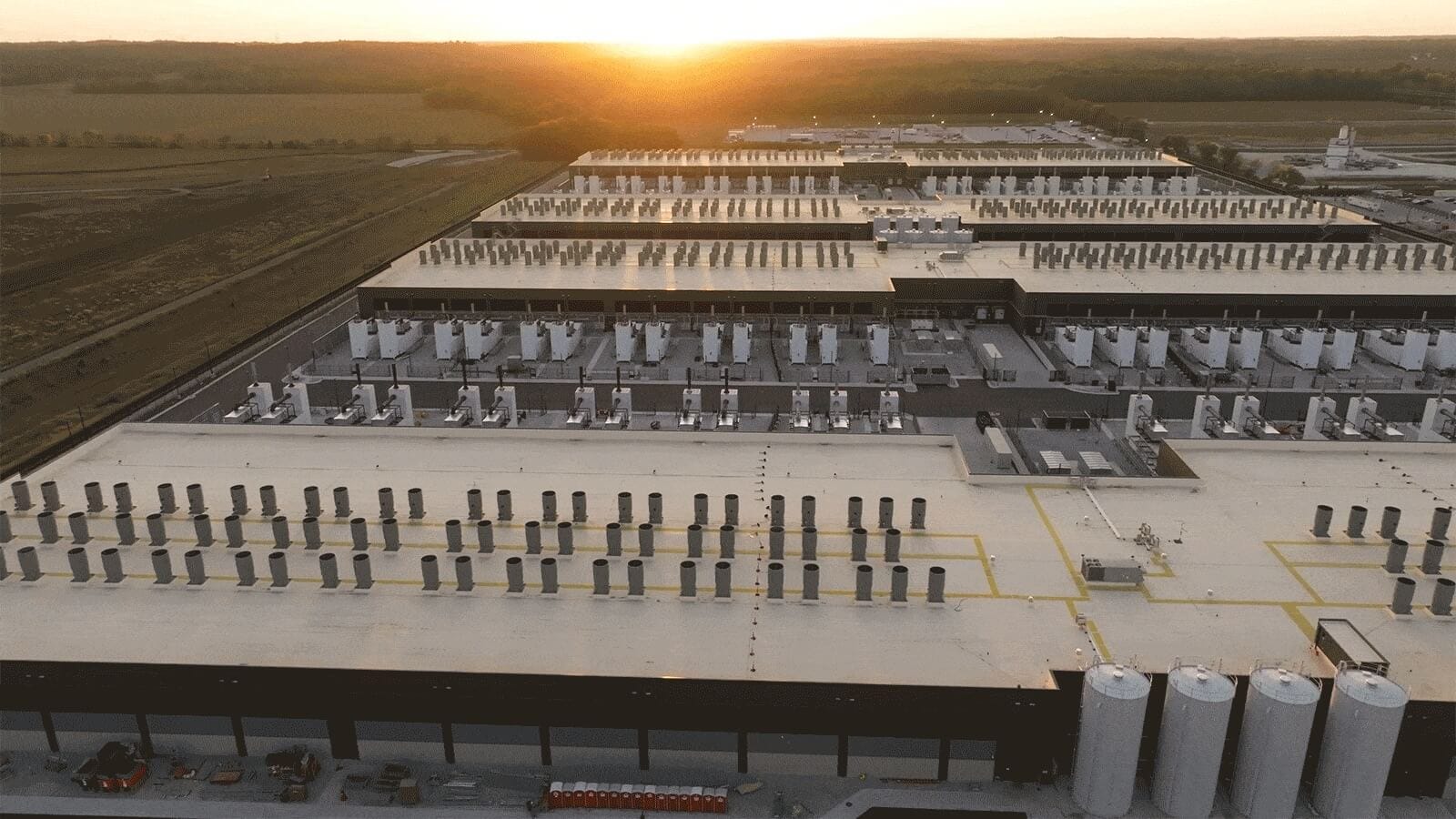
New Carlisle’s cool northern-Indiana climate lets the data center buildings reject heat with outside air for all but about 2% of the year — on the order of 175 hours, roughly one week, in total — sidestepping the chillers and evaporative cooling towers that drive water use at most hyperscale data centers.
Source: Amazon.
The campus uses no water for cooling from October through March, and from April through September the buildings call on cooling water for only a few hours on a typical warm day; AWS expects the finished campus to use less water than the cornfields it replaced. Running essentially chiller-free holds the campus to an estimated Power Usage Effectiveness (PUE) of 1.15, matching AWS’s published global average — near the practical floor for a hyperscale data center, versus the reported average annual PUE of 1.54 that the Uptime Institute reports via its Global Data Center Survey.
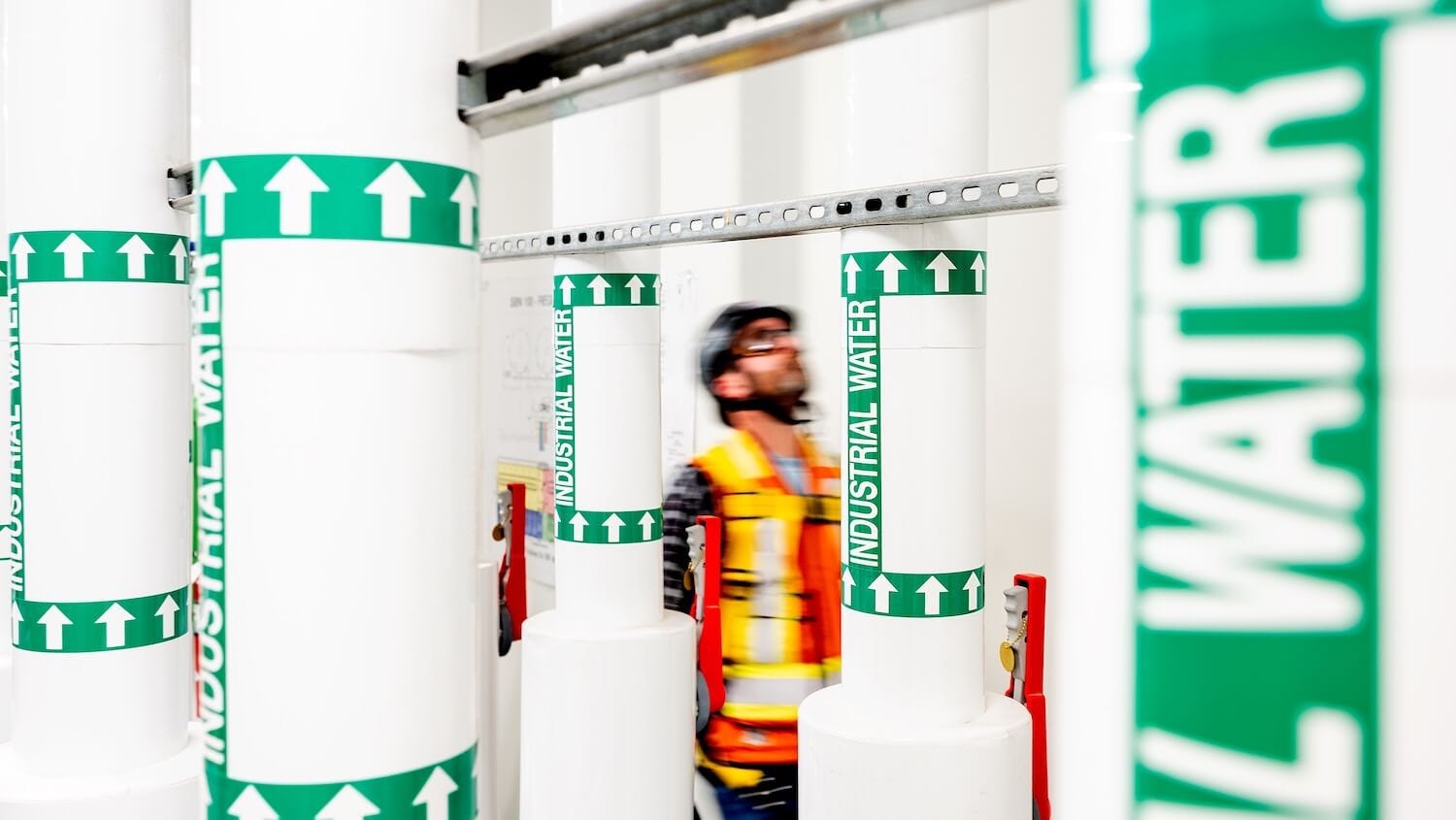
When water is needed, the cooling is “open-loop.” Warm-month supplemental cooling uses non-contact cooling water — pumped through the buildings, run as-is through the pipes with nothing added or removed, and ultimately sent to the sewer rather than evaporated in a cooling tower.
Source: Amazon.
That open-loop design reconciles two facts that seem contradictory: the air permits correctly state the site has no cooling towers, yet the campus still moves real volumes of water.
For Phase 1 (the 9-building North Campus known as SBN100), the metered cooling-water discharge is permitted at up to 1.58 million gallons per day (MGD) and averages about 0.8 MGD, pre-treated on-site and sent to the City of South Bend’s wastewater plant under an industrial discharge permit; intake water is cycled through the process five or six times before it leaves. Because the water is returned rather than evaporated, net consumption is low — the large contested volumes come from construction, not cooling.
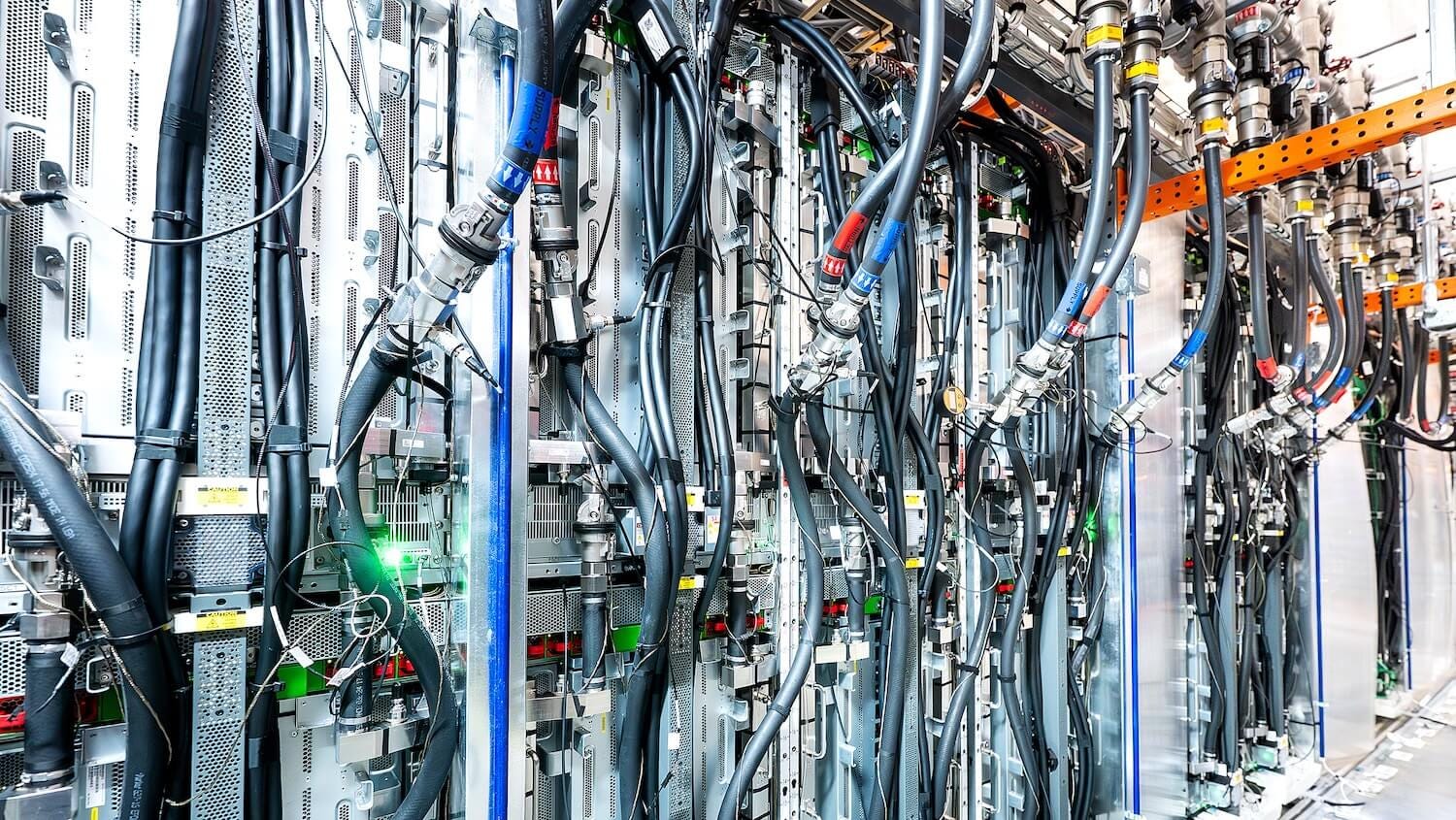
AWS’s Phase 2 Expansion buildings, now under construction, add direct-to-chip liquid cooling as part of a new building type. An SBN210 wetlands filing names liquid cooling among the technologies the site can integrate, and the expansion’s mixed-format buildings — six of the fourteen two-story — depart from the uniform single-story air-cooled halls in exactly the way liquid cooling permits. The sealed loop continuously recirculates coolant and does not increase the site’s water use — added cooling capacity suited to the denser, next-generation Trainium3 silicon AWS is deploying at New Carlisle.
Source: Amazon.
Trainium3’s air-cooled variant still drops into the existing halls without redesign, so the campus will run a mix of air- and liquid-cooled space as it expands; in both cases the heat is ultimately rejected to outside air, not to evaporative cooling towers.
Both the drinking water and the cooling water are supplied by the Town of New Carlisle from two municipally owned plants on Edison Road — the converted St. Joseph Energy Center (SJEC) plant and the Cliffs plant. They draw water from a shallow, unconfined aquifer near the headwaters of the Kankakee River. Lacking an overlying clay cap, that aquifer responds quickly to pumping and is unusually susceptible to surface contamination, which sharpens local concern.
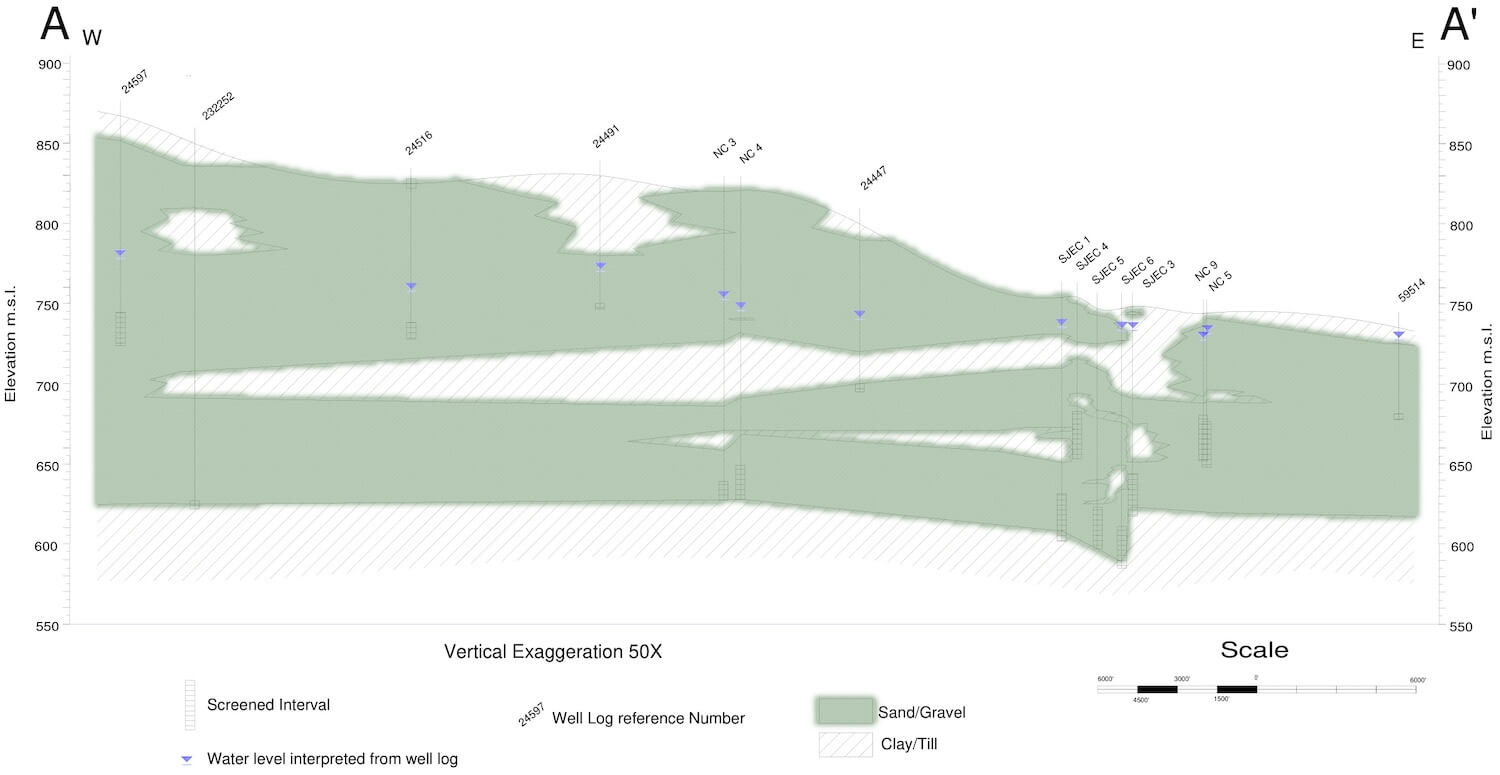
West–east cross-section from St. Joseph County’s 2019 Peerless Midwest hydrogeological study. Green = sand and gravel; hatched = clay/till. The town’s SJEC and New Carlisle supply wells (right) are screened in the same surficial sand and gravel that holds the water table — no continuous clay layer seals it from the surface. Source: Peerless-Midwest.
AWS is paying for the build-out that makes the water supply possible: expansions of both plants, a new 1.25-million-gallon water tower on Fillmore Road, and the Edison Road trunk sewer, part of roughly $114 million of AWS-funded water and sewer infrastructure.
Built capacity far exceeds current draw. The two water plants are rated at about 16 MGD of firm capacity (up to 18 MGD), but as of 2025 were producing only about 4–6 MGD, because the AWS data center campus is not fully built out and the neighboring $3 billion-plus GM–Samsung SDI EV Battery Plant (branded “Synergy Cells”) is not drawing water at all: GM paused the project in mid-2026, roughly half-built. AWS reserved more municipal capacity than it has needed — in January 2026 it returned 1 MGD to the town at no cost.
St. Joseph County adopted a voluntary cap of 24 MGD on water produced from the town’s two plants — the peak output of their current and planned wells. The cap covers the plants’ production — the supply AWS and GM draw on — but not farms, private wells, or construction dewatering; above that level, a monitoring “alarm” and an action plan kick in. The county’s hydrogeological analysis put the combined Kankakee–Valparaiso Outwash aquifer system’s total safe yield near 49 MGD, of which only about 21–27 MGD remained available after existing withdrawals.
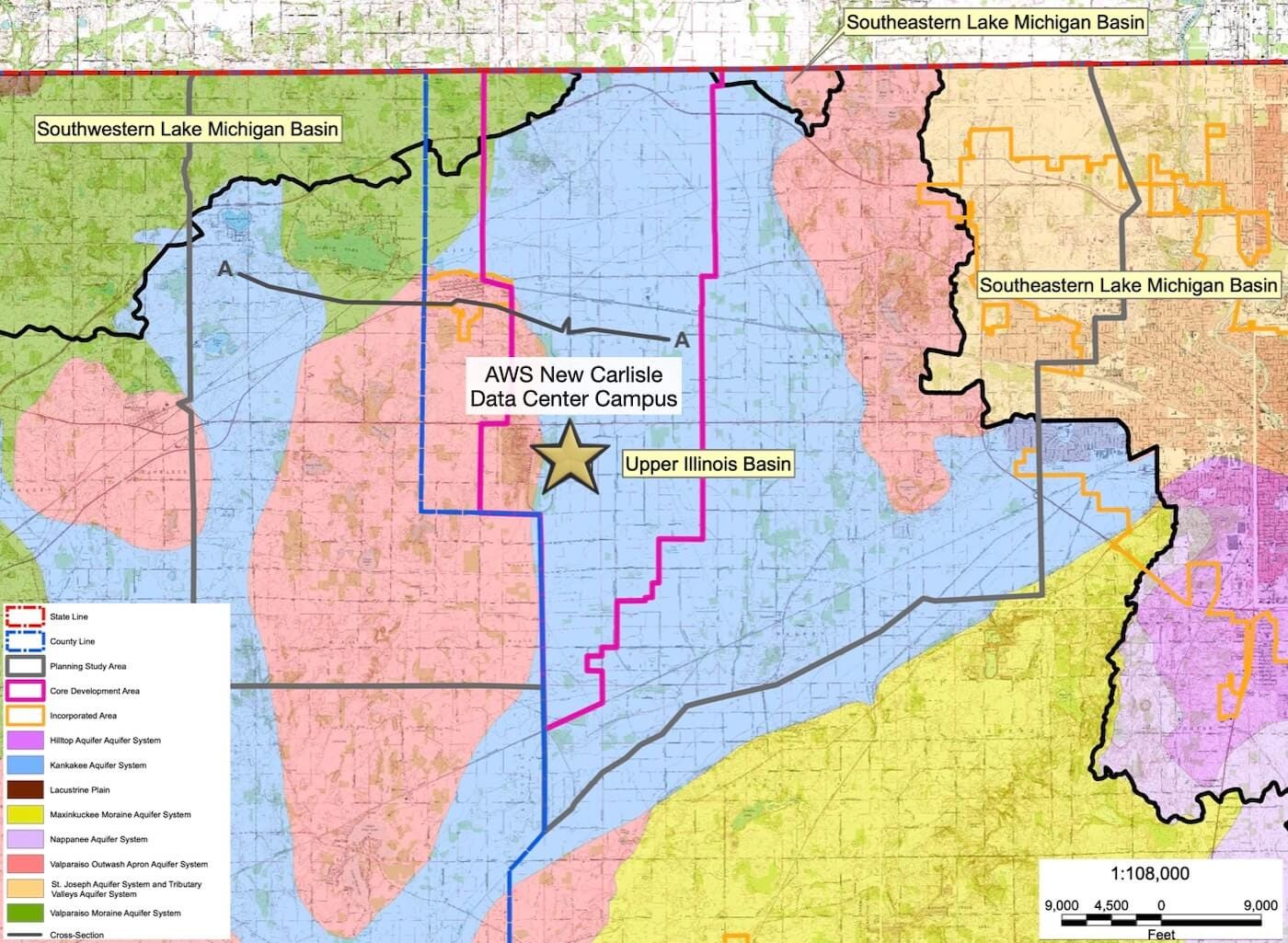
St. Joseph County’s 2019 study mapped the two aquifer systems beneath the site — the Kankakee (blue) and Valparaiso Outwash Apron (pink) — with the Indiana Enterprise Center (IEC) Core Development Area outlined in magenta and the AWS New Carlisle Data Center Campus denoted by the star. The black line is the drainage divide: everything south of it drains to the Upper Illinois basin, the headwaters of the Kankakee River. Source: Peerless-Midwest.
The 24 MGD cap sits within that remaining band, effectively allocating most of the aquifer’s headroom to the new industrial users. Critics note that the cap is voluntary, with no penalties or fines attached, and that comprehensive draw figures are shielded by non-disclosure agreements.
Construction dewatering — not cooling — drove the fight. To keep foundations dry, AWS’s contractors pump groundwater out of the excavations and discharge it to a farm ditch. The IEC-3 South dewatering permit sought to run up to 1.45 million gallons per hour — about 35 MGD — later trimmed roughly 10% to 1.3 million gallons per hour (~31 MGD), using vertical and horizontal wells to about 70 feet to draw the water table down to the 20–25-foot construction depth. The county Drainage Board approved the renewal in May 2026 — though in practice the contractors never reached the permitted ceiling.
The water figures cited in St. Joseph County hearings — ranging from 9 to 52 MGD — are not competing estimates of one quantity. They mix operational cooling water (modest, ~1.6 MGD permitted for Phase 1), the 24 MGD cap on plant production, construction dewatering discharge (~31–35 MGD), and aquifer safe-yield/recharge benchmarks (44–51 MGD). The large numbers that dominate the debate are dewatering and withdrawal ceilings, not the water actually used to cool servers. The one figure that can’t be pinned down is the finished 32-building campus’s operational water use, which AWS frames only as intermittent — a portion of the shared 24 MGD cap, used about 2% of the year — and otherwise declines to quantify.
The last layer of the bet is the deal around it — what Amazon pays St. Joseph County and the state of Indiana, and what they gave up to land it.
Source: Amazon.
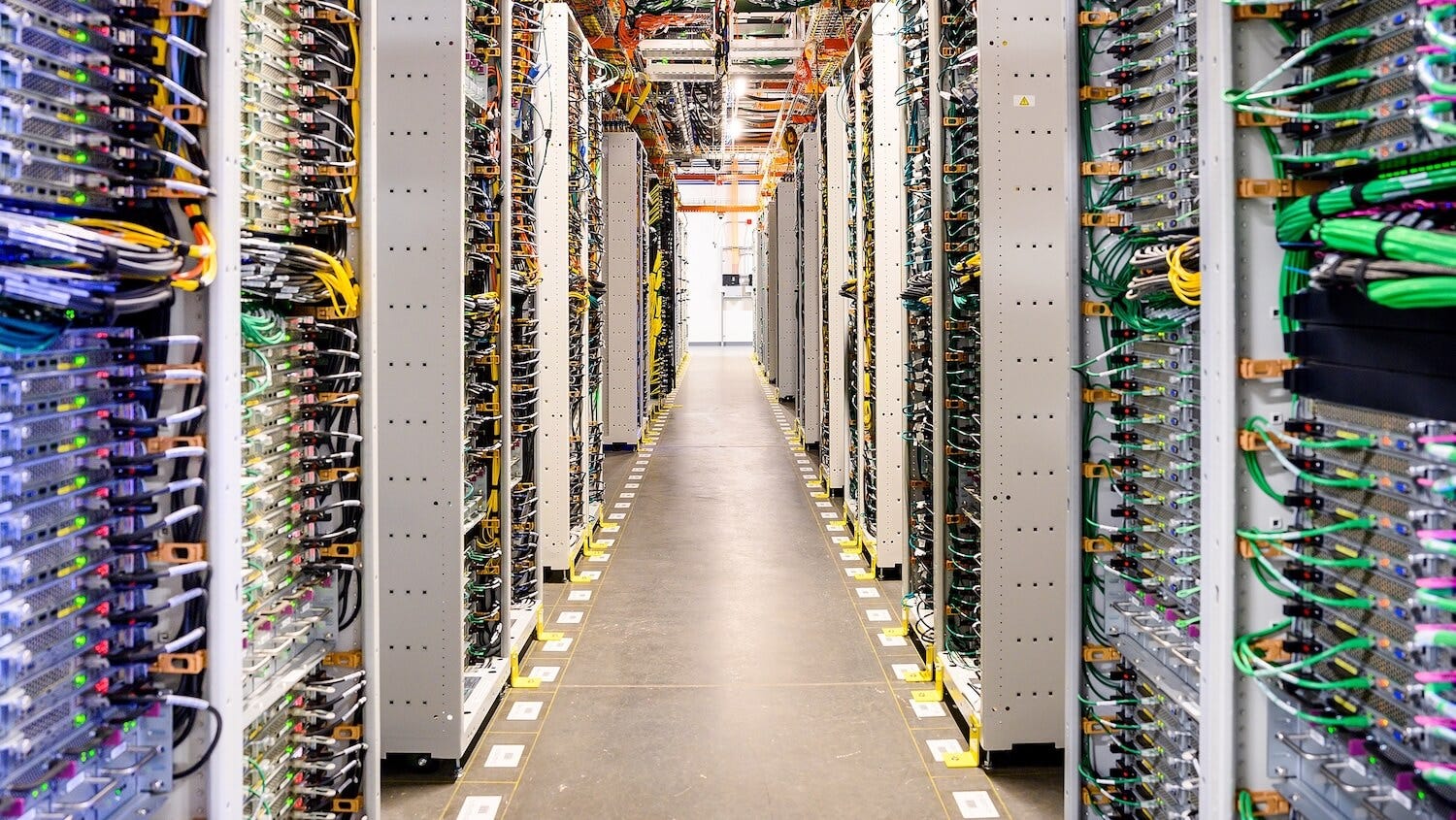
New Carlisle is a roughly $11 billion AWS self-build — the largest capital investment in Indiana’s history at announcement. In August 2024, the St. Joseph County Council approved an economic-development agreement granting Amazon a 50% real-property tax abatement for 10 years plus an ~85% exemption on technology equipment for 35 years — a structure that tracks how often data center hardware is replaced. The campus sits inside a New Carlisle tax-increment financing (TIF) district, with its property taxes phasing in to full effect in 2027.
The deal got its first audit in June 2026. The county’s first annual abatement-compliance review of AWS reported that $8.9 billion of the $11 billion had been invested as of January 1, 2026 — including $1.7 billion of assessed real property. On those values, Amazon is projected to pay about $12.5 million in property taxes in 2027, abatements applied — the first hard tax number the campus has produced.
Under Indiana’s 2019 data center law (House Bill 1405), the New Carlisle campus carries a 50-year state sales-and-use-tax exemption on its equipment, electricity, and water — running from January 1, 2024, through December 31, 2073, the longest such exemption of any state when the law passed — including exemption from Indiana’s 7% sales tax on electricity. On top of that, the Indiana Economic Development Corporation (IEDC) committed a performance-based package of up to $18.3 million in headcount-based tax credits, $5 million in training grants, $55 million in Hoosier Business Investment credits, and $20 million in redevelopment credits.
Public commentary often puts the combined incentives at roughly “$4 billion over 35 years” in county property and technology exemptions plus “$4 billion more over 50 years” from the state law.
Even with the abatements, the campus becomes a major new tax base — and payments rise sharply once they expire. County officials project Amazon will become the county’s single largest taxpayer, with annual payments exceeding $20 million, roughly a quarter of the county’s entire annual budget.
Alongside the tax deal, AWS signed a Community Enhancement Agreement valued at about $143 million, bundling water and sewer upgrades, its share of the State Road 2/Larrison interchange, sheriff road patrols, and per-building “community engagement” fees (fire service, student success, and park/green-space funds).
A reimbursement model keeps the county’s infrastructure build off its own books. Rather than the county bearing the cost, AWS reimburses St. Joseph County — through its Redevelopment Commission — for the Indiana Enterprise Center infrastructure the campus needs, including the $11.1 million Fillmore Road water tower, the $7.9 million Edison Road sewer, and phased water-treatment-plant expansions.
Cumulative AWS reimbursement reached $88.3 million by April 2026, including about $22 million in calendar-year 2025. TIF increment across all of the county Redevelopment Commission’s allocation areas — county-wide, not just New Carlisle — ran just over $5.8 million in 2025.
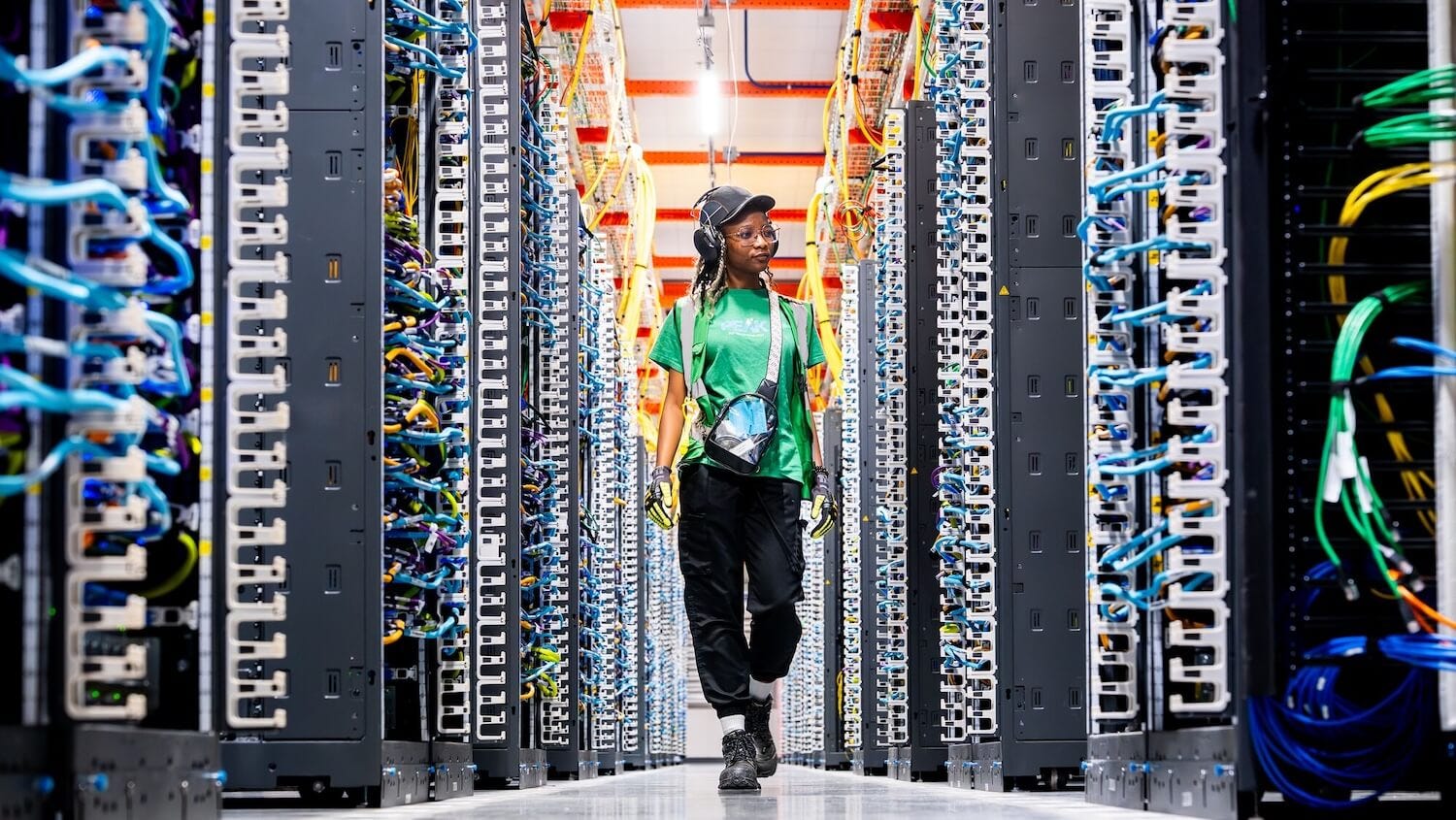
At the county’s first annual compliance review in June 2026, AWS reported 935 permanent on-campus jobs to date — a count that excludes construction labor, though the split between Amazon’s own employees and permanent on-site contractors went unresolved at the hearing. At least 600 of the jobs pay above the county average, and AWS has stated a commitment to an average salary near 125% of the county average (about $70,000).
Source: Amazon.
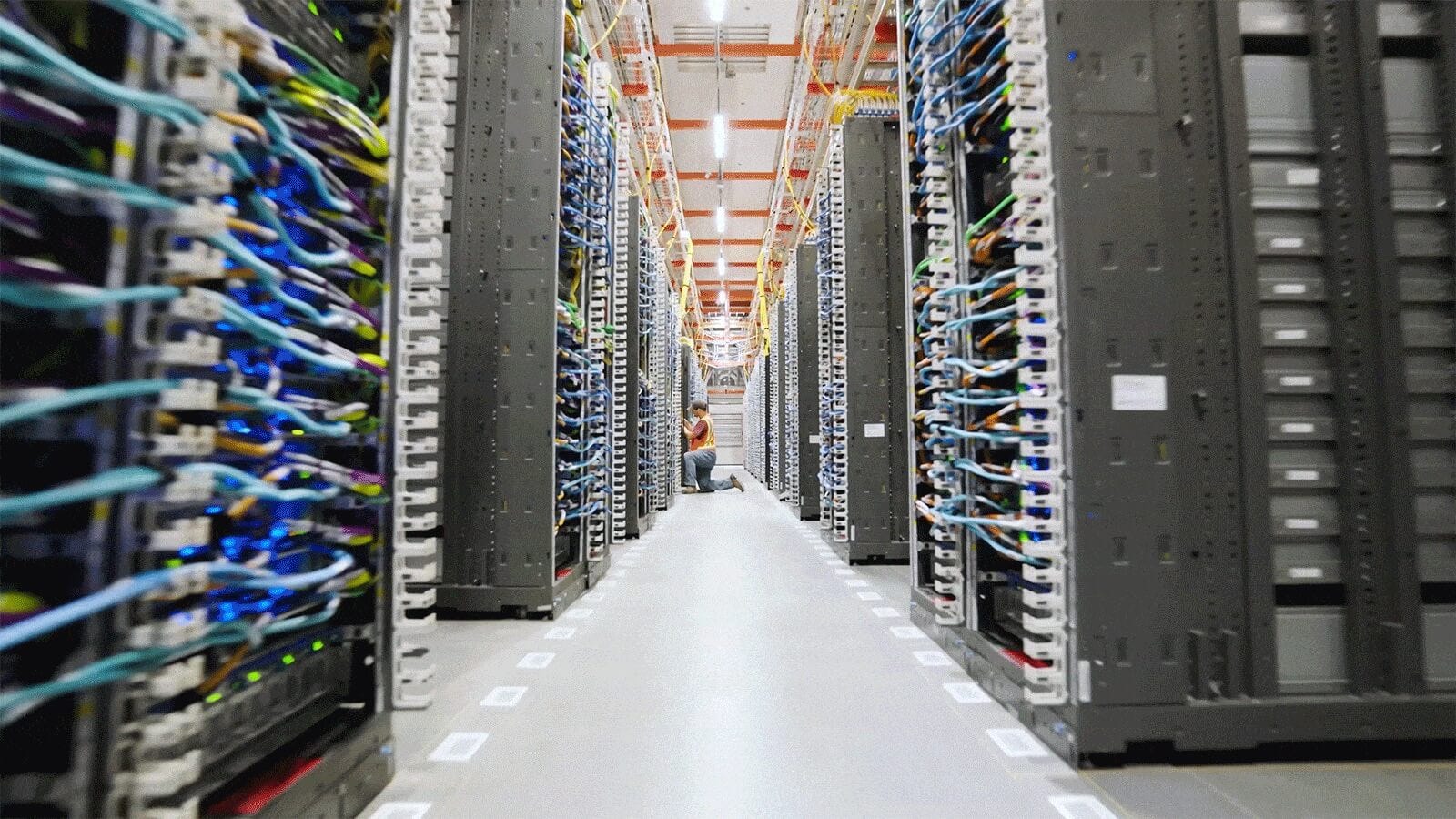
Operations are highly automated: each data center building runs on a lean crew of roughly 6–9 people per shift, consistent with the modest direct headcount, and economic-impact modeling assumes about six indirect jobs for every direct AWS job.
Source: Amazon.
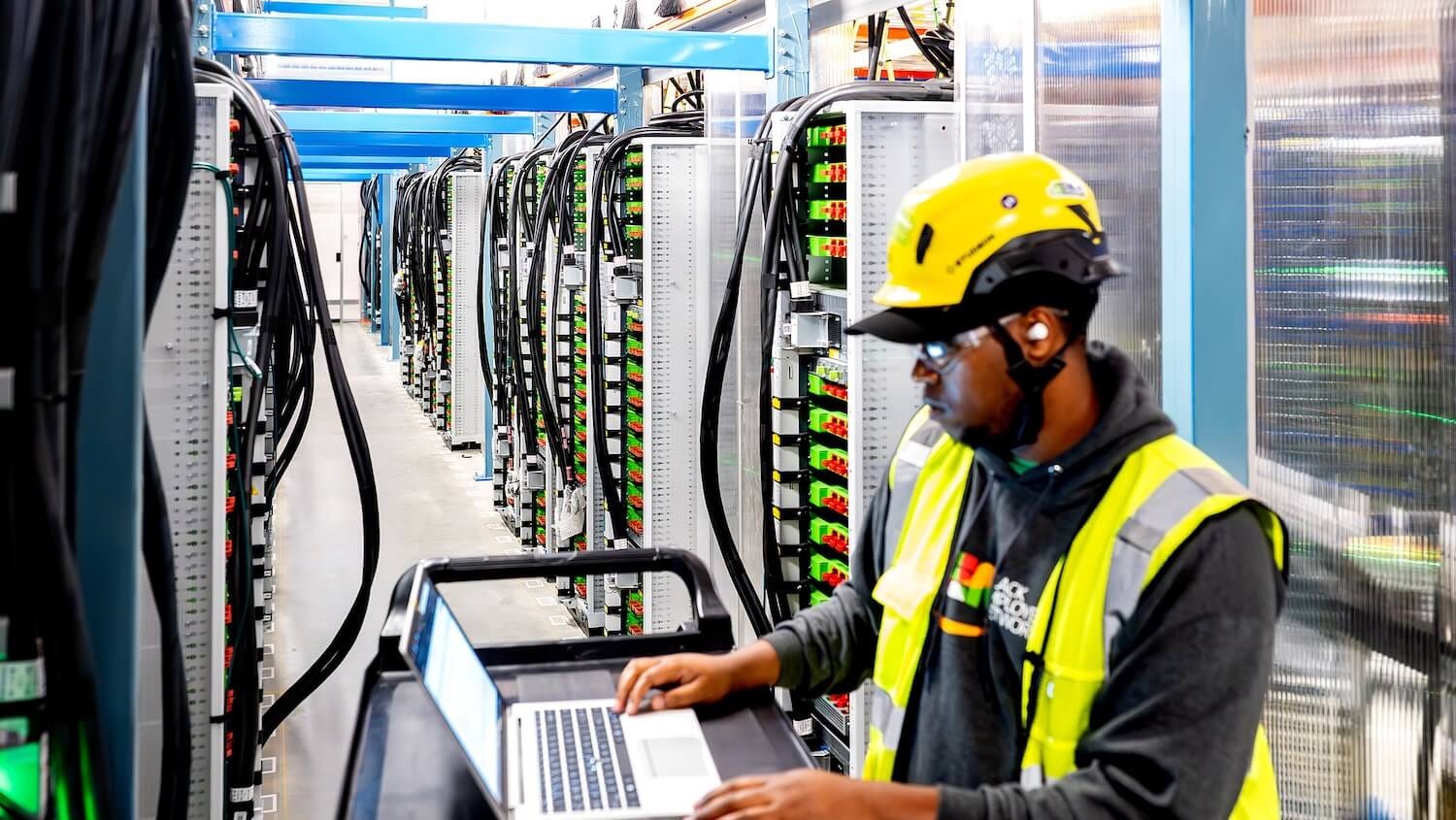
Construction is the larger near-term economic engine. At peak, roughly 4,000 construction workers are on the AWS site each day. To date, the build has supported close to 9,000 jobs and more than $1 billion in GDP, with union apprenticeships scaling to meet demand. Statewide, Amazon’s Indiana data center investment is projected to add $4.7 billion to Indiana’s GDP and support more than 3,000 full-time-equivalent jobs a year.
Source: Amazon.
Most of what happens next at New Carlisle is already scheduled — on a permit docket, a transmission plan, or a tax calendar. Six markers sit ahead in the public record, plus two questions that no single filing will settle.
SBN210’s two pending permits — decisions likely by early 2027. The expansion’s IDEM air-permit application (May 2026) adds 406 generators across 14 buildings and caps the combined South Campus fleet at 215 tons of NOx per year to stay clear of PSD review. Its wetlands application (June 2026) seeks to fill 4.94 acres of wetland and about 3,890 feet of stream, against 9.94 acres of mitigation. Phases 1 and 2 each went from application to air permit in eight to nine months; that precedent makes early 2027 the schedule gate for the expansion — 767 MW its stated minimum capacity, 775 MW its preferred design — and the late-2027 build-out target.
First 345 kV energization — December 2026. AEP’s two new delivery substations, Larrison Drive and New Prairie, carry a December 15, 2026 in-service date for the campus’s initial ~1.1 GW of firm delivery. Transmission, not silicon, is the pacing item: whether these stations energize on schedule sets the ramp toward the full 2.25 GW.
Trainium3’s ramp — and the milestone-gated money. AWS expects Trainium3 supply committed by mid-2026, with Anthropic due to have nearly 1 GW of combined Trainium2/Trainium3 capacity online across AWS by the end of 2026 — New Carlisle the flagship. The financial tell sits with Amazon: the $20 billion financing facility opens to Anthropic only as “delivery milestones of compute capacity” are met, making each disclosed drawdown a proxy for capacity delivered. Behind it, Trainium4 starts delivering in 2027, much of it already reserved.
I&M’s next base rate case — expected 2026–2027. Indiana’s consumer counselor has recommended I&M file within a year of Amazon’s or Google’s operations start. That case is where the tariff’s central claim meets real numbers: I&M’s projected ~7% residential-rate benefit per gigawatt of new load, tested against the 47% bill increase of the past decade and PJM reserve margins thinning toward 8% by 2028–2029.
Water’s October 2026 deadline — then the meters. The town’s AWS-funded system is contracted to deliver 2.5 MGD of potable water by October 2026. The GM–Samsung battery plant was to begin drawing from the same two plants on a similar clock — but with that project paused half-built in mid-2026, the voluntary 24 MGD cap on plant production (no penalties attached) will be tested by AWS’s ramp essentially alone. Metered production becomes the most telling number in the county record.
The 2027 fiscal turn. The campus’s property taxes reach full effect in 2027 — the county already projects a $12.5 million Amazon payment that year; the latecomer-fee window — under which later developers tapping the AWS-funded water and sewer lines owe a share of their cost — opens July 1, 2027, its trigger (seven functional data centers on IEC-2) already met; and the $50 million State Road 2/Larrison interchange targets completion by December 31, 2027, with Amazon covering $7 million of the county’s match. Somewhere past that line, Amazon becomes the county’s largest taxpayer at more than $20 million a year.
Two questions outlast the calendar. The first is water: AWS maintains the finished campus will use less water than the cornfields it replaced, yet the operational draw of all 32 buildings is the one number it declines to quantify — so the claim can only be tested meter by meter, summer by summer. The second is the bet itself: one customer, one chip family, 32 buildings wired as a single machine. Anthropic’s 5 GW Trainium reservation and Trainium4’s 2027 arrival will tell whether New Carlisle is the template for how frontier AI campuses get built — or a one-off, engineered to perfection for a single partnership at a single moment.
Measured AI provides institutional-grade analysis of the physical infrastructure powering AI data centers. For access to our full research library, regulatory intelligence, and weekly briefings, visit MeasuredAI.com.
No posts
Comments
Nothing yet. Say the first thing.
Sign in to join the conversation.