
It’s Christmas Day, December 25, 2017, a little after 2 p.m. I’m standing in my kitchen when I hear the door open and watch my sister walk through it.
Christmas feels a little somber this year. Mama and Daddy are no longer here to celebrate with us, and I think our whole family is still trying to figure out how to get through the holidays without them.
Katherine, one of Mama’s closest friends, has come over too. Seeing her walk through the door brings a little warmth back into the house. For a few minutes, it almost feels like old times.
Almost.
There’s still an empty place at the table that nobody can fill.
I invited Katherine, my sister and a few friends over for Christmas dinner because I wanted the house full. I wanted the noise, the laughter, and the people I loved sitting around my table.
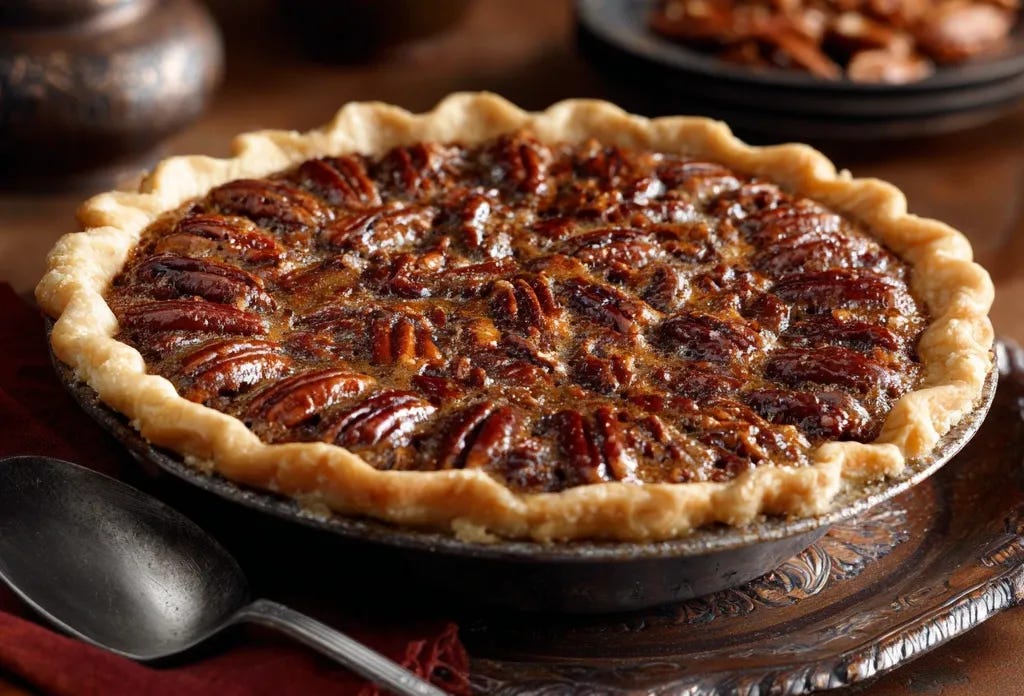
My sister walks over to me and hands me a pecan pie.
It’s sitting inside a green box.
I look down and see the words Marie Callender’s on the front.
I smile and take it from her.
I don’t say anything.
Because it’s Christmas.
My sister has never prided herself much on her cooking, not like Mama and me. But I know that pie is her way of showing the Christmas spirit and doing her part to make the day special, and I appreciate that.
But as I look at that green box sitting on my kitchen counter, my mind goes somewhere else.
It goes back to Mama.
Three years earlier, I never imagined I’d be standing in my own kitchen on Christmas Day without her.
There would always be another Christmas.
There would always be another pecan pie.
There would always be Mama.
Or at least that’s what I thought.
Mama could make a pecan pie.
Not a fancy pecan pie.
Not something you’d see sitting behind glass at some high-end restaurant.
Just a good old-fashioned pecan pie made the way Mama made it.
I can still picture it.
I can still remember the smell coming out of the kitchen. I can still remember the way the pecans looked on top and the way that first bite tasted.
There was nothing complicated about it.
But there was something about it that I can’t explain with a recipe.
It tasted like home.
That’s the thing about the food we grew up with.
You don’t just remember what it tasted like.
You remember where you were.
You remember who made it.
You remember who was sitting around the table.
And sometimes, you remember somebody who isn’t there anymore.
My sister cuts the Marie Callender’s pie.
Everybody gets a piece.
I take a bite.
It’s good.
There’s nothing wrong with it.
It’s sweet. It’s got pecans. It’s a pecan pie.
But it isn’t Mama’s.
And that’s when I realize I’m not comparing two pies.
I’m comparing a store-bought dessert to a lifetime of memories.
That’s not really a fair fight.
Because Mama’s pecan pie wasn’t just a recipe.
It was Mama.
There’s a difference between good and great.
Good is picking up a pie at the grocery store on the way to Christmas dinner.
Good is opening the package, putting it on a plate and having dessert ready in minutes.
There’s nothing wrong with that.
Sometimes life is busy. Sometimes you need something quick. Sometimes you just don’t have the time to spend half a day in the kitchen.
But great is something different.
Great is making the crust yourself.
Great is cracking the pecans and knowing exactly how many you want.
Great is standing in your kitchen with flour on the counter and ingredients spread out in front of you.
Great is knowing how your family likes it.
Great is making something with your own hands that somebody remembers years later.
Great pecan pie isn’t about how complicated the recipe is.
It’s about who made it and why.
Mama didn’t need a box to tell her how to make a pie.
She didn’t need a picture on the package showing her what it was supposed to look like.
She knew.
She’d made it enough times that her hands knew what to do.
That’s how Mama cooked.
She didn’t stand around measuring every little thing like she was taking a chemistry exam. She knew what looked right. She knew what smelled right. She knew when something needed a little more of this or a little less of that.
And if you asked her how much of something she put in the recipe, you might not get an answer that would help you very much.
“Just a little.”
“About that much.”
“You’ll know.”
That’s how a lot of us learned to cook.
We watched.
We stood beside Mama or Grandma.
We paid attention without realizing we were paying attention.
We thought there would always be another opportunity to ask.
Now, before anybody gets upset with me, let me be clear.
I’m not saying Marie Callender’s makes bad pie.
I’m sure plenty of people love it.
It’s convenient. It’s easy. You can buy one, take it home and have dessert ready without spending hours in the kitchen.
But Marie Callender’s ain’t Mama’s pecan pie.
A store-bought pie can’t give you Mama’s kitchen.
It can’t give you the smell of that pie baking while you were growing up.
It can’t give you the memory of walking into the kitchen and seeing her standing there.
It can’t give you the sound of her voice telling you it needs just a little more something.
And it certainly can’t give you Mama.
That’s what I was missing that Christmas Day.
I wasn’t missing a particular recipe.
I was missing a person.
Somewhere along the way, a lot of us stopped learning how to make the things our families used to make.
Not because anybody decided to forget.
Nobody meant to forget, it just happened.
One generation didn’t learn, then the next generation didn’t ask, and eventually the recipe disappeared along with the person who knew it.
That’s how traditions disappear.
Quietly.
The problem isn’t that convenience exists. The problem is when convenience becomes the tradition.
We can buy almost anything now.
We can buy the pie.
We can buy the rolls.
We can buy the stuffing.
We can buy the gravy.
But when we buy everything, we can eventually forget how to make anything.
And when the person who knew how to make it is gone, sometimes there isn’t anybody left to ask.
That’s the part I wish I’d understood when I was younger.
You don’t realize you’re watching a tradition being passed down until there’s nobody left to teach you.
Because now I can’t ask her.
I can’t call Mama and say, “How did you make that pecan pie?”
I can’t stand beside her in the kitchen and watch her hands.
I can’t ask her how much sugar she used or how she knew when it was done.
That opportunity is gone.
And that’s why I believe we have to start paying attention while we still can.
It doesn’t have to be complicated.
Learn one family recipe.
Find that one thing Mama or Grandma used to make. Ask questions. Write it down. Watch somebody make it if they’re still around to show you.
Make it with somebody watching.
Don’t just make the recipe yourself. Bring your kids or grandkids into the kitchen. Let them see what you’re doing. Let them ask questions.
Make it yours.
Traditions don’t have to stay exactly the same forever. You can change a recipe. You can add something. You can make it your own.
But somebody has to carry it forward.
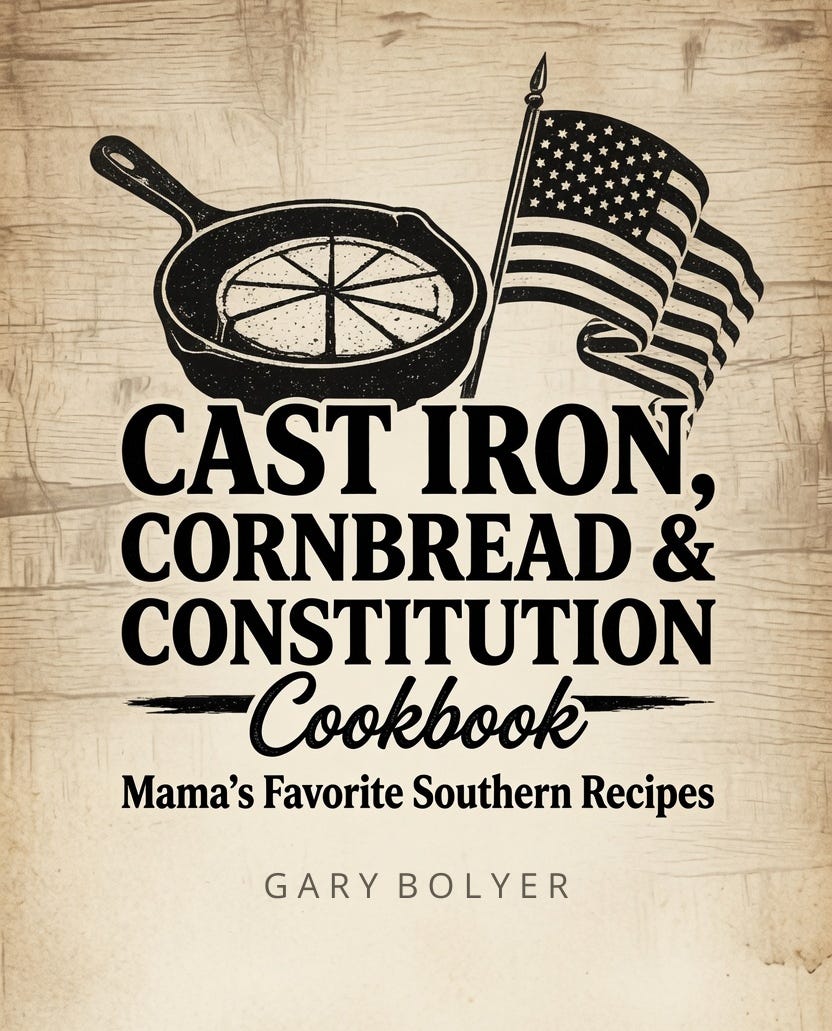
That’s one of the reasons I wrote the Cast Iron, Cornbread & Constitution Cookbook.
I didn’t write it because I think everybody needs to spend all day in the kitchen.
I didn’t write it because convenience is evil.
And I certainly didn’t write it because there’s only one right way to cook.
I wrote it because I believe some things are worth remembering.
The recipes in this book are about the kind of food that belongs around a table.
Cast iron.
Cornbread.
Fried chicken.
The simple things that fill a kitchen with a smell that makes people start wandering toward the stove asking when dinner will be ready.
That’s the kind of cooking I want to preserve.
Not perfection.
Tradition.
And maybe, somewhere along the way, you find a recipe that becomes your family’s recipe.
Get Cookbook + FREE SuperFast Planner
Think about what happens twenty years from now if nobody learns.
Mama’s gone.
Grandma’s gone.
The people who knew how to make those old recipes aren’t around anymore.
Not because anybody decided to forget. Nobody meant to forget, it just happened. One generation didn’t learn, then the next generation didn’t ask, and eventually the recipe disappeared along with the person who knew it.
That’s how traditions disappear.
Quietly.
And the sad part is that you don’t always know what you’ve lost until you try to remember it.
Now forget about my kitchen for a minute.
Think about yours.
Imagine your kids or grandkids standing beside you while you’re making something they love.
Maybe it’s pecan pie.
Maybe it’s fried chicken.
Maybe it’s cornbread in a cast iron skillet.
Maybe it’s something nobody else in the world makes exactly the way you do.
They’re watching you.
They’re asking how much you put in.
You might tell them, “I don’t know. Just watch me.”
And someday they’ll make it for their own family.
Maybe they’ll change it a little.
That’s okay.
That’s how traditions work.
The important thing is that they learned it from you.
I think back to that Christmas Day just after Mama died.
My sister brought a Marie Callender’s pecan pie.
We ate it.
We laughed.
We spent the day together.
And I’m grateful she brought it.
But I still remember Mama’s pecan pie.
I remember the kitchen.
I remember the smell.
I remember the taste.
Most of all, I remember her.
That’s what food does when it’s made by somebody you love.
It becomes more than food.
Years later, you can take one bite and suddenly you’re standing in another kitchen, at another table, with people who may not be there anymore.
That’s why I don’t want us to lose these traditions.
Because someday, somebody is going to remember you the same way.
They’re going to smell something baking in the kitchen and think about you.
They’re going to pull out an old recipe and remember watching your hands make it.
They’re going to make it for their own family and say, “This is how Mama used to make it.”
And that is worth more than any store-bought pie.
Marie Callender’s may make a good pecan pie.
But Mama made memories that have lasted for decades.
Make pecan pie great again.
Get Cookbook + FREE SuperFast Planner
- Gary
P.S. Don’t forget, the SuperFast Planner ($62 value) is included FREE with the Cast Iron, Cornbread & Constitution Cookbook only through Sunday, August 23 at midnight. If you’ve been thinking about getting the cookbook, this is the week to do it.
P.P.S. The $29 early-bird presale price on the Cast Iron, Cornbread & Constitution Cookbook also ends Sunday, August 23 at midnight. After that, the price goes up. If you want the cookbook for $29 and the SuperFast Planner FREE, this is your week. Clock is ticking. Tick. Tock.
Comments
Nothing yet. Say the first thing.
Sign in to join the conversation.