
New to Behind the Curtain? I'm a screenwriter, novelist and historian, and in this series, I’m documenting the real-time journey of pitching and developing two screen projects. Episode 1 is here. This is Episode 4. And it's the one where Elon Musk picks a fight with the wrong person.
Elon Musk, aka Phony Stark, has been ripping into the “historical inaccuracy” of Christopher Nolan’s Odyssey.
My response? Fuck off, rocket boy.
Flipping through Cliff’s Notes and reading the unhinged racist rants of the incel crowd objecting to Nolan’s colour-blind casting for the film doesn’t qualify you to have an opinion.
I’m a historian with a PhD and a former archaeologist who has worked in the same corner of the world excavating sites the same age as the places Homer wrote about in the Odyssey. I’m now a screenwriter and novelist who, amongst other things, adapts historical stories into screen-based and paper-based work. And that does qualify me to have some thoughts about it.
And I have skin in the game because I’m in the process of working on a feature film and a TV series based on separate historical events.
Two key words there.
“Based on.”
Remember those words.
Today, I’m giving you the good oil on how adapting history usually works in the film and TV industry.
And showing why Felon Muskrat has revealed, yet again, how little he knows, and how wise he would be to stick to his fucking lane.
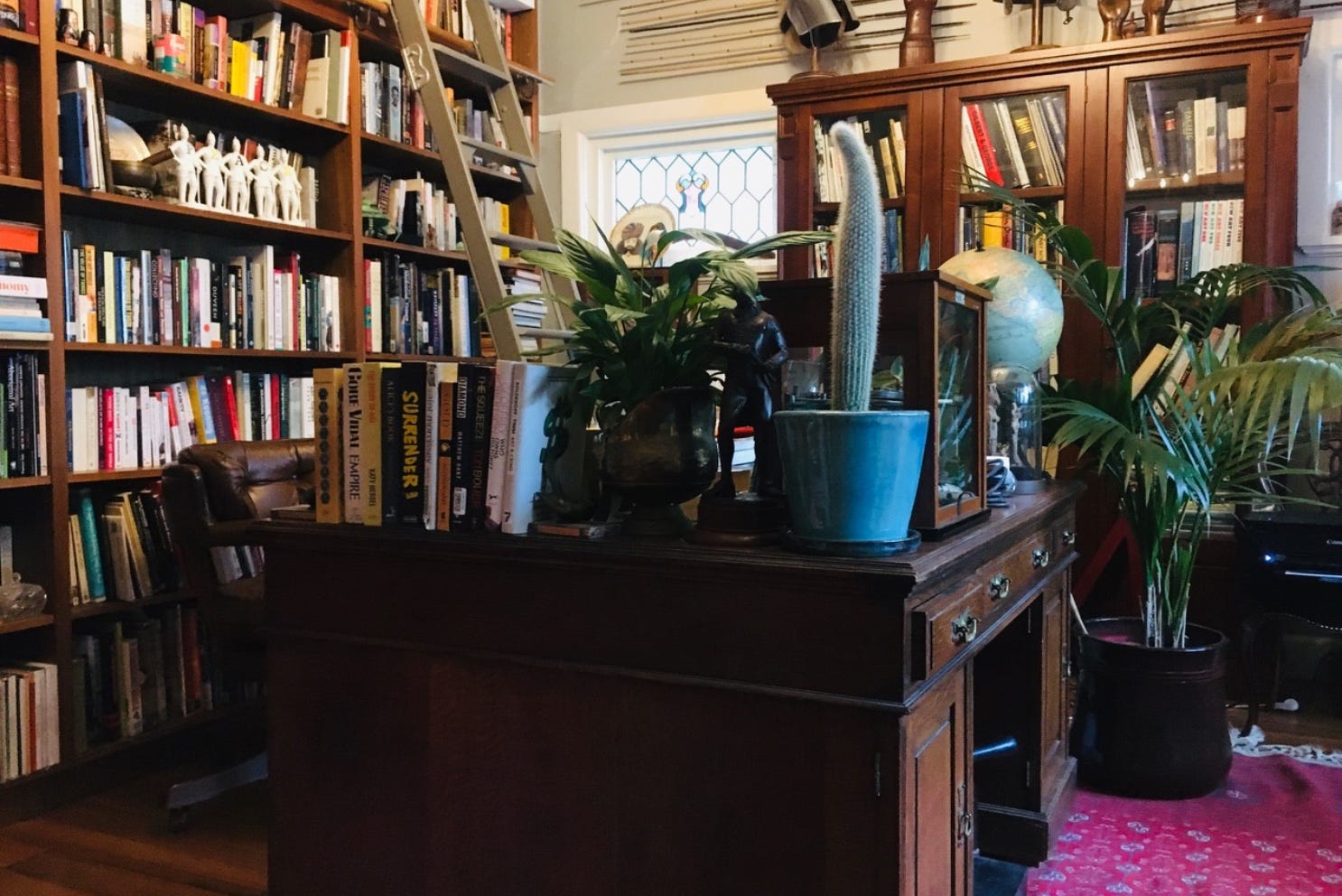
Yeah. Welcome to my study.
Those books? A fair number of them are the byproduct of research for my print and screen projects.
It goes a little something like this.
A producer calls and asks me to work on something.
First stop?
Bookfinder.com. My go-to for second-hand books. When I was doing my PhD, it was more economical and far more efficient to just order the obscure oddities I needed and have them delivered to my door than it was to comb the country’s libraries in the vain hope I’d find a copy.
It’s been the same since. I’ve written scripts for everything from a feature film for Australian car fanatics, to the culinary history of Turkey, all the way to Adolf Hitler’s sexual proclivities.
The result?
With two projects on the go, I’m expecting a deluge of parcels over the next week or two. But I’ve got a head-start, because a key biography for one project is fucking expensive as a second-hand book, but also available as a digital download.
So, my husband, Andrew Anastasios, and I have been reading it. Me on my laptop, taking notes in a word document as I go. Him on a kindle, writing notes with a pen, because he’s old-fashioned like that.
This part of the process is almost my favourite. The stories and characters start to seep into my brain and make themselves at home.
It’s different when I’m writing something that’s imaginary. The people who populate my non-fiction stories grow from seeds already planted in the grey matter and burst into life, fully formed.
Non-fiction means I need to get to know the people I’m writing about.
That’s not to say I won’t take them new places or edit their personalities to fit the narrative we decide to tell. But it’s important to at least start as close to the truth as possible, even if the intention is to pick it apart in the end.
Andrew and I start batting ideas around.
“Hey, this is brilliant, did you see that bit about the - - - - - -?” I shout out to Andrew, who’s working at the other end of the house.
“Yeah! Love it! We could use that to - - - - - - - -!”
“Perfect! And then we can - - - - - - - !”
Sorry about the self-censoring there.
But I can’t let anything slip about this, or you’ll find me in the professional equivalent of a 40-gallon drum somewhere.
As well as working out who the people are, what we’re doing is working out where the best bits of the story lie. That will help us decide where it should begin, and where it should end.
It’s less book-with-chapters than it is a soccer stadium filled with ramen noodles.
Try to follow one thread, and you’ll end up in a right-royal mess. Best to take some scissors and chop a bit out.
That’s where screen adaptations start putting people’s noses out of joint. Because it’s no easy thing fitting a historical narrative into 120 minutes at the local cineplex, allowing for promos, ads, and warnings to turn your phone off in the cinema and make sure you grab a choc-top and popcorn before the movie starts.
As writers, we ask you to do it all the time.
The payoff? When it works, you’re entertained. At best? We make you think.
It’s why you can’t hold us to the conventional storyline.
Apocalypse Now. The most iconic war movie of all time. Francis Ford Coppola used Belgian atrocities in the Congo as described in Joseph Conrad’s 1899 novella, Heart of Darkness, as the basis for his story of Captain Willard’s mission into Cambodia during the Vietnam War to assassinate Colonel Kurtz.
Then Quentin Tarantino completely flipped the timeline in his epic WWII movie, Inglourious Basterds, (spoiler alert) and sent Adolf Hitler to meet his maker. And by “maker” I mean the demons of hell.
And in his Academy Award-winning film, Braveheart, Mel Gibson took countless liberties with the life and times of the real 13th century Scottish knight, Sir William Wallace.
It’s not just timelines. Entire eras have been co-opted to create filmic narratives.
Star Wars is a take on the fall of the Roman Republic and the rise of the Empire.
The 2008 feature film, Outlander, uses Norway’s 8th century Viking Age as a setting for an alien arrival.
And James Cameron took the story of the Spanish colonization of the Americas and massacre of its Indigenous population as the inspiration for Avatar.
Comments
Nothing yet. Say the first thing.
Sign in to join the conversation.