
Why did no one tell me that Oxford offers a part-time master’s degree in practical ethics? Cambridge runs one in AI ethics and society. Edinburgh has two fully online MScs in philosophy, taught by the same faculty as the on-campus program.
One of the recurring frustrations I hear from readers, and one I definitely feel myself, is that serious humanities study is hard to fit into an adult life.
The MIT Philosophy Challenge is my answer to that on the self-directed side, but programs like the ones below are the credentialed answer: real degrees, taught by real faculty, structured for people who can only show up online and part-time. They’re a genuine route back into the humanities for anyone who left them behind for more practical endeavors but wants to circle back.
Stay tuned in the coming months for similar roundups on degrees in creative writing, history, English, and other humanities fields. This one’s first because philosophy is what I’ve been deepest in, and because the prestige landscape here is genuinely confusing… more on that in a moment.
One of the most important things I noticed while surveying for online philosophy credentials is that the brand on the diploma and the program behind the diploma are not always the same thing.
For example, the Harvard Extension School offers a certificate in philosophy and ethics which is a real credential issued by a real Harvard division. However, the diploma will read “Harvard University Extension School” or “Extension Studies,” which insiders recognize as distinct from the Graduate School of Arts and Sciences. There’s no admissions filter, meaning that you enroll, take courses, and get the certificate without having to apply. So in that sense, it’s a serious learning opportunity but a weak signaling credential. Whether that matters depend on what you want the credential for.
Oxford’s MSt in Practical Ethics, by contrast, is admissions-filtered, taught by the Uehiro Centre, and awarded as a master’s degree from the University of Oxford. The diploma reads the same as any other Oxford master’s. The program is hybrid, including six week-long residentials over two years, but the credential is unambiguously a full Oxford degree.
Both of these have “Harvard” or “Oxford” attached, but you can see how they’re not exactly the same.
So when you’re evaluating these programs, there are three questions worth asking:
Is the brand strong? Almost all of these have strong brands, so we can check yes on that one.
Is the program disciplinarily serious? Is it taught by the actual philosophy faculty, or by a continuing-education arm that licenses the university’s name? Does it have admissions standards? Does the diploma read the same as the on-campus version?
What do you want it for? A credential for personal enrichment, a credential for a career pivot into ethics consulting, and a credential to support a future PhD application are three different jobs. Some programs on this list do one of those well and another poorly.
A few quick notes on cost:
I’ve added a $ to rating next to each program below, based on the total cost of completion for international (non-UK) students. These ratings break down as:
$ - under $10,000
$$ - $10,000–$20,000
$$$ - $20,000–$30,000
- over $30,000.
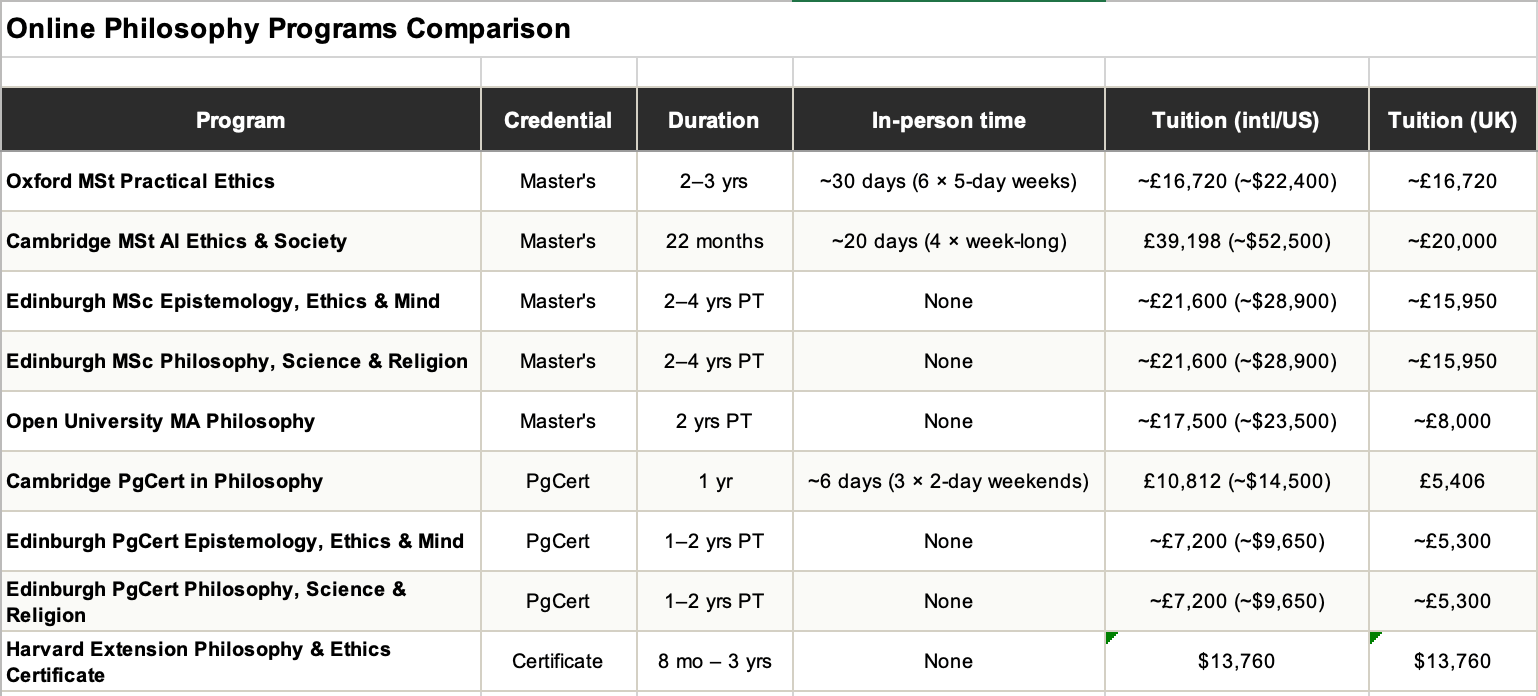
UK students pay substantially less than international students at almost every program here so if you’re UK-based, expect to land one tier lower than the rating suggests. Full tuition figures and a complete comparison are in the table at the bottom of this post.
If your employer offers any kind of educational benefit or professional development stipend, consider whether one of these might not be eligible!

I found four universities offering part-time master’s in philosophy that can be completed largely or entirely online.
Master’s degree · 2-3 years · 6 week-long residentials in person
Taught by the Uehiro Centre for Practical Ethics, which is the top-ranked applied ethics program in the world per the Philosophical Gourmet Report. The credential is a full Oxford master’s, indistinguishable on paper from any other MSt the university awards.
If you can make the residentials work, this is the strongest credential on the list. Applied ethics focus means it’s especially well-suited to people working in medicine, law, tech policy, or anywhere ethical questions might come up.
Master’s degree · 22 months · In-person residentials in Cambridge
Newer than the Oxford program and narrower in scope, this masters’ program is explicitly oriented toward AI ethics, governance, and the social dimensions of emerging technology rather than ethics broadly. Affiliated with the Faculty of Philosophy but with a more interdisciplinary, STS-flavored teaching team. The credential is a full Cambridge master’s.
If your interest is specifically in AI and you want a serious academic credential rather than a tech-industry certificate, this is an awesome and unique choice.
Master’s degree · 2–4 years part-time · No in-person requirements
Edinburgh’s philosophy department is ranked fourth in the UK per REF 2021 and in the global top 20, and the online program is taught by the same faculty as the on-campus MSc. The credential is identical to the on-campus version. Graduates have gone on to PhD programs at Princeton, Oxford, and other top departments, which is the strongest evidence I know of that an online master’s can be a real philosophy credential.
Master’s degree · 2–4 years part-time · No in-person requirements
Same standing and institutional backing as the MSc above. The difference is that the scope of this program is more specialized, with strengths specifically in philosophy of religion and philosophy of science. If those are your interests, the specialization is a feature, but otherwise, the Edinburgh MSc above probably makes more sense.
Master’s degree · 2 years part-time · No in-person requirements
The Open University is the UK’s largest distance-learning institution and has a genuine REF-rated philosophy department; the program has a 95% PTES student satisfaction score and is taken seriously by people who know UK higher education.
Unfortunately, I think OU outside the UK is associated with mass-market distance learning rather than research prestige. If credential signaling matters to you, this is the riskiest pick on the master’s tier, but if just the learning matters, then I see this as an excellent choice.

If a full master’s is more than you want to commit to, graduate certificates are the lower-stakes version of the same idea. Shorter, cheaper, and in some cases open-enrollment, but issued by the same universities and (in the best cases) taught by the same faculty.
Post-graduate certificate · 1 year part-time · Weekend visits to Cambridge
Sixty credits rather than a full master’s, but taught through Cambridge’s Institute of Continuing Education in coordination with the Faculty of Philosophy, awarded by the University of Cambridge, and listed on the Faculty’s postgraduate page. No Extension-Studies-style asterisk on the diploma.
The best option on this list for someone who wants a Cambridge credential without the twenty-two-month commitment of the MSt. The weekend residentials are the only major constraint to plan around.
Post-graduate certificate · 1-2 year part-time · No in-person requirements
Same faculty and teaching as the Edinburgh MSc of the same name, just a shorter exit point. If you start the PgCert and want to continue, the credits typically apply toward the full MSc.
A strong choice for fully online study with no residency requirement and an elite philosophy department behind it. The shorter format makes it a reasonable place to test whether part-time graduate philosophy fits your life before committing to the full master’s.
P.S. All of the above also applies to the PgCert in Philosophy, Science, and Religion!
Post-graduate certificate · 8 months - 3 years part-time · No in-person requirements
The Harvard Extension caveat from earlier applies here. This includes real Harvard courses and faculty but open enrollment and a disploma that reads “Extension Studies” rather than the Harvard Graduate School of Arts and Sciences (GSAS). If you want to start studying philosophy at a serious institution next month without writing a personal statement, this is probably your best bet.
Below is a full comparison at a glance. Tuition figures are approximate for the most recent published cycle (2025-26 or 2026-27), and international students should expect higher fees for most UK programs except Oxford’s MSt, which charges the same to all students. Cost figures don’t include travel and accommodation for residential programs, which can obviously add several thousand dollars to Oxford and Cambridge totals.
For a long time I assumed that going back to school to study philosophy seriously meant either dropping out of life for two years to enroll full-time or settling for self-study that nobody would ever credential. Putting this list together changed my mind. There are genuinely good options for adults who want to keep their jobs, keep their lives, and still get rigorous philosophical training from institutions that carry expertise.
If you’re trying to figure out which one fits you, the Edinburgh PgCert is probably the lowest-risk way to test whether part-time graduate philosophy is something you can sustain. Oxford and Cambridge are the strongest credentials if the residentials work for your life. Open University is the best learning-per-dollar option if you trust the program on its own terms.
I’ll be back in the coming months with the equivalent roundup for creative writing, history, and other humanities fields. If there’s a subject you’d particularly like me to dig into next, leave a comment! I’d love to know what people are looking for.
No posts
Comments
Nothing yet. Say the first thing.
Sign in to join the conversation.