
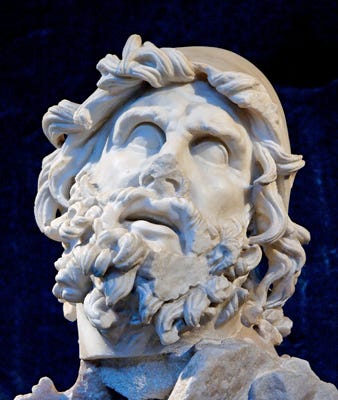
At a time when Hollywood is floundering—releasing countless remakes that no one wants, sabotaging once powerful franchises, while engaging in suicidal attacks on the fans—a successful director decides to bring one of the greatest stories of all time to the silver screen. You’d think that this would be just what filmdom needs. But, you would be wrong, dead wrong.
The poem (composed between 725–675 BC) tells the story of Odysseus, king of Ithaca, who wanders for ten years, trying to return home after the Trojan War (itself of ten years’ duration). Since the gods took sides in the war, he and his men are beset by many hardships along the way. On his return, he is recognized only by his faithful dog and a nurse. Enlisting the help of his son Telemachus, Odysseus destroys the insistent and boorish suitors of his faithful wife, Penelope, and several of her maids who had fraternized with the suitors, and reestablishes himself in his kingdom. The timeframe is around 1200 BC, in the late Bronze Age.
Alas, Christopher Nolan’s take on Homer’s Odyssey is likely doomed to not only fail, but will probably bring even more scorn on Hollywood. Apparently, Nolan has wanted to make this film for decades, but inexplicably became a fan of the recent “progressive” translation of the work, credited to Emily Wilson. Wilson is by no means the first woman to translate the Odyssey, but she is credited as the first to put it into poetic form. There was a prose translation in 1952 by Barbara Leonie Picard, and women had previously translated the work into languages other than English.
Wilson’s real claim to fame is that she is “making visible the cracks in the patriarchal fantasy,” rather than “honoring it.” (Her own words.) Thus, the battle lines are clearly drawn. On one side is 3000 years of tradition, and on the other is the camp of those who would pervert the Odyssey, to make it suitable for so-called “modern audiences.” Never mind that the original work contains several strong female characters, including Athena, Calypso, Circe, and of course Penelope, Odysseus’ faithful, strong, smart, and long-suffering wife.
Classicist Richard Whitaker offers a blistering criticism of Wilson’s translation. Here are some key points:
The two great novelties of Wilson’s Odyssey are the way she represents a group of characters that we might term ‘underdogs’ – notably the Cyclops, and the suitors and their allies – in a sympathetic light, while representing Odysseus as, on balance, reprehensible. The big problem, however, with Wilson’s heterodox approach to the characters of the Odyssey is that she can sustain it only by distorting and misrepresenting what the Greek text says.
Evidently, in Wilson’s fantasy world, “Polyphemus the Cyclops is a sort of prelapsarian pastoralist, more sinned against – by a devious, violent, proto-colonizing Odysseus – than sinning.” And Wilson writes that the “suitors ‘behaved badly’ where the relevant line of the poem talks of men who ‘[i]n their criminal folly … perpetrated a monstrous wrong’.”
Whitaker cites numerous mistranslations of the Greek, especially as Wilson uses “slave” to translate a host of very different Greek words. And when this convention gets her into trouble, as it does concerning the herald Peisenor, she just abandons it, then calling him a “competent official.”
With dozens of Odyssey translations extant (I like Robert Fagles’), it strains credibility that someone familiar with the poem could stomach Wilson’s misguided effort.
Turning to what we know about the movie—to be released in July—we must consider the stunt casting. Although, the term “stunt casting” has surely lost meaning in the light of the new Academy Award inclusion standards.
How about Lupita Nyong’o as Helen of Troy AND her sister Clytemnestra. Not only does Nolan give us flagrant race-swapping, but he also ups the ante by having the most beautiful woman in the world played by an actress who hardly qualifies for that description. Online commentators have referred to her as “Helen of Detroit.”
Rapper Travis Scott is set to play a bard (possibly Demodocus), presumably because the oral tradition of Homer is just like rap, or something. Clueless defenders of these casting choices will no doubt point to Black Athena: The Afroasiatic Roots of Classical Civilization, the widely discredited book by Martin Bernal.
And, then there’s Eliot Page, rumored to be playing Achilles, the greatest Greek warrior of all time, visited in the underworld by Odysseus.
With absolutely unbeatable source material, and a budget reported to be $250 million, Nolan had the opportunity to make a billion dollar film, yet he chose to bury it in DEI, while coveting awards and adulation by his peers. On the positive side, the Odyssey will be introduced (such as it is) to a new audience, and the story is just so good that it might not be undone by its telling.
Nonetheless, the cultural vandalism is undeniable.
No posts
Comments
Nothing yet. Say the first thing.
Sign in to join the conversation.