
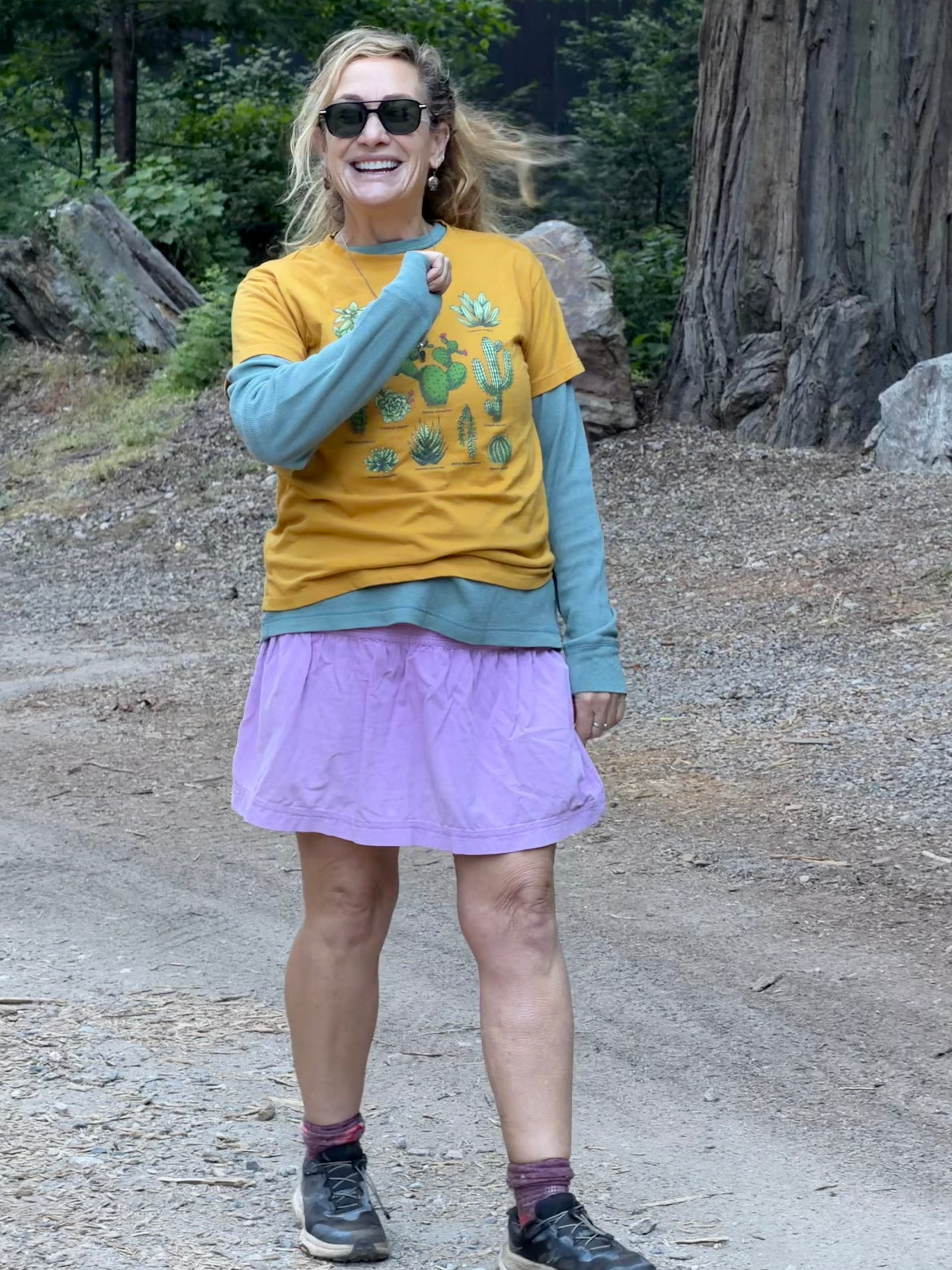
I love working artists. I admire them with a devotion that lands somewhere between obsession and worship.
But I have a confession.
Until this past week, I don’t think I’ve ever shown up daily for a personal art practice.
Yes, I’ve completed The Artist’s Way, with the required 252 morning pages in a row. But I’ve always stopped when the 12-week session ended.
I was accountable to a practice, but one that belonged to a book, not to me.
And each time I’ve been contracted to write a magazine article, book or screenplay, I’ve written every morning to advance it in a timely manner. But that wasn’t about practice. It was about meeting deadlines.
As a worker, I’ve been disciplined, and I’ve created habits that got the projects done. But discipline, habit, and practice are not the same thing.
For most of my adult life, I’ve organized my creative life around work. I raised four children while teaching full time. There was always coursework to prepare, classes to teach, field trips to organize, speech and debate tournaments, Boy Scout expeditions, calendars to keep. I built a yoga practice, a yoga community, yoga teacher training programs. I served on committees, mentored students, created holiday magic for my growing family.
But it’s taken me all the way until now to really ask myself: What is an art practice?
Rick Rubin suggests that creativity is less about making things than about learning to perceive. An artist’s greatest tool isn’t talent. It’s the ability to notice what other people walk past.
Twyla Tharp says that inspiration is unreliable, but ritual isn’t. We don’t wait for creativity to arrive; we create the conditions in which it is more likely to find us.
Natalie Goldberg describes writing practice as a way of training the mind. When we return to the page every day, we begin to trust our own attention.
I think all three are pointing toward the same mystery.
An art practice isn’t only something you do to make art. It’s a way of training your attention so that when life offers you something astonishing, you are awake enough to receive it.
A practice is doing something much stranger than producing art. It is producing us.
In this first cohort of The Secret Garden, I’m learning to play guitar. Where I come from, the guitar was an evil instrument, one hippies played to subvert authority. I haven’t consciously considered this in the decades since, but I suspect that message got inside of me. I suspect it has influenced my hands, which have never reached for one.
Until now.
And now I’m thinking about how many messages we absorb in the microcultures of our families and early communities that still determine what we believe we are allowed to touch, claim, make, or become.
A practice does not only expose what we are learning. It exposes what we were taught not to claim.
I was a guest teacher in a memoir course last week, for a teacher I absolutely adore. And during the Q&A, I mentioned that right now, I preorder and purchase books by living women writers. I still read men, but I am more likely to get their books used or from the library. The audience was made up almost entirely of older women, and I wanted them to know that someone would invest in their stories.
A man in the class got angry and wrote in the chat that I’m offensive. Then he looked me up online and sent me a hateful email. Apparently, he heard a woman say she was choosing to invest in other women, and his response was to criticize this publicly and pursue her beyond the classroom to make his point further.
This, too, is part of the training women receive: Speak publicly, and someone may decide you need to be punished for it. Choose women, and someone may demand that you justify the choice.
I didn’t respond to him, but I’ve been thinking since about the many instances when readers of color have told me they can’t buy my book because they are focusing their attention and dollars on writers from a particular community, whether Indigenous, Black, Pacific Islander, or a plethora of others whose stories have been systematically excluded. Every single time, I have applauded them for recognizing how much we need to hear diverse voices and supporting the writers telling them.
I have read thousands of stories by men. I do not owe anyone an inventory of those books before I say that, right now, I am choosing to buy books by women.
I was raised reading only the Bible. In my twenties, I continued to privilege the voices of men because they were presented to me as authorities, and the canon was full of them. In college, entire courses could pass without reading one woman. The canon was not neutral. It trained my attention.
When I was growing up, men in the religious cult in which I was raised physically, sexually, and psychologically abused me and took away my ability to trust myself or to use my voice publicly. I did not begin to reclaim that trust or use my voice publicly until I was nearly fifty. I know I am not alone in this. Many women are afraid to tell their stories because they know that women’s speech is often answered with contempt, threat, or punishment.
We have to support one another. We have to invest in women who are finding their voices for the first time and make it harder for fear to silence them.
What’s surprised me so far about learning to play chords isn’t that my fingers hurt or that I’m not particularly good at this. I expected both of those things. It’s that I’ve started to think about who feels they have the right to claim their voices and perform their stories.
I personally don’t know any women who are singer-songwriters, and I don’t know a woman who plays guitar. Yet this, too, is a way of carrying our stories into public and sharing them with our communities.
Practicing the guitar is changing the way I inhabit the world.
Claiming a practice widens the aperture. It reminds me that it takes time to recognize, resist, and eventually reprogram the messages we were handed. It takes repetition to grow into a larger version of ourselves.
Young coyotes engage in play bows, chase games, and mock hunting that refine communication and coordination before they join the hunt. Many young songbirds don’t arrive knowing their species’ song; they listen, improvise, and practice until the song becomes their own.
Ecology reminds me how living systems work. Repeated behaviors enlarge capacity. They make an organism more capable, not merely more productive.
Practice changes the organism. It changes what the organism can perceive. It changes what it can reach for. It can make the once-forbidden feel possible.
Maybe we don’t return to the page, the guitar, the trail, or the story because today’s session will produce something remarkable.
Maybe we return because attention is a muscle. Because showing up is a rep, and repetition reshapes perception.
For those of you in the Secret Garden, you’ve just completed your first week of daily practice.
What has surprised you about returning each day? Did your relationship to the practice change, even if the work itself didn’t?
What is the practice beginning to make possible in you?
Please respond in the comments below. And if this resonates with you, please re-stack or text it to a friend.
VIRTUL COMMUNITY - Am I feeding the life I say I want?
It’s not too late to join us!
The Secret Garden Series is an 8 week exploration of your chosen art practice, held within the container of community. The series opens with a storytelling workshop and continues through the summer with monthly workshops and weekly prompts.
Wander in and out of this garden, as little or as much as you like.
Workshops are offered on the following Saturdays from 1:00-2:00 PT
June 27 - The Art of Storytelling
July 25 - Art as a Daily Practice
Aug 29 - The Art of Mindfulness
Included (free) with your annual paid subscription
All recordings will be sent to paid subscribers.
Step into a whole year of experiences.
Yoga at the Maloof – Fridays at 10 a.m. Yoga on Tap at Claremont Craft Ales – 2nd & 4th Sundays, 11:30 a.m. Crestline Hot Yoga - Tuesdays at 9:00 a.m.
Summer retreats are sold out. Registration for our Full Moon Retreat, October 22-26 is available now for paid subscribers.
I’m a writer, teacher, and lifelong forager. Raised in an apocalyptic cult in the mountains of California, I learned to survive off the land and listen for what lives beneath the surface.
My memoir, Forager: Field Notes on Surviving a Family Cult (Golden Poppy finalist), tells the story of how I left everyone and everything I believed in, and why.
Through this newsletter, classes, retreats and workshops, I help people build creative lives rooted in attention, embodiment, and a relationship with the natural world.
Comments
Nothing yet. Say the first thing.
Sign in to join the conversation.