
I have a habit of answering “How are you?” honestly.
I picked that up, I think, from the Dutch—or was it the Germans?—who, I heard, will answer the commonplace, rhetorical question with an unflinching:
“NOT GOOD.”
That factoid was funny to me, and I shared it whenever the topic of curious European behaviors came up. But it’s since migrated from my anecdotes into my behavior. Now, even though people aren’t usually seeking the truth, I just give them mine.
So, on Saturday, at our first McGolrick Bird Club since early summer, reunited with folks I hadn’t seen in a while, I got a chance to say:
Text within this block will maintain its original spacing when published
“I'm not good.”
“I'm not great.”
"How am I? Awful."
People’s reactions are usually some combination of surprise, concern, and amusement. But one woman gave me a serious look and said:
“Thank you. I’ve been having a hard time, and I don’t know how to share that with people.”
I’m not suggesting my social moves are solid. It’s just that, after a personally excruciating summer, in the middle of what the journalist—and my lovely neighbor—Anya Kamanetz calls the polycrisis (or, even better, the omnishambles), and at the precipice of a seasonal turn, I want to keep thinking about change.
Jenny Odell winds down her seminal book How to Do Nothing with the subject of “Manifest Dismantling.” As in: the opposite of Manifest Destiny.
Undamming rivers so salmon runs return. Unearthing buried creeks. Undoing the overstepping of Industrial Revolution and Urban Renewal development. Rewilding, many call it.
I love every example of dismantling and the hopefulness they inspire. I want to undam every river, untarmac every parking lot, pulverize every concrete slab, and bomb every data center… with native plant seeds, G-men! Relax!
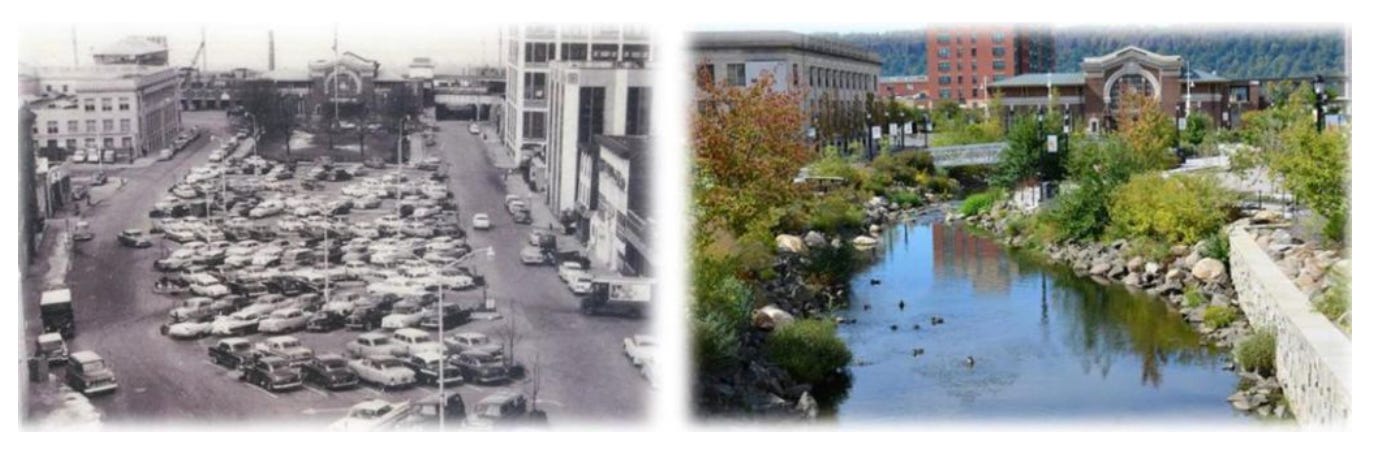
This got me thinking about the occasionally necessary work of dismantling other things. Like, what about our inner selves? I mean, if we’re ever NOT GOOD, if we’re SUCKING, maybe it’s useful to notice:
Text within this block will maintain its original spacing when published
What did we push out of sight in the name of progress?
What dreams have we paved over?
What rivers in us are dammed?
What did we abandon because it no longer seemed useful?
What’s left to be released, and what will return if we unblock it?
While I was unearthing this okay metaphor—and trying to do some of my own related work in the field and in therapy—a podcast I like featured a member of Alcoholics Anonymous. I’m a few years sober and have never been to a meeting or worked any program. But I do, from afar, admire AA’s track record of transforming lives.
My ears perked up when the guest called “giving yourself permission to acknowledge that you’re not feeling good and that you need help” the most powerful prerequisite.
My European affectation suddenly feeling pretty wise.
Alstublieft.
What is NOT GOOD right now? Notice it.
Notice it like a German or a Dutchwoman.
Notice it like a brave Yonkersonian.
Buy a shovel.

But first—
UPDATES & ANNOUNCEMENTS
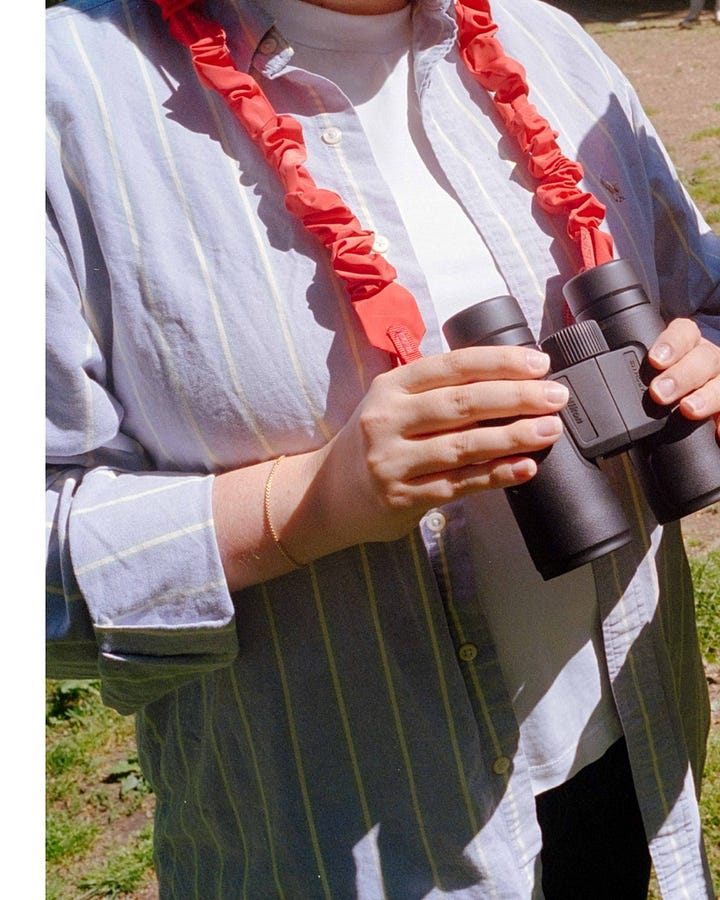
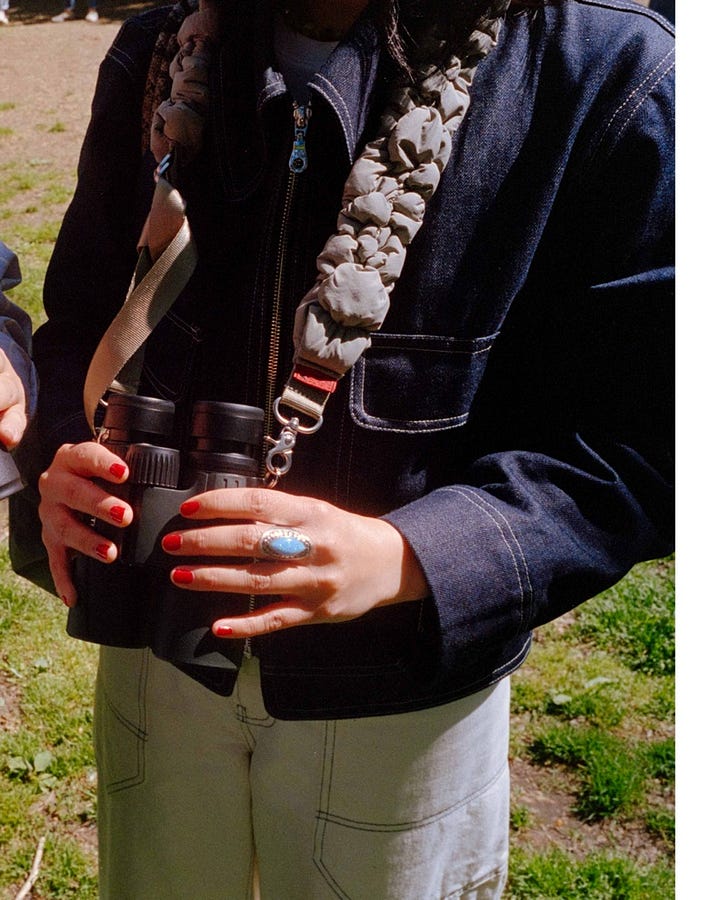
Binocular straps aren’t typically the most inspired of accessories.
Leave it to a couple of aesthetically intelligent bird clubbers, Carolyn and Tammy, to rig sweet Topologie straps to their tools.
Voilà. Shit looks pretty cool:
Next Sunday, August 23rd, we’ll visit SoHo, bird some unexpected spots, and hang out with new friends at Topologie’s Prince Street shop.
Come. Expect birds. Expect refreshments. Expect free stuff.
30 spots. Sign up below.
Members get first dibs via the below—hidden to freebirds—link.
If we don’t fill up, I’ll share it with the rest of you.
MICROSEASON: Signs of Autumn (Aug 10–16)
This week in New York:
1. Check your nearest milkweed.
Milkweed isn’t flowering right now. Its leaves are wide, upright, and a little fiddle-leaf-figgy. Look closely and you’ll probably find one of these guys:
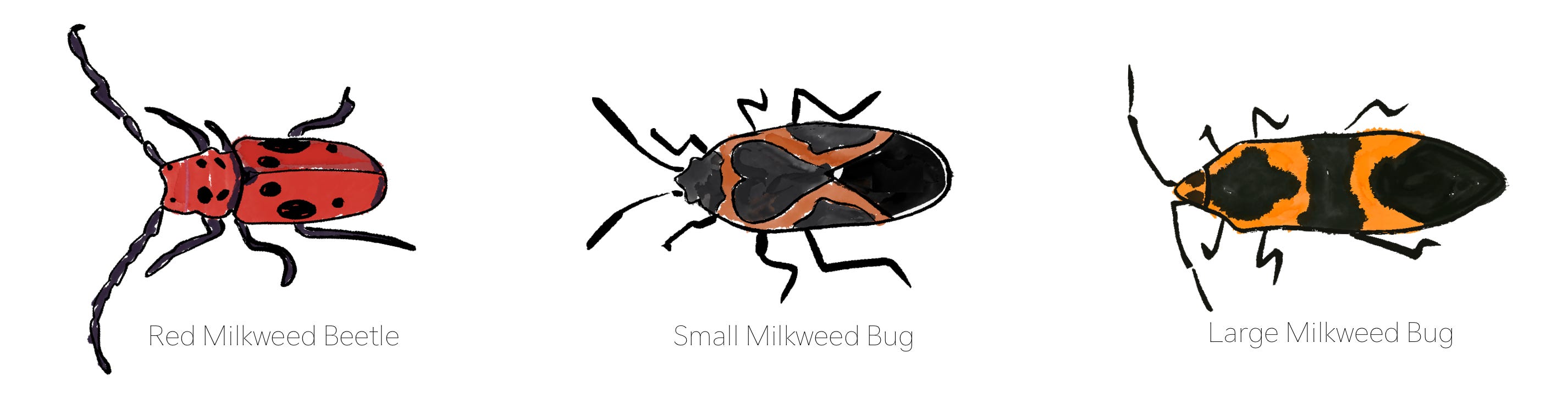
You may also find tiny yellow Oleander Aphids. They’re invasive and gross. More about them here.
2.) The second edition of my Microseasons Calendar is here.
3.) Spend some time examining recent birds by location. Find McGolrick Park’s recent bird sightings here. Do the same for Prospect Park here. Far-flung reader? Go to eBird.org:
Explore → Explore Hotspots → Search for a park near you → View Details → Bird List.
The bigger the park, the better.
BIRD TYPE: NONBREEDING WARBLERS I
It’s getting too cold here. NOT GOOD. I better change.
That change is the improbable, thousands-of-miles journey known as fall migration. And for many warblers, it means changing more than location.
The bright breeding plumages we learned in spring are fading into quieter looks called nonbreeding plumage.
Sometimes the change is subtle. Sometimes the bird looks completely different. And sometimes it doesn’t change at all.
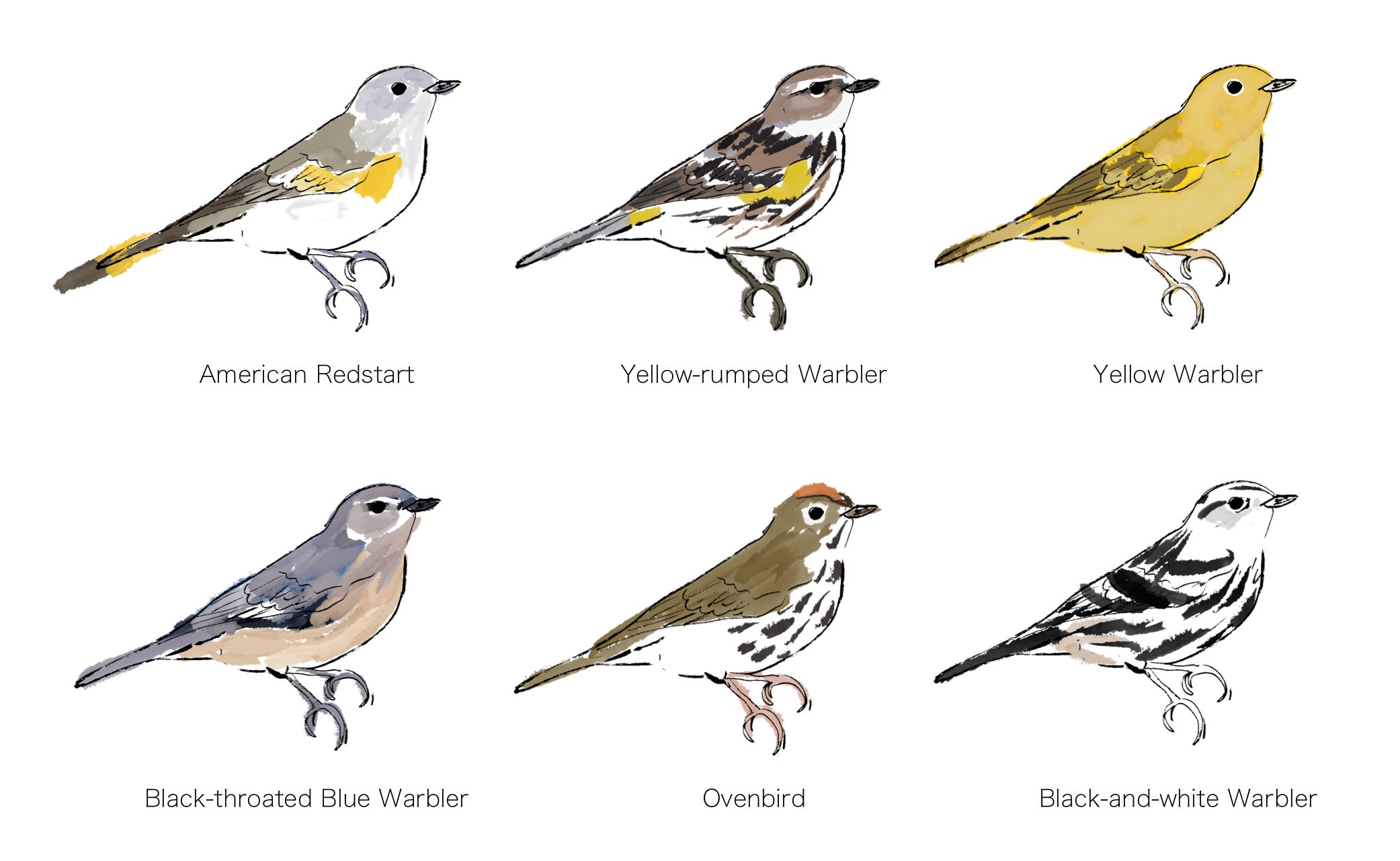
Below, we’ll meet six warblers arriving in North Brooklyn now or soon, and get a preview of the types of fit changes that make fall warblers so sweet—and so tricky—to learn.
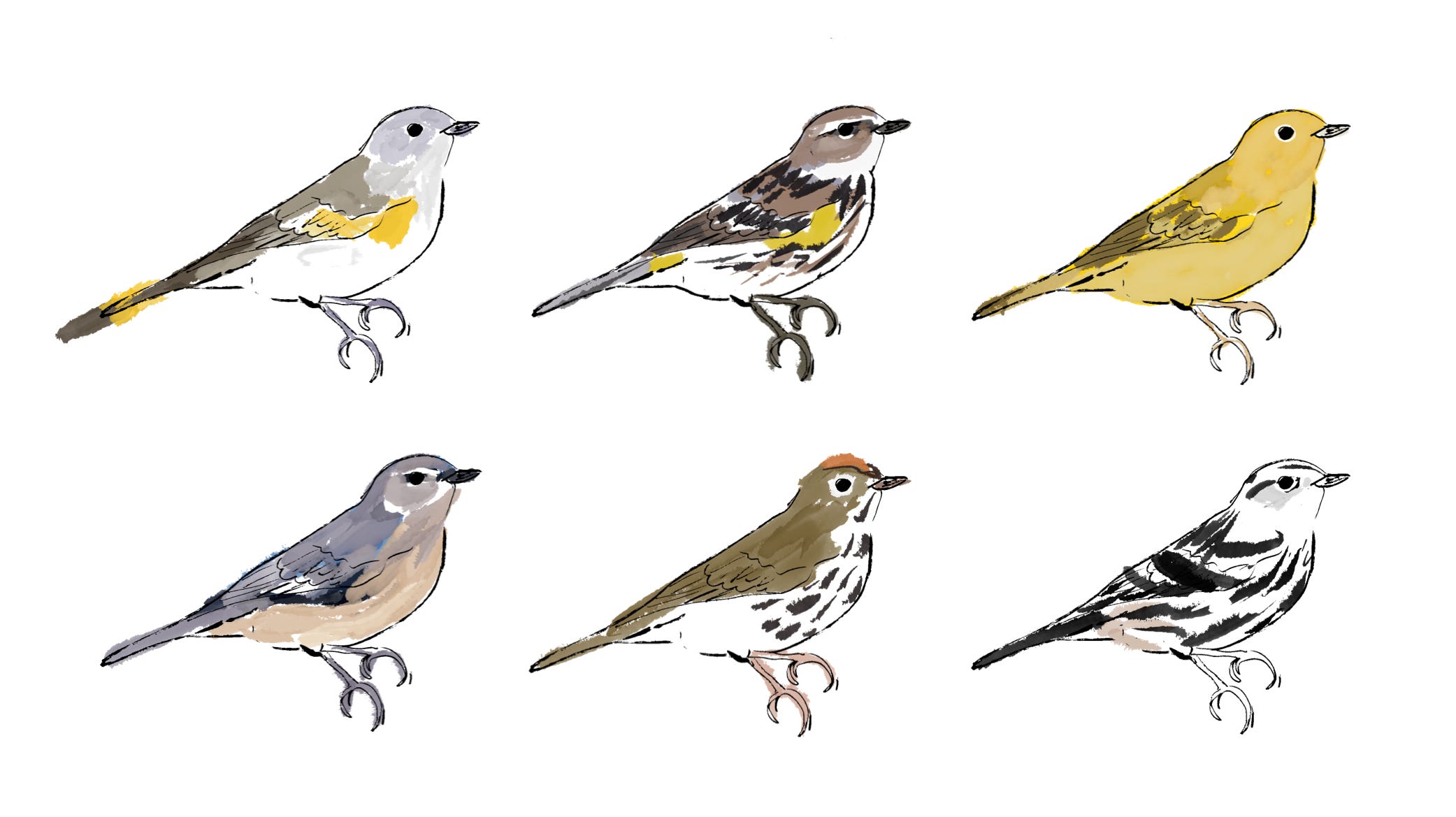
NO CHANGE. About eight of the 35 warbler species we’ve studied don’t change plumage at all.
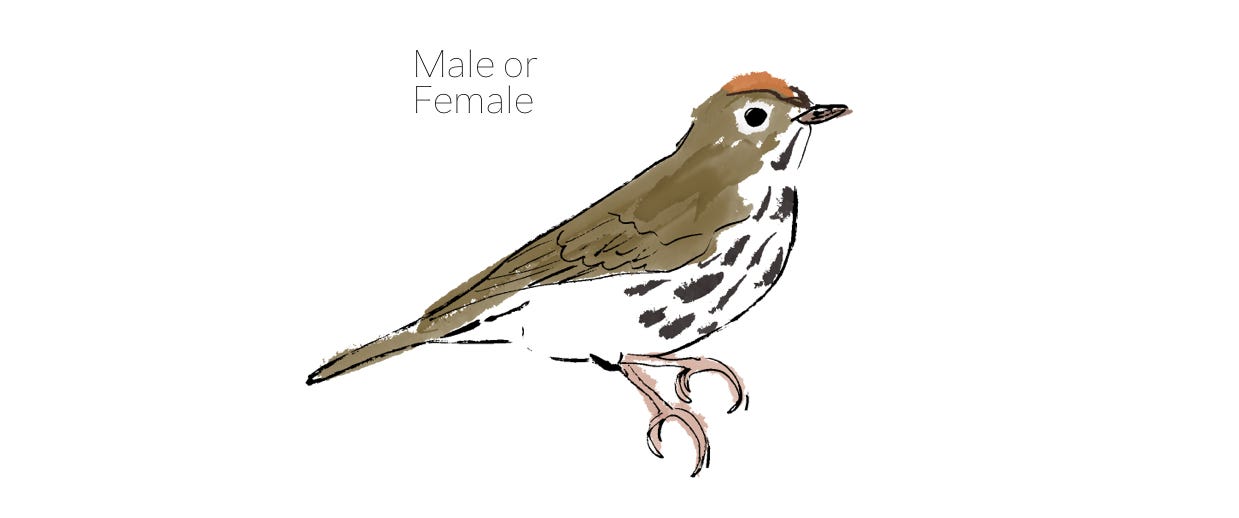
The Ovenbird still looks like an Ovenbird: brown-olive, orange mohawk, thick white eye-ring, striped front.
And it’s still mostly on the ground, doing its signature chicken walk.
A LITTLE CHANGE. Most warblers change just a little.
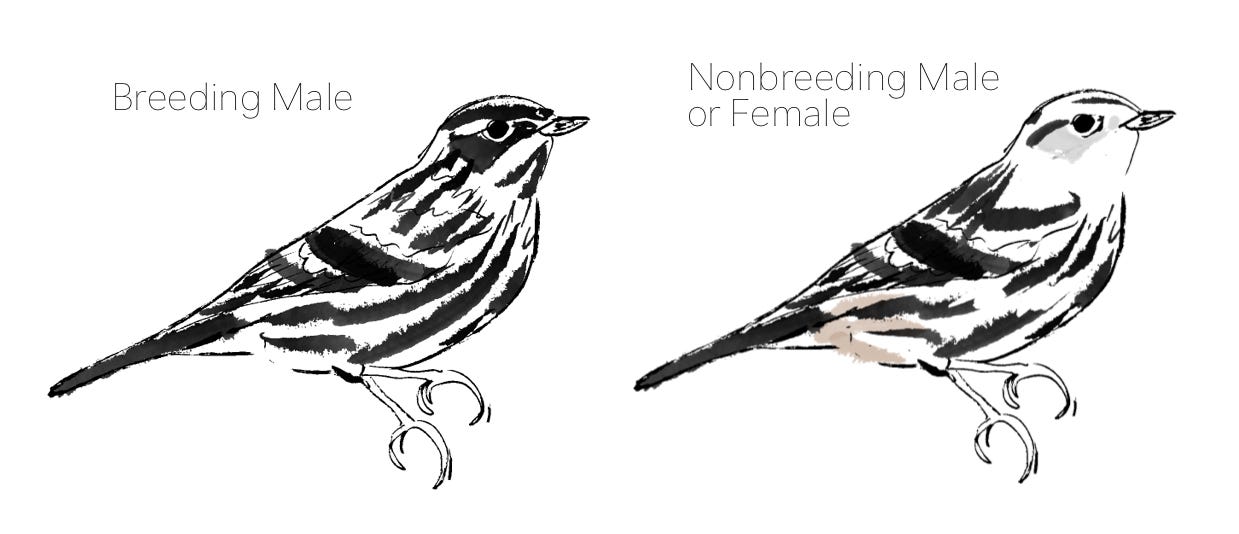
The Black-and-white loses some of its crisp head striping and may get a little buffy at the rear.
Otherwise, same bird.
You’re still looking for that zebra-striped little creeper shimmying along branches and trunks.
A LOT OF CHANGE. A handful of warblers change dramatically. The American Redstart is one of them.
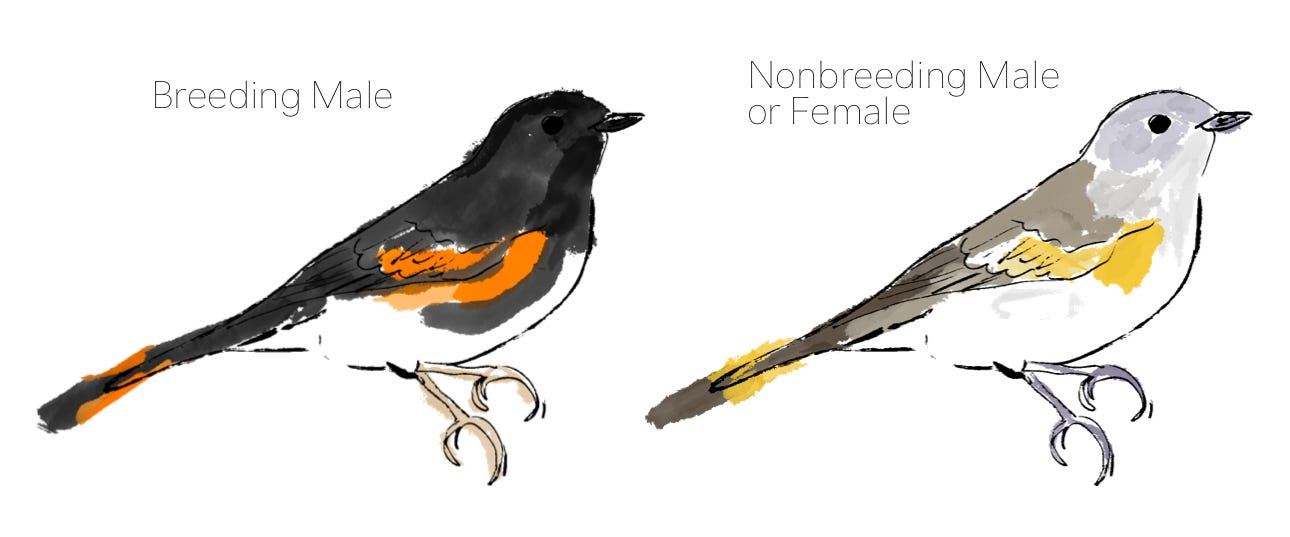
Black becomes gray. Neon orange becomes yellow.
But the shape and behavior remain familiar: look for the long tail, often fanned, and those bright flashes of color in the wings and tail.
A LITTLE DULLER. The Yellow-rumped, like many warblers, just loses some of its drama.
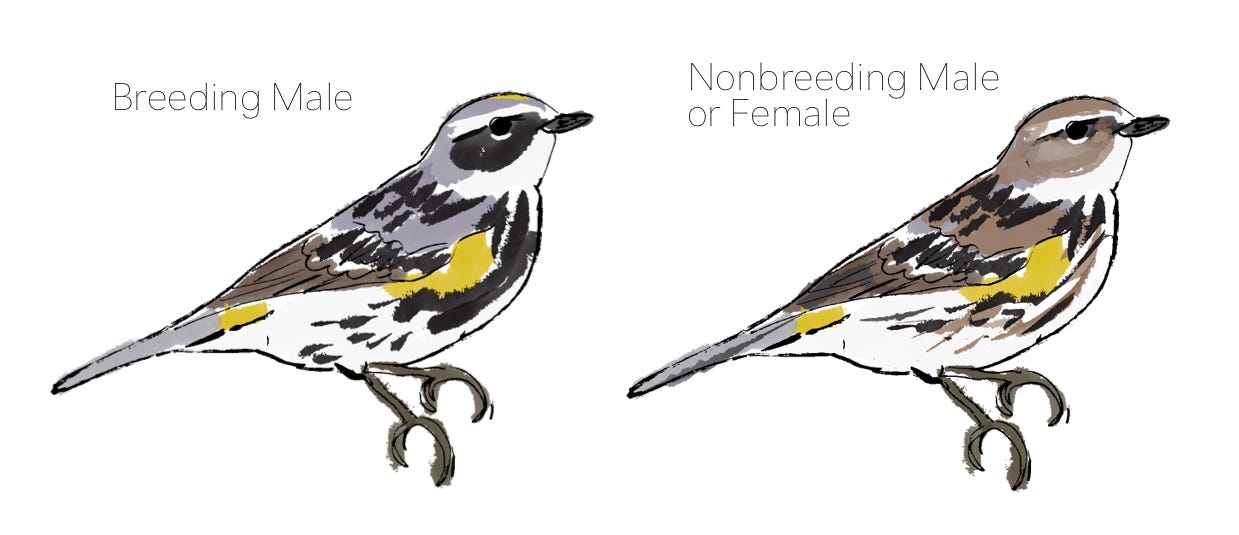
The black mask and breast markings fade. Everything gets a little grayer.
Look for yellow flashes under the wings and, of course, the yellow rump.
A LITTLE DULLER. The bright yellow of spring becomes softer, and the reddish chest streaks disappear.
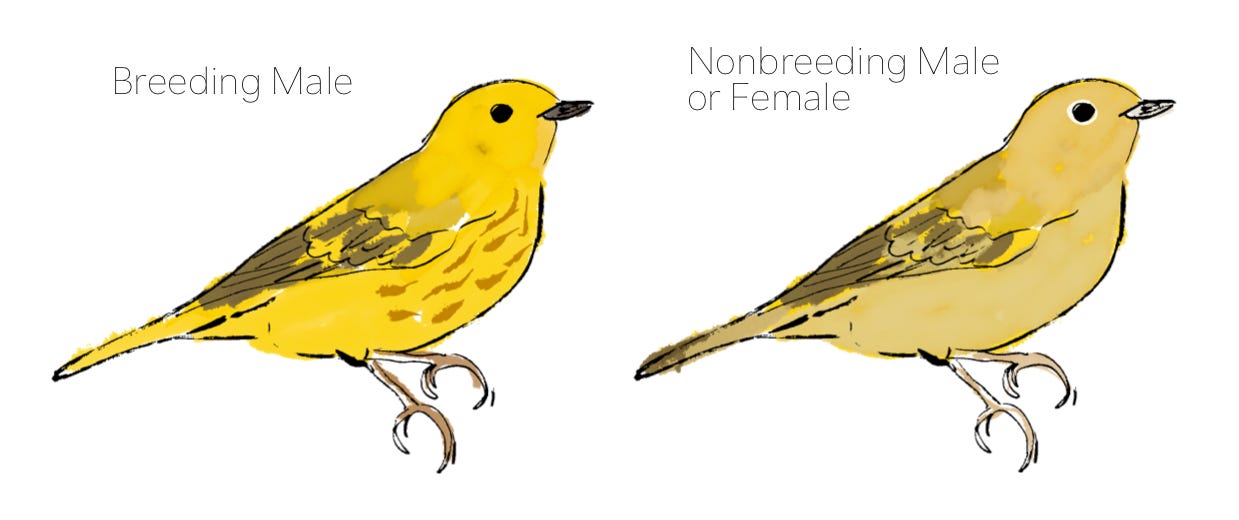
But this is still one of the easiest warblers to recognize: look for a little bird that is basically yellow from beak to tail.
A LOT OF CHANGE. The blue fades into a warm gray-blue. The black throat disappears.
But one thing survives: the white pocket square.
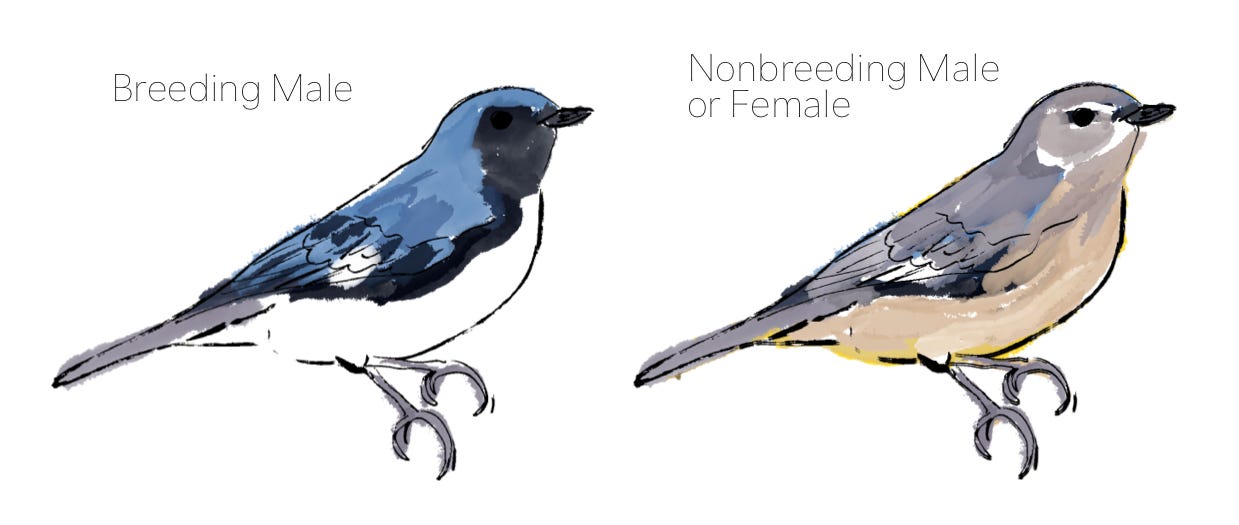
Look for a pale brow and cheek and, crucially, that little white patch on the wing of an otherwise grayish bird.
If you’re new to birds, don’t worry about memorizing any of this. The point is to develop a glancing familiarity. Over time, you’ll see them enough that knowing becomes felt.
It’s like learning a new, very manageable language.
Want more warblers? Check out this weird warbler lesson, that includes the Ovenbird and two others every human must know.
Or go revisit the whole Warblers thing. It includes pretty much all the warblers found in the United States, with that pretty much getting explained at the end.
Want to find a warbler in real life?
Go slow.
Consider as many trees, bushes, and patches of earth as you can.
By “consider,” I mean place your visual attention, wide open and highly sensitive to movement, on everything. Then pat it all down like a concert security guard.
Listen deeply to every sound. Follow the ones that feel anomalous. This time of year, warblers are mostly making short chips.
Put your binoculars up and rule out sparrows (mostly House Sparrows) and finches (mostly House Finches).
Keep looking.
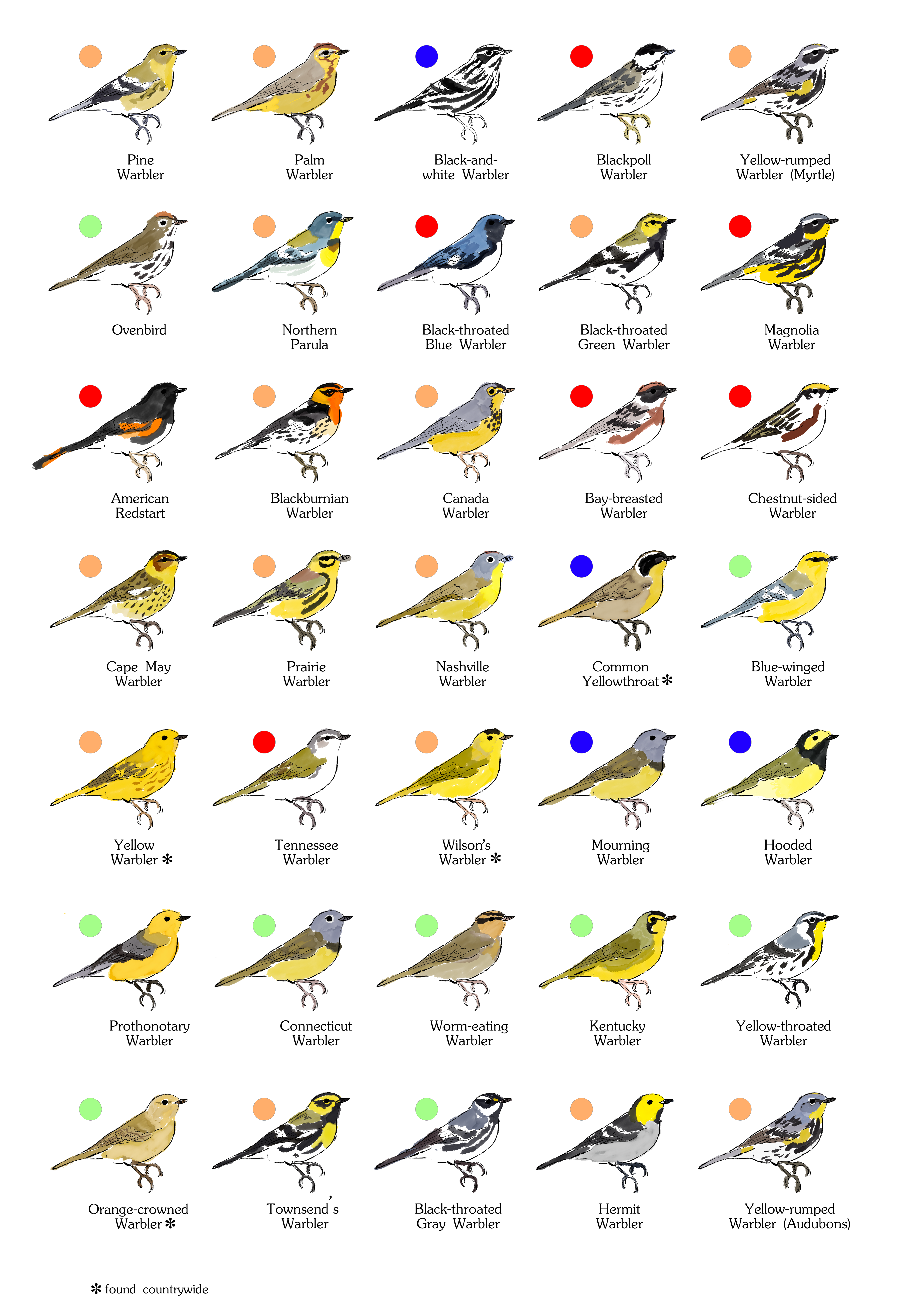
BONUS: THE WARBLER CHANGE-O-METER
I made the below visual for all you nascent Warbler Sickos.
The colored dots show how much each species changes between breeding and nonbreeding plumage:
Text within this block will maintain its original spacing when published
🟢 Green: no change
🟠 Orange: mostly loses some brightness
🔵 Blue: loses a salient feature, usually a mask
🔴 Red: looks like a totally different bird
⋆˙⟡ ⋆.˚ ⊹₊⟡ ⋆⋆THANK YOU .ೃ࿔.𖥔 ݁ ˖*:・༄
Recent bird lessons:
Doves · Terns · Herons · Swifts & Swallows · Waxwings · Hummingbirds · Buntings · Cuckoos · Tanagers · Vireos · Towhees · Finches · Phoebes · Jays · Grebes · Loons · Scoters · Swans · Woodpeckers
And here’s a handful of short essays:
See you next microseason.
Comments
Nothing yet. Say the first thing.
Sign in to join the conversation.