
I’m writing from Mexico City, in an enchanting — if over-touristed and expat-swollen — neighborhood where I’ve spent the last 48 hours, I suppose, being part of the problem.
(Also: gobbling carne asada, wandering, and meeting new birds.)
Leaving the United States for the Fourth has become an accidental tradition. I never plan it, but I never mind when it happens. I came of age when waving the American flag started to feel cheap — when patriotism was conscripted into lies, the Patriot Act, and embarrassments like Freedom Fries. It was the wake of 9/11, when a brief, beautiful New York togetherness curdled into what Chris Rock called hatriotism.

But I believe in America.
Not in the mindless flag-waving, the tribal reflex, the endless sorting of life into Us and Them. Not in the insistence that we’re the good guys, by default. That reflex is ancient. It helped us survive once: fear the outsider, defend the tribe, stay alive.
But now?
In a world where we increasingly encounter one another, othering feels less like principle than displaced grievance. Wounded egos and frustration as victimhood, all disguised as morality.
The whole thing is ugly. Useless. Us-versus-them thinking is embarrassing.
And I’m not above it. I have my teams too. My people. My enemies, real and imagined, especially those who benefit by amplifying the sides themselves. The shameless and the liars and the people who profit from keeping us apart.
Still, I believe in America.
I mean the real one: a place where differences collide and cohere into something stranger and stronger. Hybrid vigor. Hybrid vigor. Not a city on a hill, maybe, but a thousand Jane Jacobs streets — sidewalk ballets of friction, improvisation, neighborliness, and oddity.
That place still exists. On sidewalks, in parks, in corner stores. Sometimes even online, buried beneath the sludge.
Remember the panic over immigrants eating cats and park geese? Pure sludge. … Or, you know what? Maybe not. Maybe someone did eat a fucking cat.
Fine. Talk to them. Tell them that’s not how we get down here. Move on.
Because I’m supposed to be writing about birds, I can’t resist the metaphor: imagine a hawk deciding doves don’t belong in trees. A sparrow calling gulls evil. An egret denouncing the painted bunting as impure.
Absurd.
And that’s not to say the dove in the tree shouldn’t try to know her hawk neighbors. I’ll admit, I still flinch walking through South Williamsburg, where a large Hasidic community can feel like a nation unto itself. But unfamiliarity isn’t danger. It’s just unfamiliarity.
In Against the Machine, one of the most eye-opening and queasy-making books I’ve read this year, writer Paul Kingsnorth argues that the Culture War isn’t the disease. It’s a symptom.
The real issue is the Machine: the technological and economic system enclosing modern life, severing us from place, nature, spirit, and each other. The culture war is often just the froth on the machinery.
Screens, my go-to enemy, certainly inflame things. Especially their recent love affairs with economies of attention and bite-sized videos featuring one-sided outrage. But the deeper issue is a kind of spiritual confusion.
Secure cultures, Kingsnorth notes — like the Hadza, who I wrote about a few weeks back — don’t talk about identity. That fixation belongs to civilizations that are missing something. Left and right are fighting over the same unspoken absence.
We don’t know what we are.
Kingsnorth’s remedy to the Machine isn’t conquest. It’s retreat into the local, the small-scale, humility. Disobedience, even. And, yes, love.
It reminds me of one of the original Americans, Benjamin Franklin. “The soul has many motions,” Ben wrote. “Many gods come and go. Know that you are responsible to the gods inside you and to the men in whom the gods are manifest.”
Franklin understood that virtue is not ideological, but interior. That the best parts of us are forever competing with the worst. He recommended 13 virtues: temperance, silence, order, resolution, frugality, industry, sincerity, justice, moderation, cleanliness, tranquility, chastity, humility. (Read more here.)
Not identity. (Not ego.)
Character.
I’d wave a flag for all that.
“It is not easy,” writes Maria Popova, the Bulgarian-born essayist now American National Treasure, reflecting on Franklin, “living with those constant visitations from conflicting gods, each with a different dictate.” What makes it bearable, she says, is recognizing that these warring fragments are part of something greater — a vast, coherent universe that makes the smallness of the self feel almost laughable.
She’s describing nature. Which is to say: all of us.
Birds do not care for sides. And when we pay attention to them — to birds, to weather, to the old rhythms still humming beneath the noise — we recover something older than politics.
Something prior to identity.
Something holy.
The land still holds promise.
And so, maybe, do we.
HOW TO LEARN THE COMMON BIRDS OF ANY PLACE
Here in Mexico, I recognize a few species whose ranges include some of my own old patches in California. The native finches and wrens. The improbable Vermillion Flycatcher.
But there are plenty of new faces too.
I studied up a bit before coming, on the plane, using the trick below. If you’re ever traveling away from home, or if you’re just new to birds in your area, you should do this too.
Here’s how:
Open the Merlin app (download it here). Then—
1.) Tap Explore.
2.) Tap the Filters icon in the top-right corner.
3.) Under FILTER BY, tap Likely Birds.
4.) Under SORT BY, tap Most Likely.
5.) Then, under FOR, enter your location and date. That should end up looking something like this:
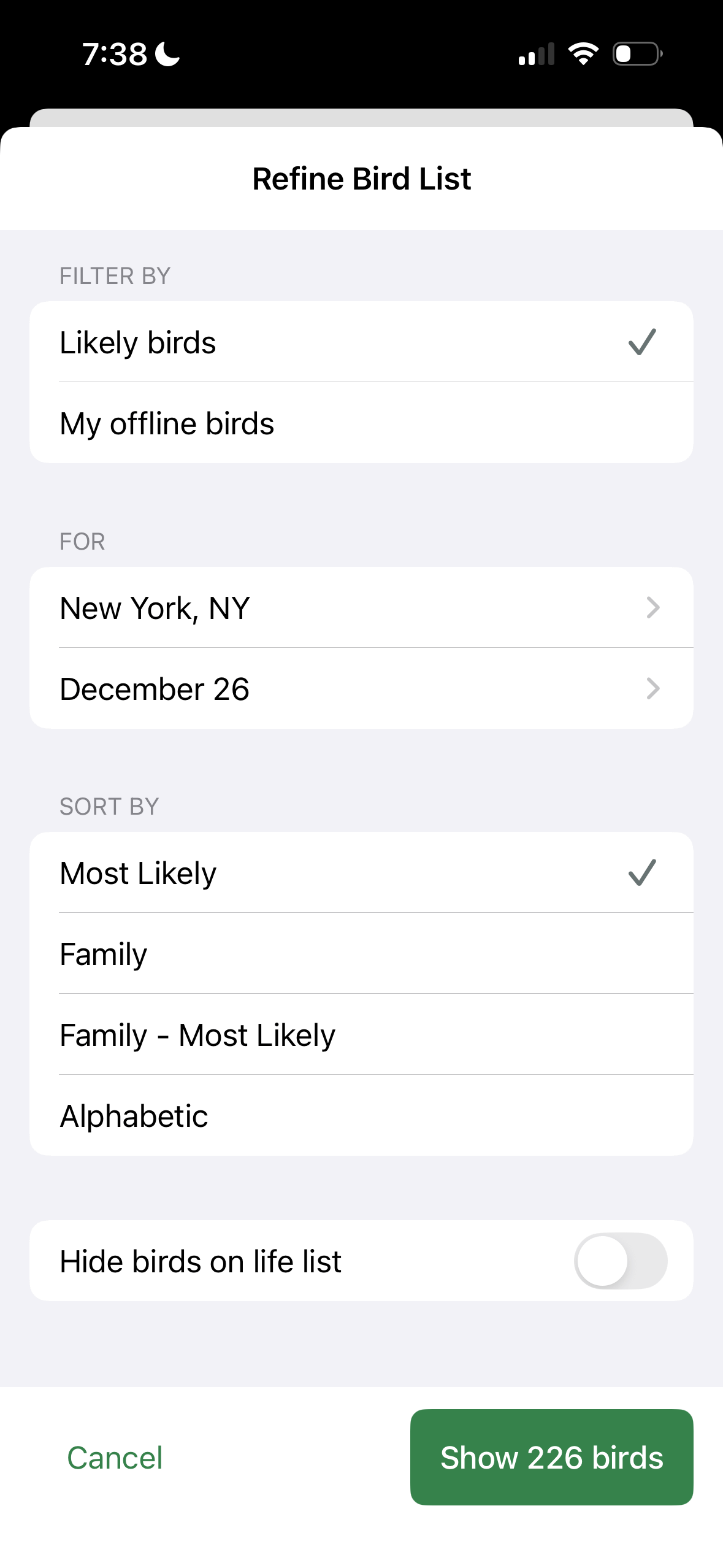
6.) Click Show <n> birds, the green button at the bottom-right.
7.) Now you’re holding a list of the birds found in that place, at that time, ordered from most common to least. It should look something like this:
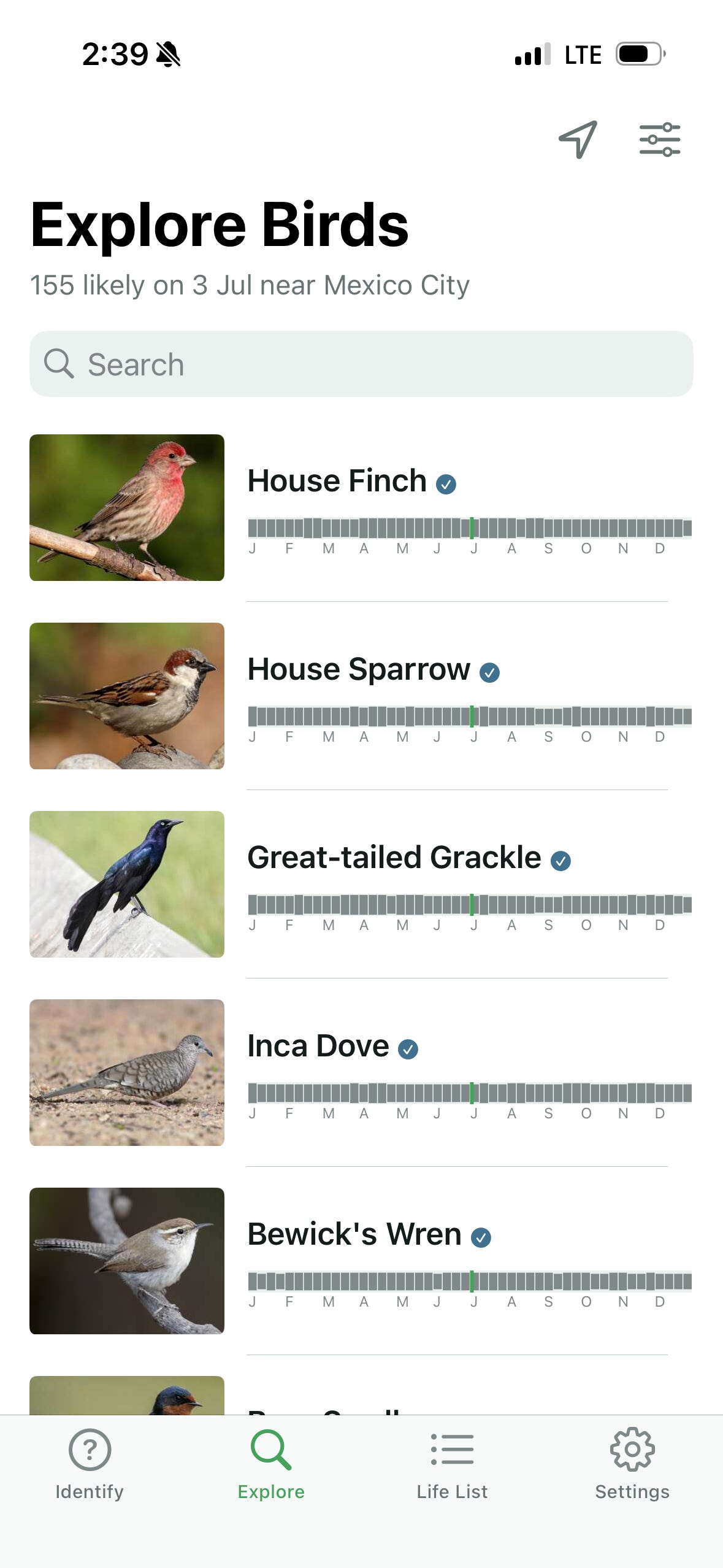
8.) Browse the list. Try to commit at least the top six birds to memory. Notice who else speaks to you.
Bonus: you can see where birds were recently reported near you using eBird. Follow the instructions here.
RECAP & REVIEW
Our guide to Terns dropped last week. Herons, the week before.
I recently saluted a nationwide bounty of outstanding Summer Birds.
The best meditation on life on the wing (feat. swifts and swallows and Taoism) is here.
Here’s where you learn hummingbirds and commit, once and for all, to your weirdness.
UPDATES & ANNOUNCEMENTS
1.) NEXT SATURDAY I’m hosting our first July Field Trip.
That’s the 11th, at one of Brooklyn’s best summer birding spots.
All 20 spots are currently claimed, but life happens. Scroll to the end of the newsletter and hop on the waitlist. (Waitlisters will get first dibs on the next outing.)
There will be more small gatherings. Subscribe so you don’t miss them.
2.) Even fewer Together Tees remain.
Grab one here. Be a vibe. Support the mission(s).
Prices are reduced even further because you all are sleeping on this one.
(Members get an extra discount. Check the bottom of the newsletter for your code.)

BIRD TYPE: DOVES
The species is all over Mexico City, and found up into the southern United States. Got me thinking about the six must-know doves in the United States.
Here they are:
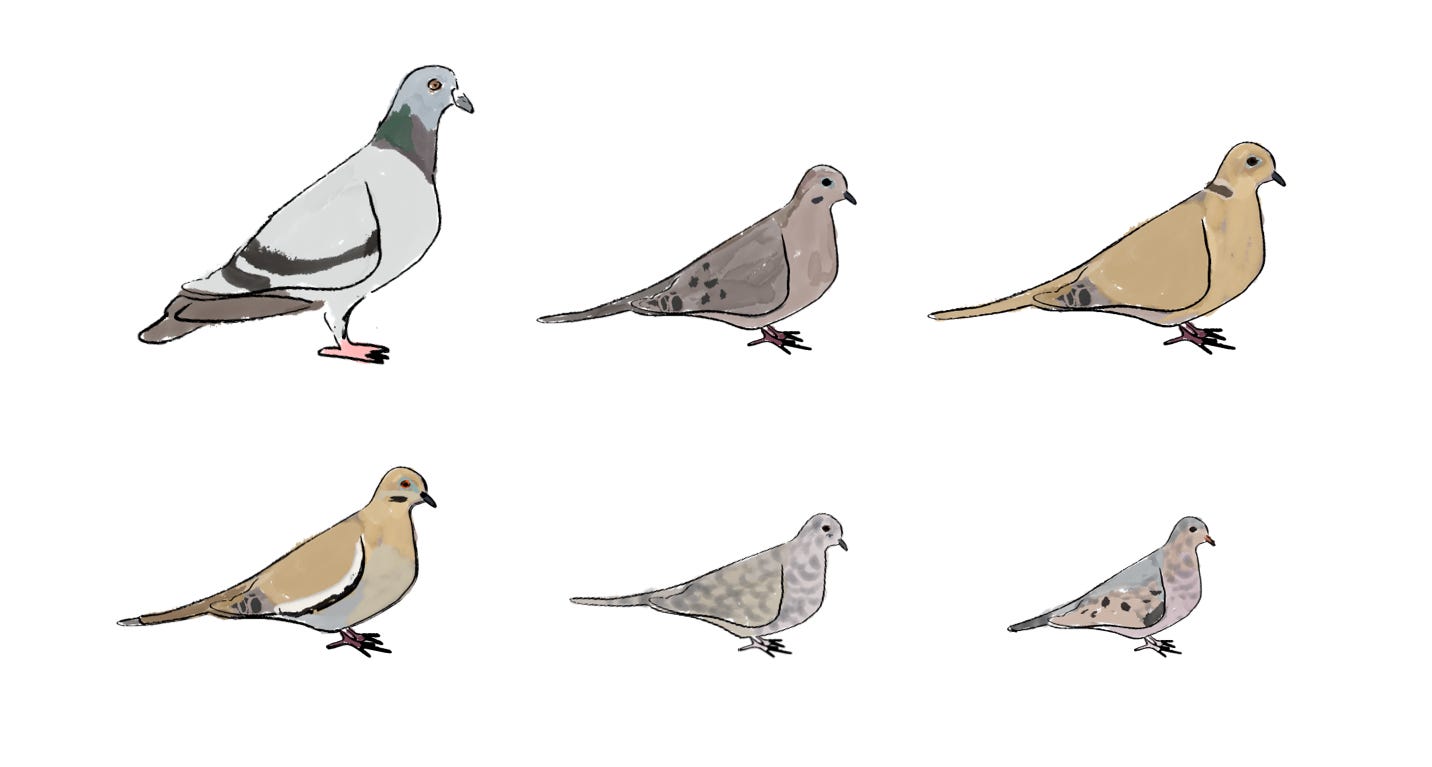
Doves and pigeons belong to the same scientific family (Columbidae), comprising over 300 species worldwide. (These highly adaptable birds are found on every continent except Antarctica!)
Ready?
The Icon.
Introduced to North America from Europe in the early 1600s, for food, pigeons are smart, misunderstood, and only considered dirty because we are.
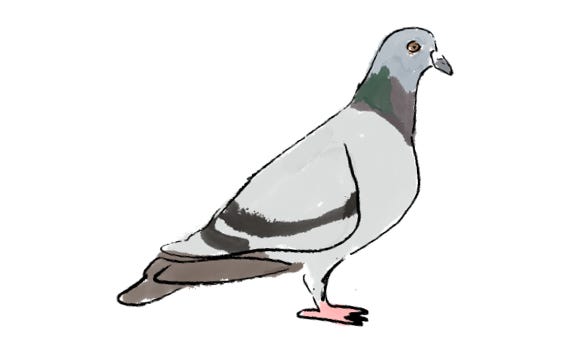
While “dove” typically refers to smaller, slender species and “pigeon” to larger ones, the distinction is casual. Pigeons were actually called rock doves until fairly recently. I miss the retired, in my opinion more affectionate moniker.
In addition to the typical gray bird with two dark wingbars, you'll often see flocks with plain, spotted, pale, or rusty-red birds in them. Why? Humans. Variable plumage is primarily the result of centuries of selective breeding. Rock pigeons descend from captive and domesticated birds, so various artificial color and pattern mutations mix and emerge freely in urban gene pools.
“Pigeons can find their way home, even if released from a distant location blindfolded. They can navigate by sensing the earth’s magnetic fields, and perhaps also by using sound and smell. They can also use cues based on the position of the sun.” — All About Birds
It’s for this reason that humans have used pigeons as messengers for more than 3,000 years. The earliest recorded use dates back to 1350 B.C.E. in ancient Egypt, where they carried agricultural reports and military dispatches.
SHOUTOUT Chaunté Vaughn, our magnificent neighbor friend bird clubber who has done wonderful portraiture work among the New York area’s pigeon fanciers. Check that work here. Don’t miss “Laird the Pouter.”
The other icon. (Range map)
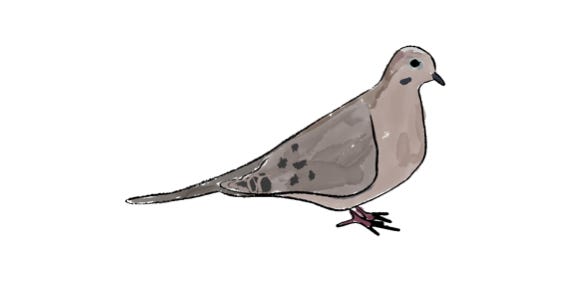
I want you to be able to clock this omnipresent bird in flight. Look for fast fliers with, mostly, long pointed tails and angled, pointed wings. Like this. (Pardon the source. Yes, they’re hunted. The most common game bird in North America, in fact.)
Sweet and mournful call is perhaps the most noticeable birdsong in North America.
When taking off, their wings make a sharp whistling or whinnying.
Collared and common. (Just absent the Northeast; Range Map)
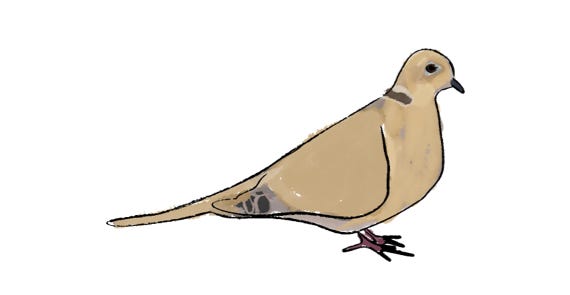
Handsome, namesake collar
A few were introduced to the Bahamas in the 1970s. They made their way to Florida by the 1980s and then rapidly colonized much of the US (but not the Northeast) and Mexico.
Southern, white-winged one. (Range map)
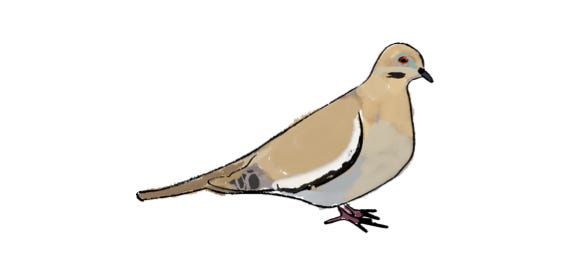
Another Southwest/South dove with a slightly bigger range than the Inca that is also expanding
Telltale white wing edge
“Take a closer look and you’ll see a remarkably colorful face, with bright-orange eyes and blue “eye shadow.” — All About Birds
Small. Southern. Scaly. (Range map)
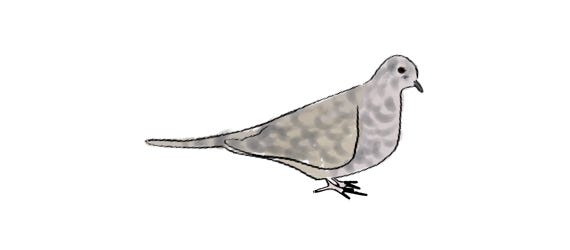
“No hope” call.
Mourning, “no hope” … lighten up, doves!
Pinkish underwings flash beautifully when birds depart and alight.
They like human settlements and are reportedly expanding north.
“The eyes of an Inca Dove may give away what it is feeling. Inca Doves have red eyes, but their red eyes become even brighter when they are threatened by an intruder.” — All About Birds
Small, southern, pinkish. (Range map)
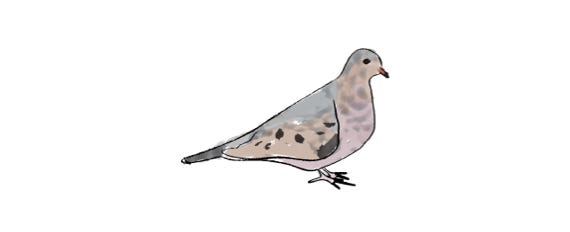
Mourning dove spots and kinda scaly necks, but Sparrow-sized
“It’s estimated that a Common Ground Dove has to eat more than 2,500 seeds every day to meet its energetic demands. It can store hundreds of seeds in its two-lobed crop, an enlarged pocket of the esophagus.” — All About Birds
BONUS
Ruddy Ground Dove — Really a Mexican Dove, but since 1975 ruddies heave occurred in eight U.S. states, and are now annual visitors to Arizona.
Spotted Dove — Native to Asia. Introduced to the Hawaiian Islands, Southern California, Australia, and other sites around the world.
White-tipped Dove — In the United States, occur only in southernmost Texas, in the lower Rio Grande Valley.
Fruit Doves — colourful, frugivorous doves found in Southeast Asia and Oceania. Good to know how beautiful this bird type can get.
Passenger Pigeon — Extinct since 1914, this once-abundant North American pigeon was so prevalent that they accounted for 30 to 40 percent of the breeding bird populations here.
The bird was a short-distance migrant that was possible to watch flock overhead in a sky-blackening mass that took three days to pass and that may have contained upward of one billion birds.
So, uh, Americans hunted them into oblivion.
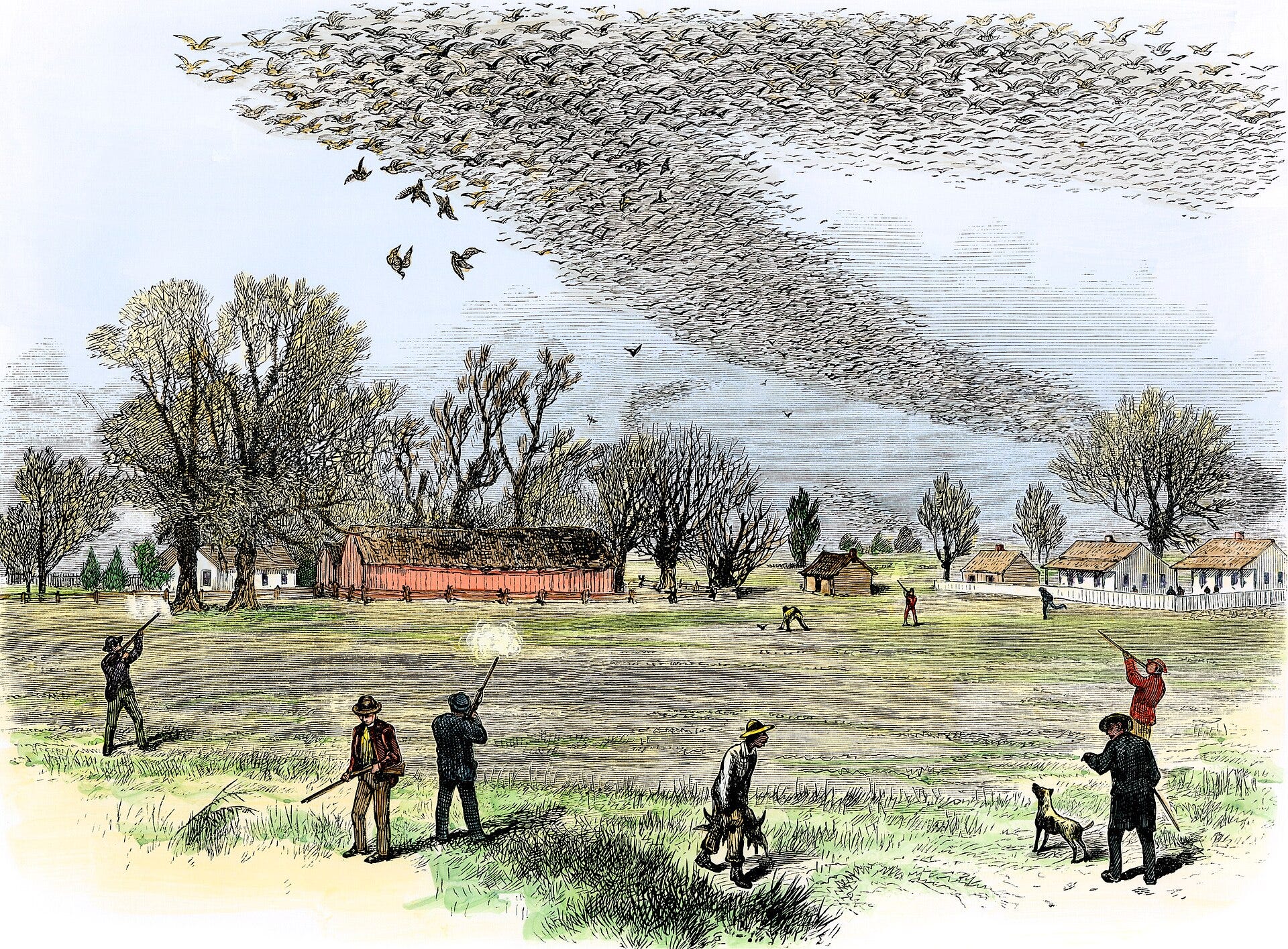
No descriptions of the great flight of passenger pigeons, and the slaughter they inspired, are more riveting than none other than John Audubon’s own. He described one frenzied bird massacre like this:
Every thing was ready, and all eyes were gazing on the clear sky, which appeared in glimpses amidst the tall trees. Suddenly there burst forth a general cry of “Here they come!” The noise which they made, though yet distant, reminded me of a hard gale at sea, passing through the rigging of a close-reefed vessel.
As the birds arrived and passed over me, I felt a current of air that surprised me. Thousands were soon knocked down by the pole-men. The birds continued to pour in. The fires were lighted [to asphyxiate them], and a magnificent, as well as wonderful and almost terrifying, sight presented itself.
The Pigeons, arriving by thousands, alighted everywhere, one above another, until solid masses as large as hogsheads were formed on the branches all round. Here and there the perches gave way under the weight with a crash, and, falling to the ground, destroyed hundreds of the birds beneath, forcing down the dense groups with which every stick was loaded.
It was a scene of uproar and confusion. I found it quite useless to speak, or even to shout to those persons who were nearest to me. Even the reports of the guns were seldom heard, and I was made aware of the firing only by seeing the shooters reloading.
Holy f*cking sh*t.
Cleanse your mental palette with the six-must know, still alive, doves:
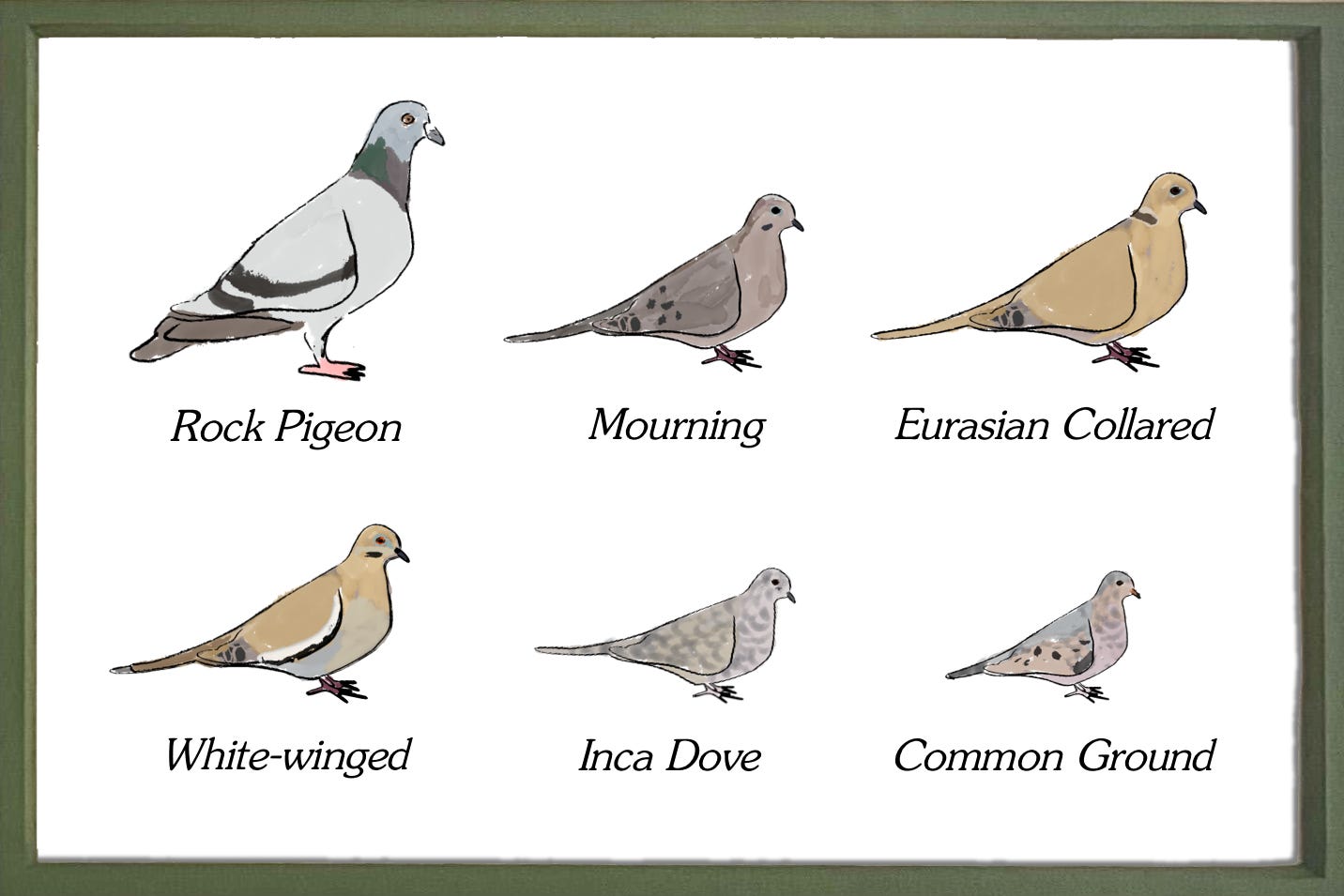
Then go notice one.
MICROSEASON: JUNE 29 – JULY 5
And here’s the full list of birds logged in McGolrick Park:
Summerers: Baltimore Oriole · Barn Swallow (flyover) · Chimney Swift (flyover) · Gray Catbird · Great Crested Flycatcher · Laughing Gull (flyover) · Red-eyed Vireo
Birds of prey: American Kestrel · Red-tailed Hawk
Woodpeckers: Downy Woodpecker
Year-round New Yorkers: American Crow · Blue Jay · Double-crested Cormorant (flyover) · Herring Gull (flyover) · Northern Cardinal · Northern Mockingbird · Ring-billed Gull (flyover)
Lingering Winterers: White-throated Sparrow
Virtually always present in urban parks: American Robin · Common Grackle · European Starling · House Sparrow · Mourning Dove · Rock Pigeon
BONUS:
You might compare the short list above to this heftier one for Prospect Park. Water and habitat size matter a lot to bird numbers.
MEMBERS’ CIRCLE STUFF
Comments
Nothing yet. Say the first thing.
Sign in to join the conversation.