
I wonder - sometimes I think I might know, but I don’t, I just wonder - what it is that makes driving fast so important to the people of America. To people in general.
There is a legend in my family that back in the early days of the automobile, a distant uncle named Fred bought a car and, with his wife, departed on a nationwide driving tour which would take them much of the rest of their lives.
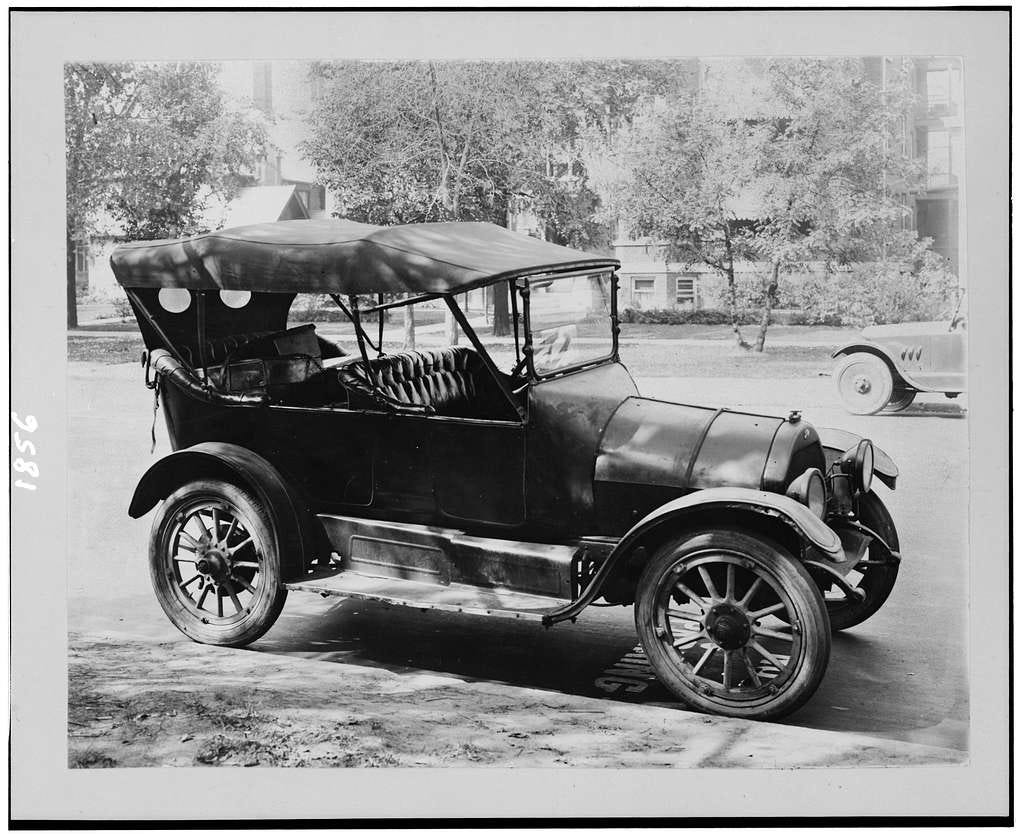
In those days fuel stations weren’t on every street corner, nor were most roads paved. The US highway system, an organized nationwide numbered system built by states and local governments, a system initially planned in 1926 and still in use today, mostly didn’t yet exist during Fred’s years on the road.
Fred drove. His wife, whose name I never learned, observed. Every time Fred got above 25 miles per hour she would raise her voice and say, “Where’s the fire, Fred?” and he would slow back down.
Fast forward to 1988. Scientist James Hansen spoke before the United States Senate, outlining and explaining the looming catastrophe of global warming and the specific process by which increasing atmospheric CO2 directly added energy in the form of heat to the atmosphere and thereby to the entire global system, land, water, and air. He further explained how burning fossil fuels directly resulted in adding CO2 to the atmosphere. Unfortunately, he neglected to point out the logarithmic link between surface speed and fossil fuel burned. Not that it would have made any difference.
Thirty years later I began writing about that link. Writing about how the faster we go, the faster we burn ever increasing amounts of fuel. Writing about how drivers slowing down any amount would immediately reduce global fossil fuel use, to the logical outcome that we could actually survive by slowing all the way to walking speeds and eliminating all the energy we spent doing something we had done for a quarter of a million years without it.
I think it appropriate at this point to acknowledge that I have no credentials. I have no formal education beyond literacy and numeracy, as represented by a 1965 issue high school diploma from the Kansas City public schools. I do not have any research or links. I stick to very simple concepts which have been proven since at least the 1940s. It’s science, but it’s not cutting edge science. It’s 10th grade science class science. That makes it no less true. People did the research. Decades ago.
When I say we did the actions we now spend fossil fuels on without said fuels or any concentrated energy, I am thinking in particular of transportation and farming.
We did transportation, both private and commercial. We did it at lower speed. We moved fewer tons per mile per day. But we did it. We traveled and traded around the world. We have records of long distance trade as long as we have records of ourselves. The bronze age was built entirely on long distance trade. The two components of bronze, copper and tin, do not exist in nature in the same regions. They not only don’t come out of the same mine, they don’t come out of mines on the same continent. Bronze Age civilization was based on long distance trade in metals.
People worldwide traded from corner to corner of their respective continents. We find their stuff where they left it, and - that stuff doesn’t come from around here, wherever here is. Somebody brought it.
People farmed without added energy beyond food. Americans, in particular, developed mechanized agriculture powered entirely by hay and grain. Almost all modern, tractor drawn farm implements, are upscaled, computer-refined versions of machines that were originally made to be drawn by horses. The combine harvester didn’t come along until engines to pull them, but it’s a matter of scale and speed.
What adding energy gives us is speed and scale. What reducing speed and scale gives us is the fuel we didn’t burn. What reducing speed to a walk gives us is no fuel required.
The general belief is that to do so would require somewhere between four billion and seven billion people dying off, because our current numbers could not live except as sustained by high energy technology. This position is supported by a well organized package of correlations which are taken as proof positive. Correlation is not causation. In particular I’ve never had anyone try to explain to me how the masses of the hungry world are better fed by Americans going 70 instead of 60. I’ve never had anyone explain a why we have to ship grain from Ukraine to Africa so Africans can mine cobalt to ship to China so Americans can claim to have made electric cars. I think it would be a better idea to ask the remaining farmers of Africa how we could feed ourselves efficiently using annually produced food energies on modest amounts of land. They do.
Then we could get to work restoring ecosystems wherever we are so that they will produce food for us perennially, while simultaneously providing food and habitat for all the creatures we haven’t killed off already and their offspring.
I understand how we feed the 8+ billion today, and why it requires so much energy. We use a system wherein we produce enough of three grasses and one bean to feed almost all the humans on Earth, while simultaneously using a portion of the yields to make diesel fuel and psuedo-gasoline out of it. We also divert yields to run through cattle, hogs, and chickens in massive torture chambers at about a two-thirds loss of food energy. This system also wastes about a quarter of total production in simple loss and spoilage.
I accept that to operate that system requires vast amounts of energy constantly in addition to the gigajoules embedded in huge tractors and combines, in Haber-Bosch nitrogen, and in global shipping. I accept that this is how we feed our numbers. I don’t accept that this is the only, or even the best, system for feeding 8 ⅓ billion people on Earth in real time.
To transition from what we have now to a system that would run on food energy and work at least as well as the one we have now will take time. I’ve been addressing that for years too. Here’s the most recent iteration of it.
This was, last time I checked the stats, my least read essay for 2026. I later referred to it as “directions to get to a place nobody wants to go.”
The response to these 8 years of work has been “People won’t.” That’s it. People don’t try to refute the science, because it’s not so much science as it’s arithmetic and it’s just there. People quibble about whether 35 mph is really where the energy demand increases, maybe it’s 45 - makes no difference. It’s about miles and gallons per day worldwide.
No known climate spokesperson has picked it up.
Here’s a quick run of the arithmetic if you’re interested.
Arithmetic notwithstanding, it’s pretty hard to argue with “people won’t.” I’ve observed that.
I’ve been a sort of “old crank on a hobby horse” about speed for years, but the arithmetic works. If we want to degrow the economy, reducing speed nationally will definitely have that effect. In the first place, a lot of “the economy” is the petroleum industry, and a nationwide reduction in speed will come right out of their pocket. There’s more. I explain it in the essay above.
As I said, I’ve been an old crank with a hobby horse. Oh him again. I feel it. I get the same responses year after year, and now states are increasing their speed limits.
Then last week Gizmodo republished an article about how much money Americans could save, how much fuel they’d save, how much CO2 they’d save, every day, by just slowing to the speed limit.
6.7 million gallons of gas. 57,000 tons of CO2. $22 million. A day. Burn 6.7 million less gallons of gas every day, just in this country. By slowing to the speed limit.
Americans could save two billion, four hundred forty five and a half tons of CO2 per year by slowing to the speed limit.
They could keep over 8 billion dollars a year out of the hands of the oil companies.
I was, as you might imagine, ecstatic.
I reposted it on Substack with the following comment.
I’m having a day.
I feel validated and obscured, proven right and proven irrelevant.
That well-known climate activist website Gizmodo republished an article about a NEW STUDY!
Stuff NOBODY KNEW BEFORE!
If Americans slowed TO THE SPEED LIMIT - not some radical slowing to five under or anything, just SLOW DOWN TO THE SPEED LIMIT - they could save SIX POINT SEVEN MILLION GALLONS OF GAS A DAY and 57 THOUSAND TONS of CO2.
Per day.
Oh, and at Trump prices, they could save 22 million bucks a year.
On gas.
Not counting brakes and tires. Not counting wrecks. Not counting deaths and injuries.
This is AT LEAST as obvious as sunrise.
NOT ONE FUCKING CLIMATE SCIENTIST OR OTHER CLIMATE PROFESSIONAL IN THE WORLD HAS EVER SAID ONE WORD ABOUT SLOWING DOWN.
It’s “new research.”
Back in about 1972 or so, Porsche Labs published a paper indicating that no car, including formula 1 race cars, could exceed ~35 mph without increasing energy requirements, i.e. reducing fuel economy.
Also known as burning extra gas.
I guess this is new because back in the 70s we weren’t paying Trump’s War prices.
Or something.
Re climate change: Absolutely nobody cares enough to quit lying about it. Absolutely nobody cares enough to make meaningful change.
Many do love to write about how awful it is, though.
One response was that it’s not worth slowing because an aircraft carrier burns more than that.
One response was that I should be worried about population, not speed.
I’ve had my essays reposted with headings that they would work after we died back to a billion people.
Slowing down doesn’t mean you have to quit working on overpopulation. As an elderly childless adult I’ve given it my best shot, and I don’t have any other suggestions. I don’t know what to do about overpopulation, but I do know how a billion of the 8 billion could drastically reduce their collective emissions.
Slow down. Even to the speed limit.
If you’re worried about aircraft carriers the best thing you could do is burn less oil. Wars are mostly about oil. Even if it doesn’t stop the aircraft carriers you’re burning less oil.
I had somebody tell me that she wasn’t going to slow down until the United States quit allowing fossil fuel engines to be built. She had a Prius, which gets 50 mpg. The reason she is able to quote that number is because her Prius has in it, among other power units, a fossil fuel engine.
If it’s a real hybrid, theoretically she could slow down to where it didn’t burn any gas at all.
Regardless of what we build tomorrow, whether it’s an IC car, an electric car, or a bicycle, we could simultaneously burn six and a half million fewer gallons of petroleum motor fuel by slowing to the speed limit in the cars we have now.
I’ve been writing this message since November of 2018. Slow down. All the way to a walk. Park all the cars. Park all the airplanes. But first of all and most important slow down.
Everybody’s waiting for The Gubmint or The Corporations to do something. While funding said corps to the tune of 8 billion bucks a year extra for the privilege of going faster than the law allows. All they’d have to do is take those signs along the highway as maximum speeds rather than posted minimums.
“Fer Chrissake he’s not even going the speed limit!”

I not only write about driving slower, I drive slower. My other car burns hay. For the fast car I have a fairly simple set of rules I set myself.
I never exceed the speed limit. Not to pass, not for any reason.
I only go the speed limit in times of emergency. Late to a doctor’s appointment, things like that. It is my habit to leave early for everything. I typically only feel forced to go the whole speed limit once or twice a year.
My normal maximum speed is 55 mph or 5 mph below the speed limit, whichever is slower. That means if the speed limit is 55 I go 50. If the speed limit is 75 I go 55.
Nobody has to force me to obey these rules. I already know that the government and the corporations want me to burn more. I’m responsible for my actions. I’d be happier if I never had to drive a car, but I’m stuck in this machine. I’m looking for the exit.
Among the recurrent excuses people give me for “not being able” to slow down, one common one is, “People will run right over you.”
No. They won’t. If they hit you that’s going to slow them to a dead halt for half an hour or an hour. They’ll have to deal with cops and insurance companies. They don’t want that. They may hate you but they won’t hit you. If I’m going 55 on I-70 in Kansas and somebody is rolling up on me at 75, he’s approaching me at 20 miles an hour. He can see me for at least a thousand yards on an Interstate highway. Pretty much everybody out there can figure out how to miss an obstacle going 20 mph slower than them.
They won’t even hit you on a 2 lane blacktop. I’ve been in two rear end collisions, and in both cases I was standing still, once behind a school bus and once at a red light. Your odds are way better when you’re moving. Interstate highways have posted minimums and I’m going 10 mph above them.
“You can’t do that in…” name your town.
Yeah I can. You can too. I’ve done it in LA. I’ve done it in Washington DC, in Chicago, in Jacksonville, FL. I’ve been doing it for years in Kansas City and Saint Louis and on the Interstate between.
I have received more negative feedback about driving slower, negative feedback on Twitter, Bluesky, and Substack and in conversations, than I have about all my other opinions put together. Americans feel an almost visceral claim on going fast. A human right.
I was just reading an essay today about how evidence doesn’t persuade people because to change their opinions and actions would change their identity. Or words to that effect. I would say it is obvious that almost all driving Americans consider driving a car fast as a part of their identity.
Slowing down is a physical possibility. It wouldn’t take any government action. It wouldn’t cost one cent. It would put money back in every participant’s pocket. In responses to my writing I hear a lot about what “they” will do, how “they” won’t obey the speed limit. From where I’m sitting “they” is you and everybody else, and yes, I see that “they” won’t. That’s the point of this essay.
Why not?
Don’t blame the corporations for drilling more oil. Burn less. Let the motherfuckers choke on it.
Some two-thirds of Americans identify themselves as concerned about the climate. Most if not all of them claim to want emissions to go down, claim to want less oil burned.
They’ve spent the last 8 years telling me I’m crazy for telling them how. They may be right.
Six and a half billion gallons of gas a day. Twenty two billion dollars.
Tires. Brakes. Moving parts.
Deaths and injuries.
Speed is a helluva drug.
Where’s the fire, Fred?
No posts
Comments
Nothing yet. Say the first thing.
Sign in to join the conversation.