
While reading Substack, which is currently what I often do on phone or computer, I follow or observe a conversation about AI. A woman whose writing interests me makes use of AI, not for writing but basically like I used to use Google, and before that the Kansas City Public Library. She looked something up by asking AI. I get it.
I’m reasonably sure a few of the writers I read use AI to create cover art. It was groovy for a week or two but it’s become stale. I preferred the human work that used to go on the covers of science fiction magazines.
AI is speed. AI is the same thing thing I have been trying to reduce through my writings. AI does things faster than the previous tool. Speed is energy. If MS-DOS was the car and the 386 was the airplane, AI is Mush’s exploding Starship.
These writers ask whether AI is uniquely worse than Google before it, or for that matter worse than the horseless carriage before that. They ask, assuming that the answer is no, it’s not, it’s all progress, and therefore AI is OK.
The answer to their question is, no, AI is no worse than those other things. To put that another way, the car was and is no better than AI. It was all the same mistake. We valued the wrong things. The things we failed to value. rural life, community, local production, neighbors, three quarters of all the wild animals and birds in the world (so far) not to mention the stable temperatures of the Holocene, all died for the car and its cousin the tractor. The entire Industrial Revolution, and most of the Agricultural Revolution before it, were and are fundamentally wrong and bound to collapse.
As evidence I offer the fact that every agriculture-based, meaning agriculture as we know it, annual grass seeds mostly, every agricultural civilization which has ever existed has collapsed utterly, its survivors returning to tribe/village hunter gatherer land occupant ways of living until some other hotdog with an army comes along and starts the cycle again.
There’s nothing about current high energy global civilization which makes its survival any more likely than all its long dead predecessors.
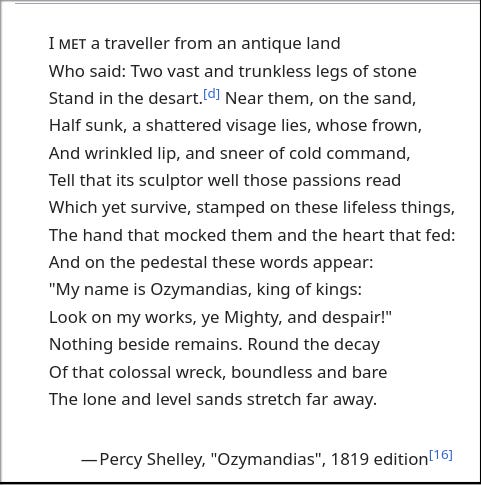
It’s a question of value system. Many tribal cultures around the world have viewed Earth around them as a sacred part of themselves. Few of us would sell a kidney for money, because we value our bodies as they are and don’t consider cashing them in. Most of us, anyway. Renewable energies like blood plasma do get sold by some; others would find it repellent. It’s a matter of values. These other humans valued and maintained the trees and rocks, the rivers and creatures around them. No, not always, never always, but the focus can be this way or that.
When we started out here, we homo Sap and our ancestors, all of Earth was doing whatever it was doing as a coherent global system. We altered our immediate environment; almost all creatures do, but at one time those alterations stood within a functioning ecosystem rather than degrading it. I have a swallow nest built of mud and grass on my back porch, with the mark of swallow entropy below it on the floor. The swallows altered my built environment. Some might object, but I welcome them. Next year I do plan to catch their entropy so I can put it on the garden.
Foxes dig tunnels and dens under the ground. Groundhogs push up piles of mud and beavers build ponds. Woodpeckers bore holes in standing trees. The question isn’t whether a creature alters their environment, the question is can other things live within the new arrangement. Beavers, for instance, often increase the total biomass in a given area by building dams, cutting down trees, digging channels and wetlands. When their construction eventually silts in and they move on, they leave a richly fertile wet meadow, often watered by a tiny clear creek, becoming eventually a rich flat field where almost anything anybody needs to eat will grow and prosper.
Apologists for industrial life have numbers which express the ways in which they believe that their system has bettered humankind. They pick things which they value and count them, and yes, their value system has produced much of what they value. For one thing we are many, over 8 billion. This didn’t turn out so great in the long run. We tend to quarrel when we get crowded up. It looks good on a spreadsheet.
Our average age at death is high. This number is usually advertised as life expectancy, and leads to absurdities like people saying, “Back then an old man was 35!”
Yeah no. Back then not many folks got old. Most people died young, many in childhood. But an old man could still realistically reach 90, and an old woman longer. Old hasn’t changed.
As to the rest of the numbers, they represent a value system. The people telling you the numbers have silently assumed agreement as to what is valuable.
I often argue with people about what they call “renewables,” now often rebranded as “clean energy.” I’m not going into the terms of the argument now - surely regular readers have already seen it all. If we accept that doing things faster is inherently valuable, if one ignores the fact that all the carbon emitted in the construction and installation of renoobles is already in the air and capturing additional heat energy before the day they get turned on, then based on those assumptions and denials there become what appear to be valid grounds to install them.
What if one doesn’t accept that faster is better? What if one doesn’t accept that a car is better than walking? What if one doesn’t accept that carbon emitted last month isn’t justified by carbon not emitted next year? What if one values a square kilometer of living biosphere, connected to the total mass of life on Earth, as more valuable than all the energy or materials we might harvest off it?
I believe the following to be a physical truth, but I cannot prove it: There is no value which a square meter of Earth can render to homo Sap which is greater than its potential value as living biomass. A living biomass can feed humans and other living things. A living biomass can extract and sequester carbon, return oxygen to the atmosphere, regenerate topsoil, and otherwise combat ecosystem catastrophe, including but not limited to climate change.
The highest and best use of any piece of land anywhere on Earth is to restore the full function of a natural living ecosystem to it. There is nothing more valuable. Having a question answered fast is not more valuable. Being able to go a mile in a minute is not more valuable. Neither a wind turbine on a tall pole bolted to a thousand tons of concrete where the soil used to be, nor a pocketful of gold, is more valuable than a living ecosystem.
All the people in the country who are today employed building and repairing highways would be better, more productively, employed tearing them up, while others make compost to go where the topsoil was before the highway came. Next they can all plant plants native to whatever place that is.
It would be a better use of manpower to employ 100 men with picks, shovels, and donkeys, to pick removed mountaintops, one rock at a time, out of the creeks of Appalachia, haul them back to the top, and pile them back up. Make compost. Put the outhouse there. Build a village at the foot of the mountain. Apply permaculture, horticulture, and human ingenuity to feed and support the hundred for the decades required to rebuild one mountain, reclaim one system of valleys and creeks.
What we need, globally, is a food energy, human powered, total global attempt to rebuild every swamp, to return every beaver, to grow back every forest, to plant and burn and return the oceans of grass that once covered Earth’s semi arid plains. All of it.
If that means we live in grass houses, we live in grass houses. Or houses made out of reused Interstate Highways. We can pull up all 46,876 miles of Interstate Highway plus all the miles of frontage roads and parking lots which line them. We can cut them into two foot square chunks. Then we’ll have all the building materials we need.
Next we can start on the rest of the high speed highways. And airports. And seaports as we know them now.
Plant it all back.
If we valued our own likely survival, we’d never open another copper mine. We could get all the copper we need for centuries of low energy restoration by mining modern buildings. All the steel we’ll ever need is already in junkyards. It doesn’t take that much steel, or even that much charcoal, to make a pick, a shovel, and a scythe.
I’m serious as a heart attack. I’m talking about the real changes it would take to really survive. Not to keep what have now and call a civilization. Civilization doesn’t work. It’s been tried over and over. All it does is create deserts and bloody wars; what it leaves behind is cursed ground that can’t heal for millennia.
I’m not saying that the stuff we have isn’t fun. Modern technological society obviously values all of it more than it values a living ecosystem. I’m not saying humankind couldn’t create an internally consistent value system that defined having WiFi in a motor camper on a deserted mountaintop as worth having Elon Musk fill the sky with satellites. Obviously modern technological society has created exactly that value system and lives within it. Everyone on Earth is surrounded by it. Industrial global culture brags about its successes while watching everything which other humans have valued get wiped out, dug up, paved over, killed off, plowed, burned, flooded, and dried out.
That’s the trade. Everything we have, for everything we evolved to have. Trade a living Earth for gadgets. Trade being eaten by a tiger for dying with a needle in your arm. Trade an endless future among living land and waters for a jittery, loud, foul smelling, nearly lifeless now filled with bright lights and fast answers.
I see all we have. I don’t think it’s worth what we gave for it. It’s all a question of value system.
No posts
Comments
Nothing yet. Say the first thing.
Sign in to join the conversation.