
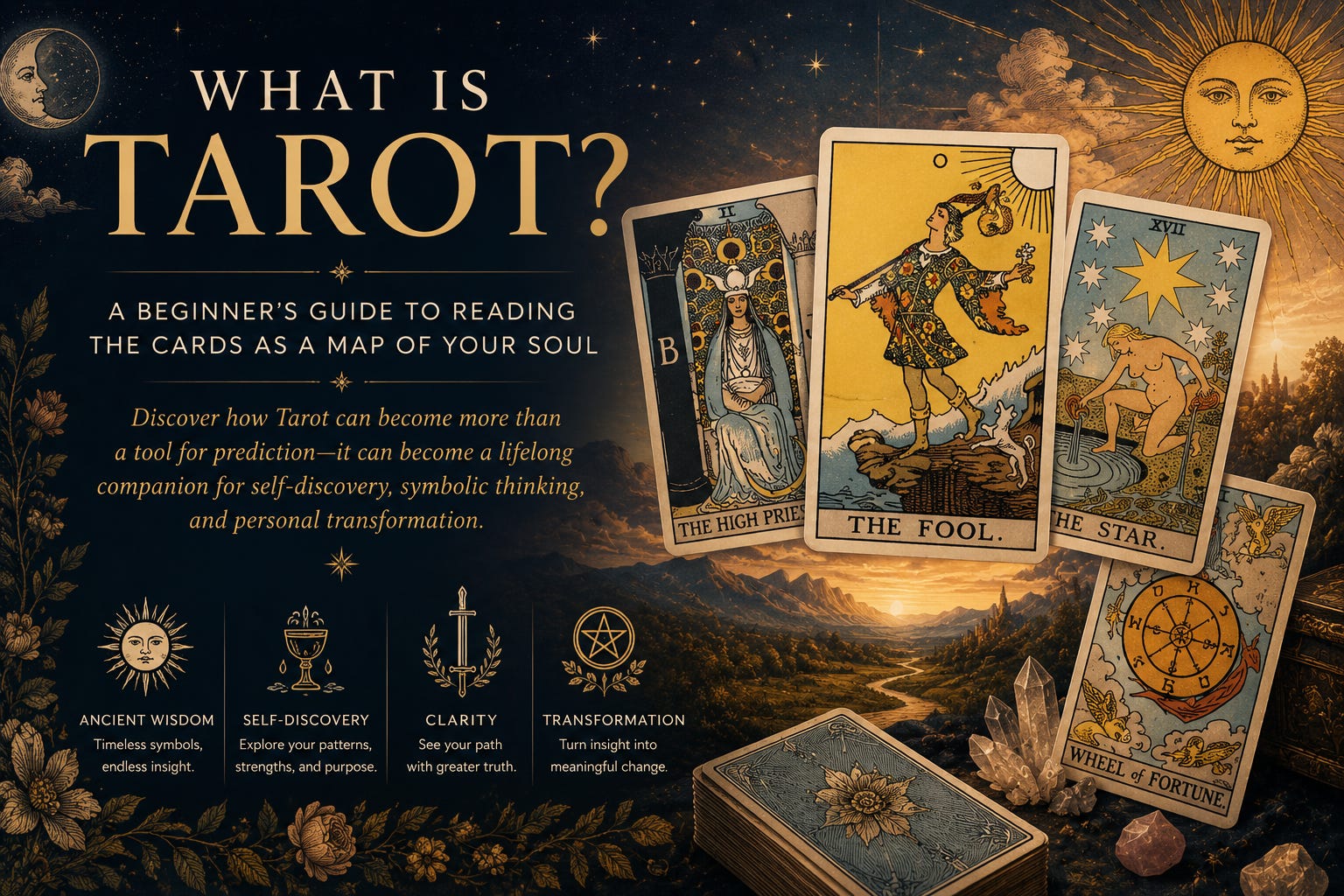
Most people are introduced to Tarot through mystery.
A deck of beautifully illustrated cards.
A dimly lit room.
A reader predicting romance, career changes, or what the future may hold.
While those images have helped make Tarot famous, they only scratch the surface of what these cards have offered humanity for centuries.
Tarot is not merely about fortune telling.
At its deepest level, Tarot is a symbolic language.
A mirror.
A conversation with your unconscious.
A map of the universal human journey.
Whether you consider yourself spiritual, religious, skeptical, or simply curious, Tarot offers something remarkably practical: a way of seeing yourself more clearly.
A traditional Tarot deck contains 78 cards divided into two sections.
The 22 Major Arcana represent life’s greatest transformations—the profound moments that shape who we become.
The 56 Minor Arcana reveal the everyday experiences through which those transformations unfold.
Rather than predicting a single fixed future, Tarot reflects the patterns already present within your life.
Think of the cards less as answers and more as questions.
They invite reflection instead of demanding certainty.
Every reading becomes an opportunity to pause, examine your assumptions, and reconnect with your own inner wisdom.
This is perhaps the most common question.
The honest answer is that no one can explain Tarot with complete certainty.
Different traditions understand it differently.
Some believe the cards communicate through divine guidance.
Others see them as expressions of synchronicity, a concept introduced by psychologist Carl Jung to describe meaningful coincidences that connect our inner and outer worlds.
Some understand Tarot purely as a psychological tool—a collection of archetypal images capable of revealing unconscious thoughts and emotional patterns.
Personally, I believe these perspectives don’t necessarily compete.
Tarot becomes meaningful because symbols speak a language older than words.
The cards don’t create your intuition.
They give it a voice.
Human beings naturally seek stories.
Long before psychology existed, myths helped people understand love, grief, courage, fear, sacrifice, temptation, and transformation.
Tarot preserves those timeless stories within symbolic images.
The Fool stepping into the unknown.
The Hermit searching inward.
Death making way for renewal.
The Star restoring hope.
These are not merely characters.
They are experiences every one of us encounters throughout life.
The reason Tarot continues to endure is because human nature hasn’t changed.
We are still searching for meaning.
One of the biggest misconceptions about Tarot is that every reading predicts unavoidable events.
In reality, the cards often reveal the emotional and psychological landscape you’re currently walking through.
Imagine standing at a crossroads.
One path leads toward growth.
Another toward familiar patterns.
Tarot doesn’t force either direction.
Instead, it illuminates the consequences of each path.
The future is shaped by your choices.
Tarot helps you make those choices with greater awareness.
The Major Arcana tells one complete story.
Beginning with The Fool, we witness an ordinary individual stepping into the unknown.
Along the way, they encounter teachers, lovers, trials, loss, awakening, surrender, transformation, hope, and ultimately completion.
This sequence closely mirrors what mythologist Joseph Campbell called The Hero’s Journey—the universal pattern found in myths, religions, and great literature throughout history.
Each Major Arcana card represents an archetype living within every human being.
The Fool isn’t someone else.
It’s the part of you beginning something new.
The Tower is the collapse of identities you’ve outgrown.
The World is the realization that the journey has transformed you.
Seen this way, Tarot becomes less about predicting life and more about understanding it.
If the Major Arcana tells the story of your soul, the Minor Arcana reveals how that story unfolds each day.
The four suits represent four fundamental dimensions of human experience:
Wands — inspiration, creativity, passion, and purpose.
Cups — emotion, relationships, intuition, and love.
Swords — thought, conflict, communication, and truth.
Pentacles — work, health, resources, and the physical world.
Together they remind us that profound transformation isn’t reserved for extraordinary moments.
It happens in conversations.
Habits.
Decisions.
Relationships.
Work.
The ordinary is where the sacred quietly reveals itself.
Absolutely not.
One of the greatest myths surrounding Tarot is that only gifted psychics can understand the cards.
While intuition certainly develops with practice, Tarot is fundamentally a language of symbols.
Like any language, it becomes more familiar through study, reflection, and lived experience.
Some of the most insightful readers are not those claiming supernatural certainty.
They’re the ones who ask thoughtful questions.
Who listen deeply.
Who recognize recurring patterns.
Tarot is a practice of observation before it becomes a practice of interpretation.
If you’re just beginning, resist the temptation to memorize all 78 card meanings.
Instead:
Spend time looking at the imagery.
Ask what emotions each card evokes.
Journal your observations.
Pull one card each morning.
Reflect on how its symbolism appears throughout your day.
Tarot is less about memorization than relationship.
Over time, the cards begin speaking in a language uniquely your own.
The greatest gift Tarot offers isn’t certainty.
It’s perspective.
The cards won’t live your life for you.
They won’t remove uncertainty.
They won’t make your decisions.
But they can illuminate the stories you’re living, the patterns you’re repeating, and the possibilities waiting just beyond your current understanding.
In that sense, Tarot isn’t really about predicting who you’ll become.
It’s about remembering who you’ve always been beneath the noise.
If this introduction resonated with you, I’ve written an in-depth guide for those who want to move beyond memorizing card meanings and begin experiencing Tarot as a living spiritual practice.
Mapping the Soul Through Tarot: The Hero’s Journey Within reimagines the entire Tarot through the lens of mythology, Jungian psychology, and the timeless Hero’s Journey.
Inside you’ll discover:
The 22 Major Arcana as the complete mythic journey of the soul.
The Minor Arcana as the four elemental paths of human experience.
A symbolic approach to reading that emphasizes archetypes over prediction.
Practical journaling prompts, rituals, and daily practices to deepen your relationship with the cards.
A complete framework for using Tarot as a mirror of consciousness rather than simply a tool for divination.
Whether you’re opening your first deck or returning to the cards after years of practice, this book offers a fresh way of seeing Tarot—not as something outside yourself, but as a map of the journey unfolding within.
Because perhaps the greatest mystery Tarot reveals isn’t your future.
It’s you.
No posts
Comments
Nothing yet. Say the first thing.
Sign in to join the conversation.